
42% of residents report significant depressive symptoms during training, yet fewer than 10% ever disclose mental health history in their applications.
That gap is exactly where a lot of anxiety, bad advice, and self-sabotage live.
You are not the first applicant to wonder:
“I took time off for depression / burnout / anxiety / hospitalization. Do I say anything? How? Is this a red flag that will sink me?”
Let me break this down specifically, because most people give you one of two useless extremes:
- “Never ever mention mental health; it will ruin your chances.”
- “Be fully open and vulnerable; programs will appreciate your honesty.”
Both are wrong in practice. The truth is more strategic, more nuanced, and frankly more cynical than either camp likes to admit.
1. How Program Directors Actually Think About Leaves
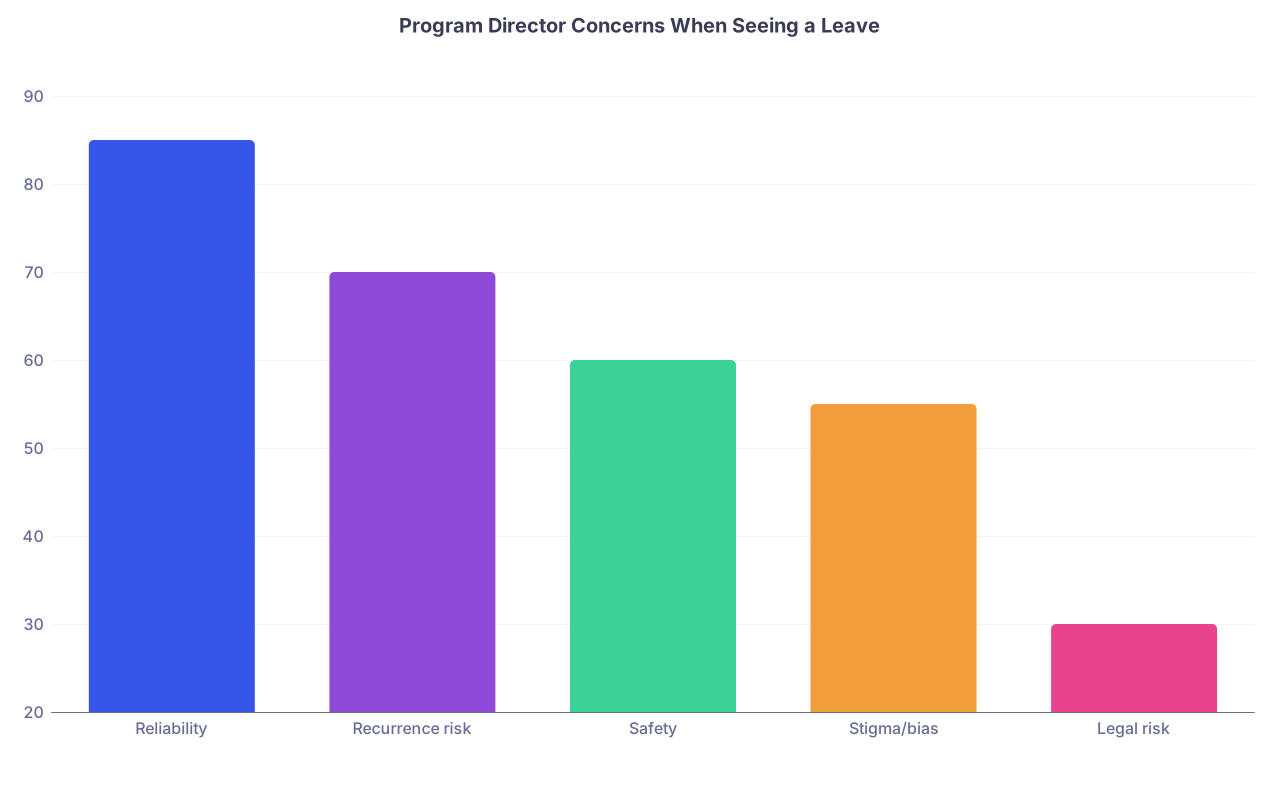
| Category | Value |
|---|---|
| Reliability | 85 |
| Recurrence risk | 70 |
| Safety | 60 |
| Stigma/bias | 55 |
| Legal risk | 30 |
Let’s start with the uncomfortable part.
When a PD or selection committee sees a gap, extended leave, or LOA note in your MSPE, they are not primarily thinking about your “journey” or “growth.” They are thinking:
- Can this person show up consistently and safely for 3–7 years?
- Will they be able to take call, manage stress, and keep up?
- Are we inheriting an unstable situation?
- Will this be a wellness success story or a chronic coverage problem?
This is not fair. It is reality.
Attendings around the table will say things like:
- “We just had a resident go out on leave for 8 months, it almost broke our schedule.”
- “If this is depression that relapses every time they’re under stress, that’s a huge problem in intern year.”
- “If they’re stable on treatment and self-aware, that might actually be a plus.”
They are balancing three competing forces:
- Clinical reality: Residency is punishing. People who are barely holding on tend to crash hard.
- Operational reality: One resident out on extended leave can destabilize an entire program.
- Legal/ethical reality: They cannot discriminate explicitly on disability or mental health diagnosis.
So they do the thing everyone does when they cannot legally ask what they really want to know:
they read between the lines.
Your goal is to control those lines.
2. When a Mental Health Leave Matters for Your Application
Not every episode of anxiety or burnout is the program’s business. But some situations are absolutely going to show up on their radar.
Here are scenarios where your mental health leave is likely relevant:
- Documented leave of absence (LOA) on your transcript or MSPE
- Graduation extension (5+ years to finish med school without a formal dual degree)
- Failing/withdrawing from multiple courses or clerkships clustered around the time of the leave
- Significant gap on CV (6+ months unaccounted for)
- Change of schools or re-entry after a break for “personal reasons”
If any of that describes you, the question is no longer “Should I explain this?”
It is “Do I want to control the narrative or let them invent one?”

Red Flag vs Context: What PDs Actually See
Programs usually categorize applicants into mental buckets:
- No major concerns
- Mild yellow flags with decent explanations
- Serious red flags that require justification to rank
A mental health leave can land in any of those depending on:
- Duration (2 weeks vs 12 months)
- Timing (preclinical vs middle of core clerkships)
- Pattern (single discrete episode vs repeated breaks or chronic underperformance)
- Outcome (returned, passed everything, strong letters vs ongoing struggles)
One 3-month leave in M2 for depression, followed by solid clerkship performance and strong Step 2 scores? That can be contextualized into a “single-episode, now stable” story.
Three separate leaves, extended time to graduation, multiple remediation episodes, and marginal exam performance? That will be seen as an ongoing risk no matter how you frame it.
3. Should You Disclose? A Structured Decision Framework
Let’s skip the vague “it depends” and use a real framework.
Step 1: Is your leave/issue already documented?
- MSPE mentions LOA
- Transcript shows gap / off-cycle dates
- School letter references “personal leave,” “medical leave,” or “time away”
If yes:
You must assume programs know something happened. You are not “protecting” yourself by staying silent. You are just forcing them to guess. And they will usually guess worse than reality.
Step 2: Has there been sustained recovery and performance since?
Key markers that help PDs relax:
- 12+ months of full-time clinical work or advanced coursework without major issues
- Passing Step/COMLEX on retake with clear improvement if you failed during that period
- Strong clinical evaluations, no new professionalism or reliability concerns
- Consistent narrative from your dean’s letter and recommenders about current stability
If you took a mental health leave 18 months ago, came back, crushed your rotations, and your letters say you are reliable and mature — you can safely frame this as a resolved episode that taught you skills.
If your return has been rocky, grades borderline, or you needed accommodative scheduling just to get through? Then programs are not going to buy the “I’m stronger than ever” line.
Step 3: Will disclosure materially improve understanding of existing red flags?
Disclosure is worthwhile when it:
- Connects disparate data points into a single, coherent story
- Demonstrates insight, growth, and risk mitigation strategies
- Reassures them about current function and future reliability
Disclosure is not worthwhile when it:
- Introduces new concerns that were not documented anywhere
- Becomes the dominant theme of your personal statement
- Reads as an unresolved, raw emotional process
If your record otherwise looks clean and no one outside your school knows you struggled with anxiety during Step studying? Do not volunteer that in ERAS. That is private medical information, not a personality trait.
4. Where (and How) To Explain a Mental Health Leave
You have four main real estate options:
- ERAS “Education interruptions” / “Additional Information” box
- Personal statement
- Dean’s letter (MSPE) — usually controlled by your school, but you can influence how it is written
- Interview answers when directly asked
Each has a different purpose. Mixing them up is a common mistake.

| Step | Description |
|---|---|
| Step 1 | Leave shows on MSPE/transcript? |
| Step 2 | Do NOT disclose in ERAS |
| Step 3 | Single resolved episode? |
| Step 4 | Use brief ERAS note + neutral PS |
| Step 5 | Discuss with advisor about strategy |
| Step 6 | Prepare concise interview answer |
4.1 ERAS “Education Interruptions” / Additional Info
This is where you handle the factual skeleton of what happened. Not the emotional memoir.
Structure it like this:
- Brief label for the interruption
- Neutral cause description
- Resolution and current status
Example of solid wording:
“From January–April 2023, I took a medical leave of absence for treatment of a health condition. I completed recommended treatment, was cleared to return by my care team and school, and have since successfully finished all required clinical rotations and coursework on schedule.”
If you want to clarify it was mental health without oversharing:
“From January–April 2023, I took a medical leave of absence for treatment of a mental health condition. With appropriate treatment and ongoing care, I returned to full-time clinical duties and have completed all rotations and examinations without further interruption.”
What you do not do here:
- “I had severe suicidal ideation and was hospitalized for…”
- “I experienced a complete breakdown due to toxic leadership in my clerkship…”
- “This was the worst period of my life…”
This box is about risk signaling and operational reassurance, not catharsis.
4.2 Personal Statement: Use Sparingly
The personal statement is not your therapy note.
Use it for mental health disclosure only if:
- The leave is a key part of understanding who you are now as a physician
- You can write about it with clear distance, insight, and specific takeaways that directly relate to patient care, resilience, or professionalism
- You spend no more than ~20–25% of the statement on it
A workable pattern:
- Short factual description of the disruption
- One or two concrete things you learned (not “I learned resilience” — too vague)
- How this shows up in your current clinical behavior and career goals
- Smooth transition back to present strengths and future plans
Example:
“During my second year of medical school, I took a brief medical leave to address a depressive episode. Engaging in treatment and structured support forced me to confront the limits of working through exhaustion and silence. I returned to the wards with clearer boundaries, an actual sleep schedule, and much less ego about asking for help.
On my medicine sub-internship, I found myself listening differently to patients describing ‘I just do not feel like myself anymore.’ I recognized the hesitation to admit they were not coping, and I had the language and patience to sit in that space with them. This experience sharpened my interest in internal medicine, where chronic disease management often intersects with unspoken psychological burden.”
Note what that does:
- One sentence on the leave
- One sentence on treatment and boundary setting
- Specific examples of behavior change
- Clear tie to chosen specialty
If you cannot write about it this cleanly without drifting into raw pain or unfocused narrative, leave it out of your personal statement and keep it in the ERAS interruption box.
4.3 Dean’s Letter (MSPE): Quietly Important
You usually cannot rewrite your MSPE, but you can:
- Ask your dean’s office how they typically document medical leaves
- Clarify that your issue is now stable and you have completed everything without further concern
- Request that they comment on your current reliability and professionalism if they are aware of past difficulty
An ideal MSPE phrase looks like:
“Student took a medical leave during the second year. Since returning, they have completed all required coursework and clinical rotations without incident and have been described by faculty as reliable, prepared, and engaged.”
Programs care more about that line than whatever you write in your essay.
5. What To Say In Interviews (And What Not To)
If you have a documented leave, expect the question in some form:
- “I noticed a leave of absence; can you tell me about that?”
- “Your training was extended — what happened there?”
- “I see a gap on your CV; how did you use that time?”

Your answer should be:
- 20–40 seconds, not a 5-minute saga
- Factually accurate but not graphically detailed
- Focused on recovery, insight, and current function
- Comfortable and practiced, not hesitant or evasive
Template that actually works:
- Name it broadly
- Anchor in treatment and resolution
- Emphasize what changed and current stability
- Pivot back to strengths
Example:
“During my second year I took a 3-month medical leave to address a mental health condition. I engaged in treatment, made some concrete changes to how I manage stress and sleep, and was cleared to return to full-time training. Since then, I have completed all of my clerkships and sub-internships without any further interruptions, and my attendings have described me as reliable and steady under pressure. Going through that process has made me more attuned to burnout and more proactive about using support early, which I think will help me sustain myself through residency.”
If they push for details (few will, but some do clumsily):
“I am happy to share that it was a depressive episode, which I addressed with appropriate treatment and ongoing care. I am fully functional now, and my recent clinical performance reflects that. I would like to keep specific treatment details private, but I am glad to answer questions about how I manage stress and workload currently.”
You do not need to:
- Provide your DSM code
- Describe suicidality, self-harm, or admissions in detail
- Justify that your suffering was “bad enough” to deserve leave
6. High-Risk Pitfalls That Raise Red Flags
This is where applicants shoot themselves in the foot.
Over-disclosure and emotional flooding
Turning your personal statement into a trauma confessional usually backfires. It makes reviewers nervous that you are still in the middle of the storm, not on the other side of it.
Red flags in narrative form:
- Graphic descriptions of self-harm or suicide
- Blaming language (“Toxic attendings pushed me to…” “The system abused me…”)
- Present-tense instability (“I still struggle to get out of bed some days…”)
- Framing yourself primarily as a victim rather than an agent
Minimizing or evasiveness
The opposite problem: obvious transcript gaps, but you say nothing, or you dance around direct questions.
If your MSPE clearly says “medical leave,” and you answer with:
“Oh, it was just some personal stuff, nothing important.”
You look evasive. PDs assume the worst: substance use, professionalism violations, or untreated severe mental illness.
Unresolved pattern
This is the hardest one to fix with words.
If you have:
- Multiple leaves or repeated “reduced schedules” over years
- Ongoing failures, withdrawals, or professionalism notes
- No sustained 12–18 month period of stable performance
You will be fighting an uphill battle no matter how elegantly you explain. At that point, you need:
- Very strong, recent, specific letters attesting to reliability
- Possibly a transitional year / prelim option at less competitive programs
- A brutally honest conversation with your dean or advisor about competitiveness and specialty choice
7. Specialty-Specific Realities and Strategy
Not all programs read mental health leaves the same way.
| Specialty | Relative Concern Level | Comments |
|---|---|---|
| Psychiatry | Low–Moderate | More understanding, still note patterns |
| Family Medicine | Low–Moderate | Holistic view, wellness focus |
| Pediatrics | Moderate | Team fit, reliability key |
| Internal Medicine | Moderate | Depends on program culture |
| Surgery | High | Intensity, coverage concerns |
| EM | High | Shift work, acuity, burnout fears |
No, this is not written in any policy manual. Yes, you can feel the difference when you sit in their conferences.
Surgical and EM programs are particularly sensitive to anything that looks like:
- Inability to tolerate sleep deprivation
- Poor stress tolerance in acute scenarios
- Recurrent leaves that wreck coverage and call pools
That does not mean you cannot match there with a history of depression or anxiety. But your evidence of current robustness has to be very strong.
Pediatrics, FM, and psychiatry often contain more vocal advocates for mental health and wellness. Still, they have been burned by unstable trainees too. They will not blindly embrace risk because you use the word “resilience” a lot.
Use your specialty advisors. Ask them directly:
- “If you saw this LOA in an applicant to your field, what would you want to know to feel reassured?”
- “Would you address this in the dean’s letter or leave it to ERAS?”
- “Have your residents with prior mental health leaves generally done well here?”
The answers will recalibrate your expectations quickly.
8. Concrete Communication Templates
Let me give you specific language you can adapt. Not fluff — actual sentences that work.
ERAS Education Interruption Example (Single Leave)
“From March–June 2022, I took a medical leave of absence to address a mental health condition. Following treatment and clearance by my care team and school, I returned to full-time clinical training and have since completed all remaining rotations and examinations without further interruption.”
ERAS Education Interruption Example (Extended Graduation)
“My medical school education was extended by one year due to a medical leave of absence related to a mental health condition. Since resuming training, I have completed all clinical requirements, passed Step 2 on the first attempt, and received strong evaluations for consistent performance and professionalism.”
Personal Statement Snippet (Short, Embedded)
“In my second year, I took a brief medical leave to address a depressive episode. Working with my care team, I learned to recognize early warning signs, to accept help, and to set more realistic limits on my work hours. I returned to the wards with a more sustainable approach and a deeper appreciation for the vulnerability patients feel when their minds no longer cooperate with their intentions.”
Interview Answer (30–40 seconds)
“Yes, I did take a 3-month medical leave during M2 for treatment of a mental health condition. I engaged fully in treatment, made concrete changes to my routines and support systems, and was cleared to return to full-time training. Since then, I have completed all of my core rotations and sub-internships without further interruption and received strong feedback on reliability and teamwork. That experience actually pushed me to be more proactive with wellness and communication, which I think will help me sustain myself through residency.”
Practice these out loud. You want your tone calm, matter-of-fact, not ashamed but not performatively “brave” either.
9. Legal Reality vs Practical Reality
Quick, blunt point.
Legally:
- Programs cannot ask you to disclose diagnoses or specific treatments.
- They cannot explicitly use disability status to deny you a position.
- You are not required to reveal protected health information.
Practically:
- They can (and do) judge what is already on your transcript and MSPE.
- They can (and do) make inferences from gaps and vague statements.
- They can (and do) choose “safer” candidates when faced with uncertainty.
So you walk a line:
- You do not owe them your entire psychiatric chart.
- You do owe them an honest, coherent explanation of documented educational interruptions.
- You should provide enough information to demonstrate present stability and realistic coping tools.
If you are currently unstable, barely hanging on, or considering another leave? The best move is not clever wording. It is stepping back and protecting your health before locking yourself into a residency contract you cannot uphold.
Summary: What Actually Matters
Two or three points, since you have read this far and do not need fluff.
- If your mental health leave is documented, control the narrative: brief, factual, anchored in treatment and proven stability, not raw emotion.
- Programs care less about the diagnosis and more about the pattern: a single treated episode with solid performance afterwards is survivable; recurrent instability with weak performance is not fixable with words.
- Use each platform for its proper role: ERAS for facts, MSPE for institutional reassurance, personal statement only if you can connect the experience cleanly to who you are as a physician, and interviews for concise, confident clarification.