
12% of otherwise solid residency applicants have at least one marginal or failed core rotation on their transcript.
Most of them try to hide it. That is usually a mistake.
Let me break this down specifically: a failed surgery or ICU rotation is one of the most radioactive red flags in residency applications. It hits exactly where program directors worry most—clinical judgment, work ethic, and ability to function on a team under pressure.
Handled badly, it sinks your application. Handled well, it becomes a contained fire instead of a house burning down.
1. How Bad Is This, Really? Understanding the Red Flag
The first thing you need is an honest severity assessment. Not the “my classmates said it’s fine” version. The “what does a PD actually see” version.
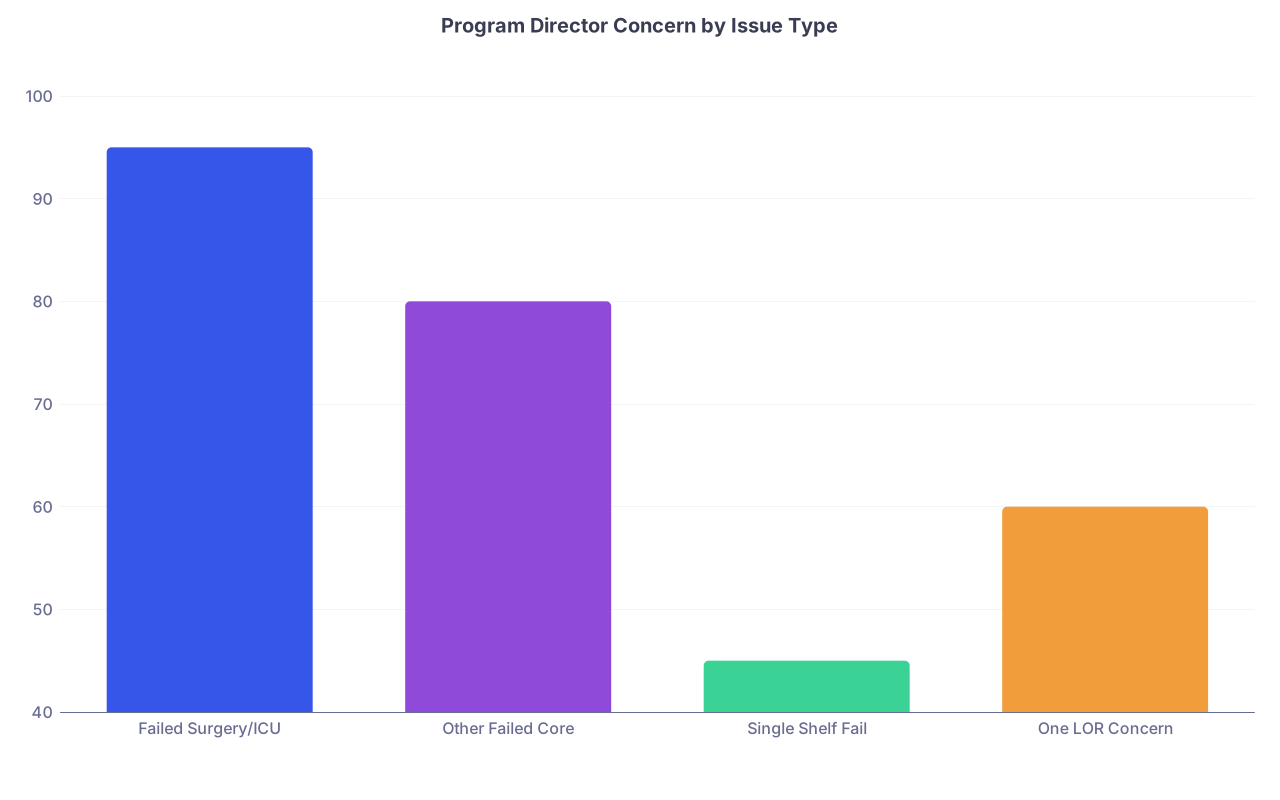
Here is roughly how programs react when they see a failed or marginal core rotation (surgery or ICU especially):
| Category | Value |
|---|---|
| Failed Surgery/ICU | 95 |
| Other Failed Core | 80 |
| Single Shelf Fail | 45 |
| One LOR Concern | 60 |
That “95” is not an exaggeration. I have sat in those meetings. The room gets very quiet when someone scrolls to the transcript and says, “There’s a fail in ICU.”
What they actually worry about:
- Is this person unsafe with sick patients?
- Is there a pattern of unreliability or unprofessional behavior?
- Will this blow up when they are my PGY‑1 on nights?
Your job is not to pretend it was “no big deal.” Your job is to prove three things, concretely:
- The problem was defined and limited.
- It was actually fixed.
- People who have worked with you after the problem will vouch for you.
If you cannot demonstrate all three, you will leak credibility no matter how good your personal statement sounds.
2. Diagnose the Failure: What Actually Went Wrong?
Before you write a single sentence for ERAS or open your mouth in an interview, you need a precise internal diagnosis. Vague self-awareness does not convince anyone.
Step 1: Get the documentation
Do this like you are auditing a chart:
- Official evaluation(s) from the failed rotation
- Any professionalism or remediation notes
- Grade change forms if you remediated
- If it was an ICU sub-I or away: both the school’s summary and the site’s written comments
Do not rely on memory. I have watched applicants confidently tell an explanation that does not match what is in the dean’s letter. That is how you lose credibility instantly.
Step 2: Classify the core problem
Most failed surgery or ICU rotations fall into one dominant category:
Performance / knowledge
- Could not carry the expected number of patients
- Missed critical lab trends or exam findings
- Poor presentations, disorganized, slow to pick up tasks
- Shelf exam failure in combination with marginal clinical performance
Professionalism / behavior
- Tardiness or absences
- Arguing with residents, difficult communication
- Ignoring pages, disappearing from the unit or OR
- Inappropriate comments or poor boundaries with team or nurses
Situational / health (real, significant issues)
- New diagnosis (depression, anxiety, ADHD, seizure disorder, etc.)
- Family crisis (parent in ICU, caretaker responsibilities)
- Visa, financial, or housing instability
Sometimes it is a mix. But usually one theme is obvious once you read the actual comments.
Step 3: Translate it into “program director language”
You then map the failure to what PDs actually hear:
- “Failed surgery due to knowledge gaps” → safety / judgment concern
- “Failed ICU due to absences” → reliability / professionalism concern
- “Failed ICU during new-onset major depression, now treated and stable” → potentially fixable, but needs concrete evidence of stability and performance afterward
Be brutally honest with yourself here. If you rewrite a professionalism problem as “communication style mismatch,” it will sound defensive and evasive in any serious interview.
3. What You Need In Hand Before You Explain Anything
You do not regain credibility with words. You regain it with evidence.
Before you build your narrative, make sure you have as many of these as possible:
| Evidence Type | Why It Matters |
|---|---|
| Successful repeat of same/similar rotation | Shows the issue was remediable and now resolved |
| Strong LOR from a high-acuity setting | Counters the idea that you cannot handle sick patients |
| Consistent passes/honors after the failure | Demonstrates trajectory and growth, not decay |
| Documentation of remediation process | Shows insight, accountability, and institutional trust |
| Personal health documentation (if relevant) | Confirms that a specific, now-controlled issue was addressed |
Minimum package I recommend before you “go public” in your application:
- The failed rotation has been formally remediated OR there is a clear explanation why this was not possible (e.g., graduation timing, away rotation logistics).
- You have at least one very strong letter from a surgery or ICU‑adjacent rotation (e.g., trauma, acute care, hospitalist service) where you were explicitly described as reliable and safe.
- Your subsequent clinical grades show no further collapses.
If your situation does not meet that minimum, your priority is not perfect phrasing in your application. Your priority is to fix the underlying evidence: additional rotations, extra letters, sometimes a delayed application cycle.
4. Where To Address It: Strategy Across ERAS Components
You have four main “levers” to control this story:
- ERAS Experiences / “Education” and transcript
- Personal statement
- MSPE (dean’s letter) – largely not under your control
- Supplemental statement / program‑specific questions
- Interviews
Let me be clear: you do not need to write a 700‑word confession in your primary personal statement. In fact, obsessively centering the failed rotation in your essay can be a mistake.
MSPE (Dean’s Letter)
This often already includes:
- Description of the failed rotation
- Remediation process and outcome
- Sometimes, faculty commentary about improvement
You need to read this draft. Sit with your dean or advisor and see exactly what it says. Then build your explanation to be consistent with it, not in conflict.
Personal Statement: when and how to mention it
Use the main personal statement for the failure only if:
- It is your only major red flag, and
- You can tie it directly into your professional growth and current strengths without sounding self‑pitying or defensive.
If yes, you can use a concise paragraph, not your whole essay.
Structure:
- One sentence stating the fact
- 2–3 sentences of clear responsibility and context (no melodrama)
- 3–4 sentences on concrete changes you made and how they’ve held up
- Pivot back to what you bring now
You do not detail every emotional nuance. You highlight insight and outcome.
If the MSPE already gives a fair, neutral description and you have a dedicated advisor letter explaining remediation, you can choose to omit it from the personal statement and address it in interviews instead. That is often safer for applicants with multiple issues—do not make your PS a red-flag catalog.
Supplemental statements / “Anything else we should know?”
This is usually the best written venue.
Those open-text questions (“Is there anything in your academic history you would like to explain?”) are exactly where PDs expect to see a calm, specific explanation. Use it.
Think 150–250 words. Tightly written. No rambling.
5. The Actual Script: How To Explain Without Losing Credibility
Let me give you concrete, word-level guidance. This is where most people go wrong with vague, apologetic paragraphs that satisfy no one.
Absolute rules
- Name the problem. Directly. “I failed my surgery clerkship” or “I failed my ICU sub-internship.” Not “I had challenges.”
- Own your share of responsibility. Without turning it into self-flagellation.
- Put the event in the past tense and the growth in the present tense.
- Use specific behavioral changes, not fluff (“I improved my task tracking by…” not “I learned the importance of responsibility”).
- End on stability and external validation (grade trends, letters, repeat performance).
Example: performance / knowledge-based failure (surgery)
Here is a template you can adapt:
During my third-year surgery clerkship, I received a failing grade based on concerns about my clinical efficiency and ability to manage the expected patient load. At that time, I struggled with task prioritization and was slower than my peers in pre-rounding and formulating plans.
I met with the clerkship director and completed a structured remediation plan, which included repeating an eight-week surgery rotation and working weekly with a faculty mentor on presentations and operative planning. On the repeat rotation I received a High Pass, with written comments highlighting improved organization, reliability, and attention to detail.
Since that experience, my subsequent inpatient rotations, including medicine and trauma, have been graded High Pass or Honors. Faculty comments have consistently described me as dependable, prepared, and able to manage a full census of patients safely. This experience forced me to build more disciplined systems for organization and communication that I now use daily and plan to carry into residency.
Why this works:
- The failure is explicit and unambiguous.
- The cause is specific and believable.
- The remediation is structured and externally verified.
- The “new you” is backed by grades and comments, not your own opinion.
Example: professionalism / attendance issue (ICU)
Higher stakes. Programs hate unexplained professionalism problems. You must be very clear and very controlled.
I failed my fourth-year medical ICU sub-internship due to repeated tardiness and one unexcused absence. There was no patient safety issue, but my reliability did not meet expectations, and that is my responsibility.
At the time, I was commuting a long distance and did not communicate proactively about the impact of transportation issues on my schedule. After meeting with the course director and the dean’s office, I completed a formal professionalism remediation course focusing on communication, time management, and expectations in high-acuity settings. I also repeated an ICU-equivalent month on the step-down / intermediate care service, where I received a Pass with positive comments regarding punctuality and teamwork.
Since then, I have had no further professionalism concerns, and my subsequent evaluations consistently comment on being present, responsive to pages, and a reliable member of the team. I understand that reliability in critical care is non-negotiable, and this experience permanently changed how I plan and communicate about my responsibilities.
Notice what I did not do:
- I did not blame the attending.
- I did not write a 400‑word saga about the unfairness of public transportation.
- I did not pretend the failure was a misunderstanding.
You tell the truth, explain the context briefly, and anchor heavily in what changed.
Example: situational / health-related (legitimate, now controlled)
You must walk a fine line: honest but not disclosing your full psychiatric chart.
During my third-year ICU rotation, I failed the clerkship while experiencing untreated major depression. Looking back, I recognize that I ignored early symptoms and delayed seeking help, which affected my energy, concentration, and performance.
After this rotation, I took medical leave, established care with a psychiatrist, and began therapy and appropriate treatment. In coordination with student affairs, I returned to clinical rotations only after my symptoms had stabilized. Since returning, I have completed all remaining core and sub-internship rotations with passing or higher grades and no further concerns about reliability or performance.
I continue in regular treatment and have developed concrete strategies for recognizing early signs of stress and seeking timely support. Faculty who have supervised me since my return have described me as steady, engaged, and dependable. I am comfortable discussing this with programs that have further questions.
This is as much as you usually need. Do not detail medications. Do not fully narrate your psychiatric history. Focus on:
- Diagnosis acknowledged
- Treatment obtained
- Stability over a reasonable time frame
- Clean performance record since
6. Interview Day: Handling the Question Without Flinching
If you have a failed core rotation, assume it will come up in at least some interviews. If it does not, great. But prep as if it will.
The usual forms of the question
- “Tell me about this surgery/ICU grade.”
- “I see there was a failure here—what happened?”
- “How have you addressed the issues that came up on that rotation?”
Common mistakes I have seen:
- Talking for five minutes straight, oversharing, getting lost.
- Sounding defensive (“The attending just didn’t like me”).
- Collapsing emotionally—tearing up, spiraling into self-doubt.
- Downplaying (“It was just a tough rotation, everyone struggled”).
You want a 60–90 second, practiced, calm answer.
Structure your spoken answer like this
- Clear label: “I failed my [rotation] because of [main issue].”
- 1–2 sentences of context (without excuses).
- 2–3 sentences on remediation steps.
- 2–3 sentences on evidence of sustained improvement.
- Brief pivot to what you learned that makes you better now.
Example in spoken form:
“Yes, I failed my third-year surgery rotation due to concerns about my efficiency and ability to manage the expected patient load. I was disorganized, and my task prioritization was not where it needed to be.
I met with the clerkship director, completed a formal remediation, and repeated the full rotation. During the repeat, I implemented a strict pre-rounding checklist and daily to‑do list system, and I worked closely with a faculty mentor on organizing my notes and plans. I received a High Pass on the repeat with positive comments on reliability and organization.
Since then, my inpatient rotations—including medicine and trauma—have been High Pass or Honors, with evaluations highlighting my ability to manage a full census safely. That experience pushed me to build systems that I now rely on every day, and I am confident in my ability to handle the workload as an intern.”
Say it like you are presenting a patient. Calm, structured, factual.
If they push further (“Do you think this will be a problem in residency?”), you answer directly:
“No. I understand why you would ask, and if my performance since then suggested ongoing issues, I would be concerned too. But the last [X] months of consistently strong inpatient evaluations, increased responsibility, and positive letters from high-acuity settings give me confidence that the problem has been addressed and that I can function at the level you expect of your interns.”
No drama. Just facts plus insight.
7. Specialty-Specific Nuances: Surgery vs ICU vs Everything Else
This is a niche detail people miss: the same failure has very different implications depending on what you are applying to.
If you are applying to SURGERY and you failed surgery
This is the worst version. You are essentially asking programs to believe you are now strong in the exact environment that documented you as failing.
What you absolutely need:
- A repeated and passed (ideally HP or Honors) surgery rotation.
- At least one, preferably two, strong surgery letters that explicitly address your reliability and growth.
- No other major professionalism or clinical performance issues.
You should almost certainly address this briefly in your main personal statement, not just in a supplemental, because it sits in the center of your chosen field.
If you are applying to INTERNAL MEDICINE and you failed ICU
Program directors will take this very seriously if they are a big academic center with heavy ICU exposure.
You need to counter with:
- Strong inpatient medicine rotations (maybe a MICU step-down or CCU with good reviews).
- A letter from someone who saw you with sick patients after the failure.
- A clear explanation that separates your past issue (e.g., organization, early untreated depression) from your current functioning.
If you are applying to a field far from the failed area
Example: failed surgery, applying to psychiatry. Or failed ICU, applying to pathology.
Still needs explanation. But programs may be more forgiving if:
- Medicine / psych / relevant rotations are clean and strong.
- Letters in the target field are excellent.
- The story clearly shows you are not currently unsafe or unreliable.
Do not assume “wrong specialty” automatically excuses everything. It does not. But it shifts the focus to professionalism and growth rather than pure technical domain.
8. When You Should Delay Applying or Change Strategy
Sometimes the honest answer is: you should not apply this year. Or you should change the competitiveness level and scope of where you apply.
Consider delaying or re-strategizing if:
- You have multiple failed core rotations.
- Your remediation rotation is incomplete or too recent to have a final evaluation.
- Your post-failure rotations are mediocre at best (borderline passes, lukewarm comments).
- You cannot secure a strong letter from anyone who has seen you in a high-acuity or high-responsibility role since the failure.
In those cases, options include:
- Taking an additional clinical year with extra sub-Is and targeted letters.
- Pursuing a preliminary year, then reapplying with more data.
- Expanding your specialty list (e.g., from categorical surgery only to include prelim surgery, prelim medicine, or less competitive fields).
- Doing a structured research year with heavy clinical exposure if your school allows it, under mentors who can directly observe your clinical growth.
I have seen people salvage brutal transcripts by being disciplined and patient for one extra year. I have also seen people torpedo their careers by insisting on applying immediately with clearly unresolved red flags.
| Category | Value |
|---|---|
| Single Failed Rotation, Strong Remediation | 6 |
| Failed Rotation + Multiple Marginals | 12 |
| Failed Rotation + Leave for Health | 12 |
| Multiple Failed Cores | 18 |
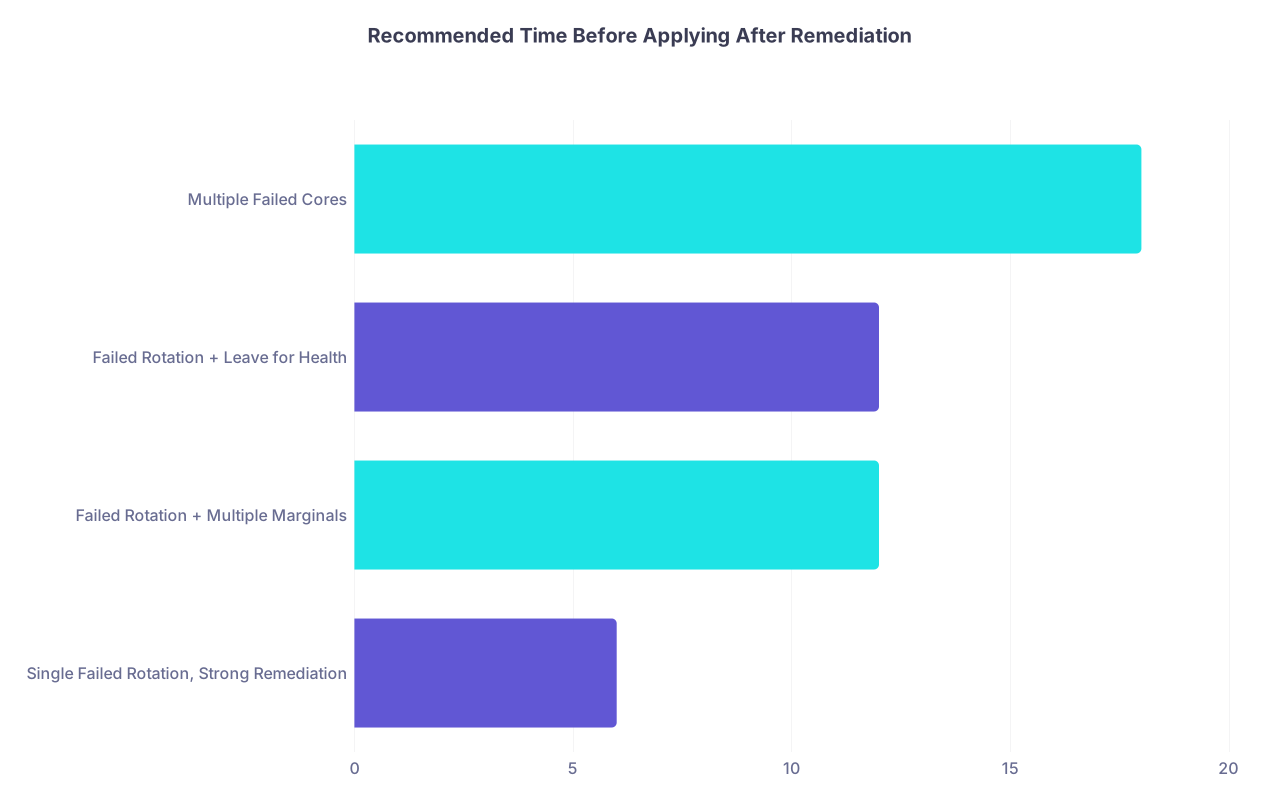
These numbers (months of clean performance) are not published anywhere. They are reality-based estimates from what PDs are willing to swallow.
9. What Actually Preserves Your Credibility
To keep this simple, programs look for three things in any red flag explanation:
Insight
You understand specifically what went wrong. You are not in denial. You are not vaguely blaming chemistry and “bad vibes.”Ownership
You accept that your actions (or inaction) played a real role. Even if other factors were present.Trajectory
The problem is not just “over.” It has been replaced by a sustained pattern of the opposite: reliability where you were once unreliable, efficiency where you were once overwhelmed, stability where you were once brittle.
If any of these three are missing, you will leak credibility. If all three are present with concrete evidence, many programs will give you a serious look, even with a failure on your record.