
Programs do not punish you for caregiving. They punish you for being vague, defensive, or sloppy about it.
Let me be very clear: a caregiving-related gap is not the red flag. Unclear documentation is. The goal is not to “hide” your time away from medicine. The goal is to present it in language that program directors recognize, respect, and can easily defend in a rank meeting.
I am going to show you exactly how to do that—down to phrases you can copy, and landmines you should avoid.
1. How Programs Actually View Caregiving Gaps
First thing: stop imagining an angry PD with a red pen circling your gap year. That is not your real problem.
Here is what program directors and selection committees actually worry about when they see caregiving on an application:
Reliability:
Will this person show up, finish residency, and not disappear midway because caregiving demands spike again?Clinical readiness:
How far removed are they from hands-on patient care and structured learning?Insight and professionalism:
Can they explain a difficult life event in a mature, concise, non-dramatic way?Pattern vs. one-time event:
Is this a single, understandable disruption, or one in a series of erratic stops and starts?
Notice what is missing: “We dislike caregivers.” Serious programs do not want to be recorded saying that out loud in 2026. What they want is a story that makes sense.
The moment you start sounding evasive—“personal reasons,” “family matters,” vague multi-year gaps with no details—that is when the red flag lights up in the committee room.
So our job is narrow and concrete:
Explain what happened.
Show you are clinically and logistically ready now.
Use language that makes it easy for them to say “fine, that checks out.”
2. Where To Put It: Strategic Placement Across Your Application
You have four main “levers” to document caregiving:
- ERAS Experiences section
- ERAS "Education gap" / “Additional Information” text boxes (if applicable for your year)
- Personal statement
- Interview responses
You do not need to use all four at full volume. In fact, you should not. You need a consistent narrative, calibrated to your situation.
2.1. ERAS Experiences: Treat Caregiving as Real Work
If your caregiving was substantial (≥10 hours/week for months) it belongs in Experiences. Not hidden, not just implied.
Use the “Work” or “Other” category and treat it like a serious job, because it was.
Structure:
- Experience Type: Work / Other
- Organization Name: “Family Caregiving – [Relationship]”
- Position Title: “Primary Caregiver” or “Family Caregiver”
- Dates: Actual start and end (or “to present” if ongoing but significantly reduced)
- Average Hours/Week: Be honest; do not oversell but do not minimize to 1 hr/week if you had full days lost to this.
Then your description does three jobs:
- Defines the clinical/adult nature of what you did
- Shows you maintained some connection to medicine if at all possible
- Subtly demonstrates time management and professionalism instead of chaos
Concrete example (strong):
Primary caregiver for my mother following a hemorrhagic stroke, coordinating daily care needs while she underwent rehabilitation and long-term recovery. Responsibilities included medication management, transport to medical appointments, communication with neurologists and primary care physicians, and oversight of home health services. Maintained clinical engagement by completing online CME modules, case-based reading, and participation in virtual journal clubs with peers.
What this tells a PD in 10 seconds:
- This was real and serious (stroke, rehab, long-term)
- You were the point person, not vaguely “helping out”
- You did not abandon medicine entirely; you kept your brain alive
Now, a weaker, common version you should fix:
Took time off for family reasons. Helped care for a sick relative and supported my family during a difficult time.
To a PD, that reads as: vague, emotional, no clear duties, no evidence of ongoing academic engagement.
Rewrite this. Do not send it.
2.2. Short Gap Explanations: Honesty Without Oversharing
If there is a dedicated “Explain gaps” section or your dates leave an obvious hole, you want one controlled, 2–4 sentence explanation. Think of it as an official log entry, not a confession.
Template you can adapt:
From [Month Year] to [Month Year], I served as the primary caregiver for my [relationship] during [brief medical description, no drama]. During this period, I managed [logistical/medical coordination elements, 1 clause]. As their condition stabilized and additional support was arranged, I transitioned back to full-time clinical preparation through [research, observerships, CME, etc.]. I am now able to commit fully to residency training.
That is the kind of language PDs respect because:
- It is specific without sharing HIPAA-level details
- It ends in present readiness, not in tragedy
- It acknowledges that the situation changed and is now stable
Avoid:
- “Unforeseen circumstances”
- “Personal issues I prefer not to discuss” (you are effectively daring them to imagine the worst)
- Multi-paragraph emotional narratives
You are writing for a time-pressed committee, not for therapy.
2.3. Personal Statement: When To Include It—and When Not To
Here is where a lot of applicants shoot themselves in the foot.
Your caregiving story belongs in your personal statement only if at least one of these is true:
- It fundamentally shaped the specialty you chose
- It directly explains a major timeline disruption (like several years off or a sudden withdrawal)
- It produced concrete skills or insights that clearly map onto residency life
If your caregiving was a 4–6 month gap between Step 2 and graduation with minimal impact on your trajectory, I would usually keep it out of the personal statement and handle it in ERAS experiences / gap box only.
If you do include it, the personal statement structure should look something like this:
- Clinical anchor – show you are a doctor first
- Brief, focused description of the caregiving episode
- Translation of that experience into what you bring to residency
- Clear statement of why this specialty, now
What you do not do: open the essay with “My father’s illness...” and spend 75% of the word count on family history and tragedy. Programs have read 500 versions of that essay. It does not help you.
A strong, concise integration example for IM:
During the final year of medical school, my father suffered complications of long-standing congestive heart failure that required repeated hospitalizations and eventual home-based care. I returned home to coordinate his medications, monitor his symptoms, and interface with his cardiology team. Standing on the other side of the bed rails, I watched how small acts of clear communication and consistent follow-up prevented crises. That period deepened my respect for longitudinal internal medicine and confirmed that I wanted to be the physician who knows the patient well enough to anticipate problems before they escalate.
Notice the balance:
- One sentence of timeline/context
- One sentence of concrete responsibilities
- Two sentences pivoting to why IM and what you learned
That is enough. You do not need the full family biography.
2.4. The Interview: How To Answer Without Sounding Defensive
If you document your caregiving consistently, you almost certainly will be asked about it in interviews.
The version that worries programs the most is when an applicant becomes visibly uncomfortable, overexplains, or starts crying. Not because people are heartless, but because programs are watching for emotional regulation under stress.
You want a practiced, calm, 60–90 second answer. Same basic structure every time:
- Brief context and timing
- Your role and responsibilities
- How the situation is now stabilized
- What you learned and how you are ready for residency
Example:
During my fourth year, my mother had complications from breast cancer treatment that required several months of intensive at-home care. I moved back home and became her primary caregiver—managing medications, transportation, and daily support while coordinating with her oncology team. Over time, her condition stabilized, and we arranged ongoing help through home health services and local family members. That experience reinforced my commitment to [specialty] and taught me a great deal about communication with families. At this point, my mother’s care is stable, and my responsibilities are compatible with the demands of residency.
That last sentence is critical. You are directly addressing their unspoken fear: “Will this flare up again and cost us an intern mid-year?”
3. Language That Signals Maturity vs. Language That Raises Red Flags
Words matter. Two applicants can describe the same year of caring for an ill parent, and one will sound like a steady adult and the other like a chaos magnet.
Let me be specific.
3.1. Phrases That Programs Respect
These phrases are calm, factual, and professional. Use them.
- “Primary caregiver for my [relationship] during treatment for [brief condition].”
- “Coordinated medical appointments, medications, and communication between family and treating physicians.”
- “Temporarily reduced my clinical activities to meet essential family obligations.”
- “Maintained engagement in medicine through [CME, observerships, research, QI work].”
- “As my [relationship]’s condition stabilized, I transitioned back to full-time clinical preparation.”
- “This experience strengthened my skills in [communication, advocacy, interprofessional teamwork].”
- “My current caregiving responsibilities are stable and compatible with residency training.”
These phrases give PDs exactly what they need for committee discussions and documentation.
3.2. Phrases That Trigger Concern
Avoid these or rewrite them. They sound evasive, disorganized, or emotionally unchecked.
- “Dealt with personal issues”
- “Had to step away from medicine for a while”
- “Went home to support my family during a very difficult time” (too vague, all emotion, no specifics)
- “Put my career on hold” (suggests it could happen again just as easily)
- “Struggled a lot and could not focus on studying or clinical work” (true maybe, but say it differently)
- “I prefer not to discuss the details” (on paper you can be brief; in person this sounds defensive)
Translate the emotional reality into professional language. That is not “hiding.” It is communicating in the register that residency selection operates in.
4. Different Caregiving Scenarios: How To Frame Each One
Not all caregiving gaps look alike. Programs read them differently depending on timing, duration, and proximity to training.
Let me walk through the common patterns and concrete language for each.
4.1. Short Pre-Residency Gap (3–6 months)
Example: Graduated in June, took 6 months to care for an ill parent before applying or re-applying.
This is usually low risk if explained cleanly.
What to emphasize:
- Fixed duration
- Clear transition back to training
- Any concurrent study or clinical observership
Sample ERAS experience description:
Primary caregiver for my father during a 5-month recovery period after coronary artery bypass surgery. Responsibilities included coordinating follow-up care, assisting with activities of daily living, and supporting adherence to cardiac rehabilitation. During this time I also completed online cardiology CME modules and participated in weekly virtual case discussions with peers to maintain clinical knowledge.
You do not need an essay. Half of the concern disappears when they see the end date and some ongoing clinical engagement.
4.2. Multi-Year Full-Time Caregiving
This is more sensitive. The red flag here is not “you cared for family” but “are you clinically rusty, and is your life still that unstable?”
You must do three things:
- Show that the gap is clearly explained and continuous, not mysterious
- Demonstrate concrete steps taken to maintain or regain clinical skills
- Prove that the caregiving burden is now changed (or that you have a sustainable support system)
Sample narrative snippet for an application with a 3-year caregiving period:
From July 2020 to August 2023, I served as the primary caregiver for my grandfather following a major ischemic stroke that resulted in significant functional impairment. I coordinated his daily care, therapy appointments, and ongoing medical management while supporting my family as they adjusted to his long-term needs. During this period I maintained engagement with medicine through structured reading plans, online CME, and part-time involvement in two stroke-related clinical research projects. Over the past year, we have established long-term home health support, and my day-to-day caregiving responsibilities have markedly decreased, allowing me to return to full-time clinical preparation and now residency training.
Then you back this up with:
- An observership, externship, or sub-I type experience
- Strong letters that mention your recent clinical performance
- A personal statement and interview answers that sound current, not outdated
Programs will worry less if they can point to recent, supervised clinical work.
4.3. Caregiving During Medical School (Leaves of Absence)
This one shows up in MSPEs and transcripts, so your narrative has to match.
If you took a formal leave:
- Make sure MSPE description and your ERAS description are aligned.
- Do not contradict the school’s wording; instead, complete it.
If the dean’s letter says “took a leave of absence for personal reasons,” your ERAS entry can clarify:
Took an approved leave of absence from [School] from January to August 2022 to serve as primary caregiver for my mother during treatment for advanced ovarian cancer. Returned to clinical rotations upon her stabilization and completed required clerkships on schedule with strong clinical evaluations.
Then if asked at interview:
I took a formal leave with the support of my Dean to care for my mother during an intensive period of chemotherapy and complications. Once her condition stabilized, I returned to full-time rotations and performed at my usual level or better. The experience taught me a structured way to ask for help early and plan around difficult circumstances, which I now apply proactively in my professional life.
You are signaling: “I handled this through formal channels, I came back strong, I know how to communicate when life gets complicated.”
4.4. Ongoing, Low-Level Caregiving (Still Active)
This one is tricky. You cannot pretend it does not exist if it obviously shapes your schedule, but you also cannot leave programs fearing 2 a.m. phone calls every night.
What you must show:
- The current situation is stable and has backup systems that are not you
- You have thought through call schedules, nights, and weekend demands
- You will not be the sole point of failure for your loved one’s care anymore
Language I like:
I continue to support my [relationship] as part of a broader caregiving team that includes other family members and home health aides. My current role is primarily supervisory and coordination-based, and we have structured coverage that does not depend on my day-to-day physical presence. I have discussed my anticipated residency schedule with my family, and we have put systems in place to ensure that my training will be my primary focus.
That last sentence is doing work. It tells the PD: “I am not blindly walking into this. I have planned.”
5. Concrete Examples: Weak vs. Strong Caregiving Entries
Let me put this side by side so you can see the difference in real ERAS-style text.
| Aspect | Weak Version | Strong Version |
|---|---|---|
| Title | Time off for family | Primary Caregiver for Ill Parent |
| Organization | N/A | Family Caregiving – Mother |
| Description (first line) | Took time away from medicine to help my family through a difficult period. | Served as primary caregiver for my mother during chemotherapy and postoperative recovery for colon cancer. |
| Description (detail) | Helped with daily needs and tried to support my parents emotionally during this time. | Managed medications, coordinated medical appointments, communicated with oncology and surgical teams, and assisted with activities of daily living. |
Which one would you rather defend in a rank meeting?
6. Integrating Caregiving With Other Red Flags
Caregiving rarely exists in isolation. Often there are companion “issues”:
- Step failures or low scores during the caregiving window
- Delayed graduation
- Limited research or fewer clinical electives
If you have both a caregiving gap and another red flag, you must thread the needle carefully. You cannot blame every poor outcome entirely on caregiving, but you can contextualize.
Bad approach:
I failed Step 1 because my father got sick and I was very stressed.
Better approach:
I sat for Step 1 while serving as the primary coordinator of care for my father during an acute hospitalization. In retrospect, I underestimated the impact of those responsibilities on my preparation. After arranging more stable support and taking a dedicated study period, I retook the exam and improved my performance significantly. I have since demonstrated my test-taking ability with [Step 2 score, in-training exam, etc.].
You own the decision and the outcome. You mention caregiving as context, not as an excuse.
7. Quick Checklist: Have You Covered What Programs Actually Need?
Before you finalize your application, run through this.
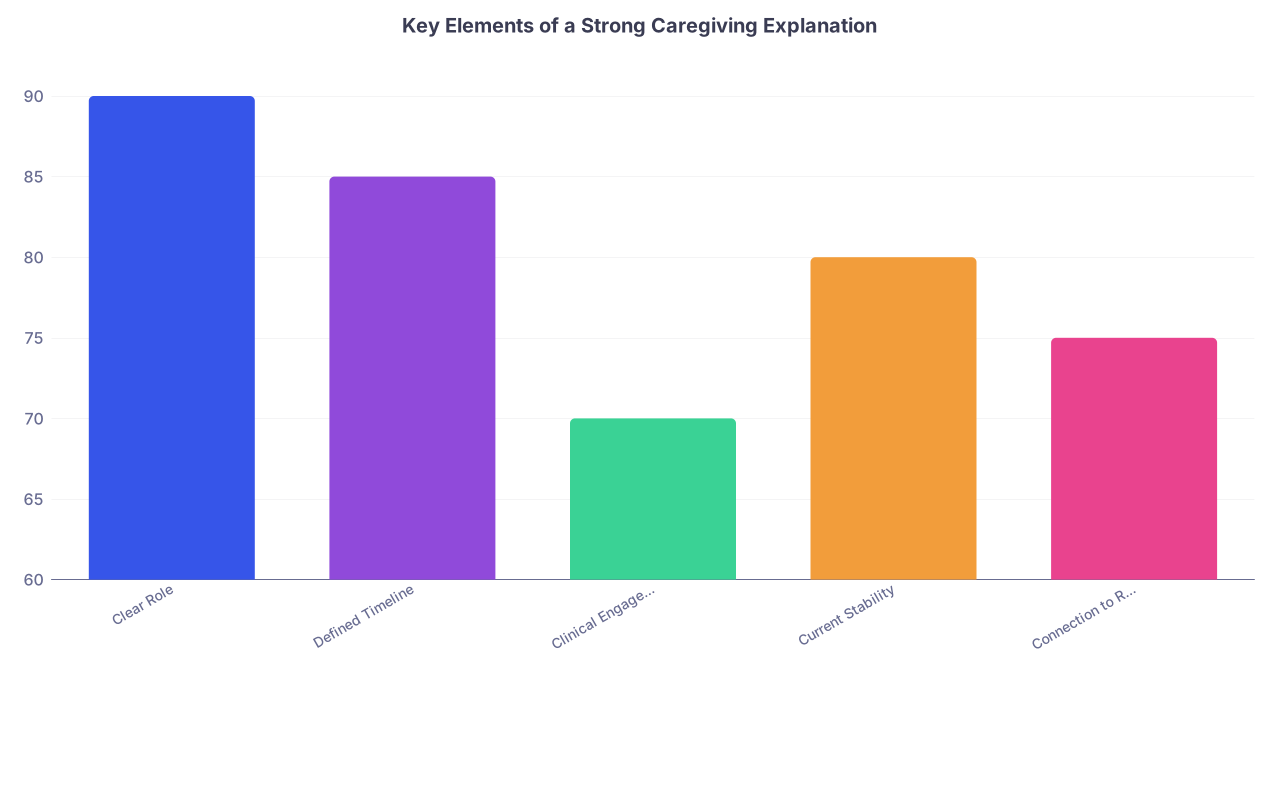
| Category | Value |
|---|---|
| Clear Role | 90 |
| Defined Timeline | 85 |
| Clinical Engagement | 70 |
| Current Stability | 80 |
| Connection to Residency | 75 |
Ask yourself:
- Does my ERAS clearly name my role (primary caregiver vs vague “helped”)?
- Are start and end dates explicit, with no mysterious multi-month blanks?
- Do I show at least minimal ongoing clinical engagement during longer gaps?
- Have I explicitly stated that my current situation is stable and compatible with residency?
- If I mention caregiving in my personal statement, does it connect to my specialty and who I am as a physician, not just my biography?
If you cannot answer “yes” to most of these, fix your language.
8. Putting It All Together: A Sample Cohesive Narrative
Let me give you a complete, realistic scenario.
- Graduation: 2022
- Step 1 pass, Step 2 OK
- 18-month gap before applying for IM, cared for father with ALS
How I would structure this application:
ERAS Experience:
- “Primary Caregiver – Father with ALS”
- Detailed description of specific care tasks and coordination
- 30–40 hours/week
Additional Info / Gap Explanation (2–3 sentences):
- Timeline, reason, transition back, current stability
Personal Statement:
- One paragraph on caregiving, mid-essay, tied to understanding chronic progressive disease, interdisciplinary teams, communication with families, and why IM appeals
Recent Clinical Activity:
- At least one 2–3 month observership or research position in 2023–2024
- Described in ERAS and mentioned in PS and interview
Interview Script (practiced):
- 60–90 second answer, calm, explicit about current stability and commitment
Suddenly that “red flag gap” stops being a liability and becomes a compelling, understandable piece of your story—with guardrails.

| Step | Description |
|---|---|
| Step 1 | Identify Gap |
| Step 2 | Brief gap note only |
| Step 3 | Create ERAS caregiving experience |
| Step 4 | Add gap explanation + observership |
| Step 5 | Short explanation only |
| Step 6 | Decide if PS paragraph needed |
| Step 7 | Prepare 60-90 sec interview answer |
| Step 8 | >3 months? |
| Step 9 | Multi-year or leave? |

9. Final Thoughts: What Actually Matters
Let me strip this down.
Programs respect caregiving when:
- You present it as structured, adult responsibility, not chaotic misfortune.
- You show that you protected at least some connection to medicine and then deliberately ramped back up.
- You make it easy for them to believe that your life is now stable enough to survive a brutal call schedule.
If your current language does not accomplish that, change the language. Not the truth—just the framing. That is exactly what good physicians do daily: honest facts, clearly communicated, tailored to the audience in front of them.