
Low professionalism scores on rotations will hurt you more than an average Step score ever will.
You can match with a 220. You will not match with a reputation for being unreliable, disrespectful, or unsafe. Programs will tolerate “still learning.” They will not tolerate “problem.”
Let me break this down specifically—what low professionalism ratings actually mean in the residency selection world, how programs interpret them, and what you can concretely do to repair the damage before it capsizes your Match.
1. What “Low Professionalism” Really Signals to Programs
Programs do not read your file like an essay. They scan for risk.
Professionalism concerns are not “weaknesses.” They are risk flags. Different category.
Most PDs mentally sort applicants into three buckets:
- Safe to train
- Extra work but trainable
- Potential problem / litigation / remediation headache
Low professionalism scores shove you toward bucket 3.
How programs actually see this
Programs use a few concrete sources to judge your professionalism:
- Clerkship evaluation narratives
- Graded professionalism domains on forms (attendance, initiative, teamwork)
- MSPE professionalism section and “noteworthy concerns”
- E-mails or off-the-record calls between faculty/PDs
- Disciplinary actions, remediation plans, or coaching notes
They are scanning for patterns:
- “Frequently late”
- “Needs repeated reminders about dress code / pager / documentation”
- “Dismissive with nursing staff”
- “Argued with attending about feedback”
- “Unreliable follow-through on tasks”
One comment in one rotation can be brushed off. Repeated comments—different services, different evaluators—and you have a professional identity problem in their eyes.
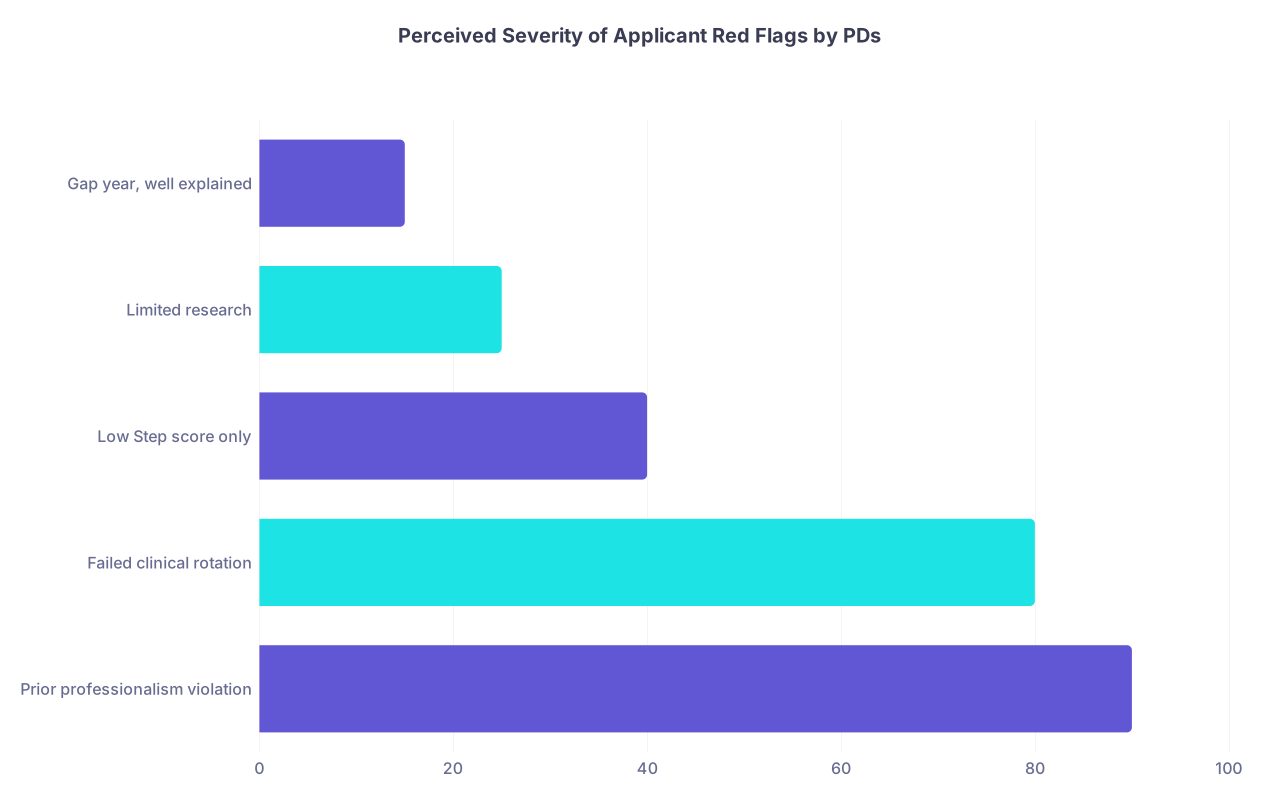
| Category | Value |
|---|---|
| Prior professionalism violation | 90 |
| Failed clinical rotation | 80 |
| Low Step score only | 40 |
| Limited research | 25 |
| Gap year, well explained | 15 |
Roughly: a prior professionalism problem sits at the top of the “do I want this headache?” hierarchy.
The difference between “average” and “concerning”
You are not in trouble because one attending gave you “meets expectations” instead of “exceeds.” That is normal.
You are in trouble when:
- A clerkship director documented professionalism concerns
- You had to meet with the Dean / Promotions Committee
- You were formally “counseled,” “remediated,” or put on a plan
- The MSPE includes any phrase like “professionalism concern,” “behavioral issue,” “remediation,” or “needs close supervision”
Also, programs know schools vary. Some schools ding students for very small things; others barely document anything. PDs look for:
- Number of incidents
- Recency (M3 vs early M4)
- Outcome (resolved vs ongoing)
Your job is to move your story from “ongoing risk” to “identified, addressed, and convincingly resolved.”
2. First Step: Get Ruthlessly Specific About What Went Wrong
Vague self-awareness does not repair anything. “I guess I wasn’t my best self on surgery” is useless.
You need a surgical-level breakdown of:
- What got documented
- By whom
- In what language
- With what consequences
Pull the record, not your memory
Do this in order:
Request and review your actual written clerkship evaluations.
Not just the final grade. The narrative comments. Ask your clerkship coordinator or Dean’s office if you do not have them.Read your MSPE draft line by line.
Especially:- Professionalism / conduct section
- “Areas of concern” or “Noteworthy concerns” section
- Any mention of leaves, remediation, or committee review
List each professionalism hit in a table format. Yes, literally.
| Rotation | Issue Documented | Date/Phase | Consequence |
|---|---|---|---|
| Surgery | Chronic lateness | M3 Fall | Meeting with clerkship |
| Medicine | Incomplete follow-through | M3 Winter | Feedback, no remediation |
| Pediatrics | Tone with nurse questioned | M3 Spring | Coaching conversation |
You cannot fix a pattern you have not actually named.
Translate the feedback into behavior categories
This is where I stop being gentle. Most students initially externalize:
- “The attending didn’t like me.”
- “It was a bad rotation culture.”
- “I was having a rough month.”
Those may all be true. But programs do not care about your justification; they care about your current reliability.
Cluster your issues into specific behavioral buckets:
- Reliability: late, missing pages, incomplete tasks
- Communication: abrupt tone, defensive, poor handoffs
- Teamwork: friction with nurses, peers, or residents
- Ownership: not following up, “not my patient” mindset
- Boundaries / ethics: documentation errors, confidentiality, lapses in judgment
This matters because each bucket has different repair strategies and different evidence of improvement.
3. Concrete Repair Strategies by Problem Type
Now the part you actually need: what to do.
A. If the issue was reliability (lateness, follow-through, organization)
Programs hate residents who disappear, show up late, or forget tasks. It breaks patient care and trust.
You need to prove you are now extremely reliable.
Tactics:
Overcompensate on subsequent rotations
- Always early. Not on time. Early.
- Proactive task lists, written or digital
- Read-back of assigned tasks on rounds (“Just to make sure I have it: I will call cardiology, follow up on troponins, and update the daughter.”)
Ask explicitly for mid-rotation feedback
Phrase: “I know in the past I have gotten feedback about follow-through and timeliness. I am actively working on this. Could you let me know mid-rotation how I am doing on those specifically?”Document “fixed” evidence in your application
Examples:- Later rotations with explicit comments like “extremely dependable,” “always early,” “excellent follow-through”
- Sub-internship evals praising your reliability
- Letter writers explicitly stating “Previous concerns in this area have been fully resolved; I would trust this student with a high level of responsibility.”
Consider structured tools
- Use a simple system like: daily to-do list divided by patient
- Set aggressive alarms for start times and pre-rounding
If you tell a PD, “I used to be late and disorganized, but I worked on it,” that is nothing. If the next three rotations have comments like “exceptionally reliable” and your sub-I letter calls you “one of the most dependable students I have worked with,” that is something.
B. If the issue was communication or attitude
This is the most common category. A few snappy comments to a nurse, visible frustration, looking disinterested, rolling your eyes at 6 a.m. pages—you know the drill.
Programs are allergic to residents who poison team culture.
You need to show emotional maturity and coachability.
Tactics:
Get explicit feedback from non-physician staff
Tell yourself this bluntly: your reputation with nurses matters. A lot.- Introduce yourself to every nurse on day 1.
- Ask for real-time suggestions: “If I am not communicating clearly about orders or plans, please tell me—I really want to improve that.”
- Watch your face and tone more than your words.
Practice “neutral professionalism” even when you are tired
No eye-rolling. No sighs. No slouching with arms crossed in conference. You can be exhausted and still look like a respectful adult.Learn one thing: how to receive feedback without self-destructing
Script:- “Thank you for telling me.”
- “Can you give a specific example so I can understand better?”
- “Here is how I will handle that going forward.”
If you argue, rationalize, or shut down, you have just reinforced the exact problem.
Get a faculty mentor to watch your interactions
Ask a trusted attending or advisor: “Can you watch how I interact with the team this week and be very direct with me about anything that comes across as defensive or dismissive?”
Then take their feedback and modify visible behavior immediately.
Evidence you want to generate:
- Evaluations explicitly calling you “collegial,” “gracious with feedback,” “excellent with nursing staff”
- A letter writer who knows about your prior issue and can credibly say, “I was aware of prior concerns about this student’s communication, and I can say definitively that I did not see those issues; in fact, I saw strengths in this area.”
That “arc” matters to PDs. It turns a liability into a growth narrative.
C. If the issue was ownership and initiative
Comments like:
- “Needed repeated prompting to follow up.”
- “Did not seem invested in patient care.”
- “Low initiative.”
Programs read that as “I will be dragging this resident through residency.”
Fix requires behavior, not words.
Sub-I (acting internship) is your proving ground
You must treat your sub-I like an audition.- Know every lab, imaging result, consult note on your patients
- Pre-emptively update residents on changes
- Volunteer for admissions, calls, scut—but smartly
- Ask overnight residents or seniors how you can lighten their load
Verbalize ownership
You want comments like “takes ownership” to appear on evals. You create that by literally saying:- “I will own Ms. X today; I will call her daughter, update the PCP, and make sure PT evaluates her before discharge.”
Close the loop. Always.
Every task:- Know who asked
- What exactly they asked
- By when they need it
- How you will confirm completion
Evidence:
- Sub-I evaluations with phrases like “functioned at the level of an intern,” “excellent ownership,” “proactively manages tasks.”
- A strong letter from your sub-I describing specific examples.
D. If the issue was ethics, boundaries, or serious misconduct
This is the category with the highest risk. Things like:
- Falsifying documentation
- HIPAA violations
- Inappropriate joking / comments about patients
- Dishonesty with faculty
- Anything that triggered formal disciplinary action
You are not repairing this in a couple of months of “being nicer on rounds.” You are rebuilding trust.
You must fully own it
Not partially. Not “contextualized.”
A PD wants to see:- Clear acknowledgment of what was wrong
- No deflection
- Concrete consequences you faced
- Concrete, structured remediation you completed
Engage formally with professionalism remediation if your school offers it
If your school has:- Professionalism committee
- Reflective writing program
- Counseling or coaching program
Use it. Complete it. Get documentation that you followed through.
Get your dean or professionalism lead on your side
You want the person who writes or signs off on your MSPE to believe that you are rehabilitated, not just skating by.
Ask them directly:- “What steps do I need to complete so you can honestly say in my MSPE that this has been addressed?”
Narrow your application strategy
This kind of hit means:- Apply broadly
- Heavier emphasis on home programs, community programs, and places that know your school well
- Expect more interview questions about this and prepare a rigorous, honest narrative
Evidence you need:
- MSPE language that includes a clear “resolved” note rather than a lingering question mark
- A senior faculty letter that directly addresses the prior problem and explicitly endorses you as safe to train
If your violation was extreme (e.g., major dishonesty, patient harm), some specialties and institutions will simply not take the risk. You may have to adjust specialty choice to a field and program tier where they are more open to second chances, and lean heavily on people who know you and are willing to stick their necks out.
4. Building a Visible “Upward Trajectory” Before ERAS Locks
Residency selection is less about absolutes and more about vectors. Are you improving, flat, or deteriorating?
You must show a clear upward slope.
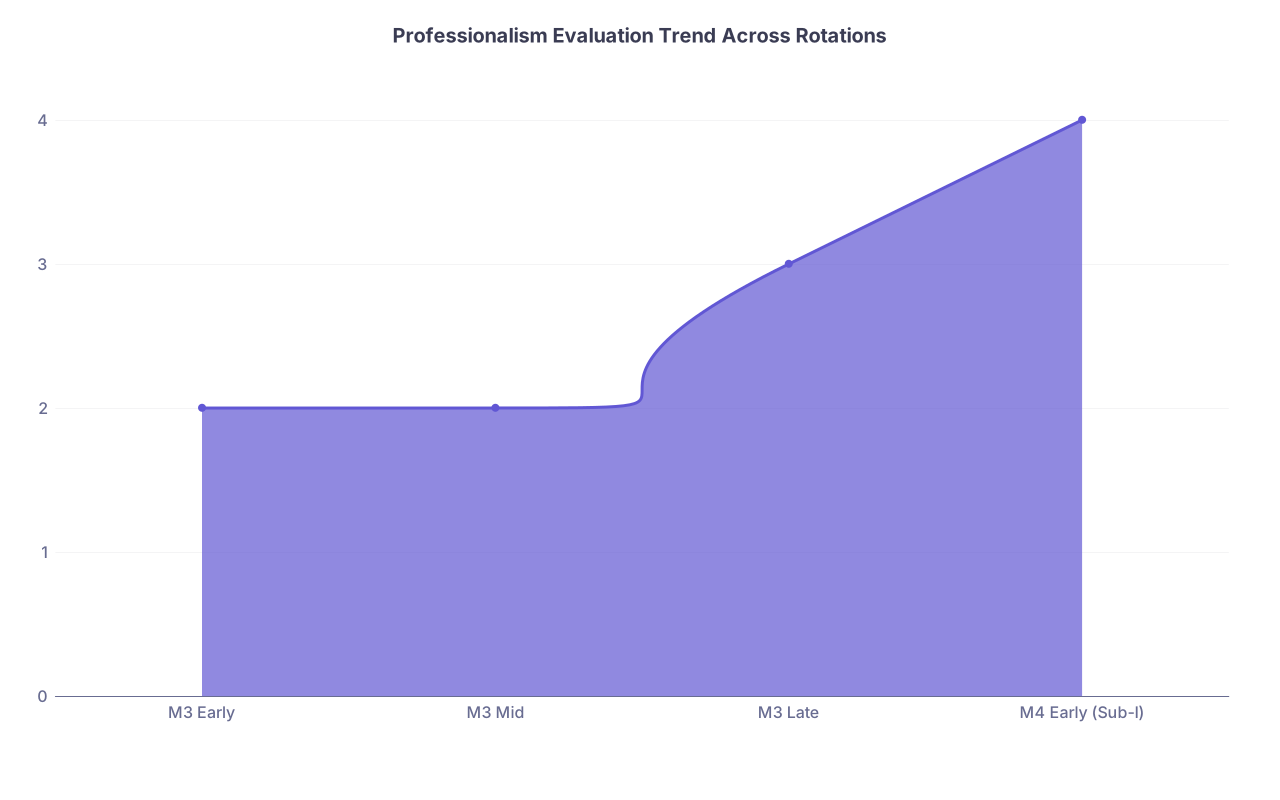
| Category | Value |
|---|---|
| M3 Early | 2 |
| M3 Mid | 2 |
| M3 Late | 3 |
| M4 Early (Sub-I) | 4 |
Think about your timeline realistically:
Timeline mindset
If:
- Your professionalism issue was early M3
- You have basically clean M3 late rotations and a strong M4 sub-I
Then you can present a strong “I learned, I changed, here is the evidence” story.
If:
- Your issue was late M3 or even early M4
- And you have limited time to show change
Then you must be strategic:
- Prioritize a sub-I in your chosen specialty at your home or an affiliated program early M4
- Or, if that is not possible, a high-exposure rotation (medicine, surgery, ED) at a place where people write detailed evals
Guard your next 2–3 rotations like your career depends on them
Because it does.
Non-negotiables:
- Request mid-rotation feedback every time
- Inform your attending (tactfully) that you care deeply about improving your professionalism record
- Respond immediately to any concern raised; do not wait until final eval
Ask: “If we froze my evaluation today, what concerns would you have?” Then fix those in the remaining weeks and explicitly ask them to reassess.
You are trying to generate a stack of comments that make any PD reading your file say, “They had a stumble but clearly turned it around.”
5. How to Frame Past Professionalism Issues in Your Application
You cannot pretend this did not happen. PDs will see it in the MSPE or in whispered reputations.
You need a clean, disciplined narrative.
Where it might come up
- MSPE: Standard location for recorded professionalism issues
- Personal statement: Optional, but can be used strategically
- Secondary / supplemental questions: Some programs explicitly ask about professionalism or disciplinary actions
- Interviews: “Tell me about a challenge or a time you received critical feedback.”
The structure of a strong explanation
Keep this mental outline:
- Brief, concrete description of the issue
- Clear ownership (“my mistake,” “my responsibility”)
- Specific actions taken to address it
- Evidence of changed behavior
Example (for a reliability issue):
“During my third-year surgery rotation, I received critical feedback about my punctuality and follow-through. I was sometimes late to early-morning rounds and once missed a follow-up call to a patient’s family. That is my responsibility and was rightly flagged as a professionalism concern.
I met with my clerkship director and dean, and we created a concrete plan: I began using a structured task-list system, set my schedule to arrive at least 20 minutes early daily, and asked for mid-rotation feedback on subsequent rotations. Since then, my evaluations on medicine, neurology, and my medicine sub-internship have consistently noted my reliability and ownership. My sub-I attending described me as “exceptionally dependable” and “functioning at the level of an intern” in their letter. The experience changed how I approach my responsibilities; I now over-communicate and double-check that every task is completed and handed off properly.”
Notice what is not there:
- No blaming the attending
- No long psychological backstory
- No vague “I learned a lot” without proof
You do not need to put this in your personal statement unless:
- The MSPE has a prominent professionalism note
- Or the issue was serious enough that you know it will dominate the PD’s concern
If you do write about it, keep it to one focused paragraph, not the centerpiece of your entire narrative.
6. Choosing Letter Writers Strategically
Letters can either bury you or rescue you.
With professionalism concerns, you want letters that:
- Are recent
- Directly observed your behavior on the team
- Address (either explicitly or implicitly) the prior weakness
Ideal letter writer categories:
- Sub-I attending in your chosen specialty
- Clerkship director from a later rotation who saw improvement
- A faculty mentor who knows your “before” and “after” story
What you should explicitly ask for:
You do not script their letter, but you can say:
“I had documented feedback earlier in medical school about [briefly name issue]. I have worked hard to address that. If you feel it is accurate, it would help me if your letter could comment on how I am currently performing in that area, especially compared to when you first met me or to your usual students.”
This gives them permission to talk about improvement in a way that PDs find credible. PDs are very good at reading between the lines. A generic “good team player” means less than: “I was aware of earlier concerns, and I can say that in my experience this student was one of the most professional and reliable on the team.”
7. Realistic Specialty and Program-Level Strategy
You repair the record and also adjust the target.
Programs differ in how much risk they will entertain.
| Program Type | Typical Risk Tolerance |
|---|---|
| Highly competitive academic | Very low |
| Mid-tier university | Low–moderate |
| Community / regional | Moderate if well-explained |
| Home program | Higher if they know you |
Practical implications:
- Competitive specialties (Derm, Ortho, Plastics, ENT, etc.): a significant professionalism history is often fatal, regardless of your Step scores. You may need to pivot.
- Core fields (IM, FM, Peds, Psych, Neuro): more nuanced. A well-documented recovery arc can still get you a solid match, especially at community and mid-tier university programs.
- Home program: if they have seen your “after” version and trust you, they can be your best advocate.
You should talk frankly with your dean or specialty advisor and ask:
- “With my record, where have students like me successfully matched?”
- “Which programs are more familiar with our school’s documentation style and more likely to put my MSPE comments in context?”
And then build a list that is heavy on those.
8. Psychological Side: How Not to Crumble Under the Weight of This
You are not the first student to get tagged for professionalism. I have seen very good residents start with ugly third-year comments.
But the mental game matters. If you go into every rotation terrified, you will freeze and underperform.
Two pieces of advice:
Treat every day like a small, winnable professionalism test
- Was I on time?
- Did I complete every task I agreed to?
- Did I treat every person—nurse, cleaner, consultant—with baseline respect?
That is it. No drama. No perfectionism.
Do not catastrophize, but also do not minimize
“I ruined my life” is inaccurate and paralyzing.
“This does not matter” is delusional and dangerous.
The correct framing: “This is a real, fixable liability. I have 6–12 months to show convincing change.”
Grab a mentor who will be blunt with you and keep you calibrated when your own guilt or defensiveness gets in the way.

| Step | Description |
|---|---|
| Step 1 | Identify Specific Issues |
| Step 2 | Review MSPE and Evaluations |
| Step 3 | Classify Problem Type |
| Step 4 | Targeted Behavior Changes on Rotations |
| Step 5 | Mid-Rotation Feedback and Adjustment |
| Step 6 | Generate Strong Sub-I and Senior Evals |
| Step 7 | Strategic Letters Addressing Growth |
| Step 8 | Honest Narrative in ERAS/Interviews |
| Step 9 | Apply Strategically by Risk Tolerance |
9. Evidence: What Actually Persuades PDs You Have Changed
PDs are pattern-recognition machines. They are not swayed by your self-reflection essay; they are swayed by converging evidence:
- Upward trend in professionalism ratings across rotations
- Clear, time-bound gap between incident and application
- Explicit resolving language in MSPE or dean’s comments
- Strong, specific letters from trusted faculty stating you are safe, reliable, and a positive team member
- No recurrence of similar problems over many months
They will absolutely still ask you about it in interviews if it was serious. Your job is to:
- Tell the story once, cleanly, without rambling or self-flagellation
- Show what changed in your behavior, not in your “intentions”
- Point (briefly) to concrete outcomes: “In the last year, my sub-I evaluations and feedback have emphasized X, Y, Z.”
If they see genuine insight plus consistent behavior change, many PDs are surprisingly forgiving. If they see excuses or vague “growth,” they will quietly move on to the next applicant.
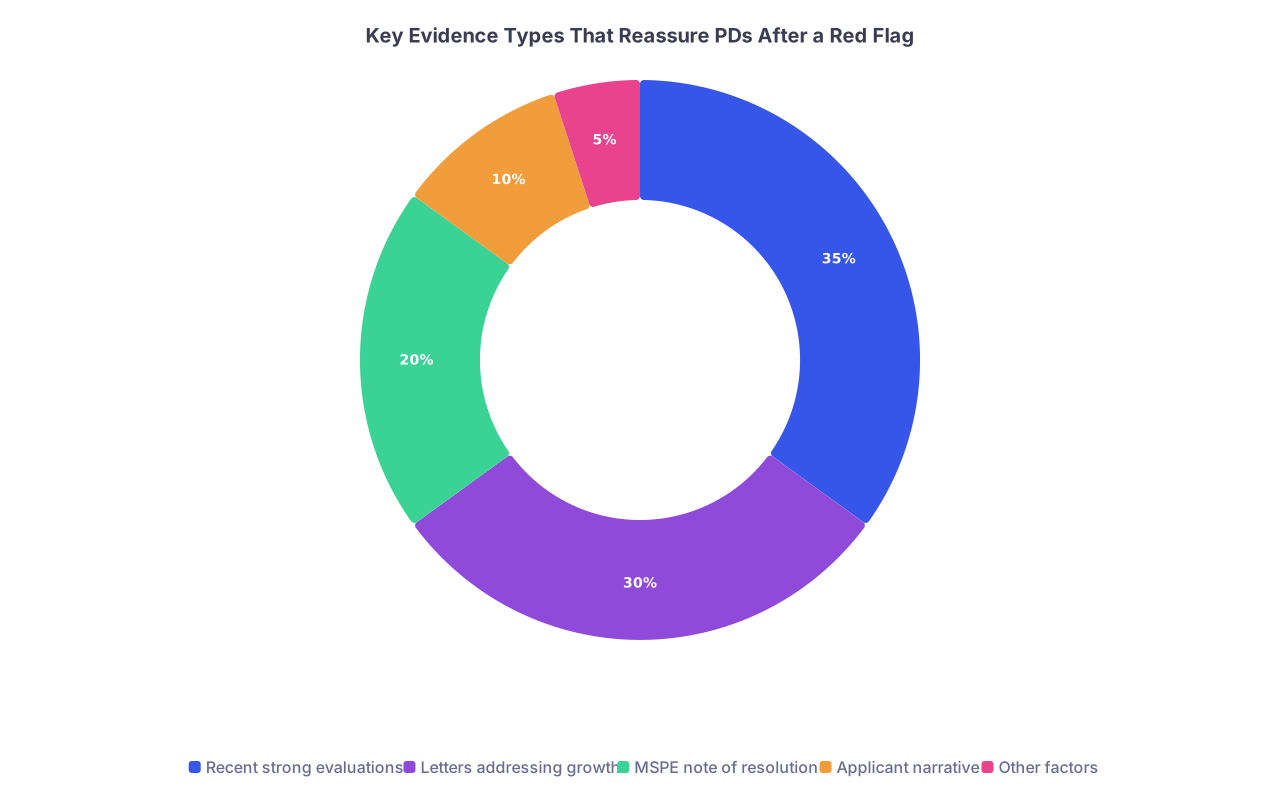
| Category | Value |
|---|---|
| Recent strong evaluations | 35 |
| Letters addressing growth | 30 |
| MSPE note of resolution | 20 |
| Applicant narrative | 10 |
| Other factors | 5 |
FAQ (Exactly 4 Questions)
1. Should I bring up my professionalism issue in my personal statement?
Only if it is clearly documented in your MSPE or was serious enough that PDs will fixate on it. If you mention it, keep it to a concise paragraph: state the issue, own it without excuses, describe specific corrective actions, and briefly point to objective improvements (strong later evals, sub-I comments). The rest of your statement should focus on why you are prepared and motivated for the specialty, not on re-litigating the incident.
2. How bad is it if my professionalism issue happened late in third year?
Worse than if it happened early, because you have less time to show a sustained change. That does not make it fatal, but it raises the bar. You must prioritize early fourth-year rotations—ideally a sub-I in your intended specialty—at sites where attendings know how to write detailed evaluations and will actually notice your growth. You need at least a few months of clean, strong performance before ERAS submission to build a believable upward trajectory.
3. Can a very strong Step score or research record offset professionalism concerns?
No. At least not by itself. Programs may overlook a borderline Step score if your professionalism and teamwork are stellar. The reverse is rarely true. A history of unreliability, poor communication, or ethical concerns makes PDs worry about patient safety, litigation, and residency morale. High scores and publications may keep them reading, but they will still need convincing, documentable evidence that your behavior has changed.
4. What if my school’s culture is harsh and “everyone” gets professionalism comments?
PDs are aware that schools vary in how aggressively they document problems, but they can usually tell the difference between one or two nitpicky comments and a real pattern. If your school is notorious for strict professionalism grading, that actually helps you—PDs who know the school will calibrate expectations. Your job is to: (1) show that your issues resolved over time, and (2) secure letters from faculty who can say, in plain language, that you are “well within the range of students we would trust as interns” despite any earlier comments.
Key takeaways:
First, low professionalism scores are not a cosmetic issue; they are a risk signal, and you must treat them as such.
Second, you repair this with sustained, visible behavior change documented by later evaluations and letters, not just introspective essays.
Third, be strategic—own the problem, generate concrete evidence of growth, and target programs and specialties that are willing to trust a documented, believable recovery arc.