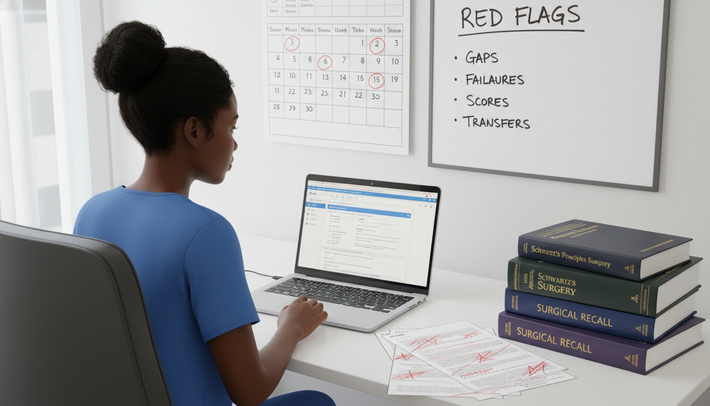
Managing Fails in Clinical Skills or OSCEs: Specific Strategies by Context
It is late evening. You just opened your email or portal. “Unsatisfactory” or “Fail” is sitting next to “Clinical Skills Examination,” “CPX,” or “OSCE Block 3.” Your stomach drops. You immediately think: “Is my residency application wrecked? Is this a red flag? How do I fix this in time for ERAS?”
Let me be clear: a single fail in a clinical skills or OSCE context is not an automatic death sentence for residency. But handled badly—poor remediation, vague explanation, no paper trail—it absolutely can become a serious red flag.
What you do in the next 3–12 months matters more than the fail itself.
Let me break this down very specifically, by type of exam, by timeline, and by specialty.
1. First, Understand Exactly What You Failed
Most applicants lump everything into “clinical skills” and panic. Program directors do not think that way. They distinguish between:
- High‑stakes, national gateway exams (old USMLE Step 2 CS, current equivalent institutional exams required for graduation).
- Internal school OSCEs / CPXs.
- Clerkship-specific OSCE components (e.g., “failed the SP encounter on my IM shelf course”).
- Pattern of problems vs one‑off event.
You cannot manage a red flag you do not understand.
1.1 Types of Clinical Skills / OSCE “Fails”
| Scenario | Stakes for Residency |
|---|---|
| Single failed internal OSCE, passed on remediated attempt | Low–moderate |
| Repeated OSCE failures across multiple rotations | High |
| Failed school-required comprehensive CPX, then passed | Moderate–high |
| Delayed graduation because of skills exam issues | High |
| Failed national clinical skills exam (CS-equivalent) | High |
The first thing you do: pull the actual evaluation. Not the summary email. The full rubric or narrative comments if they exist. You want specifics: history-taking, physical exam, communication, documentation, clinical reasoning, professionalism, time management.
Then divide your situation into one of these buckets:
- Single, early OSCE fail, now remediated.
- Multiple OSCE fails / recurring weakness.
- High‑stakes CPX or graduation requirement fail.
- Fail that directly delayed progression (repeated year, extended graduation).
The more you drift from #1 toward #4, the more carefully you have to manage the narrative, documentation, and strategy.
2. How Much Do Programs Actually Care?
Program directors do not scrutinize every OSCE from M2. They have limited time and specific triggers:
- Anything that delayed graduation.
- Anything that required formal remediation with notation in the MSPE.
- Anything that smells like professionalism or communication problems.
- Any pattern that matches “this person will struggle on the wards and with patient safety.”
They care a lot less about a single failed standardized patient note in an early OSCE if you never stumbled again.
2.1 What PDs Quickly Scan For
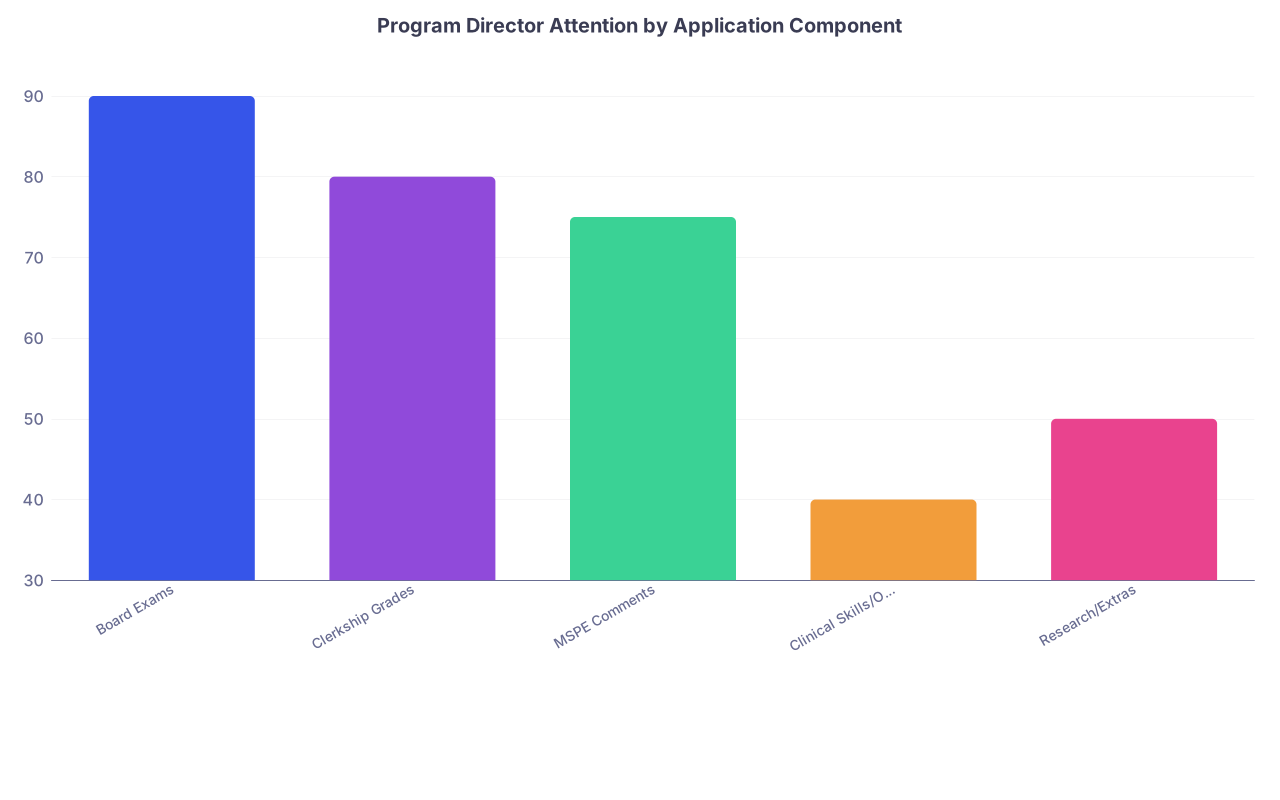
Here is roughly how attention flows when they review your file:
| Category | Value |
|---|---|
| Board Exams | 90 |
| Clerkship Grades | 80 |
| MSPE Comments | 75 |
| Clinical Skills/OSCEs | 40 |
| Research/Extras | 50 |
Those numbers are conceptual, not literal. But directionally accurate.
Clinical skills and OSCE fails become important when:
- They show up in the MSPE as “needs remediation,” “concerns,” or “required additional supervision.”
- They are tied to patient communication, professionalism, or ethical lapses.
- They suggest you may not be safe or independent early in residency.
So your job is to convert “concerning clinical skills fail” into “documented, successfully remediated, now a strength or at least a non-issue.”
3. Strategy by Context: Internal OSCE vs CPX vs High-Stakes Exam
3.1 Internal OSCEs (Course- or Block‑Level)
Scenario: M2 or early M3, you failed an internal OSCE station, or even the whole OSCE, and remediated it later.
These are usually lower stakes as long as:
- You passed on first or second remediation.
- There was no professionalism flag.
- It did not delay your progression.
Your priorities here:
Identify the skill gap in concrete terms.
“Global communication” is useless. You want specifics:- Missed critical red-flag questions in HPI.
- Disorganized, non-chronologic history.
- Forgot critical parts of the physical (cardiac auscultation, focused neuro).
- Poor time management: history took 19 minutes of a 20‑minute encounter.
- Weak closure, no clear assessment/plan communicated.
Fix it with targeted practice, not vague intentions.
I have seen students “promise to do better” and then bomb the next OSCE because they did nothing different.Better:
- Book 4–6 practice SP sessions through your simulation center if available.
- Use a checklist style approach for the domains you missed (e.g., “Every HPI: OLDCARTS + 3–4 pertinent ROS systems”).
- Record yourself and review with a faculty advisor. Painful but effective.
Create a paper trail of remediation.
Email your course director or faculty mentor something like:- “I reviewed the OSCE rubric and identified weaknesses in focused history and time management. I completed X SP sessions and Y feedback meetings. I will be using a structured HPI framework moving forward.”
Why? Because later, if asked, you can say: “I failed an early OSCE, did structured remediation including X and Y, and you can see that by mid-M3 all my clinical evaluations comment positively on my efficiency and communication.”
Link it to later strengths.
If your later clerkship evals mention things like “excellent rapport with patients,” “very organized presentations,” or “clear and efficient histories,” you will explicitly connect that arc in your personal statement or interviews.
3.2 Comprehensive CPX / School Clinical Skills Exam
These are closer to high stakes. Often taken late M3 or early M4. Failing these can:
- Block progression.
- Trigger mandatory remediation.
- Show up explicitly in the MSPE.
Programs see “failed the comprehensive clinical skills exam, required remediation, then passed” very differently from “failed one random M2 OSCE station.”
Here your strategy has three parts:
3.2.1 Diagnose the Pattern, Not the Episode
Do not settle for, “You failed because of communication.” That is lazy feedback and you should push harder.
Ask:
- Which stations were weak? Common patterns:
- All high‑complexity reasoning cases (e.g., chest pain, altered mental status).
- Psych or difficult conversations (breaking bad news, capacity assessments).
- Systems-based issues (handoff, interprofessional communication).
- Was it standardized patient scoring, faculty scoring, or written note/scoring that sank you?
- Did you underperform uniformly, or were there 1–2 catastrophic stations?
You want to walk into residency interviews able to say: “The failure was in X domain, here is how I systematically corrected that.”
3.2.2 Controlled, Documented Remediation
This is where many students screw up. They remediate, pass, then never collect documentation.
You need:
- A formal remediation plan with dates and components.
- Evidence of what you actually did: number of sessions, reflection or debriefing, faculty feedback.
- Ideally, a faculty advocate (skills director, clerkship director) who can say, “Yes, they took this seriously and improved.”
If your school allows, ask the remediation lead:
- “Would you be comfortable, if needed, speaking to a program about the work I did and my current readiness?” You will not always need this, but having a potential voice ready is invaluable.
3.2.3 Translate to Application Language
Later, when programs see this in the MSPE or ask about it, you will use a structured explanation. Something like:
Brief factual description:
“Our school requires a comprehensive CPX in M3. I did not pass on my first attempt because…”Specific skill deficit:
“…my feedback showed I was missing critical differential diagnoses in high-acuity cases and rushing closure, leaving patients confused about next steps.”Concrete remediation:
“I completed a formal remediation program with X SP encounters, weekly faculty feedback, and repeated note-writing practice. I retook and passed the exam.”Evidence of improvement:
“Since then, my IM and EM clerkships commented specifically on my clear communication and organized approach to sick patients. I have not had any subsequent concerns documented.”
Notice what is missing: excuses, blame, or “I was stressed, so…”
4. Timeline Management: How Close Is This to ERAS?
This is where things get messy.
4.1 Fail Well Before ERAS (≥ 12 months before applying)
Best‑case scenario.
You have time to:
- Remediate thoroughly.
- Accumulate a year of clean, strong clinical evaluations.
- Potentially get a letter from someone who saw you after remediation and can speak to your current skills.
In this context, a single fail becomes background noise if:
- You do not repeat the offense.
- Your MSPE narrative improves across the timeline.
- Your explanation is concise and mature.
4.2 Fail in the “Gray Zone” (6–12 months before ERAS)
Example: Fail your CPX in March, remediate in May, ERAS opens in September.
You have:
- Limited time to show a long track record of improvement.
- But enough time for at least one or two strong rotations after remediation.
Your priorities:
Ask to be scheduled on clinically intense rotations soon after remediation (IM, EM, Surgery, FM with high patient volume).
Crush those rotations. No partial effort. You absolutely want comments like “ready for intern level.”
Get at least one letter from a faculty who:
- Worked with you after remediation.
- Can indirectly counter any concerns: “Their communication with patients is excellent; they function at the level of an intern.”
Also, work with your dean’s office on MSPE wording. You cannot rewrite it, but you can ask for accurate, fair language that reflects both the initial fail and the documented improvement.
4.3 Fail Close to or During Application Cycle (< 6 months)
Now we are firmly in red‑flag territory. Especially if:
- The remediation is ongoing at the time of application.
- Graduation is uncertain or delayed.
- The MSPE will clearly show an unresolved issue.
This is where you must be brutally realistic.
For some students, the correct move is:
- Delay graduation by a year if that strengthens your record.
- Or apply in a less competitive cycle rather than pushing in with an unresolved or barely remediated skills failure.
If delaying a full year is not possible or desirable:
- Focus on less competitive specialties and programs that historically are more forgiving.
- Apply broadly, include community programs, and lean heavily on strong clinical letters that can attest to safety and teachability.
5. Specialty-Specific Reality Check
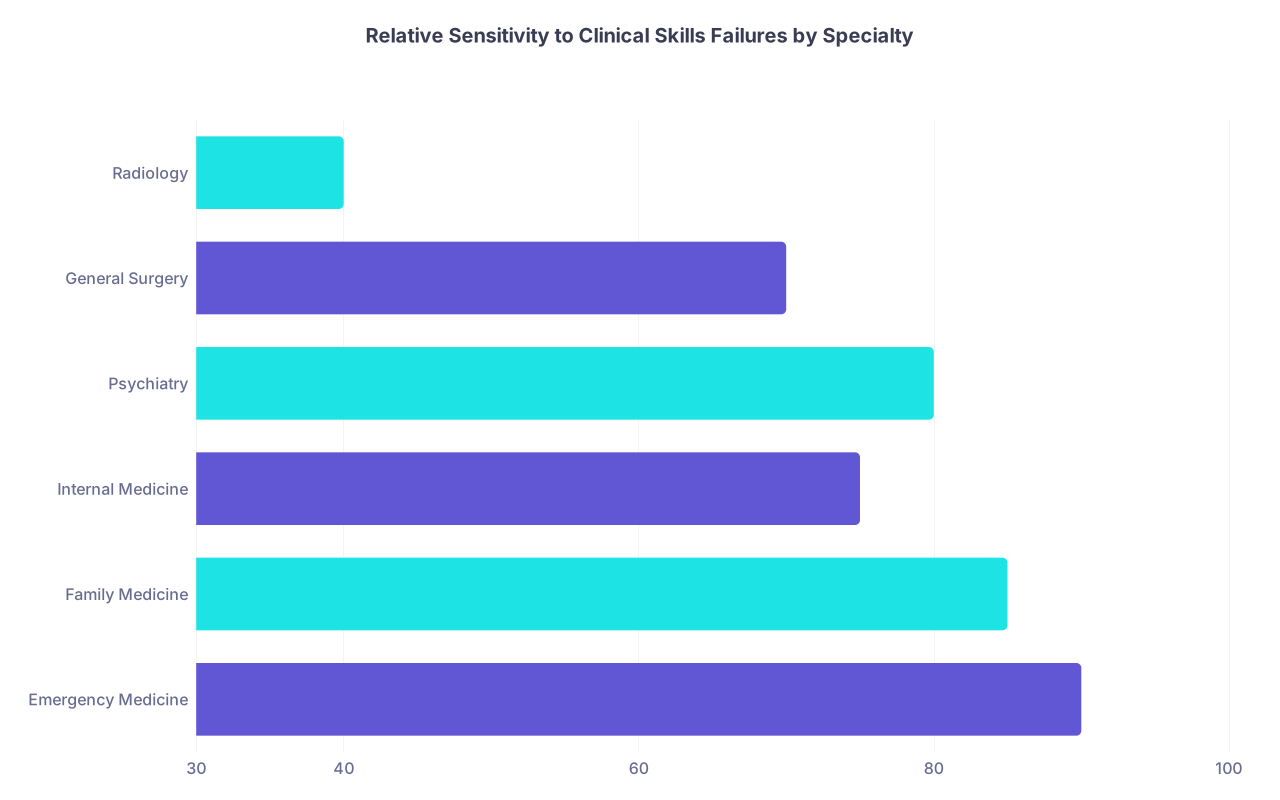
Not all specialties weigh clinical skills fails the same way.
| Category | Value |
|---|---|
| Emergency Medicine | 90 |
| Family Medicine | 85 |
| Internal Medicine | 75 |
| Psychiatry | 80 |
| General Surgery | 70 |
| Radiology | 40 |
Again, conceptual, but directionally right.
- Primary care fields (FM, IM, Peds) care a lot about communication, reliability, and bedside skills. A single fail with clear remediation is usually survivable.
- Psychiatry is extremely tuned to communication and professionalism. A clinical skills fail tied to empathy, boundaries, or interviewing is a bigger problem. You must show clear, documented turnaround and have strong psych-specific letters if possible.
- Emergency Medicine programs want to know you can function under pressure and communicate clearly during chaos. A fail for time management and disorganization will raise eyebrows—but it can be offset with crushing an EM sub‑I and getting a strong SLOE.
- Surgical fields and Radiology focus more on board scores and performance on surgery clerkships than an isolated OSCE. But if the fail suggests sloppiness or poor professionalism, it still hurts.
Practical translation: With a significant clinical skills fail:
- Highly competitive fields (Derm, Plastics, ENT, Ortho, Neurosurg) are already long‑shot unless everything else in your application is spectacular. These fields can cherry-pick applicants with clean records.
- Broader gateway fields (IM, FM, Peds, Psych, EM) remain realistic if you manage the narrative and have strong, recent clinical performance.
6. What To Say (and Not Say) in Applications and Interviews
6.1 ERAS Application and Personal Statement
Most of you will not write a full essay about an OSCE fail. That is overkill.
You consider mentioning it when:
- It is clearly documented in the MSPE as a significant issue.
- It delayed graduation or required extensive remediation.
- It ties directly into a compelling “growth” or “professionalism” arc.
If you mention it:
Keep it to one short paragraph:
- One sentence: what happened.
- One to two sentences: what you learned and concretely changed.
- One sentence: current state / evidence you improved.
Example (Internal Medicine applicant):
“I did not pass our school’s comprehensive clinical skills exam on my first attempt due to disorganized history-taking and incomplete differential diagnoses in complex cases. Through a structured remediation program involving repeated standardized patient encounters and targeted feedback, I developed a more systematic approach to interviewing and reasoning. Since then, my internal medicine and neurology evaluations highlight my organized clinical presentations and thorough consideration of critical diagnoses, and I passed all subsequent clinical assessments on the first attempt.”
That is it. No drama. No martyrdom.
6.2 MSPE and Dean’s Letter
You have limited control, but you do have some.
What you can do:
- Meet with your student affairs dean early.
- Bring documentation of your remediation and improved evaluations.
- Ask that the narrative be complete, not just “failed X; remediated.”
Something like: “Initially did not pass the third-year comprehensive CPX due to deficits in X and Y. Completed formal remediation and passed on retake. Subsequent clinical performance has been satisfactory with no further concerns.”
You are not trying to erase the fail. You are trying to include the resolution.
6.3 Interview Responses
If they ask—and with a notable CPX or skills fail, many will—your answer structure should be:
Acknowledge without defensiveness:
- “Yes, I did fail our comprehensive clinical skills exam on the first attempt.”
Brief context, not excuses:
- “The feedback showed I was rushing the history and missing key safety questions in higher acuity scenarios.”
Precise remediation actions:
- “I completed X sessions, used structured checklists, and met regularly with our skills director. I also deliberately sought out rotations with high patient volume to apply these skills under supervision.”
Evidence of current competence:
- “Since then, my supervisors on IM and EM have consistently commented that my patient communication and organization are strengths, and I have not had any subsequent concerns raised.”
Optional closing:
- “It was a humbling experience, but it forced me to rebuild my clinical habits deliberately. I am more systematic and more reflective now than I was before that exam.”
What you never say:
- “The SP was unfair.”
- “My evaluator was biased.”
- “I was just having a bad day,” full stop, with no change afterward.
Even if some of that is true, it sounds like you learned nothing.
7. Building a Concrete Improvement Plan (So This Never Happens Again)
Let me give you something more structured than “I’ll practice more.”
Use a simple, brutally honest framework:
7.1 Identify Your Primary Weakness Category
Most OSCE / CPX failures fall under 3 big buckets:
Process / Structure
Disorganized history, missing key ROS, wandering differential, no structure in exam or note.Interpersonal / Communication
Poor rapport, minimal eye contact, interrupted patient, no empathy statements, jargon-heavy closure.Time / Task Management
Took 18 minutes on HPI, did no exam. Ran out of time for counseling. Wrote half a note.
Fourth bucket is Professionalism / Attitude, which is a different level of seriousness (late, disrespectful, boundary issues). If that is your problem, you need one‑on‑one faculty mentoring and possibly counseling, not just checklists.
7.2 Match Weakness to Targeted Practice
Process / structure:
- Use standardized frameworks every time: OLD CARTS, full ROS structure by organ system, one consistent exam sequence you can do in your sleep.
- On real patients, force yourself to summarize in 1–2 minutes out loud after the encounter. Every time.
Interpersonal / communication:
- Practice “out loud empathy”:
- “That sounds really frightening.”
- “You have been dealing with this alone for a long time.”
- Record 2–3 patient or SP interactions (with permission) and watch them. Note how often you interrupt, your posture, your eye contact.
- Ask attendings: “Can you specifically comment on how I’m doing with building rapport and explaining plans?”
Time / task management:
- Use a watch. Set internal checkpoints in a 15–20 minute OSCE:
- Minute 0–7: History.
- Minute 7–12: Focused exam.
- Minute 12–15: Explanation and closure.
- Practice moving on when you have enough data, instead of chasing every tangent.
7.3 Track Improvement Like You Track Scores
Do not just “feel” like you improved.
- Keep a simple log:
- Date, type of encounter (SP / real patient), main focus (history structure, empathy, time).
- One thing you did well, one thing you will fix next time.
Over 4–8 weeks of deliberate practice, you will see patterns shift, and you will have honest data when you write or talk about your improvement.
8. When the Red Flag Is Bigger Than One Fail
Sometimes the fail is not isolated. You might be dealing with:
- Multiple OSCE / CPX failures.
- Narrative MSPE language about “recurrent concerns in clinical performance.”
- An extended curriculum or delayed graduation explicitly due to clinical skill deficits.
This is no longer “how do I explain this one event.” This is: “How do I prove I am safe and ready for residency at all?”
Here, you need:
An honest mentor
Not your friend, not a PGY‑1. A clerkship director, program director, or seasoned faculty who will tell you, “Yes, you should still apply,” or “You need another year of focused development.”An extra year used well (if you have it)
If you are repeating M3/M4 time or taking an extra year, load that year with:- High‑quality clinical rotations, not just research.
- Direct observation and feedback, not just shadowing.
- Documentation in your evaluations that your performance is now stable and at expectation.
Realistic targeting of programs
You will likely need:- Community and smaller programs more open to “non-traditional” or “improved over time” paths.
- Possibly a transitional year or prelim year if categorical positions are scarce.
Tight narrative control
You must own the story, not hide it. “I struggled early, I did X, Y, Z to fix it, and here is how my performance now compares to expectations.”
I have seen applicants with ugly early records match into IM, FM, Psych after two or three years of solid, uneventful clinical work and strong letters. But they were realistic, humble, and had advisors who vouched for their growth.
9. Quick Reality Check: How Bad Is Your Situation, Really?
Use this rough triage:
| Level | Description | Match Risk |
|---|---|---|
| Green | Single early OSCE fail, remediated, no delay | Low |
| Yellow | CPX fail, remediated, good later evals | Moderate |
| Orange | Multiple fails, some MSPE concern language | High |
| Red | Delayed graduation, ongoing issues | Very High |
Green/yellow: focus on doing the work, getting strong letters, and having a clean narrative.
Orange/red: you must sit down with your dean or a trusted PD and decide whether to adjust specialty, take extra time, or recalibrate expectations.
10. Final Thoughts: What Actually Matters to Programs
Programs do not expect perfection. They expect:
- Safety.
- Reliability.
- Capacity to improve with feedback.
A clinical skills or OSCE fail is a problem if it suggests you are unsafe, unreliable, or resistant to feedback. Your entire strategy is to demonstrate the opposite.
So:
- Show you took the feedback seriously.
- Show specific changes in how you practice.
- Show a timeline where your clinical evaluations improve and then stabilize.
If you can do that, most reasonable programs will see the fail as a data point, not a verdict.
Key takeaways:
- A single OSCE or clinical skills fail becomes a major red flag only if you repeat the pattern, lack clear remediation, or let it delay your progression without explanation.
- Your defense is not wordplay in your personal statement. It is documented, targeted remediation plus strong, post‑remediation clinical evaluations and letters.
- Own the story in concise, specific language: what went wrong, what you did to fix it, and how your current performance proves that you are ready for residency.