
You’re on call. It’s 2:47 a.m. Your senior just humiliated you in front of the team for asking a reasonable question. You have 14 patients, your notes aren’t done, you haven’t eaten since 9 a.m., and the attending’s email from earlier is still sitting in your inbox accusing you of being “not residency material” because you pushed back on a clearly unsafe order.
You’re not just tired. You’re starting to feel broken. You’re asking yourself a scary question:
“Is this just residency… or is my program toxic? And if it is, can I actually get out?”
Let’s walk through that. Step by step. No sugarcoating.
1. First: Are You Actually in a Toxic Program?
You cannot make good decisions if you mislabel normal intensity as “toxic,” or worse, convince yourself abuse is “just residency.”
Here’s the quick reality check. A hard but functional residency has:
- Long hours, but real supervision and some respect
- Difficult feedback, but no humiliation
- High expectations, but room to learn and make small mistakes
- Burnout, yes, but not fear of retaliation for speaking up
A toxic residency has patterns like this:
Systematic humiliation
Public dress-downs. Yelling in front of patients. Seniors mocking you to other staff. Being called “useless,” “lazy,” or “a problem” as if that’s normal.Chronic unsafe expectations
Regularly covering unsafe patient loads. Being strongly discouraged or punished for calling for help. Being forced to fudge duty hours. Attending pressure to “just sign it” even when you’re not comfortable.Retaliation culture
Residents who raise concerns mysteriously get bad evals, are pulled from rotations, or suddenly placed on remediation with vague reasons. People explicitly tell you, “Don’t go to GME; it’ll follow you forever.”No meaningful support
Wellness sessions are a joke. PD is always “too busy.” Chief residents tell you to just “hang in there” but nothing changes. Flagrant violations of ACGME rules are considered “how we do things here.”You’re changing in ways that scare you
You’re crying in the call room between pages. You dread the hospital every single day. You’re starting to feel numb about patient care or fantasize about just not showing up.
If 3+ of those are constant, not episodic, you’re probably not just in “a tough program.” You’re in a toxic one.
Now ask a narrower question:
Is this:
- A bad rotation?
- A bad attending/senior?
- Or a bad program culture?
You transfer for the third one. For the first two, you usually endure, document, and learn. For toxic program culture, you plan your exit.
2. The Non‑Negotiable: Protect Your Health and License First
Before you even say the word “transfer,” you stabilize yourself and your situation. This is not optional.
Your mental health
If you’re having:
- Persistent thoughts of quitting medicine and disappearing
- Passive or active suicidal thoughts
- Panic attacks before shifts
- Severe insomnia, not eating, or physical symptoms from stress
You need help now, not after you “figure out the transfer.”
That means:
- Confidential therapist or psychiatrist (ideally outside the hospital system)
- If your program has a true off-site employee assistance program with zero PD access, use it
- If things are dire, you can step away briefly. Medical leave is not career death. I’ve seen residents successfully match into fellowships after taking 3–6 months off for mental health when handled cleanly and honestly.
Your license and record
Toxic programs sometimes weaponize documentation. You need to be careful.
Immediately start:
- Private documentation: A secure, personal log (not on hospital devices) with dates, names, incidents, and witnesses. Factual, not emotional.
- Saving emails: Download or screenshot relevant emails where you raised concerns or were given conflicting or abusive instructions.
- Knowing your status: Are you on probation? Formal remediation? Any written warnings? You need exact wording and dates.
If they decide to push you out later, your prior documentation can be the difference between “problem resident” and “whistleblower/abused trainee” in the eyes of another PD.
3. Decide: Stay and Survive vs. Seek Transfer
You don’t transfer because you had 3 bad calls. You transfer when staying is likely to damage your health or future more than the risk of moving.
Here’s the decision framework.

| Step | Description |
|---|---|
| Step 1 | Identify Problems |
| Step 2 | Survive rotation and document |
| Step 3 | Assess Health and Risk |
| Step 4 | Prioritize exit and support |
| Step 5 | Consider internal fixes |
| Step 6 | Plan transfer |
| Step 7 | Try changes with time limit |
| Step 8 | Stay with monitoring |
| Step 9 | Toxic pattern or isolated? |
| Step 10 | Health or license at risk? |
| Step 11 | Any real internal change likely? |
| Step 12 | Improvement? |
Ask yourself bluntly:
- Can I realistically finish this program without major damage to my mental health or career?
- Is there any credible path to improvement? New PD coming, strong GME office, multiple residents pushing for change?
- Do I still want this specialty and this career enough to go through the pain of transferring?
If the answers look like:
- No / No / Yes → You’re probably a transfer candidate
- Maybe / No / Yes → Consider transfer, set a firm timeline (e.g., “If things aren’t measurably better in 3 months, I move”)
- Yes / Yes / Yes → You may be dealing with a local toxic pocket, not a toxic system. Different playbook.
4. Quiet Recon: What Transfers Actually Look Like
Transfers happen more than programs admit. They’re just quiet.
Common transfer scenarios I’ve seen:
- PGY‑1 IM resident moves to another IM program after major PD conflict
- PGY‑2 surgery resident moves into a prelim year then re-enters categorical elsewhere
- OB/GYN resident leaves a malignant program for FM with OB at a community hospital
- Psychiatry resident moves after severe harassment and GME involvement
But transfers are:
- Logistically messy
- Dependent on timing and available spots
- Politically sensitive (no one likes to admit their program is bleeding residents)
So you need good intel and realistic expectations.
| Factor | Reality for Most Residents |
|---|---|
| Timing | Often at PGY-2 start |
| Spot Type | Vacant positions, not new slots |
| Specialty Match | Easier within same specialty |
| Documentation | PD letter often required |
| Success Rate | Moderate if well-prepared |
5. Who You Talk To (And in What Order)
This part is political. Handle it carefully.
1. Off-program, trusted advisor first
Before you talk to anyone in your own program:
- A mentor from med school
- A fellowship director you rotated with previously
- A trusted attending in another department
- Alumni from your med school who are now faculty elsewhere
Explain your situation factually. Ask:
- “If you were in my shoes, would you aim to finish here or transfer?”
- “If I tried to transfer, what red flags would other PDs see in my file?”
- “Would you be willing to be a reference or quietly ask around?”
You want someone who’s not entangled in your program’s politics.
2. Then decide about your own PD
Here’s the hard truth: some PDs will quietly support a transfer. Others will sabotage it.
Signs your PD might support:
- Has previously acknowledged systemic issues
- Has advocated for residents in front of you
- Responds to your concerns with specifics, not gaslighting or vague “you just have to toughen up”
Signs your PD is unsafe to approach about transfer:
- Has already labeled you “not a good fit” or “a complainer”
- Retaliated against residents who spoke up
- Dismissed duty hour or safety violations as “whining”
If your PD is unsafe, you go through:
- GME office
- DIO (Designated Institutional Official)
- Program ombudsperson, if one exists
- Outside mentors to connect you with other PDs
If your PD might be reasonable, the script looks like:
“I want to be completely honest with you. I’m struggling in this environment in ways that feel unsustainable for me long term. I respect the training here, but I’m concerned this isn’t the right fit for me. I’m exploring the possibility of transferring to another program, ideally in the same specialty. I’d like to talk about whether that’s something you’d be willing to support, and how we can do that in a way that protects patient care and my professional record.”
You’re not blaming. You’re not accusing. You’re stating reality and asking for their stance.
6. How the Actual Transfer Process Works (Mechanics)
Forget the fantasy of a formal “mini-Match.” Transfers are usually ad hoc.
Step 1: Define your target
Decide:
- Stay in same specialty vs. change specialty
- Academic vs. community
- Geography flexibility (wider net = better odds)
Your three main options:
- Lateral transfer into open PGY‑2+ spot in same specialty
- Start over as PGY‑1 in another program or specialty
- Take preliminary credit (if available) and re-enter as higher PGY later
Step 2: Hunt for open spots
You look here:
- Specialty-specific listservs (e.g., APDIM for IM, ACOG listserv for OB)
- ACGME / FREIDA sometimes list vacancies
- Direct emails to PDs in your region: “Do you anticipate any PGY‑2 openings in the next year?”
You quietly ask mentors:
“Do you know of any programs that might be looking for a transfer resident?”
Step 3: Prepare your packet
Most places will want:
- Updated CV
- Personal statement (shorter, focused on fit and maturity, not drama)
- USMLE/COMLEX scores
- Medical school transcript
- Current program evaluations (if they exist and are decent)
- Letters (ideally: current PD or APD + at least one attending who likes you)
Your personal statement should not read like a legal complaint. Something like:
“During my intern year I realized that the training environment at my current institution wasn’t an ideal fit for my learning style and long-term professional goals. I’ve valued the strong clinical exposure and have maintained solid clinical performance, but I’m seeking a program with more structured teaching, collaborative culture, and consistent supervision. I remain fully committed to [specialty] and to growing from this experience.”
You’re signaling:
- Insight
- Professionalism
- Commitment to the field
- No mudslinging
Step 4: Expect backchannel calls
PDs will call your current PD. Informal. Off the record. This is where your narrative and your PD’s narrative need to not be wildly misaligned.
You want your PD to say things like:
- “Good clinician, solid fund of knowledge, but we’ve had some mismatch with our system and expectations.”
- “No professionalism red flags, but culture fit has been challenging.”
You really don’t want:
- “We’ve had significant concerns about their integrity, clinical judgment, or reliability.”
Which is why, if you’re already on formal remediation or probation for true performance issues, transferring becomes much harder. Not impossible, but harder.
7. While You’re Still There: How to Survive Without Self-Destructing
You might hate this chapter of your life. You still have to get through it without creating new problems.
Practical survival rules:
Shrink your risk footprint
Show up on time. Do the work. Do not be the resident who’s always arguing, always late, or always missing notes. You’re trying to become “quietly competent,” not “the center of drama.”No emotional venting in writing
Not in email. Not on Slack. Not in shared chats. If you need to vent, do it with one or two trusted people in person or off-platform.Avoid going nuclear unless absolutely necessary
Filing formal complaints can be necessary, especially for harassment, discrimination, or gross safety issues. Just recognize: once you push that button, relationships shift. If you’re going to do it, document meticulously and consider legal or advocacy counsel.Keep doing decent clinical work
Every transfer PD will ask: “Can they take care of patients?” Your evals, even if the narrative is lukewarm, should not show a pattern of unsafe behavior.Take what you can from the chaos
Terrible programs still give you cases, reps, war stories. You’ll come out with a high threshold for panic and a very good radar for bad systems. That’s not nothing.
8. If Things Escalate: When the Program Targets You
Sometimes, once you’re “not happy,” the program turns on you. I’ve seen this happen too often.
Red flags they’re coming for you:
- Sudden stack of negative evals after you spoke up
- Unexpected formal remediation with vague goals like “improve attitude”
- Threats about “your future career” if you keep raising concerns
If this is happening:
Get representation
Either:- Institutional ombuds,
- House staff union (if you have one), or
- An employment or education attorney who understands GME.
Force clarity
Ask in writing:- “What specific behaviors are of concern?”
- “What are the objective, measurable criteria for successful remediation?”
- “What is the timeline and how will progress be assessed?”
Do not sign things you don’t understand
If they hand you a remediation or discipline document, ask to review it and say you’d like to consult with [union/attorney/mentor]. This is your right.Parallel-plan your exit
As soon as they start formal action, you should assume you’ll either:- Transfer out, or
- Complete under a cloud and need very strong allies for future jobs/fellowships.
9. Emotional Reality: Grief, Shame, and Identity
Let me be blunt: transferring can feel like failure. Programs lean on that. “People will think you couldn’t hack it.” That’s garbage.
What you’re actually doing:
- Choosing not to normalize abuse
- Protecting your long-term ability to practice
- Admitting a mismatch and fixing it early instead of five years from now
You will likely go through:
- Anger: “They ruined this for me.”
- Shame: “Maybe I am the problem.”
- Grief: Letting go of the dream you had of how residency would be
- Relief: When you finally get out or even just commit to leaving
Get support. Therapist, partner, friend who’s honest with you, maybe a former resident who left your program and survived. You’re not the first. You won’t be the last.
10. Contingency: If Transfer Fails or Isn’t Possible
Sometimes there’s no open spot. Or your PD torpedoes you. Or your personal life ties you to a city.
If that happens, your options might be:
- Finish where you are while creating as much distance as you can: change tracks (e.g., from hospitalist-focused to outpatient-focused), choose electives with kinder attendings, angle for research time with more supportive faculty.
- Pivot specialties after residency: e.g., toxic surgery program → later do wound care, critical care, palliative, informatics.
- Step out of residency entirely and regroup → locums as a prelim-only person (limited), MPH, research roles, industry, or non-clinical medicine. Less clean, but sometimes better than staying in active harm.
Not the ideal path. But it’s still a path.
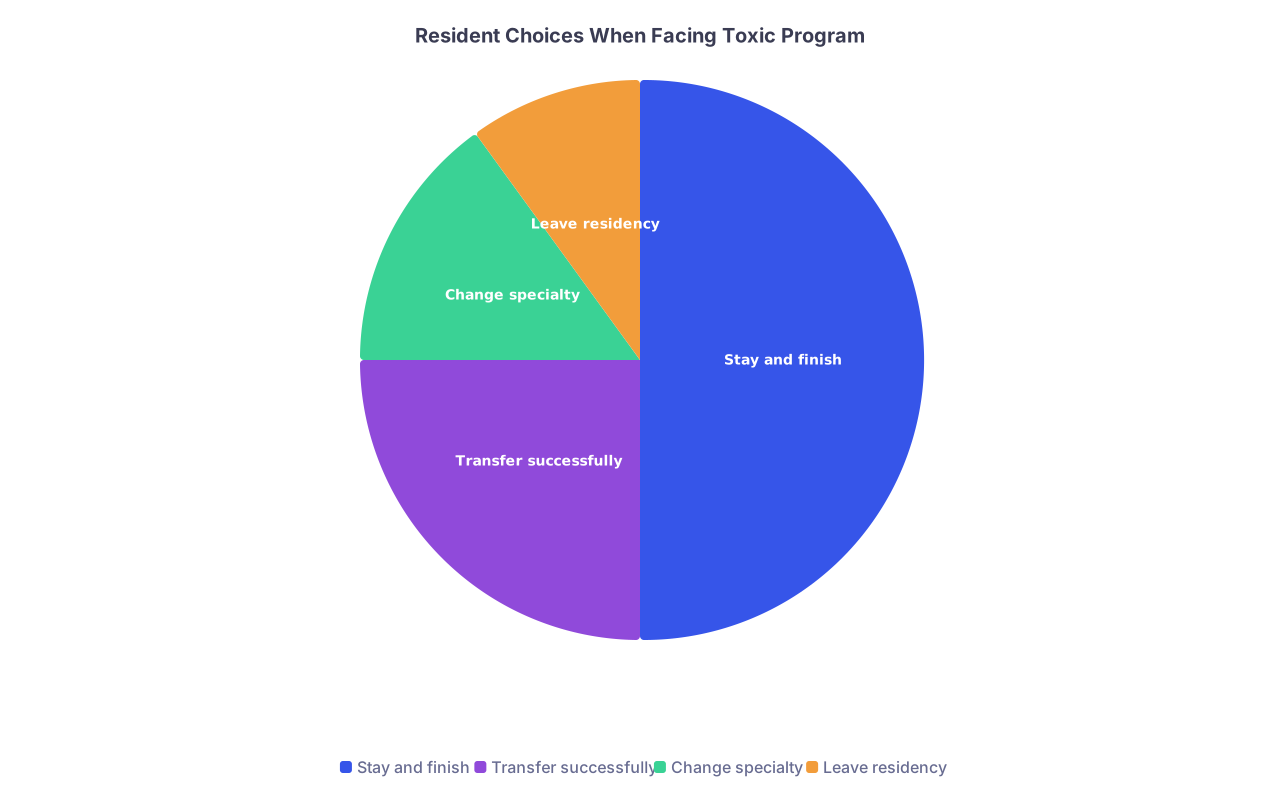
| Category | Value |
|---|---|
| Stay and finish | 50 |
| Transfer successfully | 25 |
| Change specialty | 15 |
| Leave residency | 10 |
FAQs
1. Will transferring ruin my chances at fellowship?
No, not automatically. Fellowship directors care about:
- Your clinical strength
- Letters from people who know your work
- Your story
If your record shows solid performance, and your explanation is coherent and mature (“I transferred from a program that wasn’t a good fit for me educationally, and I’ve thrived since moving here”), many fellowship PDs will accept that. What hurts you more is:
- Unexplained gaps
- Vague “professionalism concerns”
- PDs who won’t support you
2. Can I transfer if I’m already on remediation?
It’s harder, but not impossible. You’ll need:
- Absolute clarity on why you’re on remediation
- Evidence you’re actively working to improve
- At least one strong attending letter saying, “Given support, I believe this resident can be successful”
Some programs will pass. A few will see a resident who’s been mishandled or mismatched. Your honesty and insight in the story you tell become critical.
3. Should I involve a lawyer?
If:
- There’s harassment/discrimination
- You’re being pushed out with obviously retaliatory documentation
- They’re threatening to report you to boards for questionable reasons
Then yes, talking to a lawyer who knows GME/education law is smart. It doesn’t mean you sue. Sometimes a single letter from counsel forces the program to behave more carefully and document accurately.
4. How much should I tell a potential new program about how bad my current one is?
Less than you think. Do not show up to an interview and unload a 20-minute rant. Keep it simple, honest, and controlled:
- “There were persistent mismatches in supervision and culture.”
- “I raised concerns about workload and safety that I felt weren’t adequately addressed.”
- “I realized I needed a program with X, Y, and Z characteristics, which I believe your program offers.”
Answer follow-up questions directly, but don’t spiral into bitterness. They’re assessing your judgment as much as your story.
5. Is it ever better to just put my head down and finish, even in a toxic program?
Sometimes, yes. If:
- You’re close to finishing (late PGY‑3 in IM, for example)
- You’re not being actively harmed or targeted
- You have decent evals and a few strong mentors
- Transfer options are minimal and would set you back significantly
Then gritting your teeth and finishing can be rational. But only if your mental health is stable and you’re not enduring abuse. “Normal misery” is sadly common. Ongoing psychological harm is not a price you’re required to pay.
Key points to carry out of this:
- You’re not crazy for thinking your residency might be toxic; compare your reality against clear red flags and patterns, not vague feelings.
- Protect your health and your record first; transfer or no transfer, you need to come out of this able to practice.
- If you do seek transfer, play it like a quiet political campaign: secure allies, control your narrative, and line up another home before you burn this one down.