The worst residency red flag is not a nasty attending or a bad rotation. It is mixed messaging that makes you feel crazy.
You hear glowing faculty praise on interview day. Then you pull a resident aside and they quietly say, “Run.” You are not overreacting. That tension is information. And if you handle it right, it can save you years of misery.
Let’s walk through what to do when faculty praise and resident complaints do not match.
1. Understand the Game You Just Walked Into
On interview day, you are not seeing the real program. You are seeing the marketing version.
Faculty are often:
- Selling the program
- Protecting its reputation
- Genuinely proud of their academic output / prestige even if the culture is awful
Residents, on the other hand, are living the daily reality:
- Call schedule
- How people talk to them at 3 a.m.
- Who covers when someone is sick
- How administration reacts when something goes wrong
So when you get: “We really care about wellness” from faculty and, two hours later, “Wellness is a joke here” from residents — that is not a misunderstanding. That is a system problem.
Here’s the core truth:
If residents and faculty describe fundamentally different realities, you believe the people who are actually suffering the consequences. The residents.
Not because residents never complain. They do. But a consistent pattern of complaints that contradict official messaging is almost never random.
2. Sort the Complaints: Noise vs Real Red Flags
Before you write off a program or, on the flip side, ignore your gut, you need to sort what you’re hearing.
I’d put resident feedback into three categories:
- Cultural red flags (big deal)
- Structural red flags (also big deal but sometimes negotiable)
- Preference noise (might matter to you, might not)
2.1 Cultural Red Flags – Take These Deadly Seriously
When you hear:
- “They retaliate if you speak up.”
- “You’ll get labeled as ‘difficult’ if you ask for help.”
- “The PD says they’re supportive, but they always side with attendings against residents.”
- “People cry in the stairwell all the time. It’s just what we do.”
These are nuclear-level problems. They override fancy fellowship lists, shiny research, and the name on the badge.
Common cultural red flags I’ve heard across programs:
- Fear culture: residents lower their voice when they talk about leadership, look over their shoulder, or say “Please don’t repeat this.”
- Blame culture: residents describe M&M as public shaming, or say “When something goes wrong, they always look for who to blame, not what went wrong.”
- Abuse normalized: “That attending screams at everyone. You just get used to it.”
- No psychological safety: residents say they avoid calling attendings overnight because “they’ll bite your head off” or “they’ll remember it at evaluation time.”
If you’re hearing these, stop romanticizing the program. I do not care how prestigious it is. This is how people burn out, get depressed, or quit medicine.
2.2 Structural Red Flags – Heavy but Sometimes Tolerable
Structural issues are about workload and system design. Still serious, but more individual.
Examples:
- 28-hour calls rolled into a “night float” schedule that is just as bad
- Chronic understaffing of ancillary services: “We write all the orders, do most of the social work, call all the consults, and chase every scan”
- Consistent duty hour violations that everyone shrugs off
- Coverage disasters: “If one person is out sick, everyone’s life becomes hell for weeks”
You’ll recognize these if you hear phrases like:
- “You’ll survive, but…”
- “It’s do-able, but you have to be careful or you’ll get crushed.”
- “The first year is brutal, second year is only slightly better.”
These are not automatic dealbreakers for everyone. Some residents tolerate high volume and heavy work if the culture is supportive, education is good, and leadership has their back.
But if you pair structural red flags with cultural red flags? That’s a program you seriously consider cutting from your rank list.
2.3 Preference Noise – Filter, Don’t Panic
Then there’s the stuff that might not matter to you:
- “We don’t get a lot of exposure to X procedure” — but you don’t care about that subspecialty
- “We round late” — but you’re a night person and do not care
- “The city is boring” — but you’re fine staying home and studying
- “People mostly keep to themselves” — but you’re introverted and okay with that
Residents are human. They will complain about things that may not affect you.
Your job: identify which complaints are universal (“this place is bad for almost everyone”) vs situational (“this is bad for me, but maybe not for you”).
3. Decode the Mixed Messages in Real Time
You are on the interview day. Faculty are polished. Residents are guarded but leaking truth in side comments.
Here’s how to handle it while you’re still there — not six months later when it’s too late.
3.1 Watch How Residents Talk, Not Just What They Say
Pay attention to:
- Tone shift when leadership walks into the room
- Who does the talking — is it just the chief resident, or do interns speak freely?
- Eye contact, nervous laughter, the “we probably shouldn’t say this” glance
If residents sound upbeat in the group Q&A but then become blunt one-on-one, trust the one-on-one version. That’s the reality.
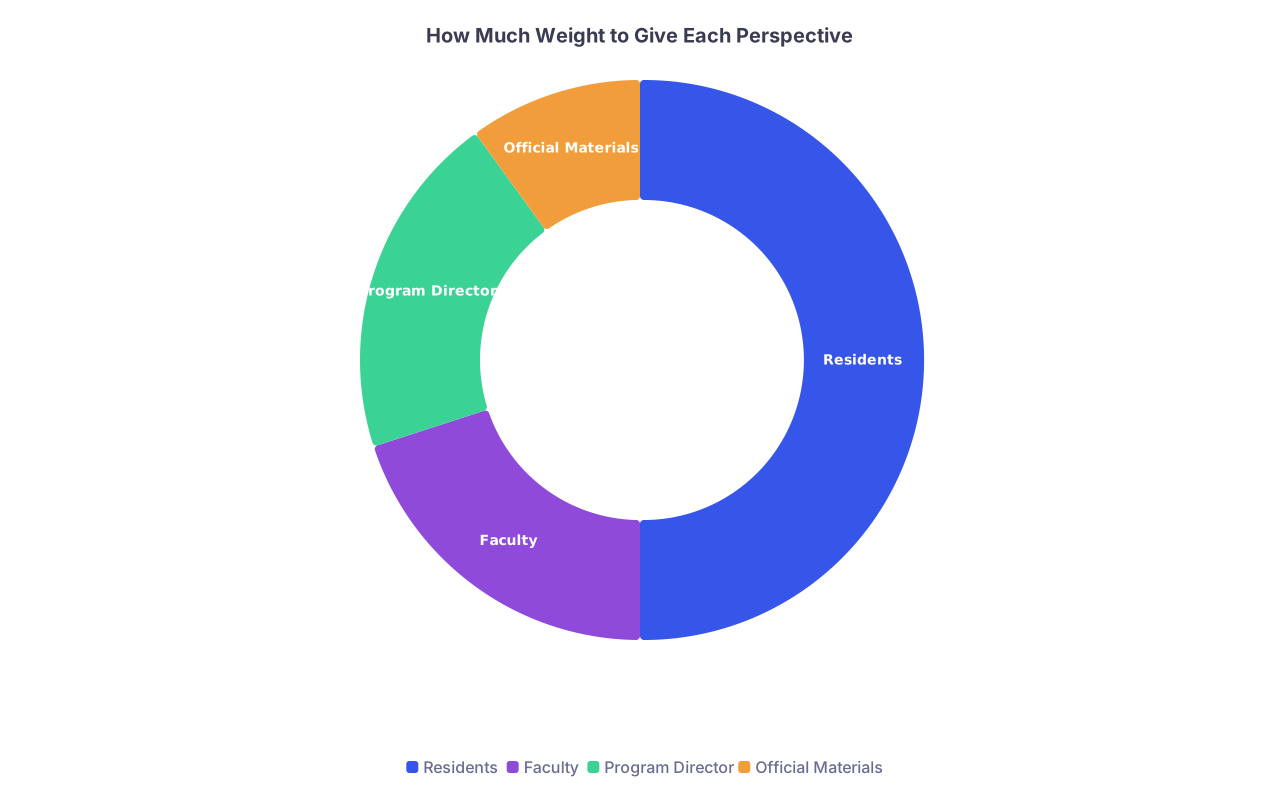
| Category | Value |
|---|---|
| Residents | 50 |
| Faculty | 20 |
| Program Director | 20 |
| Official Materials | 10 |
That chart is how I think about it: residents carry half the weight of your decision. Faculty and PD split the rest. Brochures are decoration.
3.2 Ask Triangulating Questions Instead of Yes/No
If you ask, “Is wellness good here?” you’ll get useless answers.
Better:
To residents:
“When someone is truly struggling — burned out or having a rough life event — what actually happens?”
“In the last year, did anyone go on leave? How was that handled?”
“How often are duty hours really violated, and what happens if you report it?”To faculty / PD:
“Can you give me a recent example of a resident who needed support and how the program responded?”
“What feedback have residents given you in the last couple of years that led to real changes?”
“Are there any rotations you’re actively trying to fix? What’s happening there?”
You’re not looking for perfection. You’re looking for alignment.
If the PD brags “We never have duty hour issues” and the interns tell you “We’re constantly over — we just don’t report it anymore”… that’s a message: they’ve given up bothering.
3.3 Compare Stories, Not Slogans
Faculty love slogans: “We’re a family,” “We’re resident-centered,” “We prioritize education.”
Residents tell stories:
- “Last month, my co-resident’s parent was in the ICU out of state and the chief literally did their calls so they could fly out.”
- Or: “When I got COVID, I had to use PTO and they made me feel guilty about the coverage.”
Stories beat slogans every time. If the stories do not match the slogans, believe the stories.
4. Use Back-Channel Data: What Residents Will Not Say on Zoom
You cannot rely only on interview day. Residents are often watched, or at least feel watched.
You need off-the-grid intel.
4.1 Strategic Post-Interview Outreach
After your interview, email a couple of residents directly. Not the chief. Not the “resident ambassador” who gave the official tour.
Pick:
- A PGY-1 or PGY-2 in your track of interest
- Someone who looked a little tired but honest on Zoom
- If possible, a graduate now in fellowship who is listed on their website
What you send:
“Hi Dr. X,
I really appreciated hearing from you during the interview day for [Program]. I’m ranking programs soon and wanted to ask a few candid questions about the resident experience. If you’re willing, I’d love to hear your honest take (even off the record) — especially on how responsive leadership is to concerns, and how sustainable the workload feels.
I completely understand if you’re busy, but even a quick response would help.
Best,
[Your Name]”
You’d be surprised how often people reply with, “Off the record…” and then tell you what you really need to know.
4.2 Read Between the Lines of What They Avoid
If a resident:
- Dodges every question about a specific rotation
- Says “It’s… fine” and then quickly changes the subject
- Keeps saying “It’s good training” but never says “I’m glad I came here”
That is not nothing. That’s discomfort.
When residents love their program, they gush. They name names.
“When I was having a tough time, Dr. Smith literally checked in every week.”
“I’d choose this place again — no question.”
Silence around support is itself a signal.
5. Put Faculty Praise in Its Correct Place
Faculty praise by itself is not evil. It’s just incomplete. You need to interpret it right.
Typical faculty lines and how to translate them:
“Our residents are like colleagues.”
Often means: high autonomy, maybe under-supervised. Great for confident seniors, scary for shaky interns.“We expect a lot, but our graduates are very strong.”
Usually: workload is heavy, support might be thin. Training by fire.“We take feedback seriously — we are constantly improving.”
Ask: “Can you give a concrete example from the last 12–18 months?” If they cannot, that sentence was air.“Residents never have trouble getting fellowships.”
Good academically, says nothing about whether you’ll be miserable during those three to seven years.
The key: faculty can tell you about reputation, case mix, fellowship placement, research infrastructure. Residents tell you about whether you’ll still like medicine when you finish.
You need both, but if they conflict, you know who wins.
6. When the Stories Clash: Deciding What to Do
Let’s do some specific scenarios. This is where people freeze.
6.1 Scenario A: Faculty Glowing, Residents Clearly Miserable
You hear:
Faculty: “We’re one big happy family, and the residents love it here.”
Residents (quietly): “Do not rank this place highly. We’re all so burned out.”
Action plan:
- Drop this program significantly on your list unless you have almost no interviews.
- If it’s your home program and you know these residents and trust them, seriously consider not ranking it at all if they are unanimous.
- If you’re still tempted (“But the prestige…”), write down exactly what you’re sacrificing: your mental health, your relationships, your ability to enjoy the specialty.
You are not being dramatic. You’re being realistic.
6.2 Scenario B: Residents Split, Faculty Detached but Not Hostile
Faculty: friendly but generic, not particularly invested.
Residents: some say “It’s fine, I’m happy,” others say “I wish I had ranked somewhere else.”
Action plan:
- Identify what the unhappy group has in common — specific track, one malignant rotation, personal circumstances.
- Ask targeted follow-up: “What would have made you happier here? Different city? Different culture? Different workload?”
- Decide whether their reasons align with your personality and priorities.
This is a “yellow light” program. Not automatic no. But not blind yes either.
6.3 Scenario C: Residents Praise Culture but Complain About Workload, Faculty Honest
Faculty: “We’re busy. You’ll work hard. But we try to support you.”
Residents: “We’re tired but we have each other, and leadership does listen when things are bad.”
Action plan:
- Ask yourself honestly how you handle stress when you’re physically tired but emotionally supported.
- Consider your life outside the hospital: dependents, health issues, financial stress. Heavy programs amplify all of that.
- If you’re young, fairly resilient, and hungry for training volume, this can be a top choice. High workload with good culture is often net positive.
This is the kind of “hard but worth it” program that produces strong, not broken, graduates.
7. Use Data, Not Just Vibes
You should never base everything on one awkward comment. You need pattern recognition.
Here’s a simple framework. Score each program from 1–5 in these categories based on what you heard and saw:
| Factor | 1 (Bad) | 3 (Mixed) | 5 (Excellent) |
|---|---|---|---|
| Resident Morale | |||
| Leadership Responsiveness | |||
| Culture / Psychological Safety | |||
| Workload Sustainability | |||
| Educational Quality |
Then actually fill it out for each program right after your interview day (same evening, not two weeks later when everything blurs).
Patterns will jump out:
- Great education, awful morale → red flag
- Great morale, mediocre education → could still be fine, especially in less competitive specialties
- Mixed everything → rank lower unless you have few options
This pulls you out of pure emotion and fear of “wasting” a fancy name.
8. Special Situations People Don’t Talk About Openly
8.1 What If Residents Say “Don’t Quote Me on This”?
That means they’re scared. Which itself is damning.
If residents at multiple levels (interns, seniors, chiefs) all say, “Please don’t repeat this” — that tells you the culture punishes honesty. And that’s on leadership, not the residents.
You treat that as a major red flag. Rank accordingly.
8.2 What If I Have Only a Few Interviews and One Is Clearly Toxic?
I’ve seen this: IMG or low-step applicant with 3–4 interviews, one of which is obviously malignant.
Here’s the harsh truth:
- You can rank a bad program lower but still rank it. Matching into a bad program is often better than not matching at all if you have a realistic plan to transfer or re-apply later.
- But if the program sounds truly unsafe — chronic duty hour abuse, zero supervision, retaliatory leadership — you are allowed to decide, “I would rather not match than go there.”
That is personal. You weigh your risk tolerance, finances, visa needs, family situation. Still, do not gaslight yourself: if it seems bad, it probably is.
8.3 What If Faculty Are Amazing Mentors but Residents Are Miserable?
Classic academic trap.
You think: “I’ll just stick close to the great faculty. I won’t get dragged down by the culture.”
You will. You cannot out-mentor a toxic system. No matter how great that one attending is, they are not on every call shift with you, not on every ward month, not in every evaluation meeting.
If you’re hearing resident complaints about the program as a whole, do not let a couple of superstar mentors blind you.
9. How to Trust Your Gut Without Being Reckless
Your nervous system usually picks up on problems before your rational brain does.
If you leave a Zoom or in-person interview with:
- A heavy, anxious feeling you can’t shake
- An odd sense of “something is off” even if you can’t articulate it
- Relief when the day is over, more than with other programs
That’s data. Not perfect. But data.
Balance that with:
- Match statistics for your specialty
- Your backup options (prelim year, re-applying, different specialty)
- Non-negotiables in your life (location, family, health)
Make a rank list that reflects your actual experience, not what you think you’re “supposed” to prioritize.
10. One Reality Check: There Is No Perfect Program
Every program has flaws. You’re not hunting for perfection; you’re hunting for alignment and safety.
You can live with:
- A clunky EMR
- One bad rotation everyone hates but survives
- Mediocre food
- A city that’s not your dream location for three years
You should not accept:
- Systematic disrespect
- Fear of speaking up
- Leadership that lies to your face
- Residents who look hollowed out and only talk about “survival”
When faculty praise and resident complaints conflict, that’s your cue to move from passive applicant to investigator.
Stop assuming everyone is telling the same truth. Assume you’re picking between different truths, and the one you’ll actually live is the residents’.
Today, pick one program you’ve already interviewed at and do this: open a blank document and write two honest paragraphs — “What faculty said about this place” and “What residents showed me about this place.” Then ask yourself which version you’d be willing to wake up in every day for the next 3–7 years. Rank accordingly.