
You Are Here
It’s January. ERAS season is either over or mostly done, and you’re sitting with the reality of your numbers and your file.
Your Step score is below the average for your specialty. Your class rank is nothing to brag about. You might have a leave of absence, a failed course, a failed board exam, or a professionalism comment that still makes you sweat when you think about it.
Program websites talk about “holistic review,” but you’ve seen the data. You know what you’re up against.
This is for you if:
- You have 1–3 real red flags (failures, leaves, probation, big gaps).
- Your overall portfolio is weak or middle-of-the-pack at best.
- You’re trying to figure out if you should apply again, switch specialties, do a prelim year, get a research position, or walk away.
Let’s deal with it directly. No fluff.
Step 1: Get Brutally Clear on Your Actual Red Flags
You cannot fix what you won’t name. Vague “my app is kinda weak” is useless. You need to know exactly what PDs see as problems.
Typical red flags:
- Failed Step/COMLEX attempt
- Multiple course/clerkship failures or repeats
- Leave of absence (especially unaddressed)
- Probation or professionalism citations
- Large unexplained gaps
- Very low scores for chosen specialty
- Very few or weak letters, especially from US institutions
- For IMGs: lack of US clinical experience or older YOG (>5 years)
Do this audit on yourself:
- Open your ERAS CV / MSPE / transcript.
- For each section, ask: “Would a busy PD pause and worry here?”
- Write down each specific issue in one line:
- “Step 1 first attempt fail, passed on second with 214.”
- “LOA MS2 spring – psychiatric hospitalization.”
- “Remediated internal medicine clerkship – initial grade fail.”
You want a list that fits on half a page. If you find 10+ “issues,” you don’t have 10 problems. You have maybe 3 major problems and a style issue (perfectionism) that’s making you count everything. Focus on what PDs actually care about.
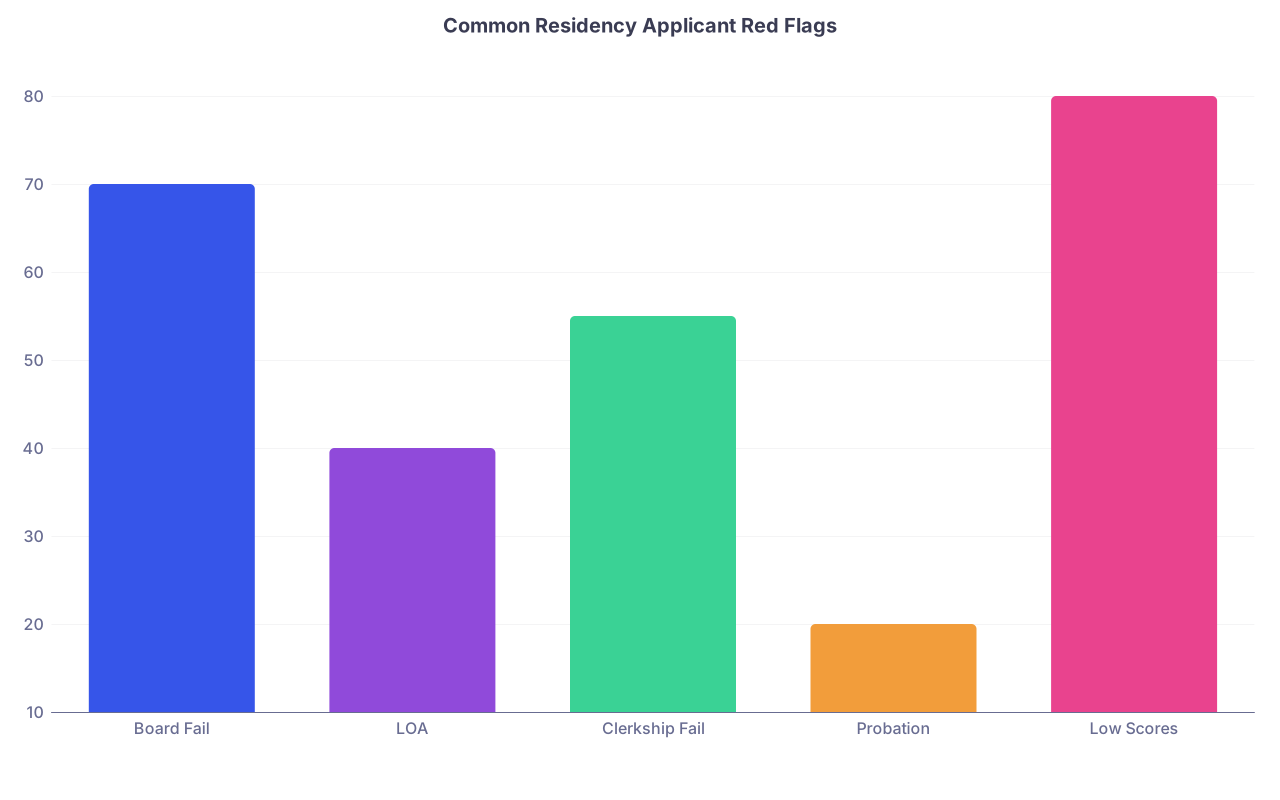
| Category | Value |
|---|---|
| Board Fail | 70 |
| LOA | 40 |
| Clerkship Fail | 55 |
| Probation | 20 |
| Low Scores | 80 |
Step 2: Separate Fixable vs Permanent Problems
Some things you can’t erase. Some you can partially or fully offset.
Permanent or mostly permanent:
- Prior Step/COMLEX failure
- Probation label in MSPE
- Big professionalism incident
- Older YOG (for IMGs especially)
Modifiable or improvable:
- Lack of strong US LORs
- Limited research
- Weak specialty exposure
- Modestly low Step 2 (you can outshine with performance + letters)
- No story/context for LOA, gaps, or failures
You are not trying to “make it disappear.” PDs are not idiots. You’re doing two things:
- Reduce the perceived risk you bring.
- Increase evidence that your current performance is stable, reliable, and trending up.
Think about red flags in terms of risk categories:
| Red Flag Type | PD Main Worry |
|---|---|
| Board exam failure | Will fail boards again |
| LOA for health | Will need time off |
| Professionalism issue | Will be disruptive |
| Repeated clerkship | Cannot handle workload |
| No US LORs (IMG) | Unknown performance |
Your entire strategy is: “Prove that worry is outdated.”
Step 3: Decide If Your Target Specialty Still Makes Sense
Harsh but necessary: some combinations of red flags + specialty are essentially dead ends. Not absolutely impossible, but the odds are so low you’re burning years for less than a 5–10% chance.
Obvious “hard mode” specialties:
- Dermatology
- Plastics
- Ortho
- ENT
- Neurosurgery
- Integrated vascular / CT
- Radiation oncology (weird market, not just scores)
- Some competitive EM markets now
If you have:
- A failed Step, plus
- Low-ish Step 2, plus
- No elite research or connections
…trying to brute-force your way into derm is not “grit.” It’s denial.
You need a realistic matrix:
| Specialty Group | Competitiveness | Tolerance for Red Flags |
|---|---|---|
| Derm, Ortho, ENT, Plastics | Very High | Extremely low |
| EM, Anesthesia, Gen Surg | High | Low–moderate |
| IM, Peds, Psych | Moderate | Moderate |
| FM, PM&R, Neuro, Path | Variable by region | Moderate–higher |
If your heart is set on a competitive field and your app is already wounded, you need a plan B specialty now, not after three failed cycles.
A common path that actually works:
- Pivot to IM / FM / Psych / Neuro / PM&R depending on your interests and strengths.
- Get in, excel, then if you still care about something like cards, GI, sports, etc., chase it through fellowship.
Do not anchor on the idea that “the right personal statement and a good interview” will override deep structural weaknesses for a hyper-competitive specialty. That’s fantasy.
Step 4: Make a 1–2 Year Rehabilitation Plan (Not a 10-Year Penance)
If you didn’t match or you’re early and see disaster coming, you probably need a rehab year (or two). That’s not a life sentence. It’s a focused project.
Most realistic rehab options:
Research Year (Paid or Unpaid)
- Stronger if tied to a residency department you want (e.g., IM research at a mid-tier academic program).
- Goal: multiple abstracts/posters, maybe a paper, strong letter from a PI.
- Best for: IM, Neuro, Psych, Path, some Surg subs.
Non-ACGME Clinical Job / Preliminary Year
- Prelim medicine or surgery spot you can actually survive.
- Or a well-structured non-ACGME clinical fellowship (hospitalist scholar, research fellow with clinical duties).
- Goal: “This person functions like an intern and doesn’t crumble.”
Extra Clinical Rotations with LOR Focus
- Especially for IMGs or people with weak MS3 evals.
- Goal: at least 2–3 powerful letters that say you’re dependable, teachable, and safe.
Academic Enhancement (rarely is this your main play)
- Extra coursework, MPH, etc.
- Helps only if coupled with clear clinical and board performance that has improved.
You need an actual written plan:
Year 1 example (for someone with Step 1 fail, Step 2 215, no match in IM):
- March–April: aggressively email IM program research coordinators for a 1-year research job.
- May–June: secure a position, move, show up early, be the “yes” person.
- July–December: push for clinic time with attendings, ask for specific feedback, document improvement.
- October–January: ask 2–3 attendings and your PI for letters once you’ve proven consistency.
- ERAS next season: apply broadly in IM and maybe FM with updated letters and a clear explanation.

| Step | Description |
|---|---|
| Step 1 | Did not match |
| Step 2 | Self audit of red flags |
| Step 3 | Choose realistic specialty |
| Step 4 | Secure research or prelim year |
| Step 5 | Earn strong LORs |
| Step 6 | Reapply broadly |
Step 5: How to Talk About Your Red Flags Without Digging the Hole Deeper
This part makes or breaks you. I’ve seen smart people crush themselves here by oversharing, blaming, or rambling.
You need a simple template for any red-flag explanation—PS, interview, or email.
Use this 4-step structure:
- Name it plainly.
- Brief context.
- What changed / what you did about it.
- Evidence of current stability and performance.
Example – Step failure:
“I failed Step 1 on my first attempt. At the time, I was dealing with untreated depression and poor study structure. I took a formal leave, engaged in therapy, and worked with an academic coach to rebuild my habits. Since then, I passed Step 1 on the second attempt and Step 2 with a 227, and my final year clerkships have all been passes with strong clinical evaluations. I’m now consistent with my studying and self-care, and my performance over the last two years reflects that.”
Quick, factual, mature. No dramatics.
Bad ways to talk about red flags:
- Blaming school, attendings, or “toxic culture.”
- Long emotional stories that never get to “and now I function well.”
- Pretending it’s no big deal when it clearly is.
- Being vague: “I had some personal issues” with no sense of resolution.
You are not auditioning for victim of the year. You’re trying to be the person the PD feels safe putting on nights in July.
Step 6: If You’re Reapplying After a No-Match
This is a special kind of psychological beatdown. You’re embarrassed, family is asking questions, classmates moved on. Fine. You still have to make decisions.
First, figure out which of these buckets you’re in:
- You got some interviews but few/none ranks.
- You got zero interviews.
- You panicked-applied too late, too narrow, or to the wrong programs.
Each needs a different response.
If you got some interviews:
- Programs saw enough to consider you.
- Your red flags are not disqualifying by themselves.
- Issues might be:
- Interview skills
- Personality fit
- Overly competitive list
- Weak letters
You fix this with:
- Honest feedback from someone senior who can run a mock interview and not sugarcoat things.
- Widening your application list next cycle to include more community and lower-tier academic programs.
- Beefing up letters and continuity with mentors.
If you got zero interviews:
- Your numbers or red flags filtered you out.
- Or you applied so late and so weirdly that you never cleared the initial screen.
Concrete steps:
- Talk to at least one PD or APD who will review your app line-by-line and tell you what screams “auto-reject.”
- Strongly consider:
- Changing specialties.
- Adding a research/clinical year with targeted LORs.
- Adjusting geographic expectations drastically.
And yes, if you applied EM-only last cycle with a shaky portfolio, you probably need to pivot specialties. The market has changed and EM is not the safety it used to be.
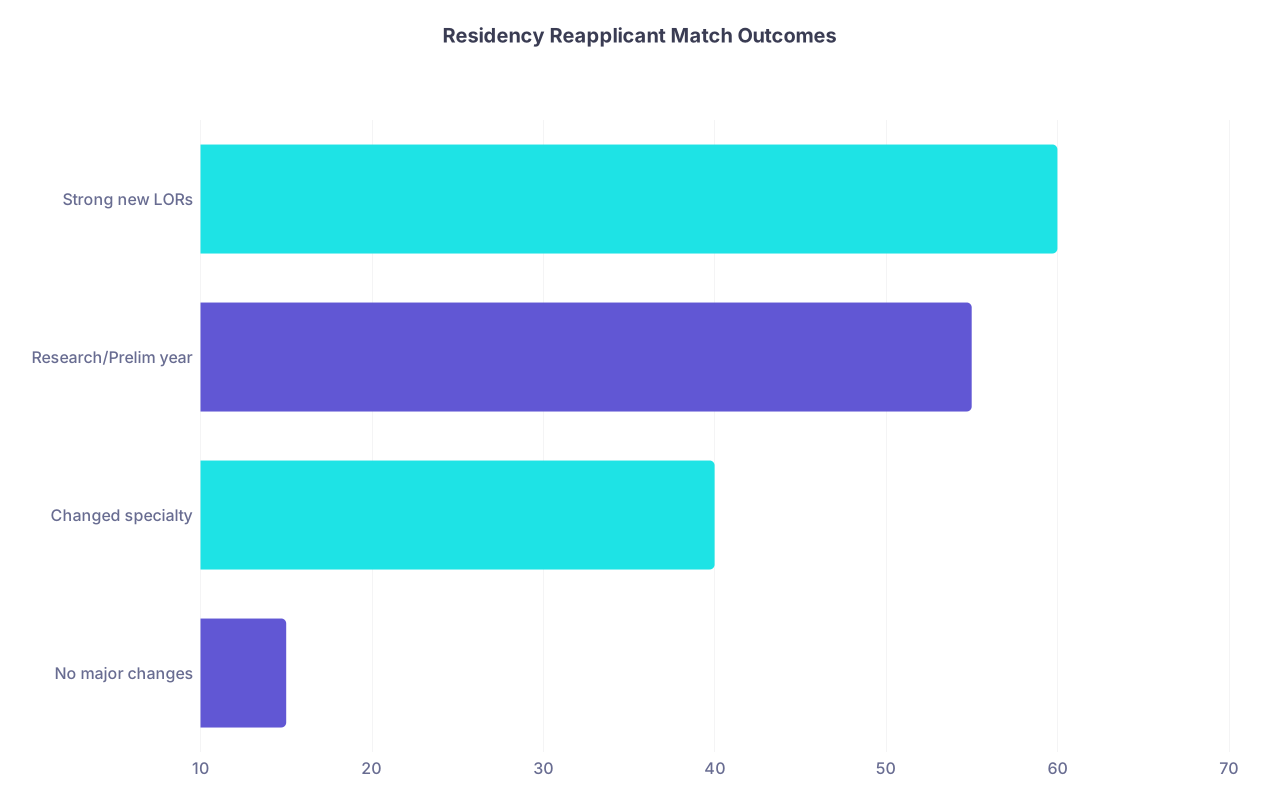
| Category | Value |
|---|---|
| No major changes | 15 |
| Changed specialty | 40 |
| Research/Prelim year | 55 |
| Strong new LORs | 60 |
Step 7: Strategic Program Targeting When You’re a Risky Applicant
If you have a weaker file, your target list cannot look like your classmates’ lists. You don’t have the same margin.
You look for:
- Community programs
- Newer programs (but not dysfunctional ones)
- Programs with a history of taking:
- DOs
- IMGs
- Prior fails
- Non-traditional paths
Clues that a program might be workable:
- Their current residents are a mix of DO/MD/IMG.
- They explicitly mention “we consider applicants with prior challenges on a case-by-case basis.”
- They invite you to send an email if you have questions about eligibility.
Do not waste time cold-emailing 200 PDs the same generic message. That gets deleted.
Instead:
- Identify 20–40 programs where your profile is at least within sight of their current residents.
- Send targeted, short emails to the PC or PD:
- Who you are.
- Your key strengths.
- One-liner acknowledging in general that you’ve had prior challenges and you’d be grateful for consideration if they review the full application.
And then stop. No begging. No 5-paragraph apology. You want to be on their radar, not on their nerves.

Step 8: Know When to Stop or Pivot Completely
Hard topic. But pretending everyone should keep applying forever is cruel.
There are times when I tell people: you should strongly consider walking away from the match treadmill or redefining your path in medicine.
Some red-flag stacks that are very tough to overcome:
- Multiple board failures with still-borderline passing scores.
- Repeated professionalism violations.
- Repeated failures in high-stakes clinical settings despite remediation.
- Very long gaps (5–10+ years) with no recent clinical activity and no compelling reason.
If that’s you, options that still use your training:
- Non-physician clinical roles (NP/PA routes if you’re early enough in your career arc).
- Clinical research coordinator or manager (especially in academic centers).
- Medical education (simulation centers, curriculum support, standardized patient programs).
- Pharma / biotech (medical writing, clinical operations, regulatory).
- Health informatics, consulting, quality improvement roles.
Are these equivalent to being an attending in your dream specialty? No. But they might be a much better outcome than spending 5–7 more years scraping for SOAP prelim spots and living in chronic dread.
There’s a difference between persistence and banging your head against a wall.

Step 9: Mental Health While You’re Carrying Red Flags
Carrying a scarlet letter through medical training is brutal. You compare yourself to everyone. You assume every rejection is because of that one failure or that one line in the MSPE.
Two things to remember:
Programs care a lot about whether your current functioning is stable.
- If your red flag is tied to untreated mental health issues, your best “fix” is actually staying in treatment, showing consistency, and not self-destructing again.
- If you burn yourself out trying to “redeem” your record, you’re recreating the exact problem that got you here.
You cannot let shame run the show.
- Shame makes you either over-explain everything or hide from opportunities.
- Neither helps you match.
Get at least one person in your corner who is not family:
- Therapist
- Trusted faculty
- Mentor from a different department who doesn’t control your fate
Someone who can say, “Stop. This plan is insane,” when you decide to apply to 80 derm programs with a Step failure and call it “manifestation.”

FAQ (Exactly 3 Questions)
1. Should I ever hide a red flag if ERAS doesn’t force me to disclose it?
Do not lie. Do not falsify. That kills careers. But there are situations where you don’t need to wave a giant banner about minor issues.
If something is:
- Not in your MSPE, transcript, or official record
- Not requested explicitly on ERAS or by the program
…you don’t need to pre-emptively confess every minor stumble. Focus on problems that are clearly visible in your file and that PDs will actually question. Answer those honestly, cleanly, and briefly. But do not create new doubts where none existed.
2. Is it worth doing an unpaid research year just to “improve my chances”?
Sometimes. Often not.
If:
- The lab is loosely connected to your target department.
- You’ll mostly be cleaning freezers and entering data.
- There’s no path to strong clinical LORs.
Then it’s probably not the best use of a year.
On the other hand, if:
- The PI is embedded in the residency department.
- Residents and attendings know and work with that lab.
- The PI is willing to help you get clinic time, teaching evals, and letters.
Then one year there can fundamentally change your application trajectory. The key: it must generate relationships and evidence of clinical function, not just a PubMed line.
3. How many cycles should I realistically apply before calling it quits?
If after two full, strategic cycles—with real changes between them, not just “more personal statements”—you still have:
- Few or no interviews, and
- No PDs or mentors telling you “you’re close; try this one more time,”
…you should very seriously consider either:
- Changing specialties to a more realistic one, or
- Exiting the match process and pivoting to another role in or near medicine.
A third or fourth cycle can be reasonable if you’re clearly progressing (strong prelim year, better scores, new letters) and your mentors are saying, “You’re competitive now; this is worth it.” But endlessly reapplying with the same or slightly tweaked portfolio is not perseverance. It’s self-harm.
Key Takeaways
- Name your red flags clearly, then build a 1–2 year plan that shows real, documented improvement and stability.
- Be brutally realistic about specialty choice and program targeting; your list should not look like your clean-file classmates’ lists.
- Explain your past issues briefly and maturely, then spend most of your energy proving who you are now, not apologizing for who you were.