
The fantasy that you can just “avoid red flag programs” collapses fast when you’re trapped in one city.
If you’re geographically locked—partner’s job, kids in school, immigration, sick parents—you do not have the luxury Reddit assumes you do. You cannot “just apply broadly around the country.” You’re staring at three programs in driving range, and two of them have reputations that make your classmates wince.
So the real question is not “How do I avoid red flags?”
It’s: How do I handle red flags when leaving isn’t an option?
Let’s walk through it like adults who actually live in the real world.
1. Get brutally clear on why you’re geographically tied
Before we talk strategy, you need to know how hard your constraint actually is. There’s “I prefer this city” and there’s “I literally can’t move.” Those are not the same.
Common scenarios I see:
- Partner’s career is locked to a metro area (big law, tech, military base, green card sponsor).
- You’re a caregiver for a medically fragile parent or sibling.
- Immigration/visa issues tie you to a particular institution or region.
- Shared custody of a child within a specific county/state.
- Financial reality: can’t afford a move, can’t take spouse out of their job.
Write down, in one line, what’s true for you. Then assign a hardness level:
| Level | Description | Flexibility |
|---|---|---|
| 1 | Strong preference (friends, familiarity) | Could move if needed |
| 2 | Family / relationship reasons, but could adjust with pain | Hard but possible |
| 3 | Legal, immigration, custody, or critical caregiving | Essentially non‑negotiable |
If you’re level 3, your game is optimize within constraint. You treat this like arranging the least-bad version of something you cannot fully control.
If you’re level 1–2, you still need to act like you might have to leave. That means: take red flags seriously, because you might decide later that staying isn’t worth it.
2. Red flags when you can't just walk away: which ones really matter?
“Red flag” gets thrown around too loosely. Some “red flags” are just personality clashes. Others will wreck your mental health or your career.
When you’re stuck in one city, you need a triage mindset.
Tier 1: Deal-breaker red flags (even if you’re stuck)
These are the ones that, if confirmed, you should only accept if the alternative is no training at all—and even then, you should have a contingency plan.
Systemic abuse / bullying protected by leadership
Not just one malignant attending. I mean: multiple residents independently say, “If X doesn’t like you, they’ll block your fellowship,” or “PD knows but defends them.”
That culture rarely changes.Chronic duty hour violations with intentional falsification
Not “we’re busy sometimes.” I mean: residents are told how to lie. Retaliation if they report. This is a safety issue—for you and patients.Consistently terrible board pass rates
One bad year is noise. A pattern is a failure of educational structure. If the program can’t get people across the finish line, that’s not “just tough training.”ACGME citations that keep repeating
Check if there are public reports or whispered history of probation. A single past citation that’s been fixed? Fine. Recurrent? Different story.
If two or more of those are strongly present and current residents are warning you off, you should seriously consider:
- Delaying graduation and doing a research year to buy time.
- Changing specialty (to something with more local options or less competitive).
- Reconsidering geographic rigidity (hard conversation, but real).
Tier 2: Manageable-but-serious red flags
These are ugly, but you can sometimes survive them with strategy:
- Understaffed / high service load but residents still pass boards and match decently.
- Weak didactics but good self-starters still thrive.
- Mediocre fellowship match with few big-name affiliations.
- High turnover of leadership creating instability.
If you are city-locked, you’re not trying to find perfection. You’re trying to understand: Can I survive this and still become a competent physician? Often, the answer is yes—if you prepare for it.
Tier 3: Noise / Reddit drama
Stuff that sounds scary but is often overblown:
- “They work hard there” (this is residency).
- “One senior is a jerk” (that happens everywhere).
- “It’s not as prestigious as Program X” (your patients and most fellowship directors won’t care as much as you think).
When you’re constrained, you cannot treat every annoyance as equivalent to a true red flag. You’ll burn your limited options for the wrong reasons.
3. How to actually evaluate programs in YOUR city (not in theory)
You don’t have 40 interviews. You might have 3. Or 1. So you cannot afford a superficial read.
You need to do three things: collect real data, cross-check it, then pressure test it.
Step 1: Data collection – what you ask, what you look up
Do your homework before you show up to interview, so you’re not wasting time with basic questions.
Things to find or ask:
- Board pass rates for the last 3–5 years.
- Fellowship placement lists (and which fellowships are internal vs external).
- Resident retention: how many leave before finishing?
- ACGME status: any probation, recent citations, major changes.
- Leadership stability: how long has the PD, chair, and core faculty been in place?
Then, during interviews, ask residents directly:
- “If you had to do it again, would you rank this program first again? Why or why not?”
- “What’s changed for the better in the last year? What’s gotten worse?”
- “Does leadership listen when residents raise concerns?”
- “Can you tell me about a resident who struggled here and what happened?”
Watch for how fast they answer, the eye contact, and who’s actually speaking. One loud PGY-3 doing all the talking while everyone else stares at the floor? That tells you something.
Step 2: Cross-check sources
Do not rely on:
- One disgruntled anonymous review.
- One overly cheerful chief who’s obviously performing for applicants.
You want at least three independent viewpoints:
- Current residents (ideally PGY-2 or PGY-3, not just chiefs).
- Recent grads (LinkedIn, alumni connections from your med school).
- Your school’s home faculty or advisors who know local politics.
If two different residents + one faculty member all hint at the same serious problem (e.g., “PD plays favorites,” “They’ll work you nonstop and ignore complaints”), assume that problem is real.
Step 3: Pressure test the program face-to-face
On interview day and second looks, you’re not just there to smile and answer “tell me about yourself.” You’re testing their honesty.
Ask leadership something mildly uncomfortable but professional:
- “I’ve heard the program had some ACGME concerns a few years ago. What changes have you made since then?”
- “Residents mentioned work has been especially heavy this year. How are you addressing that?”
- “What made your last resident leave the program, and what did you learn from it?”
Good programs will give a straight, specific answer. Bad programs will vague-talk you to death or become defensive.
4. Strategy when your city gives you 1–3 options (and some are sketchy)
Here’s where most people freeze: “But I have to stay here, and this program is bad. What do I do?”
Let’s break by concrete scenario.
Scenario A: One decent program, one obviously problematic, one unknown
Rank list strategy:
Do everything in your power to match at the decent one.
That means: signal interest, interview well, do an away or sub‑I if possible, meet the PD, follow up (professionally).Investigate the “unknown” as hard as you can—sometimes it’s just under the radar, not terrible.
Treat the problematic one as emergency backup only. Rank it last, and only if the alternative is going unmatched and you’re not willing/able to reapply.
If you’re geographically tied but somewhat flexible, you might draw a radius: “I can commute 60–90 minutes if I absolutely have to.” That can surface community programs just outside the city you’d never considered.
Scenario B: Only one program in commuting distance, and it has real red flags
This is where it gets painful. You realistically have four choices:
- Apply and hope the red flag is either exaggerated or survivable.
- Change specialties to one with more nearby options or less competitiveness.
- Take a research or prelim year locally to buy time and reapply (internal medicine prelim, surgery prelim, research position).
- Reconsider your geographic lock with your partner/family—this often means very hard conversations and trade-offs.
If you go with option 1 (you apply anyway), then your plan has to include:
- Building strong internal support early (mentors, allies).
- Shielding yourself from the worst structural issues (more on that below).
- A clear escape hatching: “If X and Y happen by month 6, I will start planning a transfer or pivot.”
Scenario C: You’re an international grad or weaker applicant and can’t be picky
If matching anywhere in your city is already a stretch, avoid magical thinking about cherry-picking programs. Your priority is to match, but you’re not powerless.
Your playbook:
- Apply to all plausible programs in your radius, including smaller community ones.
- Reach out early for observerships, research, or shadowing to show commitment.
- Once you match (even at a place with red flags), your focus becomes: protect your license, pass your boards, build a CV that lets you leave if needed.
Are you in the ideal environment? No. Are you trapped forever? Also no—if you’re intentional.
5. Surviving and succeeding in a red-flagged program you can’t leave
Let’s say the worst happens: you match at the place everyone whispered about.
You’re not doomed, but you are going to have to be deliberate. I’ve watched residents in tough programs carve out very solid careers by being strategic instead of just bitter.
Rule 1: Identify allies fast
Week 1–4, you should be quietly mapping the human terrain:
- Which attendings actually like to teach?
- Which senior residents are fair and competent?
- Who has a history of advocating for residents?
You’re looking for 2–3 people who can eventually:
- Write strong letters.
- Protect you when it matters (“I’ll talk to the PD about this”).
- Give you honest feedback before you blow something up.
Rule 2: Stay aggressively competent on the basics
Bad programs often have chaos, political games, and poor structure. The residents who still thrive there do three unglamorous things:
- They’re reliable with scut and documentation.
- They study consistently and early for in-service/boards.
- They avoid unnecessary drama.
You do not have to be a saint. But you cannot be the person missing labs, losing pages, or constantly late. In a malignant environment, those residents get eaten alive.
Rule 3: Build an external safety net
Relying solely on your program in a red-flag environment is like locking all your money in a company that might go bankrupt.
Create external anchors:
- Join national societies in your specialty (ACP, ACOG, ACC, etc.).
- Find an outside mentor—someone at another institution in the same city or even virtually.
- Present at local/regional meetings to get your name outside your program.
If your PD or malignant attending tries to block you, having outside people who know your work makes a big difference.
Rule 4: Document serious issues
If your program truly has dangerous or abusive behavior:
- Keep a contemporaneous log: dates, times, what was said/done, who was present.
- Save relevant emails or messages (within your institution’s policies).
- Use formal reporting channels if needed—but do it thoughtfully, and ideally after talking with a trusted mentor who knows internal politics.
I’m not saying “sue everyone.” I’m saying: if things really go off the rails, future PDs, fellowship directors, or even the board will take your explanation more seriously when it’s backed by specifics, not just “my program was bad.”
Rule 5: Decide early if you’re going to transfer vs. stick it out
Transfer is possible, but not common, and it’s messy. It’s easier in:
- Internal medicine
- Family med
- Psych
- Pediatrics
Harder in:
- Surgical fields
- Competitive subspecialties
If by the end of PGY-1 you’re seeing:
- No improvement in flag issues you already knew about.
- New, more serious concerns (retaliation, unsafe staffing, repeated duty hour fraud).
- Worsening mental or physical health despite usual coping strategies.
Then you should at least explore transfer options:
- Quietly reach out to PDs at nearby programs with: CV, explanation, and current PD letter if possible.
- Talk to your GME office about policy.
- Be realistic: you may have to repeat a year or switch specialties.
Sometimes, though, the right move is: finish, get your boards, leave for fellowship or a different job, and never look back. That’s not weakness. It’s triage.
6. Using data and timelines to stay in control
When the emotional load is high—family pressure, bad program rumor mill—you need structure so you don’t just spiral.
Here’s a simple decision timeline:
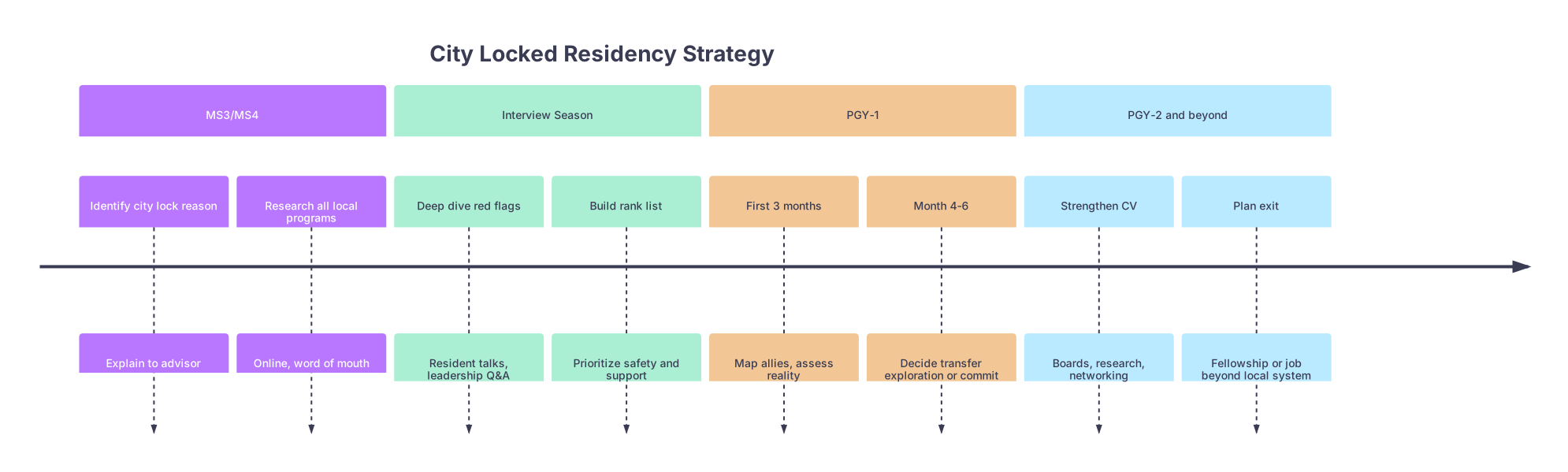
| Period | Event |
|---|---|
| MS3/MS4 - Identify city lock reason | Explain to advisor |
| MS3/MS4 - Research all local programs | Online, word of mouth |
| Interview Season - Deep dive red flags | Resident talks, leadership Q&A |
| Interview Season - Build rank list | Prioritize safety and support |
| PGY-1 - First 3 months | Map allies, assess reality |
| PGY-1 - Month 4-6 | Decide transfer exploration or commit |
| PGY-2 and beyond - Strengthen CV | Boards, research, networking |
| PGY-2 and beyond - Plan exit | Fellowship or job beyond local system |
And because people always ask “how bad is bad?” here’s a simple mental scoring system I like:
| Factor | 0 (Good) | 1 (Concerning) | 2 (Serious) |
|---|---|---|---|
| Board pass rate | 95%+ | 85–94% | <85% |
| Leadership response to concerns | Transparent | Vague | Defensive/denying |
| Resident sentiment | Mostly positive | Mixed | Mostly negative |
| ACGME / probation history | None or resolved | Past minor | Recent or ongoing |
| Duty hours | Usually respected | Often stretched | Regularly violated/falsified |
Add up the points. Rough rule:
- 0–3: Fine to rank high, especially if city-locked.
- 4–6: Proceed with caution; have backup plans.
- 7–10: Emergency‑only option. Only if alternative is unmatched and reapplying is truly off the table.
7. How to talk about your geographic tie without sounding desperate
One last tactical piece: programs know that if you’re city-locked, you’re more likely to stay. Some will see that as a positive. A few will see it as permission to work you harder. How you frame it matters.
In your application and interviews:
- Be honest but composed: “My partner works in this city and we have shared custody arrangements, so I am committed to building my career here long term.”
- Emphasize stability, not desperation: “I’m invested in this community and plan to practice here after training.”
- Avoid sounding like you’ll tolerate anything: don’t say “I’ll do whatever it takes just to be here.” You’re not signing up to be exploited.
When they ask about ties to the area, your subtext should be:
“I’m more likely to stay and build your program’s reputation, but I still expect a functional training environment.”
8. If you’re still in preclinical or early clinical years
You actually have more room than you think. If you know you’re going to be city-locked later:
- Choose a specialty with multiple local programs if possible. For example, internal med vs neurosurgery, psych vs ENT.
- Start building relationships at all the hospitals in your city early—summer research, shadowing, electives.
- Ask honest questions of residents now, not six months before you apply.
And if you’re dreaming of a hyper‑competitive specialty with only one malignant program in town? You need to decide before you invest years into that path whether you’re willing to:
- Loosen your geographic restriction.
- Or pivot to a different field where you can train safely in your city.
That’s a brutally adult decision. But better in MS2 than after you match.
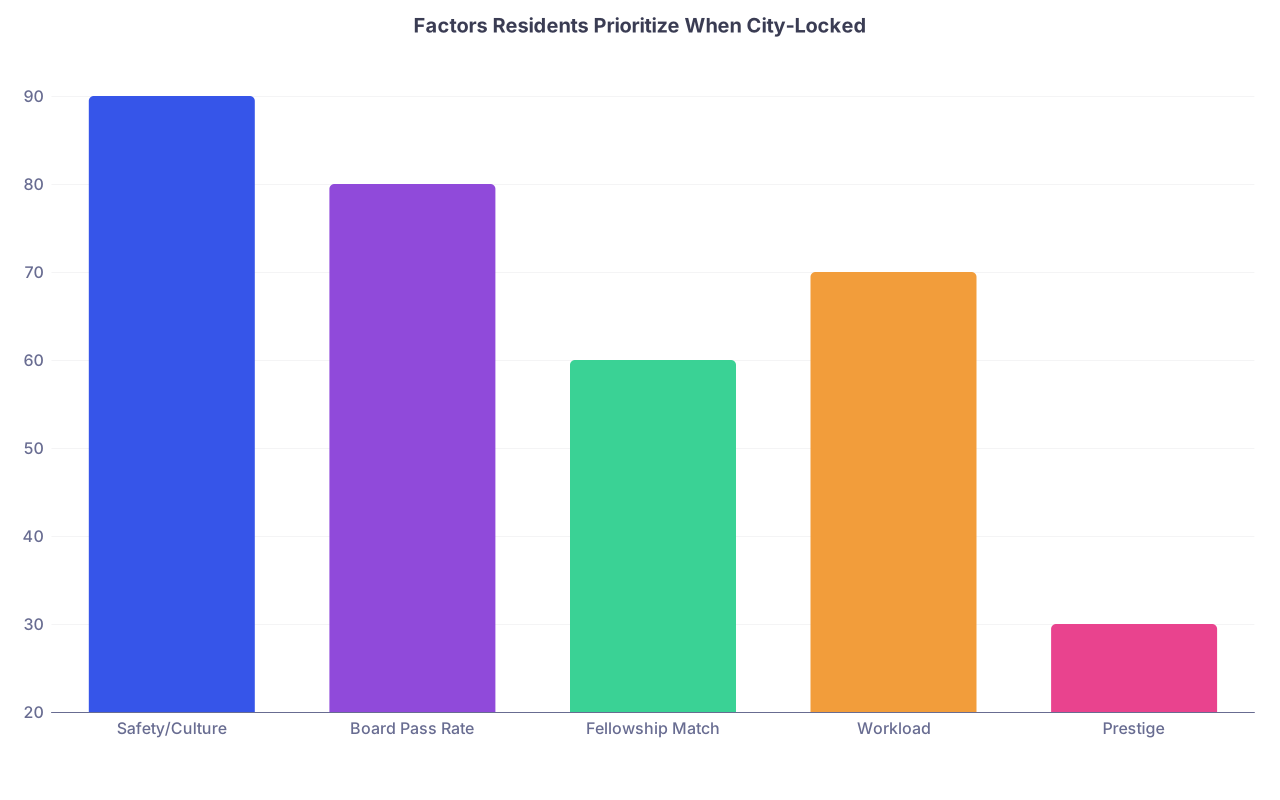
| Category | Value |
|---|---|
| Safety/Culture | 90 |
| Board Pass Rate | 80 |
| Fellowship Match | 60 |
| Workload | 70 |
| Prestige | 30 |
Key Takeaways
- When you’re geographically tied, you can’t afford vague dread about “red flags.” You need a clear distinction between deal-breakers, serious-but-manageable issues, and noise.
- If you end up at a problematic program, your job is to survive and position yourself for future mobility: find allies, crush the basics, build an external network, and decide early whether to transfer or ride it out.
- Being city-locked changes your strategy, not your standards. You’re optimizing within constraints, not agreeing to be abused. Your license, sanity, and long‑term career still come first.