
It’s March. You’re on your “home” rotation in the specialty you want. Everyone keeps saying, “You absolutely need a strong letter from your home program.”
Problem: your home program is a mess.
You’ve seen attendings screaming at residents in the hallway. The PD bad-mouths prior residents by name. There are rumors about retaliation if people complain or go elsewhere. You’ve watched fellows disappear mid-year with a vague “left for personal reasons.”
And you still need a letter. Maybe this is the only program in your specialty at your school. Maybe they own your transcript and MSPE narrative. Maybe politically, you cannot just ignore them.
You’re stuck between two bad options:
- Engage with a toxic program to get a “needed” letter and risk drama, or
- Refuse and risk looking “off” to other programs when your home program is silent.
Here’s how you handle that situation without blowing up your career.
Step 1: Get Honest About the Type of Red Flag You’re Dealing With
Not all red flags are equal. You need to classify what you’re seeing, because the strategy changes.

Broadly, you’re looking at a few buckets:
Toxic culture / bullying
- Attendings yelling or humiliating residents or students.
- Gossip about applicants, ranking, “we blacklisted that person.”
- Extreme hierarchy, fear of speaking up.
Retaliation / political games
- People who choose another specialty or another program get frozen out.
- Punitive evaluations for “disloyalty.”
- PD or key faculty track who’s “with us” vs “against us.”
Boundary / ethics problems
- Pressure to alter notes, billing, or documentation.
- Sketchy behavior with duty hours, patient safety, or consent.
- Obvious “favorites” get forgiven for things others are punished for.
Unstable leadership
- PD turnover every 1–2 years.
- Residents constantly transferring out.
- Program on probation or “quietly” under review.
Most people in your shoes are dealing with 1 + 2. The culture is bad, leadership is petty, but you still need something from them.
Your goal is not to fix the program. Your goal is to get:
- A usable, non-damaging letter
- A non-toxic MSPE narrative
- As little drama as possible
and then leave.
Step 2: Decide How Much You Actually Need a Home Letter
People throw around “you absolutely need a home program letter” like it’s a law. It isn’t.
What’s true in many competitive fields (ortho, derm, ENT, neurosurg, etc.) is:
- A letter from someone at your home program helps,
- A letter from the PD or chair can carry extra weight,
- A complete absence of any home letter can raise eyebrows, especially if your school is known for that specialty.
But residency programs are also very capable of reading between the lines. They’ve seen students trapped in weak or dysfunctional home departments.
Do a quick reality check with someone who actually knows your specialty:
- Ask a trusted advisor outside the toxic department (could be: another specialty PD who likes you, a dean, a subspecialty attending at a different hospital who knows the field).
- Be specific: “I’m applying to [specialty]. My home program is [describe briefly: small/unstable/hostile]. How critical is a home letter for this specialty if I have strong away letters?”
If they say:
- “You’ll look odd without any home letter at all,”
→ You probably need at least one faculty letter from that department. - “PD letter is ideal but not mandatory,”
→ You can often avoid the PD and get a letter from a stable, reasonable attending in the department. - “If your aways are strong, we barely care who wrote the home letter,”
→ You’re aiming for a neutral, non-damaging home letter and strong external letters to do the real work.
That distinction matters. You may not need a glowing PD letter. You may just need a competent one-liner in your application that says, “Yes, we’ve seen this student and they’re normal.”
Step 3: Identify the Safest Possible Letter Writer in a Bad Program
You don’t walk into the lion’s mouth if the lion’s secretary can do the paperwork.
Look for someone in the department who is:
- Known as fair, even if not “warm and fuzzy.”
- Not heavily involved in resident politics.
- Not the PD or the PD’s close enforcer, if you can avoid it.
- Has actually seen you work directly.
This might be:
- A mid-career attending with a reputation for solid teaching.
- A division chief who’s a bit removed from the day-to-day drama.
- A subspecialist who worked with you for 2–4 weeks and liked you.
What you’re screening out:
- “Kingmaker” attendings who play favorites.
- Anyone who gossips about students or residents in front of you.
- Faculty you’ve never worked with clinically who are “happy to write a letter” based on vague impressions. That’s a recipe for junk.
If there truly is no one in the department who meets even that low bar, then you’re in damage-control territory and we’ll talk about that later. But most toxic programs still have at least one sane person hiding in the middle.
Step 4: Work the Rotation Like It’s a 4-Week Job Interview
On your home service, you’re not just “rotating.” You’re building the only leverage you’ll get.
Act like you’re about to ask a reference from a petty boss. Because you are.
You need three things:
Consistent face time with your target letter writer
- Try to be on their team, follow them, scrub their cases, pre-round on their patients.
- Gently request “Could I spend more days on Dr. X’s service? I’m interested in [their subspecialty].” Don’t say “because I need a letter” out loud.
Predictable reliability
- Show up early. Be prepared. Know your patients.
- Do not try to be slick or impress with fluff. You want them to say “dependable, professional, works well with the team.” Those phrases play better than “genius” anyway.
Emotional neutrality
- Avoid reacting visibly when the culture goes off the rails.
- No eyerolls. No comments like “wow, that was unprofessional.” (Even if it was.)
- Your job is to look unflappable, not rebellious.
You’re not selling your soul. You’re pulling off a clean, professional performance in a bad play so you can get the review you need and leave.
Step 5: The Ask – How to Request a Letter Without Triggering Drama
Here’s how you ask in a way that minimizes risk.
Timing:
- Ask toward the end of your rotation (final week), but not on the last day.
- Ask after a day where you did something clearly useful: stayed late, helped with a tough patient, gave a good presentation.
Script it roughly like this, in person if possible:
“Dr. X, I’ve really appreciated working with you this month. I’m applying to [specialty] this cycle and I’d be very grateful if you’d consider writing a strong letter of recommendation for me.”
Then shut up. Let them answer.
Key details:
- Use the word “strong.” This gives them an out if they can’t honestly do that.
- Watch their face. You’re not just listening to the words.
Good signs:
- “Of course, you’ve been great.”
- “Yes, I’d be happy to. Send me your CV and personal statement.”
- They comment on specific things you did well.
Bad signs:
- Long pause. “Well… I don’t really know you that well.”
- “I can write a letter if you need one” in a flat, reluctant tone.
- “Sure, but just so you know, I’m very honest in my letters” with a warning vibe.
If you get a bad vibe, do not push. Say:
“I completely understand and really appreciate your honesty. I may reach out to Dr. Y instead, since I worked with them more days. Thank you again for the feedback.”
Then walk. A lukewarm or negative letter will hurt you more than the absence of a home letter.
Step 6: Protect Yourself With a Paper Trail and Multiple Letters
Once someone agrees, you do two things immediately:
Follow up with a detailed email
- Thank them again.
- Attach your CV, personal statement draft, and a one-page “highlights” sheet: 3–5 bullet points of things you did on their service, specific patients or projects.
- Gently remind them of your timeline: “Letters are due by [date], but earlier is helpful.”
Build redundancy
- Do not rely on a single home letter if you can possibly get two.
- Aim for at least:
- 1–2 strong external letters (aways or known people in the field).
- 1 “safe” home letter.
- Optional: a non-department letter (e.g., medicine attending) who can vouch for your work ethic and character.
You’re creating insulation. If the home letter is mediocre but your away letters are fire, programs can see the pattern.
Step 7: Use Aways and External Rotations as Your Real Launchpad
In a red-flag home program, you should not rely on them to carry your application. They’re a checkbox. Your real engine is external rotations.
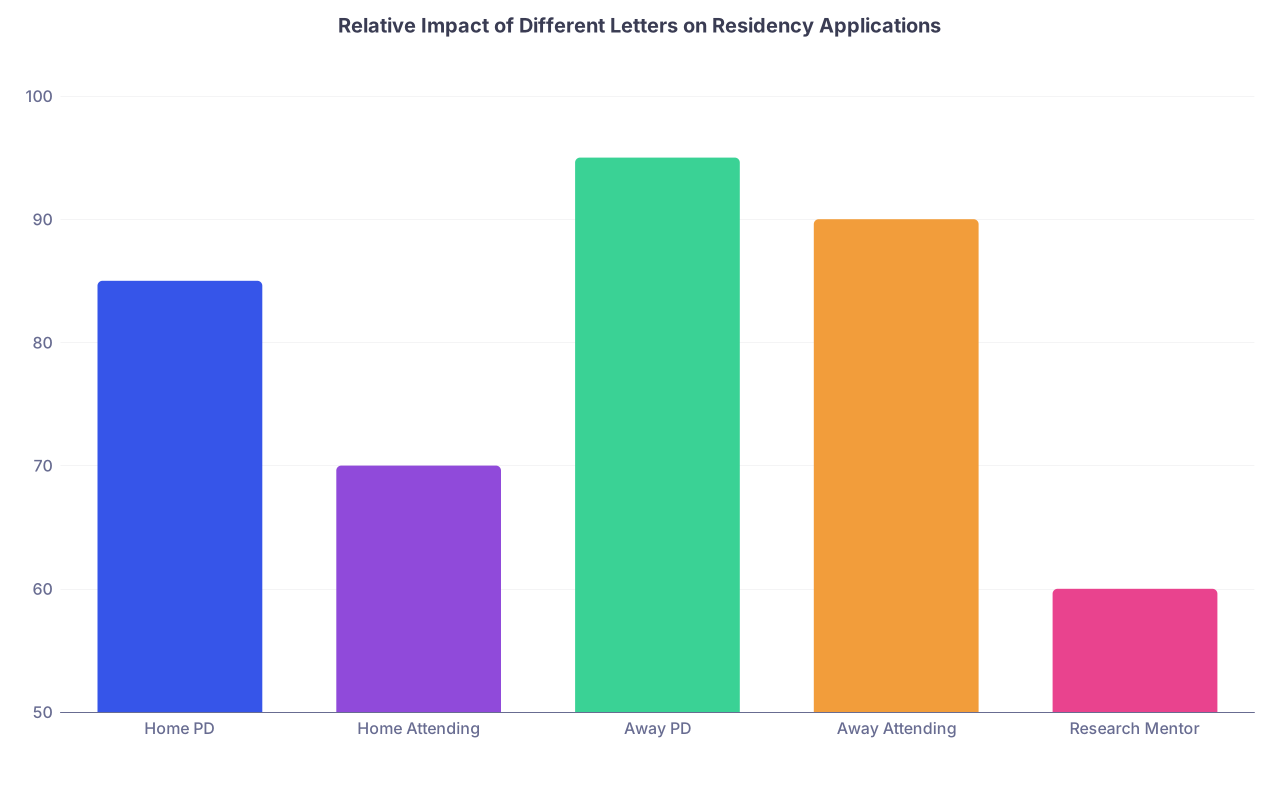
| Category | Value |
|---|---|
| Home PD | 85 |
| Home Attending | 70 |
| Away PD | 95 |
| Away Attending | 90 |
| Research Mentor | 60 |
In most competitive specialties, the rough hierarchy of letter impact looks like this (varies by field, but directionally right):
- Away rotation PD / chair who loved you
- Away rotation attending who worked closely with you
- Home PD letter (if neutral-positive)
- Home attending letter
- Research mentor / non-clinical letter
If your home PD is unstable or hostile, treat your aways like your actual audition:
- Choose programs with a reputation for fairness and teaching. Ask older students or residents where they felt treated like human beings.
- On away, be explicit: “My home department is small / in transition, so I’m really hoping to get a strong letter here.” Most reasonable attendings get it.
I’ve seen applicants from completely dysfunctional home programs match at excellent places because their away letters were gold and everyone in the field knew, quietly, that their home program was a circus.
Programs talk. If your home place is widely known as a problem, your lack of a glowing home letter is not mysterious to them.
Step 8: When You Have to Deal With the PD or Chair
Sometimes you cannot avoid the PD:
- They control all official department letters.
- Your school “expects” the PD to write a summary for all applicants in that specialty.
- They’re technically in charge of what shows up in your MSPE departmental section.
You still have some control.
First, keep interactions painfully professional:
- Always email, never text.
- Confirm significant conversations by email:
“Dear Dr. Z, thank you for meeting with me today to discuss my residency plans. As we discussed, I’ll be applying to [specialty] and would be grateful for your support.”
Second, do not overshare:
- You don’t need to tell them your rank list strategy.
- You don’t need to tell them which programs you like more than theirs.
- Stick to: “I’m applying broadly, including here.”
Third, control who else can vouch for you:
- Make sure other faculty in the department know you as a human being, not just a name.
- If the PD asks around, you want neutral-to-positive comments from several people, not silence.
If your PD is known to sabotage “disloyal” students, you have one extra layer: loop in a dean or school-level advisor early.
“I want to be transparent. Our department culture is difficult. I’m concerned about how my application will be represented externally. How does the school handle this?”
This conversation needs to happen quietly, months before MSPE season. Not after damage is done.
Step 9: If You Suspect the Letter or MSPE Is Bad
You usually will not see the actual PD letter. But you might get hints:
- Programs asking you in interviews about strange things that were never issues before.
- A dean quietly suggesting, “Your departmental summary was a bit more reserved than usual.”
You cannot fix that mid-cycle. But you can:
Have strong alternative voices
- If your away letters and non-home letters are consistently glowing, most PDs will trust those over one weird home narrative.
Be ready with a calm, short explanation If asked directly in an interview, you do not unload your home program drama. You say:
“My home department has been going through leadership transitions and some growing pains. I had a better fit clinically at my away rotations, and my strongest letters are from those settings where people saw me work more closely.”
Stop there. Mature, non-whiny, and programs can read between those lines.
- Debrief after the season Regardless of your match outcome, sit down with a trusted dean or advisor later and ask them to review what went out. You do this partly to protect the next class. Persistent sabotage from one program sometimes only gets handled when multiple cohorts speak up.
Step 10: Know When to Escalate, and When to Just Survive and Leave
Some situations cross from “toxic but tolerable” into “unsafe”:
- You’re being directly threatened or harassed.
- You’re pressured to falsify documentation.
- You’re retaliated against for protected actions (reporting mistreatment, etc.).
In those cases, you step out of the “I just need a letter” mindset and into self-protection:
- Document everything: dates, times, who was present, specific phrases.
- Save emails in a secure, backed-up place.
- Talk to a school ombudsperson, Title IX office, or equivalent.
- Strongly consider involving a dean before continuing to interact with that faculty member.
Sometimes the right move is to accept that you will not get a useful letter from that program, and instead build your application entirely on external letters and a clearly documented pattern of abuse, in case anyone asks.
Most of you, though, are not in that extreme. You’re in the gray, annoying middle: ugly culture, petty politics, but not enough to burn it down. For you, the smart play is:
- Keep your head down just long enough to get what you need.
- Build your real support network outside this department.
- Match somewhere healthier and never look back.
| Situation Type | Risk Level | Primary Strategy |
|---|---|---|
| Petty culture, minor gossip | Low | Safe attending letter + strong aways |
| PD plays favorites, mild retaliation | Moderate | Avoid PD if possible, use division |
| Known to sabotage “disloyal” students | High | Involve dean, maximize away letters |
| Harassment or pressured misconduct | Very High | Document, report, protect yourself |

| Step | Description |
|---|---|
| Step 1 | Need home letter |
| Step 2 | Work with safe attending |
| Step 3 | Ask for strong letter |
| Step 4 | Request PD letter |
| Step 5 | Involve dean or advisor |
| Step 6 | Emphasize away letters |
| Step 7 | Build external letters too |
| Step 8 | Is there a safe attending? |
| Step 9 | Is PD reasonable? |

Bottom Line: How to Play a Bad Hand Without Losing the Game
If you remember nothing else:
Treat the home letter as a checkbox, not your foundation.
Get the safest possible letter you can from that department, then put your real energy into away rotations and external advocates.Protect yourself from petty people with professionalism, documentation, and redundancy.
One mediocre or political PD should not have the power to sink you if you’ve cultivated multiple strong voices elsewhere.Use the system once, then leave it.
Survive the rotation, get the letter, match somewhere sane. The goal is not to fix your home program. The goal is to make sure their dysfunction does not become your story.