
The worst residency red flag is the one programs try to explain away.
You hear that an entire class (or a big chunk) of residents just resigned from a program. Your group chat blows up. People say “it’s all rumors” or “the PD said it was just a misunderstanding.” Let me be blunt: mass resident resignation is not normal. It’s not “growing pains.” It’s not something you ignore.
You do not have to panic. But you also do not get to shrug this off.
Here’s how to think and what to do, step by step, whether you’re a current resident in that program, an incoming intern, or a med student with an interview/offer.
First: Define What “Mass Resignation” Actually Means
Programs love to play word games. “We had some transition.” “A few residents pursued other opportunities.” That can mean anything.
You need clarity. There are big differences between:
| Scenario | What It Usually Means |
|---|---|
| 1–2 residents leave over a year | May be personal fit, not system failure |
| 3–4 leave from same class | Serious culture or leadership problem |
| 30–50% of program leaves in 1–2 years | Systemic toxicity, unsafe conditions |
| Entire class leaves at once | Crisis. Emergency-level red flag |
“Mass resignation” in our world usually means:
- Multiple residents in the same PGY cohort leaving within months
- Or several residents across classes resigning/withdrawing/“transferring” in a short window
- Or a whole program placed on probation / pre-accreditation watch while residents bail
If what you’re hearing is anything in the last two rows of that table, you treat this as a serious program-level failure until proven otherwise. Not the other way around.
Step 1: Verify The Story Without Getting Used
You cannot rely on:
- The program’s official statement
- A single resident’s rant
- Anonymous Reddit threads
You need triangulation: three or more independent points of data saying roughly the same thing.
Start with this simple path.
A. Talk to current residents (not just the chief)
Aim for at least 2–3 people at different levels (one junior, one senior, ideally someone who’s not on the “leadership track”). Script it like this:
- “I heard there were several residents who left recently. How has that affected you day-to-day?”
- “If you were a med student again, would you still rank/choose this program? Why or why not?”
- “What would you want an incoming intern to know that isn’t on the website?”
Let them talk. Silence is your friend. People will eventually fill it with the stuff they aren’t supposed to say out loud.
If someone says, “We had a communication breakdown with leadership, but everything is better now,” ask: “Okay, concretely, what changed?” If they cannot name specific policies, numbers, or schedule changes, assume nothing changed.
B. Find ex-residents if you can
If several residents resigned, some will be:
- In other programs
- Back in your med school system
- Taking research years
- On LinkedIn with updated locations
Reach out with something like:
“Hey, I’m [MS4/PGY1/applicant] considering/at [Program]. I heard there were a few residents who left recently. I would really value any candid perspective you’re comfortable sharing. I’m not looking for gossip—just trying to make an informed decision.”
If they immediately say, “I can’t talk about it,” that usually means it was ugly and lawyered. Which is its own answer.
C. Separate three questions
When you gather intel, you’re trying to answer:
- Is this real? (Did multiple residents actually leave?)
- Why did they leave? (Culture, abuse, work hours, safety, exam failure, leadership change?)
- What has actually changed since then?
Do not get stuck on #2 and forget #3. Ugly past + real structural fixes can sometimes be workable. Ugly past + handwavy apologies = you’re next in line.
Step 2: Interpret the Red Flag Correctly
Not all mass resignations look the same. Some are survivable. Some you should run from.
Here’s the rough breakdown I use when residents call me in a panic.
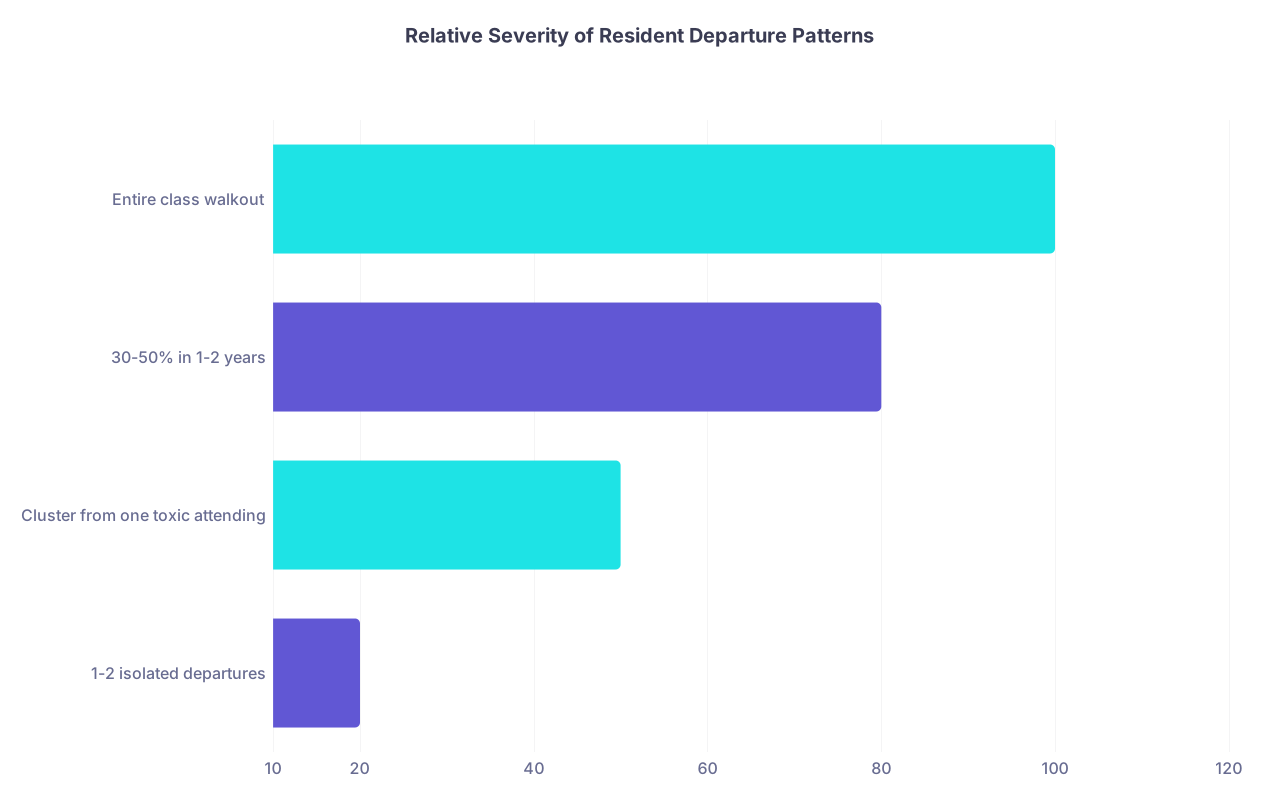
| Category | Value |
|---|---|
| 1-2 isolated departures | 20 |
| Cluster from one toxic attending | 50 |
| 30-50% in 1-2 years | 80 |
| Entire class walkout | 100 |
Pattern 1: Scattered departures over years
One leaves because of family, another for a spouse, another for a different specialty. No ACGME issues. No whispered “that place is a nightmare” from multiple sources. This is annoying, not catastrophic.
Your move: ask questions, be cautious, but don’t blow up your rank list solely for this.
Pattern 2: Clustered departures under one PD / chair
New PD comes in, multiple people leave within a year, evaluations spike in negativity, residents complain about “retaliation” or “they don’t care if we succeed.” This often points to leadership and culture toxicity.
Your move: take this extremely seriously. Leadership-driven problems rarely fix themselves quickly.
Pattern 3: Systemic collapse
Signs:
- Residents leaving from multiple PGY levels
- ACGME citations or warning/probation
- Duty hour violations as the norm, not the exception
- People using the word “unsafe” about patient care
- Talk of “we were told not to talk to the site visitors”
Your move: this is a do-not-touch for most applicants. For current residents, this becomes “how to survive long enough to escape” territory.
Step 3: What To Do If You’re Already In The Program
This is where the stakes are highest. You signed a contract. You moved. You’re halfway through intern year and then boom—three PGY-2s leave, a PGY-3 transfers, the chiefs look dead behind the eyes.
Here’s the order of operations.
1. Quietly protect yourself first
Documentation is not paranoia. It’s survival.
Keep a simple log (personal, not on hospital devices):
- Dates, hours worked, call schedule
- Major unsafe events (“Was alone covering X floors,” “Asked to do Y without supervision”)
- Instances of retaliation or bullying in response to reporting issues
Save key emails:
- Policy changes about coverage
- Schedule changes that clearly increase workload without support
- Any written retaliation or threatening language
You are not doing this to “build a lawsuit.” You are building a factual record in case you need to:
- Talk to the DIO (Designated Institutional Official)
- Contact ACGME
- Apply for transfer and explain your situation
2. Find your internal allies
Every hospital has a couple of people who quietly keep things from burning down:
- A supportive APD
- A faculty member known to go to bat for residents
- Chief residents who clearly side with housestaff over administration
You talk to them like this:
“I’m concerned about the recent resignations. I want to train here, but the current staffing feels unsafe at times. I want to understand what protections and plans are actually in place for us.”
If their answer is vague reassurance without specifics (extra APPs, capped census, new rotations, mental health support, real schedule change), you do not have a plan. You have PR.
3. Decide: fix, endure, or escape
You have three real options:
- Stay and actively push for change
- Stay and keep your head down while planning an exit after graduation
- Transfer out as soon as possible
Transferring is hard but not impossible. People do it every year, especially from toxic programs. The key:
- Talk to the DIO and GME office, not just the PD
- Ask directly: “What is the process for requesting a transfer? What documentation will I need?”
- Start networking quietly with other program directors in your specialty—faculty who like you can help here
If patient care is consistently unsafe, or if you’re facing harassment/retaliation, I’m going to be blunt: you should at least explore transfer. “Maybe it’ll get better” and “I don’t want to cause trouble” have trapped too many residents in programs that chew them up.
Step 4: What To Do If You’re an Incoming Intern
You matched. You signed a lease. And now you hear that half the PGY-3s resigned last year. Horrible timing, but it happens.
You have three timepoints to think about:
- Before July 1
- Early intern year
- If things go bad
Before July 1: Get real information, not spin
Do this quickly:
Email the chief residents and ask for a brief call:
“I’m really excited to join, but I’ve heard a few things that concern me. I’d love to hear directly from you about how the program is doing and what’s different this year.”Ask very specific questions:
- “How many residents left in the past 2 years?”
- “How has that affected call and inpatient coverage?”
- “What specific changes has the program made to prevent this from happening again?”
- “If you had to do it again, would you still match here?”
If they dodge the numbers, or say “we’re not allowed to talk about that,” that’s damning.
If what you hear is bad enough, contact your med school’s Dean of Students or equivalent. They’ve seen this before. There are rare cases where, with enough red flags, schools help you re-apply, delay start, or navigate out. Not fun, but better than stepping into a burning building.
Early intern year: Run a 3–6 month reality check
Assume you will start, unless things are catastrophic. But you don’t go on autopilot.
Ask yourself at 3 and 6 months:
- Are duty hours legit, or are violations hidden/normalized?
- Do I feel physically safe taking care of patients?
- Do residents openly talk about planning to leave?
- Are seniors and attendings invested in teaching, or just surviving?
If the answers trend negative, you don’t wait until PGY-3 to “see how it plays out.” You start planning options with your GME office.
Step 5: What To Do If You’re a Med Student/Applicant
You’re still choosing. You actually have the most power here—because your best move may be very simple: don’t go there.
On the interview trail
If you already have an interview scheduled at a program with rumored mass resignations, you do not cancel yet. You use the visit to gather data.
Watch for:
- Who isn’t in the room. If PGY-2s or PGY-3s are mysteriously absent “because they’re so busy,” I raise an eyebrow.
- How residents talk when faculty leave. The tone shift is telling.
- Any mention of “we’re rebuilding,” “we had some turnover,” “we’re working on communication.” All code words. Your next question is always: “What does that actually look like day-to-day?”
After the interview, text or email 1–2 residents you clicked with:
“Thanks again for talking with me. I heard through the grapevine that a few residents left recently. Would you be comfortable sharing how that impacted the program and what has changed since then?”
If multiple people dance around the topic, that’s your answer.
On your rank list
Simple rule I stand by:
If a program has had mass resignations in the last 1–2 years and you have any other decent option, do not rank it above safer programs.
I don’t care how “prestigious” it is. Prestige does not help you when you’re burnt out, unsupported, or stuck in a failing system.
Step 6: Watching the Institutional Response
One of the clearest tells is how leadership behaves after the crisis.
A serious program response looks like:
- Transparent communication with residents (not just leadership)
- Independent review or outside consultation
- Actual policy changes:
- Reduced inpatient caps
- More APPs or hospitalists
- Schedule redesign verified by residents
- Real mental health resources with protected access time
- Willingness to say, “We failed you,” without blaming residents
A fake response looks like:
- “We’re a family” speeches
- Mandatory wellness retreats and pizza nights
- Quiet threats: “We expect loyalty,” “Program reputation depends on what we say externally”
- Pressuring residents not to speak to ACGME or applicants honestly
If you see the second pattern, you’re not in a rough patch. You’re in a gaslighting patch.
Step 7: External Safeguards – ACGME, GME, and When to Escalate
When is this more than “my program sucks” and becomes “this needs external oversight”?
Look at:
- Recurrent duty hour violations that leadership ignores
- Extreme under-supervision with real patient risk
- Retaliation for reporting concerns (schedule punishment, bad evals, threats)
- Multiple residents with serious mental health crises tied to culture
In that zone, you should at least:
- Talk to your institution’s GME office and DIO directly
- Use formal reporting mechanisms (usually anonymous options exist)
If nothing happens and things remain unsafe, ACGME has confidential resident surveys and complaint processes. Yes, programs get angry when residents use them. But I’ve also seen programs magically find money, staff, and reforms once they realize the accreditor is watching.
Quick Reality Check: Is Any Program Perfect?
No. Every residency has unhappy residents. Every program has a few people trying to transfer. One bad chief or one malignant attending doesn’t mean “run.”
The line I draw is this:
- Individual misery = one or two people struggling for a mix of reasons
- Systemic failure = multiple people independently reaching the same conclusion: “I need to get out to survive, and leadership either doesn’t care or is the problem”
Mass resignation is almost always the second. And you should treat it as such.

| Step | Description |
|---|---|
| Step 1 | Hear about mass resignation |
| Step 2 | Verify details with multiple residents |
| Step 3 | Monitor, but lower concern |
| Step 4 | Assess severity and pattern |
| Step 5 | Document, find allies, consider transfer |
| Step 6 | Reassess commitment, talk to GME |
| Step 7 | Use interview to gather intel, adjust rank list |
| Step 8 | Confirmed multiple departures? |
| Step 9 | Current resident? |
| Step 10 | Incoming intern? |
FAQ (Exactly 5 Questions)
1. Is it ever reasonable to stay in a program that just had mass resignations?
Sometimes, but only under specific conditions: leadership has clearly changed or been constrained, there are concrete structural fixes (not just “we’re listening”), and current residents you trust say their day-to-day lives are actually better now. If what you’re hearing is mostly spin and vague “we’re working on it,” I would not gamble three+ years of my life on that.
2. How do I ask about this on interview day without sounding confrontational?
Phrase it as wanting to understand growth, not attacking the program: “I’ve heard there were some resident departures in recent years. What did the program learn from that, and what changes came out of it?” Then shut up and listen. You’re watching how quickly they get defensive, and how specific their answers are.
3. Can talking honestly about problems hurt current residents if I ask them questions?
It can if they feel exposed. That is why you never record, never screenshot, and don’t quote them to leadership. Ask them what they’re comfortable sharing. Some will be very open, some cautious. Your job is to protect them by keeping details de-identified if you discuss your concerns elsewhere.
4. How hard is it actually to transfer out of a bad residency?
Hard, but not as impossible as people think. It’s easier early (PGY-1/PGY-2), easier in larger specialties (IM, FM, peds), and easier if your evaluations and exams are solid. You’ll need: honest conversations with your DIO/GME, faculty advocates, and a clear, factual explanation of why you’re leaving. I’ve seen residents successfully transfer from train-wreck programs every year.
5. What if my only offer is a program with a history of mass resignations—do I still go?
This is where you have to be adult-level honest with yourself. If your alternative is no residency at all and trying again is low probability, then yes, you might choose to go—but with your eyes open, heavy documentation, and early planning for transfer or survival. But if you have any remotely solid alternative, I would not voluntarily walk into a chronically toxic, unstable program “for the prestige” or “because it’s academic.” You’re not just picking a line on your CV; you’re picking the environment that will shape your entire early career and mental health.
With this sorted, you’re better equipped than most applicants and residents to read the biggest red flag there is and not gaslight yourself into ignoring it. The next step, once you’ve decided where to train, is figuring out how to protect your time, sanity, and career inside whatever program you choose. But that is a problem for a different day.