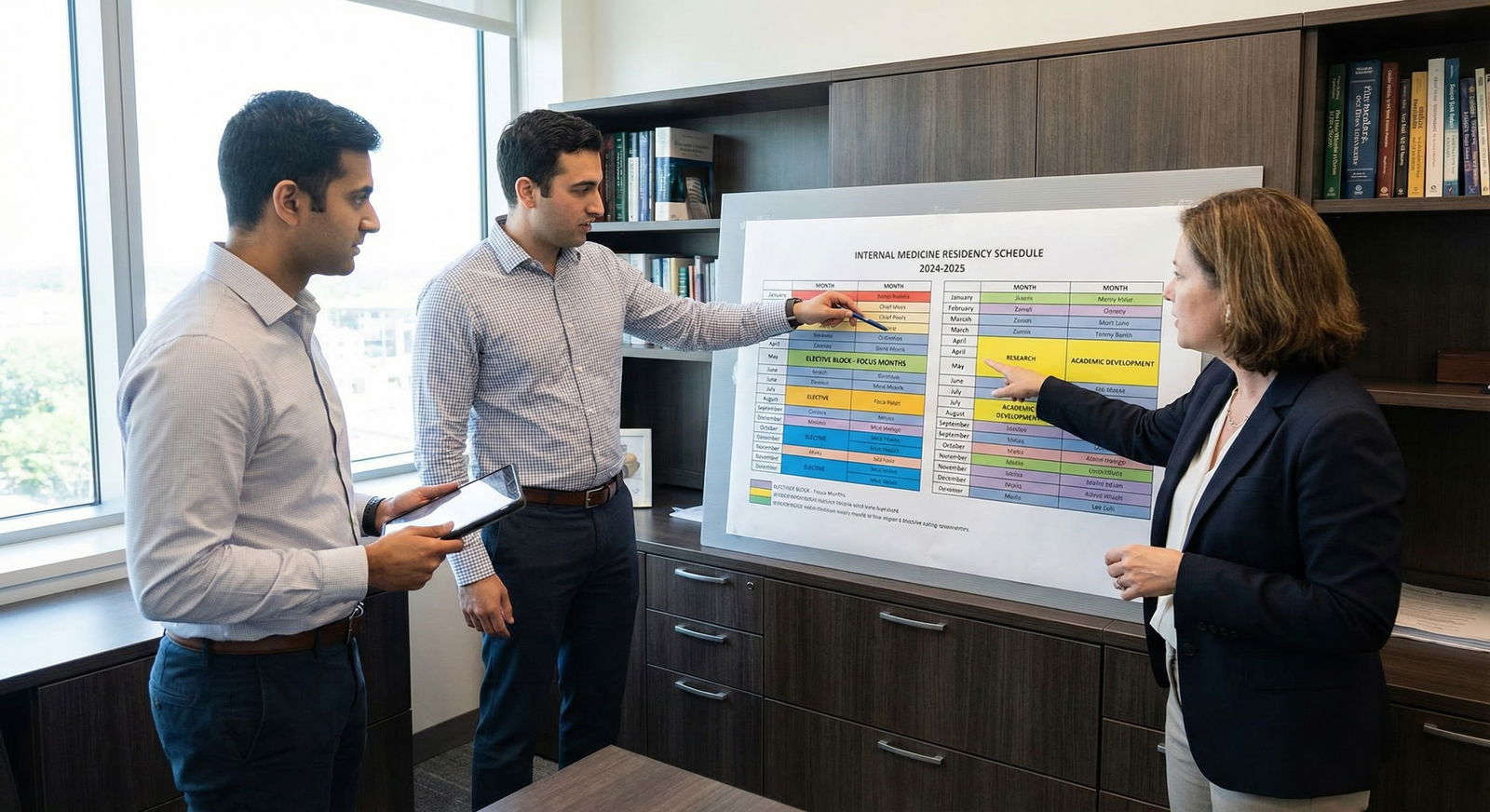
The day you learn your future residency is on probation is the day the brochure-version of training dies.
Here is the blunt truth: probation is not an abstract “administrative status.” It can affect your training, your sanity, and—if things really go sideways—your accreditation. But it does not automatically mean your career is over or that you must panic-quit and start over.
If you are an incoming or current resident and you just discovered your program is on probation, this is the exact playbook I’d use in your shoes.
Step 1: Get Clear on What “Probation” Actually Means for You
First move: stop guessing. Start reading.
ACGME probation is specific, not random. There are concrete citations behind it—things like inadequate supervision, duty hour violations, lack of faculty, poor board pass rates, or toxic culture.
You need facts in three buckets:
- What the ACGME actually cited
- What the program is doing about it
- How this affects your ability to graduate and be board eligible
Where to look first
Do this today:
- Go to the ACGME public program search and look up your program. Note the accreditation status, any warnings, and the last site visit date.
- Check your email + ERAS messages + NRMP communications. Sometimes there’s a bland sentence about “adverse accreditation action.” That’s your clue it was known before Match.
- Ask your chief residents (not the PD—yet):
“I’m seeing that we’re on probation. What exactly were the citations, and what’s the timeline for resolving them?”
You’re not looking for vibes here. You’re looking for specifics.
Examples of what you might uncover:
- “We got hit for inadequate outpatient continuity clinic volume.”
- “The site visit documented systemic duty hour violations and poor supervision on nights.”
- “The program director turnover and missing faculty in key subspecialties triggered concerns about educational leadership and resources.”
Very different situations. Very different risk profiles.
Step 2: Map the Risk: Is This Fixable, or a Dumpster Fire?
Not all probations are created equal. Some are “annoying but fixable.” Others are “get out as soon as you safely can.”
Use this table as a quick reality check:
| Feature | Lower Risk Signal | Higher Risk Signal |
|---|---|---|
| Leadership | Stable PD, clear plan | PD turnover, interim or vacant PD |
| Faculty | Actively hiring, defined coverage | Key services understaffed or closing |
| Resident Input | Residents on committees, listened | Retaliation or fear for speaking up |
| ACGME Issues | Narrow (eg, clinic volume) | Broad (culture, supervision, resources) |
| Communication | Transparent, frequent updates | Vague, secretive, defensive |
Here is how to interpret what you’re seeing:
- Narrow, concrete issues (like too few continuity clinic sessions, documentation systems not tracking duty hours properly, or needing more formal didactics) are usually survivable. Programs fix those in 12–24 months.
- Broad, culture-level issues (systemic mistreatment, supervisors ignoring duty hours, no real educational infrastructure, constant leadership turnover) are much more dangerous. These are the ones that can drag out, deteriorate further, or lead to withdrawal of accreditation.
Ask current residents privately what they think. Not in front of faculty. Reach out to PGY-2s or PGY-3s on text:
“Hey, I saw the probation status and want to be realistic. From your perspective, is the program actually improving, or is this getting worse?”
If you get multiple versions of, “They’re trying, we’ve seen some changes, but it’s stressful,” that’s different from, “We’ve been told not to talk about it” or “Everyone’s leaving.”
Step 3: Protect the Core: Your Board Eligibility and Graduation Plan
Probation by itself does not make you ineligible for boards. Residents can and do graduate from programs that were on probation at some point.
The nightmare scenarios people whisper about are usually these:
- Program loses accreditation and closes before you complete training
- The structure of training gets so chaotic you cannot meet clinical/educational requirements
- Faculty you need for letters, evaluations, or case logs leave en masse
So you immediately secure two things:
- A clear graduation pathway
- A paper trail
Questions to get answered directly
Schedule a meeting with your PD or associate PD. Go in prepared.
Ask, one by one:
- “If I complete this program as scheduled, will I be board eligible in my specialty?”
- “Has the ACGME given any indication that accreditation might be withdrawn in the near term?”
- “What contingencies exist if accreditation is withdrawn? Would there be support for transfers?”
- “Are there any planned reductions in resident complement or service sites that would affect my training?”
After the meeting, send a brief follow-up email summarizing the key points:
“Thank you for meeting earlier. I want to make sure I understood correctly… [bullet your main takeaways]. Please correct me if I’ve misunderstood anything.”
Now you have written confirmation. If things implode later, your board and licensing conversations will be a lot easier if you can show that at the time, you were told you’d be board eligible.
Step 4: Test the Program’s Honesty: Transparency Is Your #1 Indicator
How leadership behaves now tells you more than the probation itself.
Here’s what a serious, salvageable program usually does:
- Holds a town hall with residents explaining the citations, the timeline, and the plan
- Shares the categories of citations (even if you don’t see the full ACGME letter)
- Invites resident participation in fixes—committees, feedback groups, policy rewrites
- Acknowledges specific past failures without getting defensive
And here is what a toxic, dangerous program often does:
- Minimizes: “It’s just a formality,” “Everyone gets cited,” “Don’t worry about it”
- Threatens: “Talking to the ACGME will hurt our chances,” “You’re lucky to be here”
- Obfuscates: refuses to share any details, vaguely blames “paperwork” or “hospital politics”
- Punishes: residents who speak up are suddenly getting poor evaluations or schedule punishments
Watch what they do in the next 30–60 days, not what they say in one polished email.
If you’re not seeing any structured response—no working groups, no documented changes, no timeline—that’s not just sloppy. It’s a massive red flag.
Step 5: Decide Your Strategy: Stay, Stay and Watch, or Start Planning an Exit
You don’t have to decide today whether to run or ride it out. But you do need a working strategy.
Think of three lanes:
- Stay and commit – You believe in the leadership, issues are narrow, and you’re willing to help fix the program.
- Stay but quietly prepare Plan B – You’re not in immediate danger, but the trajectory is unclear.
- Start serious exit planning – The signs point to collapse, or remaining would clearly harm your training or safety.
How residents actually split in real life
In programs I’ve watched go on probation, residents roughly fall into this pattern:
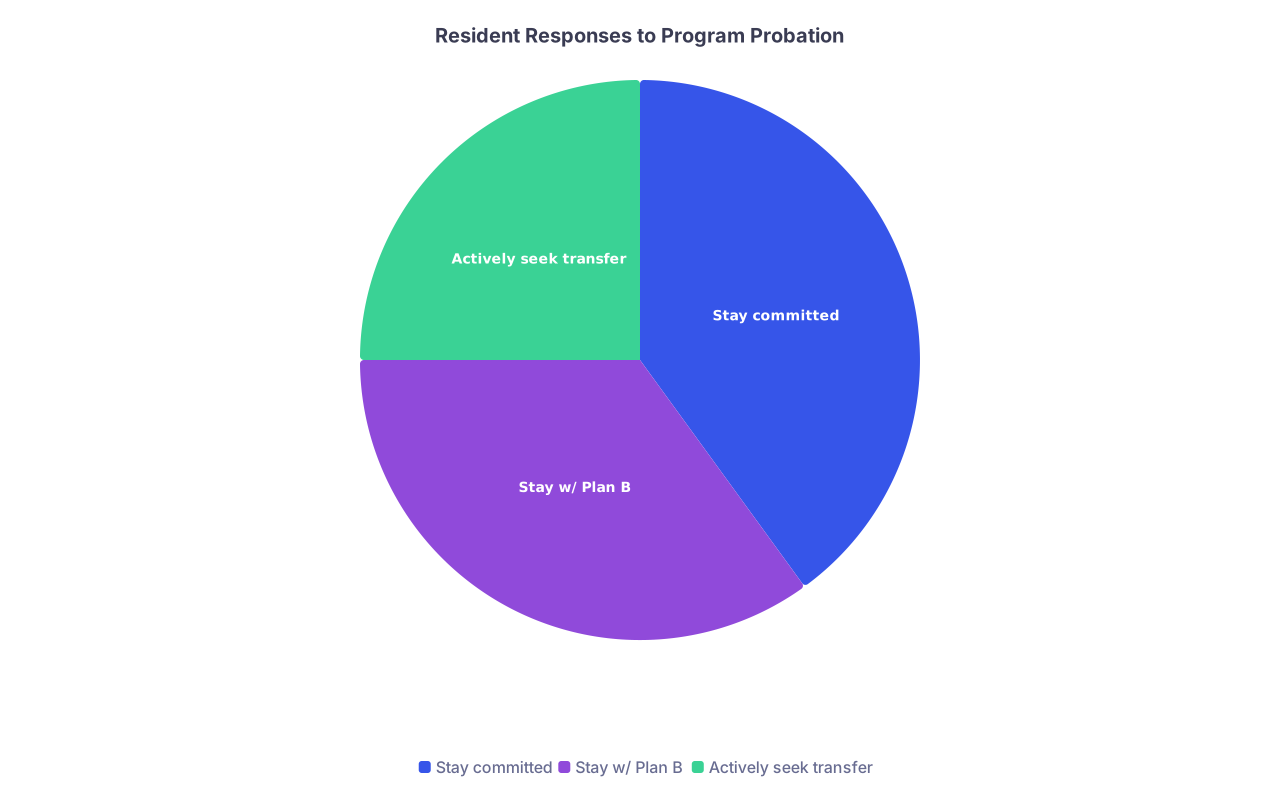
| Category | Value |
|---|---|
| Stay committed | 40 |
| Stay w/ Plan B | 35 |
| Actively seek transfer | 25 |
This shouldn’t decide for you, but it gives context. You’re not the only one thinking about leaving.
If you lean toward staying (for now)
Your priorities:
- Get the best education you can out of the chaos
- Avoid getting sucked into politics and blame games
- Make yourself maximally employable and transferable just in case
That means:
- Keep meticulous case logs and procedure numbers
- Save syllabi, rotation descriptions, and any documentation of your training
- Ask for letters early from stable faculty (before people start disappearing)
Think like someone who might need to prove what training you got, even if you never end up transferring.
Step 6: If You Consider Transferring, Do It Strategically, Not Desperately
Transferring is possible. It is also messy, slower than you think, and not something to do impulsively because you’re scared of the word “probation.”
You need three ingredients:
- A coherent story that doesn’t make you sound like the problem
- Realistic timing
- A spreadsheet-level grip on what you’ll lose and gain
Coherent story
You want something like:
“There were significant ACGME citations leading to program probation, particularly around X and Y. While I’ve learned a lot here, the instability in leadership and uncertainty about accreditation led me to seek a more stable training environment.”
Not:
“My program is trash and everyone is toxic.”
Program directors are allergic to drama. They’re OK hearing about structural problems; they’re not OK hearing you torch your current PD personally.
Timing and logistics
You need answers to:
- “If I transfer at the end of this year, how much credit will the new program give me?”
- “Will I need to repeat a year?”
- “Will my visa status (if applicable) be affected by a transfer?”
Start by:
- Quietly talking to trusted faculty at your current program:
“If I needed to explore a transfer for accreditation reasons, what’s the best way to approach that?” - Emailing program coordinators or PDs at potential target programs with a short, tactful inquiry.
And keep this in mind: many programs will only consider taking a transfer if they have an unexpected opening—resident resignation, dismissal, or complement increase. Those spots are limited, and timing is everything.
Step 7: Lean on the Right External Support (Without Torching Bridges)
Another mistake I see: residents either go fully silent or go nuclear. Both are bad.
You want measured escalation.
Start local:
- Chief residents
- Associate program directors
- GME office leadership (DIO—Designated Institutional Official)
- Ombudsperson, if your institution has one
Then, if you’re running into stonewalling or retaliation, and you have real safety/education concerns, you can go higher.
This is where a clear process helps:

| Step | Description |
|---|---|
| Step 1 | Discover probation status |
| Step 2 | Gather information |
| Step 3 | Meet with PD or APD |
| Step 4 | Stay and monitor |
| Step 5 | Talk to GME leadership |
| Step 6 | Explore transfer / contact board or specialty org |
| Step 7 | Satisfied with plan |
| Step 8 | Still concerned |
A few practical notes:
- Be specific in any complaint: dates, patterns, concrete examples.
- Avoid vague “the culture is bad” unless you can define what that means (e.g., repeated sexist comments by faculty X, documented in emails).
- Assume every email you send could be forwarded or screenshot. Write like you’re willing to defend it.
You want to be the resident who is thoughtful, constructive, and organized—not the one who looks chaotic and reactive.
Step 8: Fix Your Day-to-Day Reality While the Big Stuff Plays Out
The danger of probation news is it can paralyze you. Suddenly every annoyance becomes “because we’re on probation,” and you start doom-scrolling ACGME policies at 2 a.m.
Stop. There are parts of this you control right now:
- Your clinical competency
- Your relationships with faculty and co-residents
- Your paper trail
- Your mental health
Tighten up your training documentation
Create a simple log for yourself (even if your program has one):
| Category | What to Track |
|---|---|
| Rotations | Dates, site, key supervisors |
| Procedures | Type, number, supervising physician |
| Conferences | Dates attended, any presentations |
| Evaluations | Copies of major summative evals |
| Letters | Who agreed to write, date requested |
This is your insurance policy if you ever need to prove equivalence to another program or to a specialty board.
Watch your mental bandwidth
Probation drama can eat your brain. You still have to pass in-training exams, learn medicine, and not burn out.
- Set a limit for “probation worry time” – maybe 30 minutes a day to check emails, talk to co-residents, or read updates. Outside of that, you’re back to being a resident, not an amateur accreditation lawyer.
- Find one or two people outside your program (friend at another residency, former attending, mentor from med school) who can give you more neutral perspective.
You’re allowed to be stressed. You just can’t let it swallow your entire training.
Step 9: If You’re an Incoming Intern Who Hasn’t Started Yet
This is its own special hell: you matched, you celebrated with your family, and then you find out your future program is on probation.
Here’s the harsh reality: your options are limited, but not zero.
What you can’t realistically do:
- Re-enter the Match for this same cycle (that ship has sailed)
- “Switch” to another matched spot at a different program—NRMP doesn’t work like hotel bookings
What you can do:
- Contact the program and ask directly what the probation means for your class
- Reach out (discreetly) to current residents via social media or program emails to get unfiltered information
- Ask NRMP and your specialty board what happens if accreditation is later withdrawn and whether there’s an institutional plan for resident relocation
If, after gathering information, you feel this is unsafe or untenable, you could explore:
- Requesting a waiver or release from your Match commitment through NRMP (this is rare and not guaranteed)
- Taking a research year or other temporary position while you reposition for a future Match
Is this extreme? Yes. Have people done it when a program looked like it was circling the drain? Also yes.
But do not blow up your Match spot based purely on the word “probation” without seeing the actual situation on the ground.
Step 10: Watch for Early Warning Signs Things Are Getting Worse
You can’t stare at the ACGME website every week, but you can watch your own environment.
Big warning signs:
- Rapid, unexplained faculty departures in key teaching roles
- Multiple residents resigning or transferring mid-year
- Schedules getting more and more service-heavy with no educational balance
- Site visits or surveys occurring and residents being “coached” on what to say
- Retaliation against residents after honest feedback
Helpful visual for what a deteriorating environment often looks like:
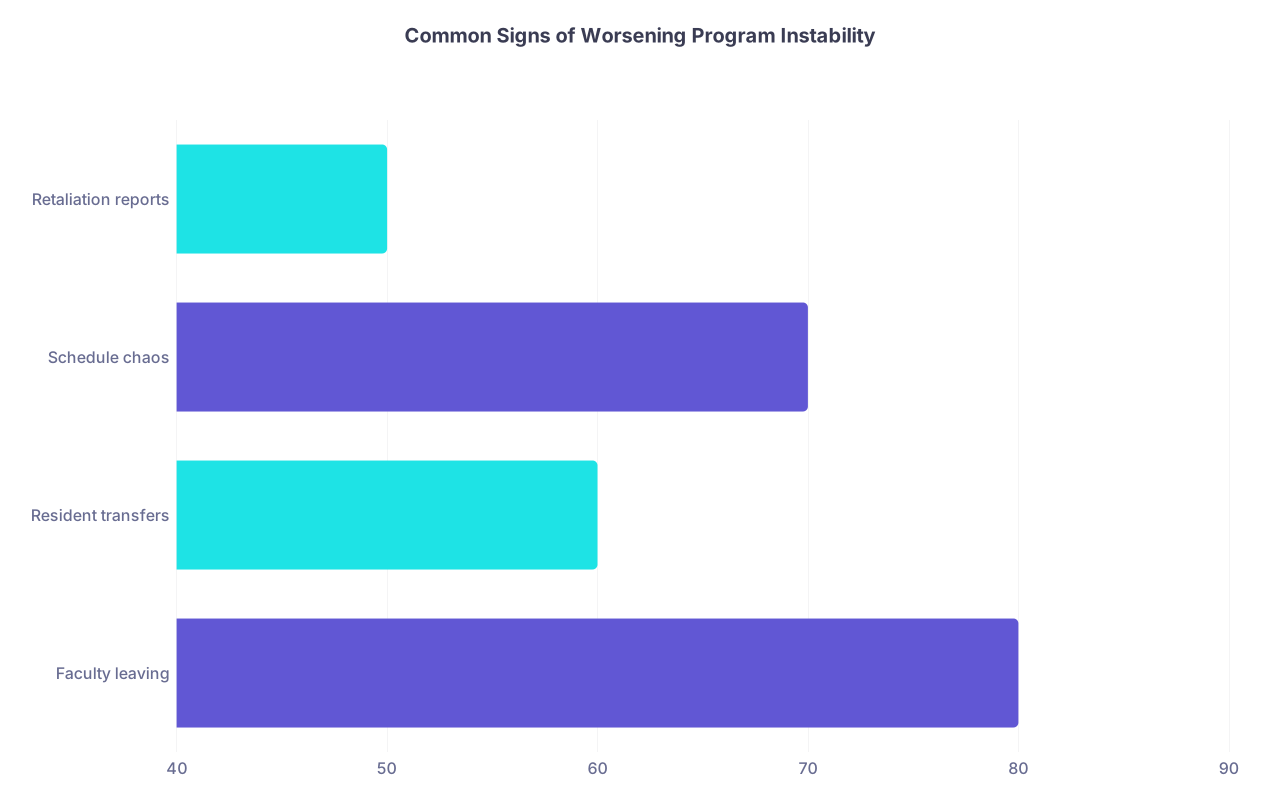
| Category | Value |
|---|---|
| Faculty leaving | 80 |
| Resident transfers | 60 |
| Schedule chaos | 70 |
| Retaliation reports | 50 |
You do not need a perfect situation. You do need a trajectory that isn’t clearly downhill.
If 3–4 of those are hitting at once, and leadership is either vague or hostile about your questions, that’s when it’s time to shift from “monitor” to “actively plan exit.”
Step 11: Use the Probation to Sharpen Your Career Positioning
Last piece most people miss: a program on probation can actually be a forcing function for you to upgrade your career planning.
How?
- You’ll usually collect more letters earlier, from multiple sites—this can help for fellowships.
- You’ll learn to advocate for yourself with data and documentation—very useful when you’re later negotiating jobs or contracts.
- You’ll be forced to think more intentionally about your training gaps and how to fill them (electives elsewhere, outside rotations, courses, etc.).
If you eventually apply for fellowship or jobs and someone asks, “I see your program was on probation for part of your training—what was going on there?” you want to be able to say:
“I was there during that time. The program had issues with X and Y. I got strong training in Z, and I personally did A, B, and C to ensure my education stayed top-tier. Here’s what I learned from that experience.”
That’s a grown-up, credible answer. It does not sink you.
Step 12: Keep Perspective: Probation Is Serious, Not Always Fatal
I’ve seen three endings to probation stories:
- Program cleans up its act, loses the probation status, and moves on.
Residents graduate fine. The story becomes a footnote. - Program limps along, never gets truly healthy, but stays accredited.
Residents have a rougher experience but still become good doctors and board certified. - Program loses accreditation and closes.
Residents scramble but often land on their feet at other programs with institutional help.
You cannot perfectly control which path your program takes. You can control how prepared, documented, and connected you are if things deteriorate.
You are not your program’s probation status. You’re the physician you’re becoming, and that depends far more on your competence, integrity, and resilience than on one ACGME line item.
Your Next Step Today
Do one concrete thing in the next 24 hours:
Email or message a current resident (if you’re incoming) or your chief (if you’re already there) and ask this exact question:
“I saw that the program is on probation. Can you share what the main ACGME concerns were and what changes are happening to address them?”
Their answer—and how quickly and honestly it comes—will tell you more than a hundred rumors. From there, you can start making real decisions instead of just worrying.