
The brutal truth: sometimes your only prelim option is a program you’d never recommend to a friend.
You know the type. Bad rumors. Poor mentorship. High attrition. Scut-heavy, education-light. And yet—it’s the only offer on the table, or the only one that logically fits your visa/geography/life constraints. You either take it or risk having no seat at all.
This piece is for that exact situation: a preliminary year with obvious red flags and very few alternatives. I’m not going to tell you to “trust your gut” and walk away if it doesn’t feel right. You already know it feels wrong. The real question is: do you take it anyway, and if you do, how do you survive it and still get where you’re trying to go?
Let’s walk through this like a triage: clarify your end goal, assess the actual risk, decide, then game-plan survival and exit.
1. Get Completely Clear on Your End Game
Your tolerance for a sketchy prelim year depends almost entirely on your long‑term target.
Are you:
- Trying to match into a competitive advanced specialty (derm, radiology, anesthesia, ophtho, rad onc, neuro, etc.)?
- Reapplying categorical IM/FM/psych after not matching?
- An IMG trying to get one foot in the US system?
- Already holding an advanced PGY-2 spot that just needs any prelim year?
You cannot evaluate the red flags without anchoring to your target.
Here’s the hierarchy of how much a bad prelim year can hurt you:
| Goal | How Damaging is a Bad Prelim? |
|---|---|
| Derm / Ortho / Plastics advanced | Very High |
| Radiology / Anesthesia / Ophtho | High |
| Neurology / PM&R advanced | Moderate |
| Reapplying categorical IM/FM/Psych | Moderate to Low |
| Already matched to PGY-2 (only need PGY-1) | Low |
If you already have an advanced spot and the PGY‑1 is just a checkbox (like anesthesia or radiology with a guaranteed PGY‑2), you care mainly about:
- Getting signed off on competencies
- Not getting fired
- Not getting your reputation destroyed with a disastrous incident
If you’re using the prelim year as a stepping stone—to impress, get letters, and reapply—then the quality of this year matters a lot more. You can survive a bad program; you can’t survive no credible advocates and a record full of “concerns.”
So first decision checkpoint: Is this prelim year just a formality, or is it part of your real audition?
2. Dissect the Red Flags Like a Clinician
“Red flags” is vague. You need to sort them into categories:
- Annoying but survivable
- Dangerous for your career
- Dangerous for your health/safety
Common Red Flag Categories
Workload & Schedule
- 6–7 day stretches repeatedly
- Chronic 80+ hour weeks
- “Off days” that are really “come to this mandatory thing”
- Night float that turns into days + nights
Culture & Leadership
- PD unresponsive or openly hostile
- Chiefs who protect the system, not the residents
- Punitive responses to sick calls
- Residents talk about “fear” and “retaliation,” not just being busy or tired
Education & Support
- Conferences regularly cancelled “due to patient care”
- No feedback, no real mentorship
- Residents not meeting graduation requirements until last second
Outcomes & Reputation
- Poor fellowship match
- Residents not getting strong letters
- High attrition or dismissals
- PD turnover every 1–2 years
Structural Problems
- Understaffed nursing/ancillary support
- EMR nightmares + no scribes
- No APP support; interns carrying 30+ patients on wards
Now, here’s the nuance: You don’t treat all red flags equally.
- Workload and chaos are miserable but often survivable if your main goal is “check the PGY‑1 box.”
- Culture, leadership, and outcomes are way more dangerous if you need letters and advocacy.
You need to map what you’re hearing to what you’re trying to achieve.
3. Decide: Take It, Decline It, or Hedge Hard
Let’s be blunt: for many people, “decline it” is fake advice. If you are an IMG, or had a low Step score, or went unmatched once already, you may not be able to “just wait another year and reapply.”
So use a more realistic framework: risk categories.
Category 1: Miserable but Functionally Safe
This is the program where:
- People complain nonstop about being overworked
- Call is heavy, notes are endless, education is weak
- But: residents graduate, no one is randomly fired, and at least some alumni have gotten fellowships or advanced matches
If this is your only option and you need a prelim year to move forward, you generally take it, with your eyes wide open and a survival plan (we’ll get to that).
Category 2: Professionally Dangerous
This is the program where you see or hear:
- Residents being put on remediation without clear documentation
- People “encouraged to resign” instead of formally fired
- PD uses vague language like “not a good fit” but can’t articulate expectations
- Residents struggle to get letters because attendings don’t know them or refuse to commit
If you need this year to produce strong letters and a narrative turnaround, this is where I’d pause hard. You might be better off taking a research year, improving your application, and reapplying—rather than gambling on a place that might actively harm your trajectory.
Category 3: Personally Unsafe
Serious harassment, discrimination, retaliation for raising concerns, ignoring blatant duty hour violations that create safety risks—this stuff isn’t “red flag,” it’s toxic waste.
If you’re picking up credible reports of that level of dysfunction, and you have literally no other options, you need to think in terms of:
- Shortest possible time to exit or transfer
- Clear documentation habits from day one
- A parallel plan for “what if I need to walk away midyear?”
That’s a worst‑case scenario. Most places aren’t here. But a few are.
4. If You Decide to Take It: Survival Strategy from Day 0
Let’s assume you’re taking the prelim offer. You don’t love it. You don’t fully trust it. But logically, you can’t risk having no residency position.
Now the mindset shift: This is not “home.” This is a one‑year contract. Your job is to get through it intact and more competitive than when you started.
A. Map Out What You Must Get From the Year
Non‑negotiables usually look like:
- Satisfactory completion of all required rotations
- No professionalism concerns on record
- At least 2–3 strong letters from attendings who actually know your work
- Something tangible on your CV (QI project, case report, teaching recognition, etc.)
Write those down. Tape them inside your notebook or on your laptop. You are not here to make everyone like you or to “fix the culture.” You’re here to extract what you need and leave.
B. Identify “Safe” Attending and Resident Allies Early
On day one, do not waste energy trying to win over the most toxic personalities in the program. Instead, scan for:
- Senior residents who seem quietly competent and not bitter
- Attendings who are:
- Fair with feedback
- Organized
- Known to write letters
- In specialties related to your target field
During your first 2–3 rotations:
- Show up early
- Be relentlessly reliable
- Ask brief, specific questions: “I’m hoping to improve my presentations quickly—what’s one thing I can change this week?”
You’re testing: who responds in a way that’s constructive versus dismissive? Those are your letter writers and advocates.
C. Manage Your Reputation Like It’s a Second Specialty
In a sketchy prelim setting, rumors and impressions spread faster than facts. That’s reality. So you operate proactively:
- Never be the source of gossip. Even if everyone else is trashing the program, you nod minimally, keep it neutral.
- When you mess up (and you will), own it quickly and calmly: “I missed X. I’ve now done Y and Z to prevent it again.”
- Respond to emails. Every time. Within 24 hours whenever humanly possible.
- If someone raises a concern, ask for it in clear language: “Can you help me understand what specifically you’d like me to change?”
This is boring adult stuff, but in a borderline environment it’s your shield.
5. Handling Overwork, Exploitation, and Burnout Without Self-Destructing
You’re not going to fix the 80+ hour weeks. You’re not going to transform the culture. But you can avoid the classic self‑sabotage patterns.
Triage Your Effort
You cannot give 110% to everything. You will break.
You give:
Max effort on:
- Rotations with potential letter writers
- Rotations related to your future specialty
- Early blocks when first impressions are formed
Solid but not heroic effort on:
- Low‑yield rotations where no one remembers your name next month
- Busy but uneducational services where survival is the main metric
This is where many “good students” struggle. They’re used to overperforming everywhere. In a bad prelim year, that’s how you burn out by October and start making real mistakes.
Build Micro‑Recovery, Not Fantasy Self-Care
You won’t have spa days. You’ll have:
- 10 minutes between cases to close your eyes
- A 20‑minute walk on your post‑call day before you collapse
- One small habit you protect viciously (a weekly phone call with someone who actually cares about you, journaling 5 minutes before bed, reading something non‑medical for 10 minutes)
You don’t aim to feel good. You aim to stay barely above the line where you start making dangerous decisions.
6. Extracting Value: Letters, Projects, and Future Leverage
You’re not just surviving. You’re quietly laying the foundation for getting out.
A. Letters of Recommendation
Target 2–3 attendings by:
- Doing at least one rotation early in the year with someone known to care about teaching
- Asking them plainly: “Dr X, I’m planning to apply to [target specialty/program type]. I really value your feedback and hope I can earn a strong letter from you. Is there anything you’d want to see from me over this rotation to feel comfortable doing that?”
Yes, you say “strong letter.” Don’t be vague. And you ask early enough that you can actually adjust.
By month 3–4, you want:
- At least one attending already committed to writing you a letter
- A PD or APD who at least knows your name in a positive context
B. Do One Tangible Project, Not Five Half-Baked Ones
You’ll hear “QI project,” “case report,” “poster.” In a red-flag prelim, resources are limited and people are disorganized. Don’t overcommit.
Pick one thing you can realistically finish:
- A simple QI on discharge summary quality
- A case report with an attending who already has a template
- A mini retrospective study that a fellow is pushing forward
Your filter: can this be completed and submitted (not necessarily accepted) by the end of the year? If not, say no.
C. Keep a Parallel Application Narrative
Throughout the year, jot down:
- Specific patient cases you handled well
- Times you took initiative and improved something on the team
- Praise snippets from attendings or seniors (“great job running that code today,” “you handled that family meeting well”)
This is raw material for future personal statements and interviews. “Tell me about your prelim year” is coming. You want receipts.
7. What If Things Get Truly Bad?
Sometimes worst‑case scenarios actually happen.
Scenario 1: You’re Put on “Remediation” or Get a Negative Evaluation
Do not panic in silence.
You:
- Ask for specifics in writing: “Can you outline the specific concerns and what improvement would look like?”
- Request a meeting with PD/APD + a neutral party (chief, mentor, or if necessary, GME).
- Keep your own contemporaneous notes of your performance, feedback, and expectations.
If you have trusted attendings who like you, you quietly ask them for support: “I’ve received some concerning feedback on X. You’ve worked with me—do you see this as an issue? Would you be willing to share your observations with leadership?”
You’re building a counter‑narrative, not starting a war.
Scenario 2: The Environment Feels Unsafe or Abusive
Patterns of harassment, discriminatory remarks, or punitive retaliation for raising basic concerns—this isn’t “tough love.” It’s a liability.
Your options:
- Use institutional channels (GME, ombudsman, HR) selectively. Not with every petty gripe—only with repeated serious issues.
- Loop in a trusted faculty member outside your department if you can (hospitalist in another service, for example).
- If you feel at real risk, consider legal counsel early, not after you’re already pushed out.
You do not have to martyr yourself to “not rock the boat.” There’s a difference between being resilient and being a doormat.
8. Planning Your Exit: Reapplying or Moving On
While you’re grinding through this prelim year, time is moving. ERAS will open again. Positions will shuffle. You should plan in quarters.
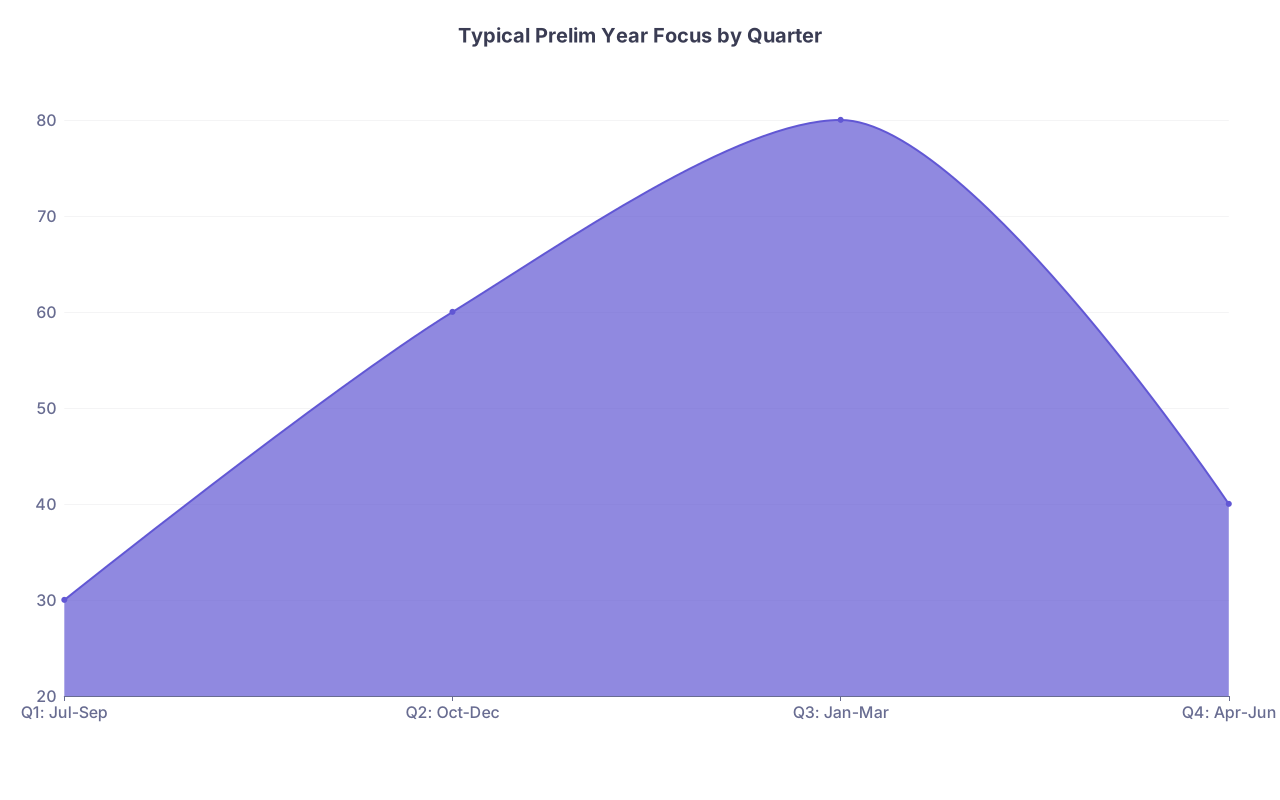
| Category | Value |
|---|---|
| Q1: Jul-Sep | 30 |
| Q2: Oct-Dec | 60 |
| Q3: Jan-Mar | 80 |
| Q4: Apr-Jun | 40 |
Rough idea behind that chart: your career‑planning workload usually peaks mid‑year, then drops as you lock in your next step.
Q1 (July–September): Orientation and Scouting
- Learn the EMR, workflows, personalities
- Identify potential letter writers
- Avoid big mistakes
- Start quietly clarifying your reapplication strategy (talk to mentors outside the institution if possible)
Q2 (October–December): Letters and ERAS Prep
- Lock down letters from early rotations
- Draft and refine your new personal statement with updated experiences
- Request your PD letter if you think it will be neutral or positive; if not, strategize with another senior faculty advocate
Q3 (January–March): Interviews and Backup Plans
- Attend interviews while managing your schedule
- Keep performance solid; this is not the time to implode
- If interviews are scarce, start building Plan B (research year, non-traditional role, off‑cycle openings)
Q4 (April–June): Transition and Mental Reset
- Finish strong clinically
- Close out projects
- Get copies of everything you might need:
- Final evaluations
- Procedure logs
- Any awards or recognitions
- Start mentally shifting to the next phase—don’t let the bitterness of the prelim year poison your start somewhere better.
9. When Saying “No” to the Red Flag Program Is Actually Smarter
Let me be clear: sometimes the bravest, most strategic move is to not sign that contract.
You seriously consider walking away if:
- You already went through one toxic program and it nearly broke you
- Multiple independent sources describe residents being fired or pushed out regularly without clear cause
- You have a credible alternative path this year:
- A paid research year with a strong mentor in your specialty
- A well-structured observership + exam improvement plan (for IMGs)
- A supportive home department willing to back a reapplication
You compare:
- One year in a place that might permanently brand you as “problematic” or give you no letters
- One year improving your application intentionally with people who’ll actually fight for you
Most students chronically underestimate how much damage a vindictive PD or horrible narrative can do. You can fix a low Step score. Fixing “concerns about professionalism” on your record is way harder.
10. The Real Goal: Use the Year; Don’t Let It Use You
A prelim year with obvious red flags is never ideal. It tests more than your knowledge. It tests your boundaries, judgment, and ability to act like a professional adult in an unprofessional system.
But it can still move you forward—if you:
- Stay relentlessly clear on your end goal
- Distinguish between noise (complaints about workload) and signal (patterns of sabotage or abuse)
- Decide consciously—do I take this or walk away?—rather than drifting into it out of fear
- If you do take it, treat it like a short, hard contract, not a marriage:
- Get your sign‑offs
- Get your advocates
- Get one tangible accomplishment
- Get out
You are not your prelim program. You are not the worst night on call or the pettiest attending’s opinion. You’re playing a longer game.
Survive this year. Extract what you need. Document your story. Then aim for a place that actually deserves the doctor you’re becoming. The prelim year is just one chapter; the rest of the book is still unwritten.