

The most dangerous lie about burnout is that it’s all about picking the “right” specialty or job.
You feel that, don’t you? Like if you choose wrong now—hospitalist vs outpatient, academics vs private practice, surgery vs psych—you’re basically signing a contract with future misery. Your brain is trying to turn “career choice” into “burnout prediction model.” And the stakes feel nuclear.
Let’s unpack this honestly. Not the sugar‑coated “self-care and resilience” garbage. The real “what actually makes people crash and burn” stuff.
The ugly truth: every path has burnout landmines
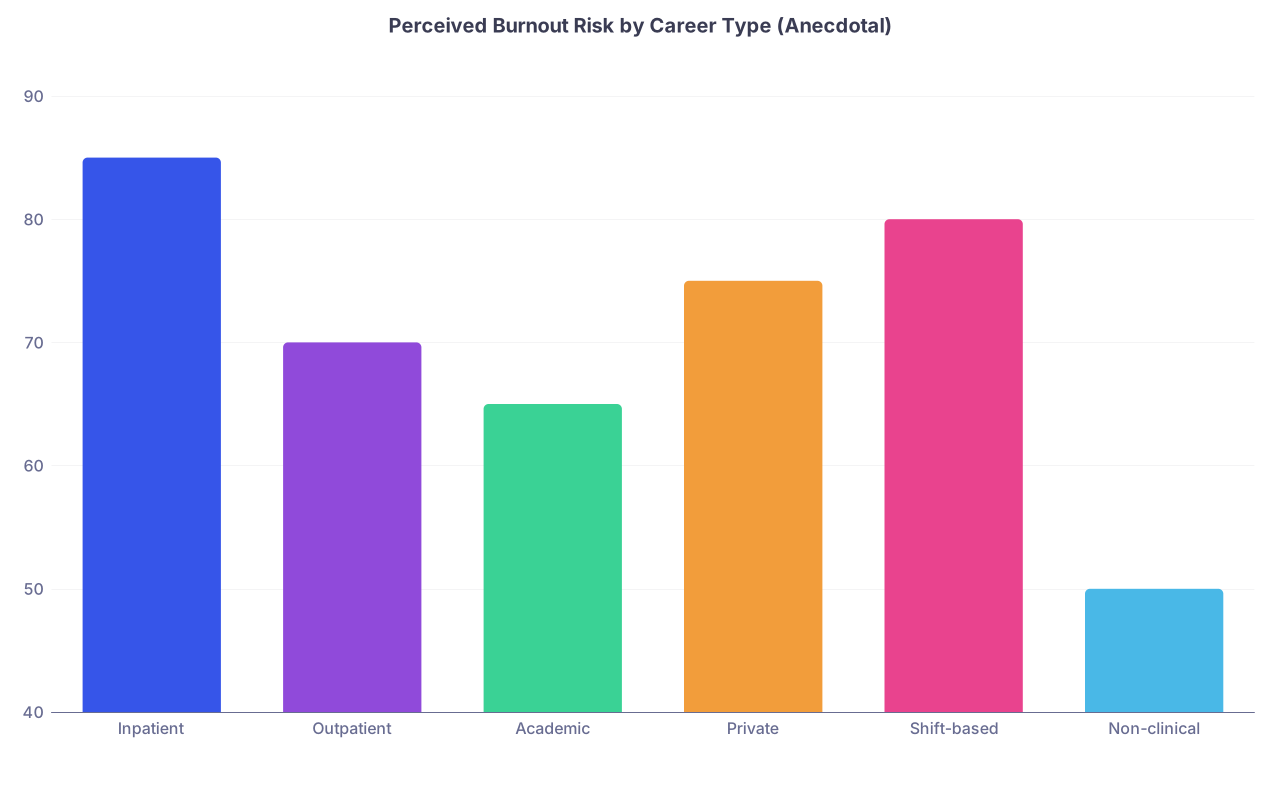
| Category | Value |
|---|---|
| Inpatient | 85 |
| Outpatient | 70 |
| Academic | 65 |
| Private | 75 |
| Shift-based | 80 |
| Non-clinical | 50 |
Here’s the part no one tells you clearly: you’re not choosing between “burnout” and “no burnout.” You’re choosing which flavor of burnout risk you want to manage.
Pick inpatient work? You get:
- Chaos, nights, codes, emotional whiplash, system constraints you can’t fix.
Pick outpatient clinic? You get:
- Back‑to‑back patients, relentless inbox, RVU grind, prior auth hell, phone messages at 4:58 p.m.
Pick surgery? You get:
- High stakes, long cases, early mornings, OR politics, perfectionism on steroids.
Pick psychiatry? You get:
- Emotional heaviness, under-resourced systems, safety concerns, compassion fatigue.
Pick non‑clinical? You get:
- Identity whiplash, impostor syndrome, maybe lower pay at first, feeling like you “left” medicine.
Every path has its own version of:
- Too much work
- Too little control
- Too many demands and not enough support
Burnout doesn’t ask what specialty you chose. It asks: how trapped do you feel? How replaceable? How powerless?
So if your brain is obsessing over “Which career path guarantees I won’t burn out?” the correct answer is: none. But some paths make it a lot easier to recognize you’re burning out early and actually do something about it.
The highest-risk setups (it’s not just the specialty)
The riskiest situations aren’t just “EM vs derm.” They’re patterns. I’ve watched people across specialties implode in similar conditions, like clockwork.
1. High volume + low control = burnout factory
If your days look like:
- Overbooked schedule you don’t control
- No-shows still counted against you
- You get emails about “productivity opportunities” when you’re already drowning
You are in a high‑risk environment. Doesn’t matter if you’re family med, cardiology, or GI. The combo of “do more” + “you don’t get a say in how” is gasoline on burnout.
Think of the difference between:
- Hospitalist with 20+ patients every day, cross‑cover at night, no protected time, constantly told to “discharge earlier”
vs
- Hospitalist with 12–14 capped, dedicated admitter, solid nocturnist coverage, real procedural or teaching time, and stable staffing
Same specialty. Two completely different risk profiles.
2. Chronic nights and circadian abuse
Some people truly tolerate nights well. Most don’t—but medicine acts like everyone should. Long-term night work and brutal schedule flips are a known burnout accelerator.
This hits:
- EM (especially community sites without proper staffing)
- Hospitalists/nocturnists
- ICU
- OB (call-heavy setups)
- Trauma surgery
If your brain runs anxious and your sleep is fragile already, long‑term nights are not just “a challenge.” They’re a liability.
Is it survivable? Yes, especially with:
- Strict sleep protection
- Reasonable number of nights per month
- Actual recovery days built in
But if a job pitch sounds like: “The money is amazing, but it’s 14–16 nights a month and we’re short staffed right now”… that’s your red flag screaming.

3. Toxic culture > specialty choice
You can survive busy. You cannot survive busy + disrespected + unsafe + gaslit.
Toxic setups look like:
- Constant guilt-tripping: “If you don’t stay late, who’ll care for the patients?”
- Leadership that shrugs at unsafe ratios
- No mechanism for feedback that actually leads to change
- Colleagues trash‑talking anyone who sets boundaries
I’ve seen people in “low burnout” specialties absolutely wrecked by toxic group culture, and people in “high burnout” specialties doing surprisingly well in supportive, well-run teams.
So no, the question isn’t just “Which specialty burns out the most?” It’s “How does this specific job treat humans?”
Comparing paths: who’s actually at higher risk?
Let’s get concrete. Obviously, real data is messy, but patterns do show up.
| Path Type | Typical Burnout Drivers |
|---|---|
| Hospital-based inpatient | Nights, volume, documentation |
| Outpatient primary care | RVUs, inbox, prior auth |
| Procedural/surgical | Hours, pressure, complications |
| Shift-based (EM, urgent) | Nights, intensity, crowding |
| Academic medicine | Multi-role overload, low pay |
| Non-clinical/industry | Identity shift, bureaucracy |
Let me walk through how this actually feels from the inside.
Inpatient, hospital-based work
Think hospitalist, ICU, EM, inpatient psych.
Risk spikes when:
- Patient volume is uncapped or absurd
- You’re constantly asked to “do more with less”
- Night shifts are frequent and chaotic
- You’re stuck documenting half your work at home afterward
Psychologically, this can feel like: “I am responsible for everything and control almost nothing.” That’s textbook burnout setup.
Who sometimes thrives here? People who like:
- Clear off days (especially with 7 on/7 off when it’s not abuse-level)
- Intense, discrete episodes of work
- Fast decision-making environments
But if your anxiety already tells you, “If you miss something, disaster will happen,” endless acute care can feed that monster.
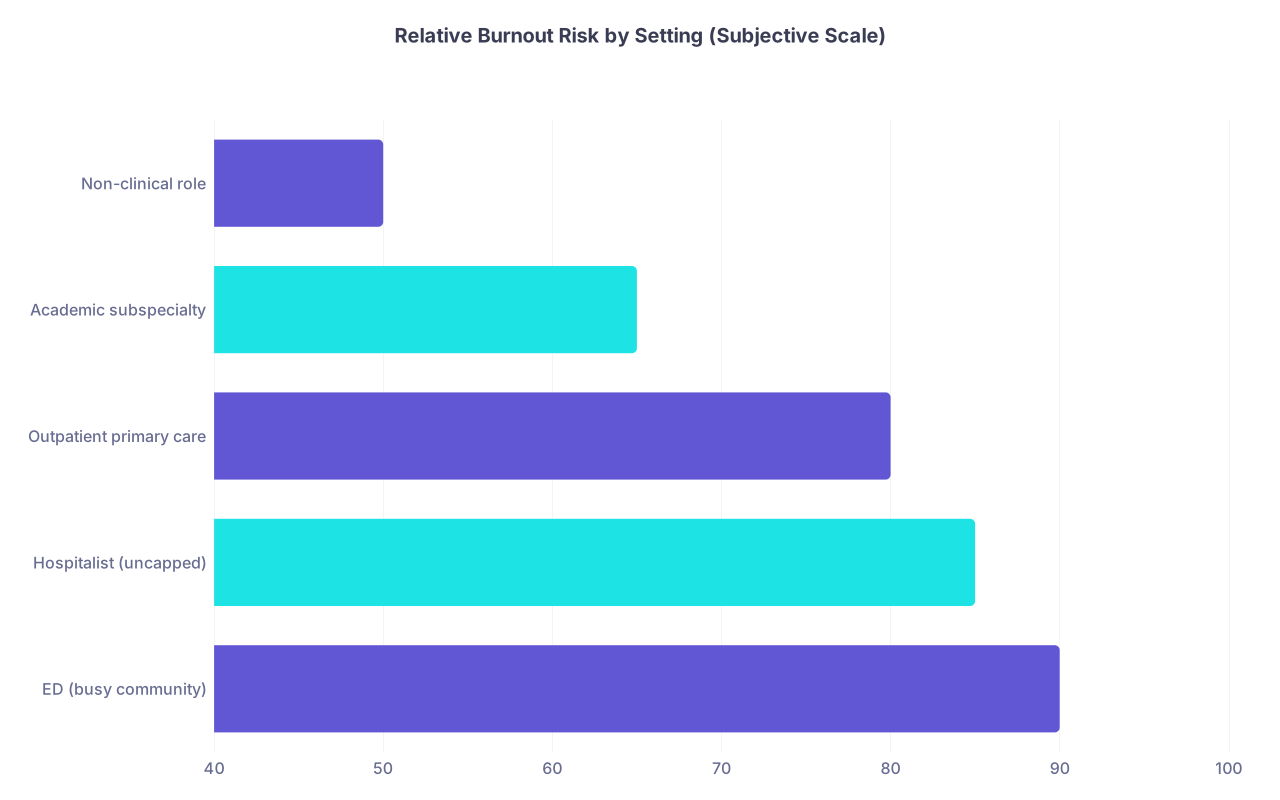
| Category | Value |
|---|---|
| ED (busy community) | 90 |
| Hospitalist (uncapped) | 85 |
| Outpatient primary care | 80 |
| Academic subspecialty | 65 |
| Non-clinical role | 50 |
Outpatient / primary care
On paper, this looks “easier.” No nights (usually). More control (theoretically). But burnout here is death by a thousand clicks.
Risk drivers:
- 15‑minute visits for 8 complex problems
- RVU targets that contradict quality care
- Inbasket messages and refill requests after hours
- Prior auths that turn you into a clerk instead of a physician
The emotional texture is different: you may not be physically exhausted like a trauma surgeon, but you’re mentally fried, constantly behind, and feel like you’re failing everyone.
If you’re conflict‑avoidant and bad at saying no, outpatient can swallow your evenings and weekends through “just one more message.”

Procedural and surgical fields
These have a reputation for burnout, and honestly, it’s not undeserved.
Stress points:
- Long OR days + early starts
- Outcome pressure (complications feel personal)
- OR delays, turnover issues, equipment problems
- RVU/models that punish you when cases cancel or insurance denies
But here’s the twist: many surgeons are less burned out than you’d expect when they have:
- Reasonable case volume
- Good OR staff and anesthesia relationships
- Protected block time
- A life outside the hospital that’s non‑negotiable
If you’re perfectionistic, this field will absolutely magnify that. If your anxiety is more about boredom and feeling underutilized, surgery might actually feel better than a slow clinic.
Shift-based specialties (ED, urgent care, some hospitalist)
On the plus side:
- When you’re off, you’re usually off.
- Time‑limited shifts.
- No long clinic panels calling you on weekends (in theory).
High risk when:
- Shifts are constantly added “just this month”
- You don’t have control over your schedule
- ED is boarding patients with nowhere to go
- You’re working too many nights and switching days/nights too often
This can feel like: “I’m either in total chaos or completely drained and sleeping. There is no in‑between.”
Academic vs private vs non-clinical: who’s safer?
Everyone acts like this is a clean hierarchy:
“Academics = safe and noble, private practice = money and misery, non‑clinical = sellout or escape hatch.”
Reality is less cute.
Academic medicine
Upside:
- Mission-driven: teaching, research, “feels meaningful”
- Colleagues often more collaborative, less RVU-obsessed (not always)
- More built-in variety: clinic + inpatient + teaching + research
Risk:
- You’re doing 5 jobs: clinician, teacher, researcher, admin, mentor
- Lower pay in many fields (with no offset in workload)
- Promotion expectations that never quite get spelled out
- “Just one more committee” creep
Burnout here often looks like: “I’m pulled in every direction, and I’m mediocre at everything now.”
If your anxiety is about “never doing enough,” academic medicine can feel like you’re failing across multiple fronts constantly.

| Step | Description |
|---|---|
| Step 1 | Residency Graduate |
| Step 2 | Inpatient heavy |
| Step 3 | Non clinical/industry |
| Step 4 | High burnout risk |
| Step 5 | Moderate risk |
| Step 6 | Moderate risk |
| Step 7 | Lower risk |
| Step 8 | Clinical focus? |
| Step 9 | Nights frequent? |
| Step 10 | Identity conflict? |
Private practice / employed non-academic
Upside:
- Sometimes more money
- Sometimes more control over schedule and operations
- Less committee/academic bloat
Risk:
- RVU-driven pressure
- Business stress if you’re an owner
- “Customer satisfaction” taken to insane extremes
- You’re suddenly a mini-CEO without any training
The burnout flavor is: “I’m chained to productivity metrics and trying to keep the ship afloat.”
Non-clinical / industry
Everyone treats this as either “failure” or “escape to paradise.” It’s neither.
Upside:
- No pager. No nights. Less acute life-and-death pressure.
- More predictable schedules.
- You’re not documenting 20 pages for a single encounter.
Risk:
- Identity: “Am I still a real doctor?”
- Learning totally new systems, language, corporate culture
- Sometimes more meetings and less direct impact on patients
- Possible pay dip early on, especially if you leave mid-career
People assume non-clinical = burnout cure. It’s a shift in stressors. But yes, for someone who’s utterly exhausted by frontline clinical work, it can dramatically reduce burnout if they find the work meaningful.
The real question: where are you most at risk?
You’re trying to answer the question: “Which path is most dangerous?” But properly, it’s:
“Given who I am, which setup is most likely to corner me into burnout?”
Ask yourself, uncomfortably honestly:
Does chronic sleep disruption wreck me?
If yes, heavy nights/rotating shifts are a major hazard. You’re not weak. Your brain just doesn’t tolerate circadian violence well.Do I obsess over every outcome and replay it in my head?
If yes, ultra-high-stakes acute settings might keep your anxiety on permanent overdrive.Do I have a really hard time saying no or setting limits?
If yes, outpatient roles with infinite inbox creep and hidden work are risky unless you have phenomenal boundaries or support.Do I get bored easily and need intensity to feel engaged?
If yes, a low-volume, slow clinic might burn you out through numbness rather than overload.
Here’s the trap: anxious people assume all of these are true about themselves. “I can’t handle nights, or boredom, or complexity, or pressure.” Your brain is catastrophizing every scenario.
Try this instead: which 1–2 of these feel most like something that’s broken you before? Long-term sleep loss? Feeling micromanaged? Having no autonomy?
That’s where your red flags should be.

How to lower burnout risk no matter what you choose
You can’t pick a career that magically immunizes you. You can pick one that:
- Gives you a way to change jobs without starting over
- Lets you adjust your hours or role as your life changes
- Doesn’t lock your identity to one hyper‑narrow capability
A few very un‑sexy but honest strategies:
Prioritize options over prestige. A flexible specialty or skillset (IM, FM, psych, anesthesia, EM, radiology with extra skills, IM subspecialties) gives you room to move: inpatient vs outpatient, telehealth, urgent care, locums, admin, industry, etc. When you’re trapped, burnout sticks.
During interviews, ask brutally specific questions about:
- Average daily patient load
- Nights/weekends, and how often people are called in on “off” days
- Number of hours people actually spend on charting after work
- How many physicians left in the last 2–3 years and why
And watch their faces, not just their words.
Assume your future self will need to lighten the load at some point. Kids, illness, aging parents, your own health—something will hit. Choose a path where dropping to 0.8 FTE or shifting your mix (more clinic/less call, more telehealth, some non-clinical) is structurally possible.
Normalize changing your mind. The most burned‑out people I’ve seen weren’t in “bad” specialties—they were in good specialties they felt guilty leaving. You’re not signing a blood oath at graduation.
What you’re really afraid of
Underneath “Which career path has the most burnout?” is usually:
- “What if I ruin my life?”
- “What if I spend my 20s and 30s training for something that makes me miserable?”
- “What if I can’t get out once I realize I hate it?”
Here’s the hard, grounding truth: you might choose a path that doesn’t fit you long‑term. You might realize five years in that inpatient work slowly destroys you. Or that clinic makes you feel like a robot. Or that industry work leaves you oddly empty.
And you will still not be trapped. Not in 2026 medicine.
People pivot. Constantly. Hospitalist to outpatient. Outpatient to telehealth. Clinical to medtech. EM to urgent care + admin. Cards to utilization review. Dermatology to industry. Yes, even the “perfect” specialties.
The goal is not “never change.” The goal is: don’t box yourself into a corner where the only way out is burning out so badly you walk away from everything.
So… which path is “worst”?
If you forced me to rank highest baseline burnout risk in broad strokes, averaged over lots of messy reality, it’d roughly look like:
- Very high: ED (busy community), uncapped hospitalist, insanely RVU-driven primary care, call-heavy surgical subspecialties with toxic culture
- High: most inpatient-heavy jobs with nights, high-volume outpatient with poor admin support
- Moderate: balanced academic roles with semi‑reasonable expectations, well-staffed hospitalists with good caps, lower-volume outpatient with team support
- Lower (not zero): non-clinical roles you actually like, mixed clinical/admin jobs with control, part-time or niche practice you chose on purpose
But that ranking means nothing without you in the equation.
You are not a generic FTE.
FAQ (exactly 4 questions)
1. I’m already scared I’ll burn out no matter what. Is that a sign I shouldn’t practice clinically?
No. It’s a sign you’re paying attention and have an anxious brain that likes worst‑case scenarios. The people who scare me more are the ones who say, “I’ll be fine, I can handle anything, I don’t need sleep.” You’re more likely to notice early warning signs because you’re already tuned into your own distress. That’s annoying day to day, but protective long term. You might eventually shift toward a lower-intensity clinical role or partly non-clinical work, but that’s not failure—that’s adjusting dosage.
2. Is there any specialty that truly has “low burnout”?
Not in the fantasy way you want. Some have relatively lower burnout in surveys (derm, ophtho, radiology, path, PM&R sometimes), but even in those, plenty of people are miserable in bad jobs. And plenty of people in “high burnout” specialties are content because their job is structured sanely, and they’ve drawn hard boundaries. So chasing “the burnout-proof specialty” is like chasing a unicorn. Better to chase: tolerable call, supportive culture, humane leadership, and flexibility.
3. What if I pick a high‑risk path and realize later I can’t handle it?
Then you change it. That might mean switching from ED to urgent care/telehealth, from hospitalist to clinic/admin mix, from heavy OR to more clinic in your specialty, or from clinical entirely to pharma/quality/utilization review/tech. Will it be simple? No. Will there be ego hits and maybe a pay reset? Probably. But I’ve yet to meet someone who crawled out of a truly soul‑sucking setup and said, “I wish I’d stuck it out another decade.”
4. What’s one concrete thing I can do right now to protect my future self from burnout?
Today, not next week: open a document and write down your absolute non‑negotiables for a job. Things like “no more than X nights/month,” “capped patient load,” “no expectation of answering non-urgent messages on weekends,” “real vacation coverage,” “leadership that actually works shifts.” This becomes your filter when you’re job hunting. If a job violates more than one or two of these, you don’t rationalize it away. You walk. Your future self will be exhausted, vulnerable, and tempted to compromise. Give them a written line in the sand now.
Close the tab with all the “burnout by specialty” articles for a second. Open a blank page. Write your top 3 actual fears about your future career—and then one boundary you’ll refuse to cross for each. That’s your starting point.


