

The cult of “you must become a partner to get rich” is one of the most persistent myths in post‑residency medicine. And it’s pushing a lot of smart physicians into bad deals.
Let me be blunt: partnership is not automatically the Golden Ticket. Sometimes it’s a pay cut wrapped in a prestige bow. Sometimes it’s a risk transfer from the senior docs to you. Sometimes it’s just employment with extra paperwork and no real control.
The Myth: “Owners Always Make More Money”
You hear it in lounges and at conferences: “You have to get to partnership—that’s where the real money is.” People say this like it’s gravity. Untouchable. Universal.
It is not.
Here’s what the data and real-world numbers actually show.
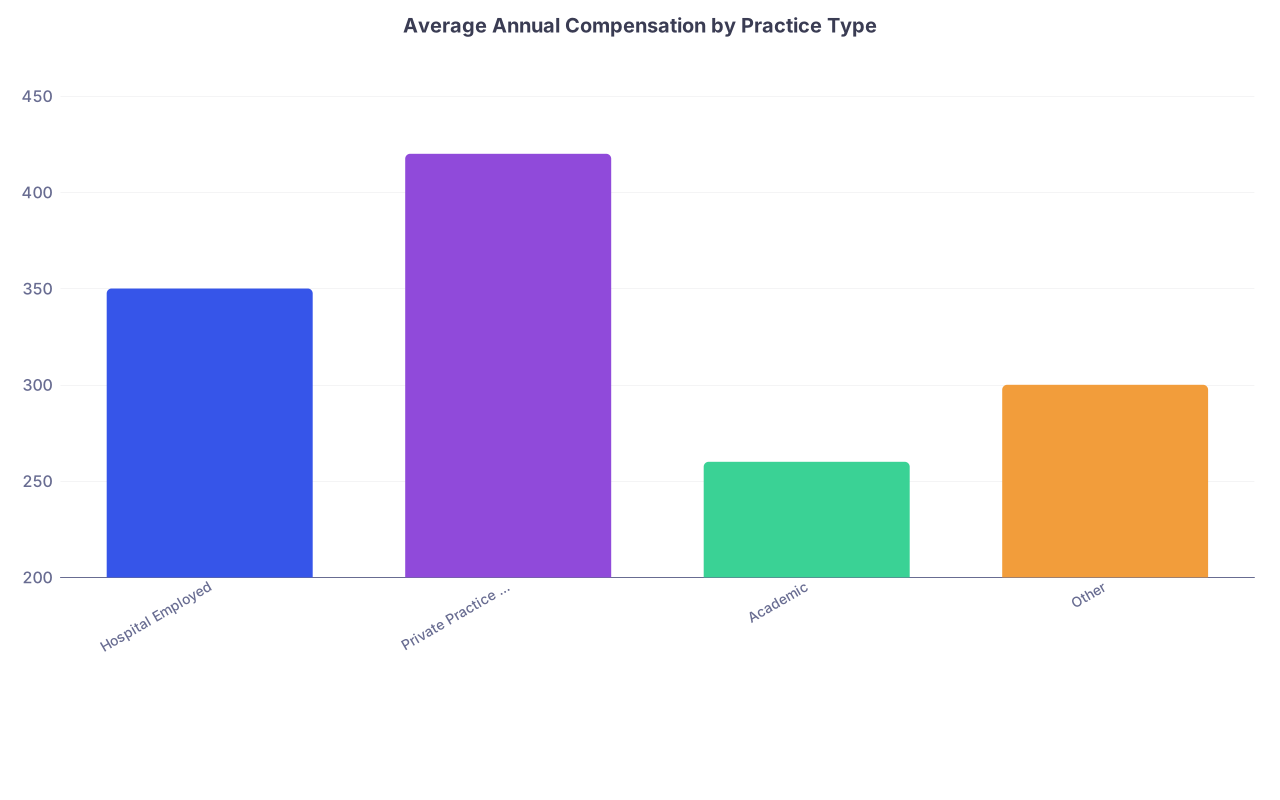
| Category | Value |
|---|---|
| Hospital Employed | 350 |
| Private Practice Owner | 420 |
| Academic | 260 |
| Other | 300 |
On paper, yes, owners on average make more than employed physicians in many specialties. MGMA and other compensation surveys consistently show higher top-end earnings in private practice and partnership models.
But that top-line number is only the first layer. Ownership wealth is not just “income.” It’s:
- Net of buy‑in costs
- Net of unpaid admin time
- Net of personal risk and guarantees
- Net of practice debt and overhead volatility
- Net of taxes on passthrough income you may not actually receive in cash
I have seen plenty of “partners” clearing less effective hourly pay than their hospital-employed peers once you factor in admin meetings, HR headaches, and off-the-clock work.
The right question isn’t “Do partners make more?”
It’s “What is my risk-adjusted, time-adjusted take‑home over 5–10 years?”
Most people never run that math. They just hear: “Partner makes $700K. Employed makes $450K. Done.” And walk right into a trap.
The Buy‑In Trap: Paying for Yesterday’s Goodwill
The most overlooked myth: that the “buy‑in” is always a rational investment in future earnings.
Reality: a lot of buy‑ins are simply a transfer of value from junior physicians to senior ones, especially in mature practices whose growth days are behind them.
Common pattern I’ve seen:
- Practice valued at some inflated multiple of prior years’ earnings
- Little to no hard assets (modest equipment, small AR, declining payer mix)
- Senior partners cashing out as younger physicians buy in
- Plateaued or shrinking volume masked by historical numbers used for valuation
You are not buying “future magic.” You are often buying someone’s past grind.
Let’s put rough numbers to it.
Say the practice offers you partnership with a $400,000 buy‑in, paid over 5 years ($80K/year after tax). As a partner, they say you’ll make $700K instead of $450K as an employee.
Sounds great. Until you actually model it.
First, compare two paths over 5 years:
| Scenario | Annual Pre-tax Pay | Extra Costs | 5-Year Total Pre-tax |
|---|---|---|---|
| Employed | $450,000 | $0 | $2,250,000 |
| Partner | $700,000 | $80,000 buy-in/yr | $3,100,000 |
Looks like partner wins big. But that table leaves out several realities:
- Partner income is more volatile and tightly tied to productivity and collections.
- You’re paying tax on passthrough income you might not fully receive in cash (retained earnings to fund working capital or partner distributions skewed to seniors).
- You’re absorbing personal or partial guarantees on leases, lines of credit, or hospital contracts.
- Your admin time is “paid” in that $700K, but it’s still your fatigue, your evenings, your weekends.
I’ve watched more than one new partner realize, two years in, that their actual after-tax discretionary cash—once you subtract buy-in payments, higher self-employment tax, and variable distributions—doesn’t look that different from what their hospital-employed friend brings home. Except the friend doesn’t have to care about payroll, EMR vendor negotiations, or why Blue Cross just changed a local policy.
Partnership can still be a good deal. But you need to look at the buy‑in like an investor, not like a grateful recent grad who finally “got chosen.”
Ask: “If I were buying this practice as a non-physician investor at this price, would I do it?”
If the honest answer is no, then you already understand more than some new partners.
Control vs Illusion of Control
Another myth: ownership equals control. In theory, yes. In many real practices? Not really.
Common scenario: a 6-partner group where two senior docs effectively run the show. The buy‑in makes you “equal” on paper. In the room, not so much.
I’ve seen new partners tell me:
- “Technically, I have an equal vote, but the two founding partners always pre‑decide everything before the ‘meeting.’”
- “All the meaningful decisions are constrained by historical vendor contracts they signed 10 years ago.”
- “We’re ‘independent’ but completely dependent on one hospital’s call contract that could evaporate with one system merger.”
You might think you are buying autonomy. Sometimes, you are. Sometimes you’re buying into a system that’s just as rigid as a hospital, minus the HR department and with more personal financial risk.
Contrast that with a well-structured employed position: predictable hours, clear RVU or salary model, standard benefits, and you walk away clean if you leave.
Ownership only has real value if:
- Governance is genuine, not symbolic
- You actually influence strategy, staffing, scheduling, and capital decisions
- The economic engine is durable enough that your “control” isn’t just rearranging deck chairs on a sinking ship
If the practice’s biggest payer (say, a single dominant commercial plan) slashes reimbursement and you own 1/7th of the disaster, “control” starts feeling overrated.
The Risk You’re Quietly Absorbing
Here’s the part people gloss over in the partnership pitch: risk.
As an employed doc, your risk is mainly professional and career-based. Reputation, performance, maybe a non-compete that boxes you in geographically.
As an owner, you add:
- Contract risk (hospital, payer, facility)
- Overhead risk (rent hikes, staff wage inflation, malpractice premiums)
- Regulatory risk (CMS changes, prior auth expansions, coding audits)
- Liability risk around billing practices you didn’t design but now co-own
Let me give you a concrete example I watched in real time.
A multi-specialty group anchored on a juicy commercial payer contract. Reimbursement above Medicare, strong volumes, happy partners. Then a regional consolidation. The payer slams reimbursement closer to Medicare levels over two renewals.
Suddenly:
- Partner distributions drop 25–30%
- They’re stuck with a long-term office lease at high rates, signed when times were good
- Staff salaries ratcheted up during the tight labor market and now are hard to cut without imploding morale
- Nearest hospital-employed group is offering guaranteed comp that now exceeds what some mid-level partners are drawing
The oldest partners shrug; they’ve already had their decade plus of high earnings.
The newest partners? Still paying buy-in. Staring at a fundamentally worse deal than the one they signed up for.
That’s ownership. Upside—which people love to talk about—and downside, which gets buried behind “entrepreneurship” buzzwords.
The Time Cost: Wealth vs Life
Wealth isn’t just money. It’s money plus time plus optionality.
This is where ownership often gets romanticized. “You’ll own your schedule. You can shape your life.” Sometimes true. Sometimes you just swap one boss for twelve and add endless meetings.
New partners discover:
- Evening emails about staffing crises
- Weekend calls about broken equipment, network outages, or angry referring docs
- Compensation debates that feel like political campaigns
- Hiring/firing conflict, especially when HR “is you now”
Meanwhile, your hospital-employed friend works 4 days a week, 44 hours, takes their PTO, and never once thinks about whether the front desk staff is about to quit.
You need to include your time in the equation. If partnership pays another $150K but you’re essentially working an extra 10 hours a week between admin, planning, and mental load, that “extra” money is buying back time you gave up. Some people are fine with that trade. Many are not, once they feel it.
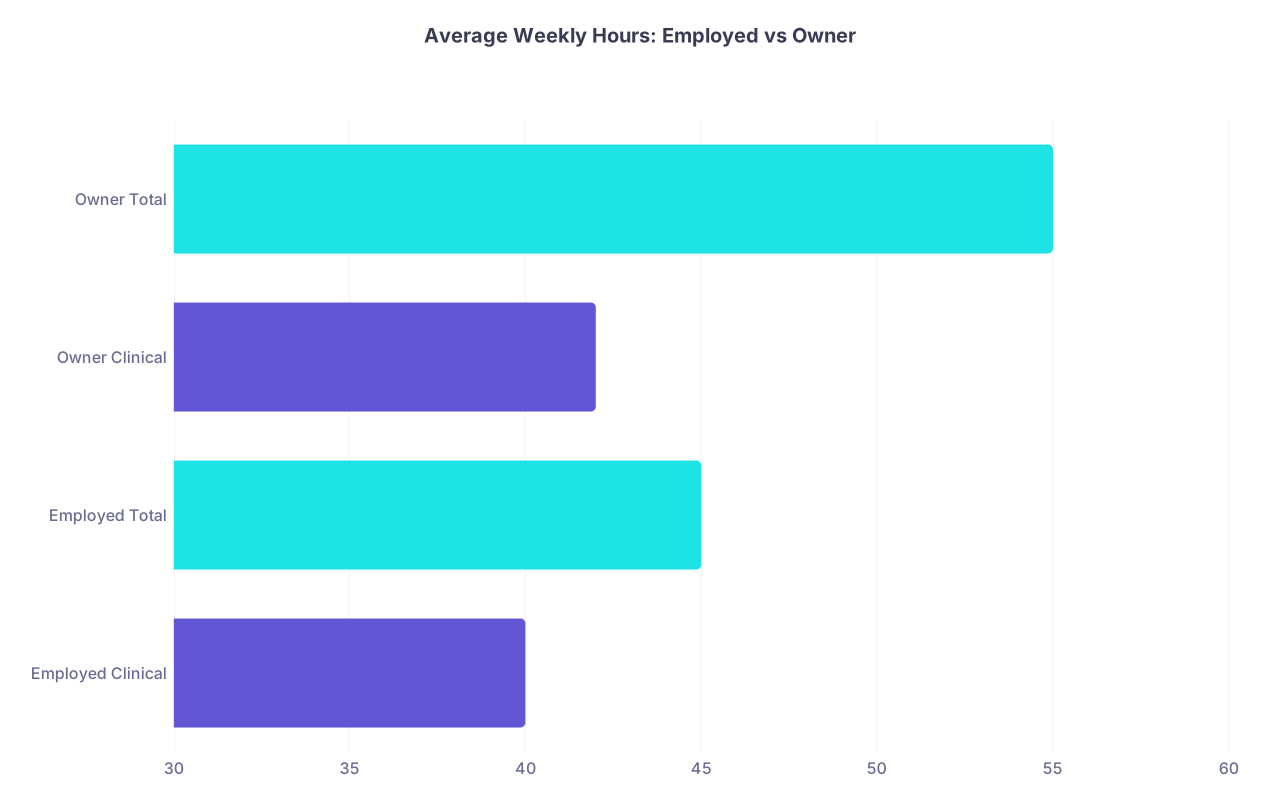
| Category | Value |
|---|---|
| Employed Clinical | 40 |
| Employed Total | 45 |
| Owner Clinical | 42 |
| Owner Total | 55 |
What matters is not the title. It’s what your weeks actually look like. And whether that reality fits the life you want in your 30s and 40s, not some abstract “someday, I’ll slow down” fantasy.
The Tax Illusion
One more sacred cow: “But the tax advantages of ownership!”
The line usually goes: “You can run so many things through the practice. You’ll save a ton on taxes. With an S‑corp or partnership structure, it’s way more efficient than W‑2.”
There is some truth here. But it’s often oversold.
Yes, as an owner, you may:
- Deduct legitimate business expenses pre‑tax
- Optimize distributions vs salary (within reason) for payroll tax savings
- Use retirement plans creatively (defined benefit, cash balance, etc.)
But let’s not pretend the IRS is a charity.
Employed physicians at high-income levels already hit the caps for Social Security. Much of the real game is federal and state income tax. Your “savings” as an owner depend heavily on how aggressive you want to be and whether the practice’s structure actually supports meaningful optimizations.
I’ve seen docs buy in thinking, “I’ll save 10–15% on taxes,” then realize most of the delta is far smaller, especially after paying for accounting, legal, and practice overhead. And if your extra profit is largely being plowed back into the practice or used to fund partner distributions unevenly, those theoretical savings may not show up in your personal account the way you expect.
Tax advantages are nice. They are not a reason by themselves to assume partnership equals greater net wealth.
When Ownership Does Make Sense
Now, I’m not anti-ownership. I’m anti‑fantasy.
Partnership or true ownership can be a massive wealth lever when a few conditions line up:
- The buy‑in is rational relative to cash flow and growth prospects, not just “what the last person paid.”
- Governance is transparent, financials are clean, and you see actual P&Ls and balance sheets, not just hand‑wavy “we all do well here.”
- The practice has realistic levers for growth: underutilized capacity, strong referral base, room for ancillaries (imaging, ASC, etc.), or market tailwinds.
- Exit mechanics are clear. You know how you get out, what you get paid, and how succession works.
I’ve seen younger physicians buy into groups with:
- Strategically located offices
- Thoughtful use of advanced practice providers
- Shared ancillaries like surgery centers or imaging
- A culture of reinvestment, not just milking the cow
Those folks did extremely well. But notice what I just described: an actual business with strategy, not a tired partnership coasting on reputation from 2005.
How to Think Like an Investor, Not a Supplicant
Here’s where you need to flip your mindset.
You are not being “granted” partnership like a diploma. You are being asked to invest capital, labor, and reputation into a small business.
So you evaluate it like an investor:
- What am I paying? To whom? For what exactly (hard assets, accounts receivable, goodwill)?
- What is the realistic range of future earnings after all costs, including my time and risk?
- What’s my downside scenario? If reimbursements drop, volume dips, or a major hospital contract evaporates, how bad can this get?
- What’s the exit? How liquid is this equity? Can I sell it? Is it only back to the group at a formula that may or may not be fair in 10 years?
And then you compare it—not to the prestige of the word “partner”—but to your best alternative. That might be:
- A high-paying hospital-employed gig with a strong RVU model
- A hybrid role splitting clinical work with admin or side ventures
- Joining a larger integrated group with some equity but more diversification of risk
One more thing: the older generation’s playbook is not automatically yours. They built wealth in a very different reimbursement world. Talking to a 65-year-old partner who crushed it from 1995–2015 does not guarantee you the same upside from 2025–2045.
Different game. Different rules.
The Bottom Line
Partnership is not sacred. It is a financial product plus a governance structure, wrapped in a lot of cultural baggage and ego.
If you strip the emotion away and look at the numbers, risk, and lifestyle honestly, you’ll find:
- Ownership is not automatically the path to more wealth; it’s a leverage play with real downside that many physicians underestimate.
- The value of partnership depends on the specific deal—buy‑in terms, governance, growth prospects, and your own time and risk tolerance—not on the title.
- You are not a grateful trainee anymore; you’re an investor. Treat any partnership offer like an investment memo, not a rite of passage.


