
The fastest way to screw up your first year as an attending is to treat every practice model like it’s the same job with different logos. It isn’t.
Your first 12 months will look radically different in academic, private, hospital-employed, and locums work—different pressure points, different landmines, different milestones. If you walk into month 1 without a plan for your specific model, you will spend the year reacting instead of building a career.
Let’s fix that.
Below is a chronological, “at this point you should…” guide to your first year as an attending across four common practice models:
- Academic faculty
- Private practice partner-track
- Hospital-employed
- Locums / traveling attending
We’ll run the same 12‑month clock for each so you can see what should be happening, and by when.
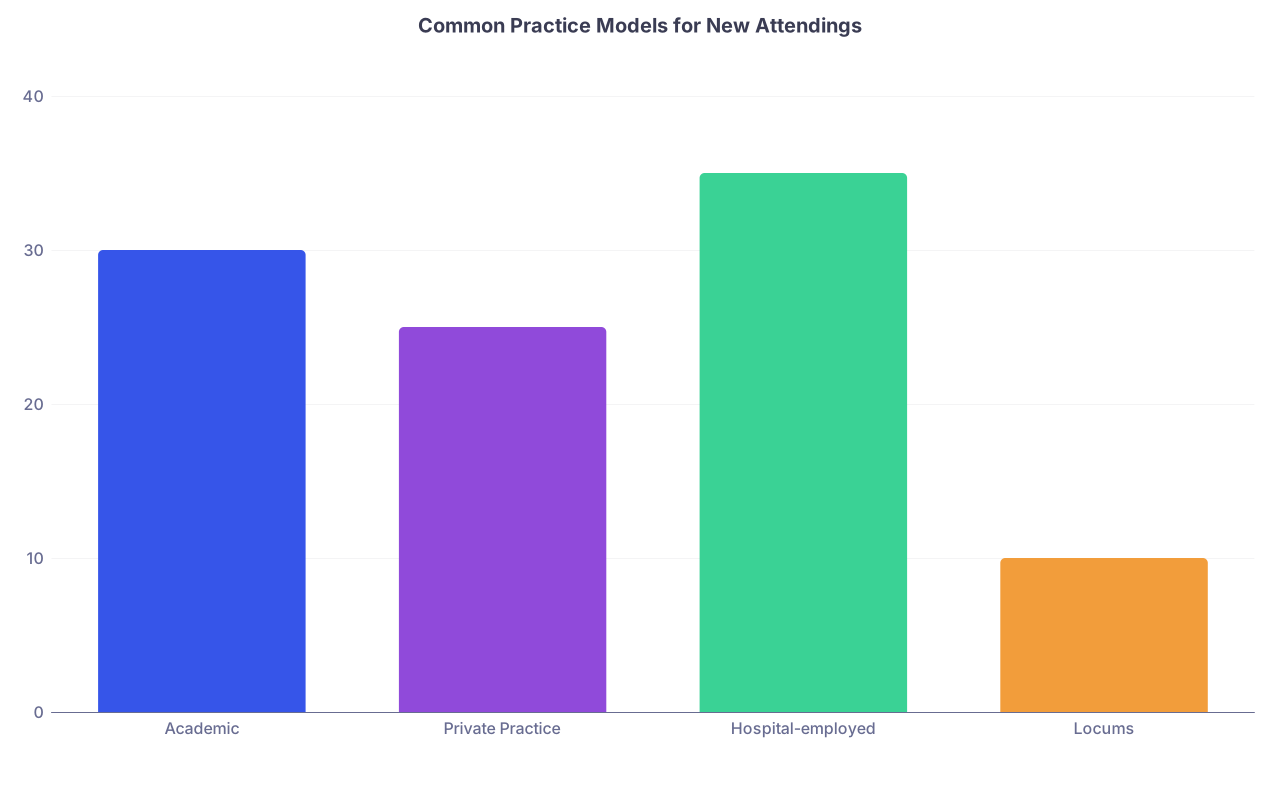
| Category | Value |
|---|---|
| Academic | 30 |
| Private Practice | 25 |
| Hospital-employed | 35 |
| Locums | 10 |
Month 0–1: Landing and Orientation
Academic Attending (Assistant Professor / Instructor)
By the end of Month 1, you should:
- Have a clear FTE breakdown in writing
- Example: 60% clinical, 20% teaching, 20% research/admin
- Know exactly who signs off on:
- Your schedule
- Your promotion file
- Your research time
At this stage you should:
Meet your division chief and mentor (separately).
- Chief: clarify RVU expectations, clinics, call, and “unwritten rules” (who actually gets protected time, who doesn’t).
- Mentor: ask, “If I want to be promoted in 5–6 years, what do I need in years 1–2?”
Lock down your evaluation metrics.
- RVUs vs. academic output vs. teaching scores.
- Get the actual numbers—do not accept vague answers.
Sort out basic infrastructure.
- EMR templates, note macros, order sets.
- Teaching responsibilities: which residents, which conferences, how often.
Red flag in Month 1: you’re “helping with lots of projects” but nothing is actually yours.
Private Practice (Partner-Track)
By the end of Month 1, you should:
- Have your partnership track terms in writing:
- Timeline (2 years? 3 years?)
- Buy-in formula
- How compensation changes at partnership
At this stage you should:
Sit down with the managing partner.
Ask bluntly:- What did the last person in my role bill in year 1?
- Why did the last associate not make partner (if one failed)?
- What does “culture fit” actually mean here?
Understand call and work distribution.
- Are you getting the leftovers or real volume?
- How are new patient referrals assigned?
Start tracking your numbers from day 1.
- New consults, procedures, collections, RVUs (whatever drives revenue there).
Red flag in Month 1: nobody wants to explain the buy-in, or they keep saying “we’ll talk about that later.”
Hospital-Employed Attending
By the end of Month 1, you should:
- Know your productivity targets and base vs. incentive comp.
- Have met:
- Practice manager
- Billing/coding educator
- Service line director
At this stage you should:
Review your contract with your actual schedule in hand.
- Compare promised clinic/OR time vs. reality.
- Identify any “bait and switch” early while you still have leverage.
Get trained on documentation for billing.
- Learn how to avoid leaving money on the table (and avoid audits).
- Ask for a 1‑month and 3‑month coding review of your charts.
Clarify support staffing.
- MAs, scribes, APPs, call room logistics, after-hours coverage.
Red flag in Month 1: your schedule is packed but your support staff is minimal or chaotic.
Locums / Traveling Attending
By the end of Month 1, you should:
- Have completed onboarding at your first site and know if you want a second site in the rotation.
- Understand exactly what you’re responsible for clinically and administratively.
At this stage you should:
Clarify the scope creep line.
- Are you covering extra units? Extra call? Admin tasks?
- If “just this once” becomes every shift, you push back early.
Dial in your logistics system.
- Travel, housing, documentation templates, backup licenses.
- Build a pre-shift checklist: passwords, on-call numbers, local policies.
Track real hourly earnings.
- Include unpaid charting time, travel, credentialing delays.
Red flag in Month 1: you’re expected to behave like core staff (meetings, committees) without core staff pay or security.
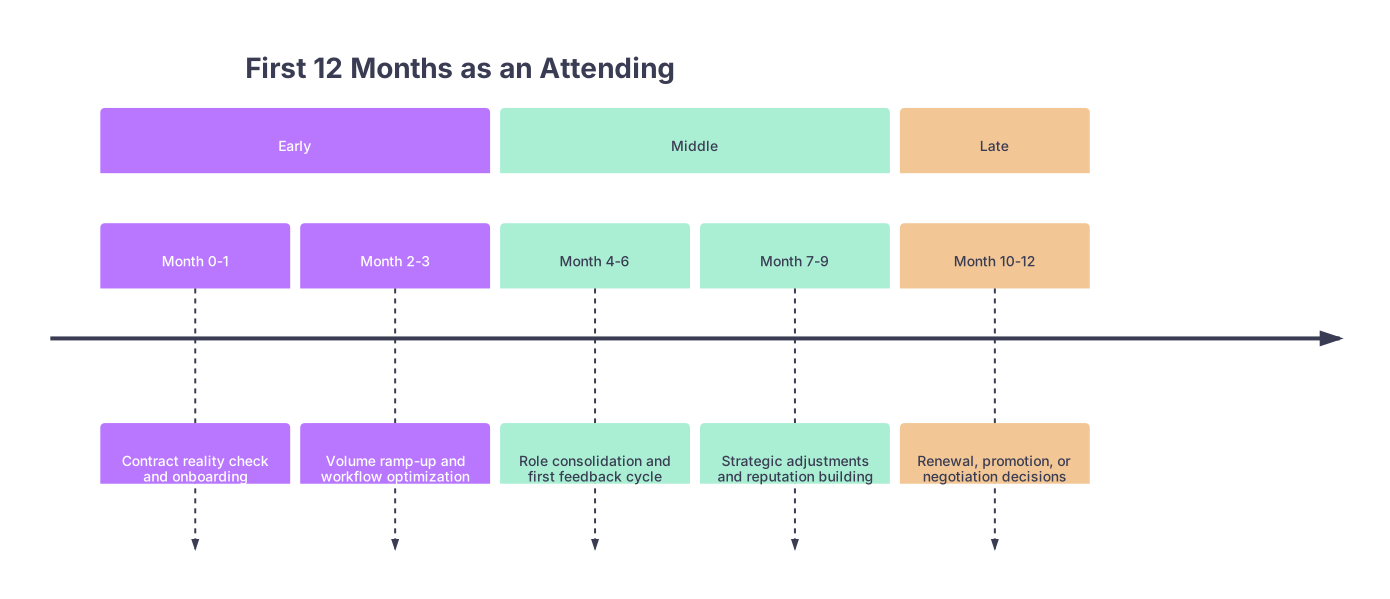
| Period | Event |
|---|---|
| Early - Month 0-1 | Contract reality check and onboarding |
| Early - Month 2-3 | Volume ramp-up and workflow optimization |
| Middle - Month 4-6 | Role consolidation and first feedback cycle |
| Middle - Month 7-9 | Strategic adjustments and reputation building |
| Late - Month 10-12 | Renewal, promotion, or negotiation decisions |
Months 2–3: Volume, Workflow, and Reputation
This is when the “new attending glow” wears off and the grind hits.
Academic
By the end of Month 3, you should:
- Have 1–2 clearly defined academic projects with your name near the top.
- Be reliable on your core clinical service (no more “new attending” excuses).
At this point you should:
Trim your commitments.
- Say no to every committee that doesn’t directly help promotion or mentorship.
- Keep one teaching commitment you do well (e.g., noon conference).
Standardize your clinical workflow.
- Templates for common notes.
- Clear expectations with residents: pre-round plan, sign-out structure.
Ask for early feedback.
- Quick 15‑minute meeting with chief: “Anything worrying you about my performance so far?”
Private Practice
By the end of Month 3, you should:
- Know your monthly collection/RVU trend and if you’re on track for partnership expectations.
- Start building a direct referral base (PCPs, surgeons, etc. who know you by name).
At this point you should:
Meet key referring clinicians.
- In person. Not just an email.
- “I’m new in the group, here’s what I do especially well, here’s my cell for urgent issues.”
Fix bottlenecks.
- New patient wait times? Procedure access? Imaging delays?
- Work with staff to protect “rapid access” slots for high-yield referrals.
Study your payor mix.
- Private vs Medicare vs Medicaid.
- Understand what actually generates revenue in your practice.
Hospital-Employed
By the end of Month 3, you should:
- Have your first productivity snapshot (RVUs, visits, procedures).
- Be comfortable enough with EMR that documentation is not doubling your day.
At this point you should:
Audit a week of your notes with coding.
- Fix undercoding habits.
- Catch anything that could trigger denials.
Clarify what “bonus eligible” really means.
- Run a mock calculation with your current volume.
Build alliances with nursing and APPs.
- These are the people who will save your career—or quietly destroy your days.
Locums
By the end of Month 3, you should:
- Have tested at least one additional site or at minimum decided to commit or swap current site.
- Have a predictable average income and schedule pattern.
At this point you should:
Decide your primary goal.
- Income maximization? Geographic flexibility? Bridge to permanent job?
- This determines how aggressively you chase more shifts vs. better conditions.
Create a “site playbook” for each facility.
- Local policies, phone numbers, admission criteria, tricky personalities.
Reassess agency relationship.
- Are they advocating for you or just filling slots?
- Negotiate rate increases if you’re pulling heavy weight.

Months 4–6: Consolidation and First Real Checkpoints
This is when patterns harden. Good or bad.
Academic
By the end of Month 6, you should:
- Have at least 1 manuscript / grant / curriculum project in progress with realistic timelines.
- Be on track for teaching evaluations that won’t hurt promotion.
At this point you should:
Do a 6‑month CV audit with your mentor.
- Ask, “If I keep this pace, where do I sit at 3 years?”
- Adjust: maybe fewer side projects, more focused big ones.
Guard your nonclinical time. Brutally.
- Block it in the schedule.
- Do not let it be “overflow clinic” unless you decide strategically.
Refine your teaching style.
- You should have 2–3 go-to teaching scripts (for common conditions, interpretation frameworks, etc.).
Private Practice
By the end of Month 6, you should:
- Have clear volume growth and early sense of your earning ceiling.
- Understand exactly how partners talk about you when you’re not in the room.
At this point you should:
Ask for a semi-formal review.
- “Am I on track for partnership?”
- “Are there concerns I should address in the next 6 months?”
Dial in your schedule template.
- New vs follow-up slots, procedure blocks, same-day add-ons.
- Reduce no-shows with staff reminders and previsit planning.
Start thinking about personal brand.
- Do local talks, write a short newsletter, offer to be “the person” for a niche.
- Example: complex diabetes, sports hips, difficult headache, etc.
Hospital-Employed
By the end of Month 6, you should:
- Know if your current volume makes your bonus realistic or fantasy.
- Have clarity on whether your job is clinically sustainable.
At this point you should:
Meet with your medical director.
- “Here’s what’s working. Here’s what’s not. Here’s my volume and coverage.”
- Ask what changes are possible before year-end.
Fix burnout precursors early.
- Chronic overbooking? Weekend calls creeping up?
- Use data, not complaining. Show your panel size, wait times, RVUs.
Take one real break.
- A week off where you actually disconnect.
- If you can’t step away for 5–7 days by month 6, your system is broken.
Locums
By the end of Month 6, you should:
- Know whether locums is a 12‑month plan or a 2–3 year strategy.
- Have smoothed most logistical chaos.
At this point you should:
Adjust your mix of sites.
- Drop toxic places.
- Keep sites that respect your time and skills, even at slightly lower hourly.
Review your effective hourly rate across sites.
- Include call burden, downtime, charting, travel.
Decide on benefits strategy.
- Retirement accounts, malpractice tail planning, health insurance.
| Model | Must-Have by 6 Months |
|---|---|
| Academic | Defined projects + realistic promotion map |
| Private Practice | On-track volume + partnership expectations |
| Hospital-Employed | Clear bonus reality + sustainable schedule |
| Locums | Stable site mix + income pattern |
Months 7–9: Strategic Adjustments and Positioning
This is where you quietly set up your second year.
Academic
By the end of Month 9, you should:
- Be able to articulate a coherent academic niche in 1–2 sentences.
- Have at least one mentor outside your immediate division.
At this point you should:
Say no more often.
- If a new ask doesn’t move promotion or genuine interest, skip it.
- Protect bandwidth for your main academic output.
Plan for your first national presentation or abstract.
- Conferences often have deadlines 6–12 months out.
Start informal promotion conversations.
- Not to rush it—just to check if you’re on track for timelines and expectations.
Private Practice
By the end of Month 9, you should:
- See consistent referral patterns with your name attached.
- Have a realistic estimated income for your first full year.
At this point you should:
Target inefficiencies that hurt both you and the group.
- Slow discharge process, imaging delays, blocked OR access.
- Propose fixes that improve revenue or flow; this builds partner goodwill.
Clean up your documentation and coding.
- Audit a handful of charts with billing.
- Get ahead of any issues before you hit partner-level scrutiny.
Clarify partnership expectations one more time.
- Especially non-financial ones: meetings, community involvement, leadership roles.
Hospital-Employed
By the end of Month 9, you should:
- Know whether you want to renew, renegotiate, or start looking elsewhere when your contract comes due.
- Understand what levers you can realistically pull: schedule, support, comp.
At this point you should:
Quietly scan the market.
- Not necessarily to leave—but to know your value.
- Talk to a recruiter or two, look at postings, ask colleagues in other systems.
Gather your own data for negotiation.
- RVUs vs target, panel size, visit volumes, call burden.
Decide on 1–2 non-negotiables for year 2.
- Example: no more than X calls/month, protected clinic blocks, or a scribe.
Locums
By the end of Month 9, you should:
- Have a solid reputation at your core sites—someone they request back.
- Know whether you’re drifting toward a permanent offer at any site.
At this point you should:
Decide if you’d entertain conversion to permanent.
- If yes, start feeling out leadership on structure and salary.
- If no, keep boundaries crystal clear.
Create a yearly financial plan.
- Taxes, retirement, emergency fund.
- Locums without financial discipline is a trap.
Check for burnout. Hard.
- Constant travel and onboarding fatigue can sneak up on you.
Months 10–12: Decision Points and Year 2 Setup
The final quarter is where people either lock in a sustainable trajectory or quietly spiral.
Academic
By the end of Month 12, you should:
- Have tangible scholarly output: at least one submission (paper, grant, curriculum) and active projects.
- A promotion-oriented CV that a senior person says is “on track.”
At this point you should:
Schedule an annual review with your division chief.
- Ask direct questions: “If I keep this pace, will I be competitive for promotion on time?”
- Get specific feedback in writing if possible.
Refine your 3‑year plan.
- What are you known for? What are the next 2–3 big projects?
Fix anything that’s clearly unsustainable.
- Chronic overload? Toxic colleague? Lack of real protected time?
- Either restructure your role or start contingency planning.
Private Practice
By the end of Month 12, you should:
- Know precisely where you stand on the path to partnership.
- Have one full year of financials to judge whether this group is worth staying with.
At this point you should:
Review your numbers with the managing partner.
- Collections, RVUs, patient volume, payor mix.
- Ask, “What would make me a no‑brainer partner?” and “Where am I relative to that?”
Evaluate cultural fit honestly.
- Do you want to be these people in 10 years?
- If no, start planning an exit before you buy in.
If things look good, start learning the business.
- Contracts, negotiations, overhead, ancillaries (imaging, PT, etc.).
Hospital-Employed
By the end of Month 12, you should:
- Have decided: stay and improve, negotiate hard, or leave within 1–2 years.
- Have all your metrics documented for your evaluation.
At this point you should:
Go into your annual review with data.
- Your volume, RVUs, access issues, patient satisfaction, any leadership work.
Ask concretely for what you want in year 2.
- “I want X fewer clinic sessions and Y protected time with Z metric attached.”
- Or: “My volume supports a compensation adjustment to align with benchmarks.”
If the answer is always no, believe them.
- Start building your exit plan with a 12–18 month horizon.
Locums
By the end of Month 12, you should:
- Have a clear next‑year plan: continue, pivot to permanent, or shift models.
- Fully understand your actual income and lifestyle tradeoffs.
At this point you should:
Do a ruthless review of the year.
- Income, taxes, burnout, skill growth, family impact.
- Decide if year 2 looks the same or very different.
If you want a permanent role, warm the right conversations now.
- Use your locums relationships as leverage; they know your work already.
If you’ll stay locums, scale up your systems.
- Better accounting, multi-state licensing plan, long-term housing strategies.
FAQ (Exactly 3 Questions)
1. When should I realize I picked the wrong practice model?
Usually by months 6–9 you’ll know. If you’re consistently dreading work, your values clash with the group/system, or every conversation about change is a dead end, that’s your signal. You do not need to “tough it out” for 3–5 years in a bad fit. Start exploring options while you’re still performing well—leaving from a position of strength is always easier.
2. How much should I be focusing on money in the first year?
Enough to understand the structure and to make sure you’re not getting quietly exploited. You don’t need to maximize every dollar in year 1, but you do need to know your pay formula, your productivity data, and where the ceiling is. Ignoring money completely in an RVU or volume-driven model is how you wake up three years behind your peers.
3. What’s the single biggest mistake new attendings make across all models?
Letting other people’s priorities define their schedules and careers. Saying yes to every committee, extra clinic, “quick favor,” or project because you still feel like a trainee. By month 3, you should be deciding what your next 3 years look like and aligning your time with that. If your calendar doesn’t match your goals, you’re not actually building a career—you’re just filling shifts.
Open your calendar right now and block 30 minutes in the next week titled: “Year 1 Attending Plan – My Model.” During that block, map out what you must have accomplished by Month 3, Month 6, and Month 12 given your current practice setting—and adjust your next four weeks accordingly.