
The idea that any 80‑hour workweek violation makes a residency program “toxic” is wrong.
Not just oversimplified. Wrong. The data, the enforcement reality, and actual resident outcomes all tell a more complicated story. If you’re treating “80‑hour violations” as a hard red flag in choosing programs, you’re about to make some bad decisions.
Let’s pull this apart.
What the 80‑Hour Rule Actually Is (And How It Really Works)
Before you can judge a “violation,” you need to understand what’s actually being violated.
The ACGME duty hour standards for residents include:
- Average ≤ 80 hours/week, averaged over 4 weeks
- ≥ 1 day off in 7 days, averaged over 4 weeks
- In-house call no more frequent than Q3 (again, averaged)
- Specific limits on continuous duty (e.g., 24+4, depending on level and specialty)
That “averaged over 4 weeks” part is not a technicality. It’s the entire ballgame.
You are allowed some crazy weeks. You’re even allowed a couple of absolutely brutal, “did I actually live here?” stretches, as long as the 4‑week average stays under 80. A single 95‑hour week isn’t automatically a violation. A consistent pattern of 85–90 hours is.
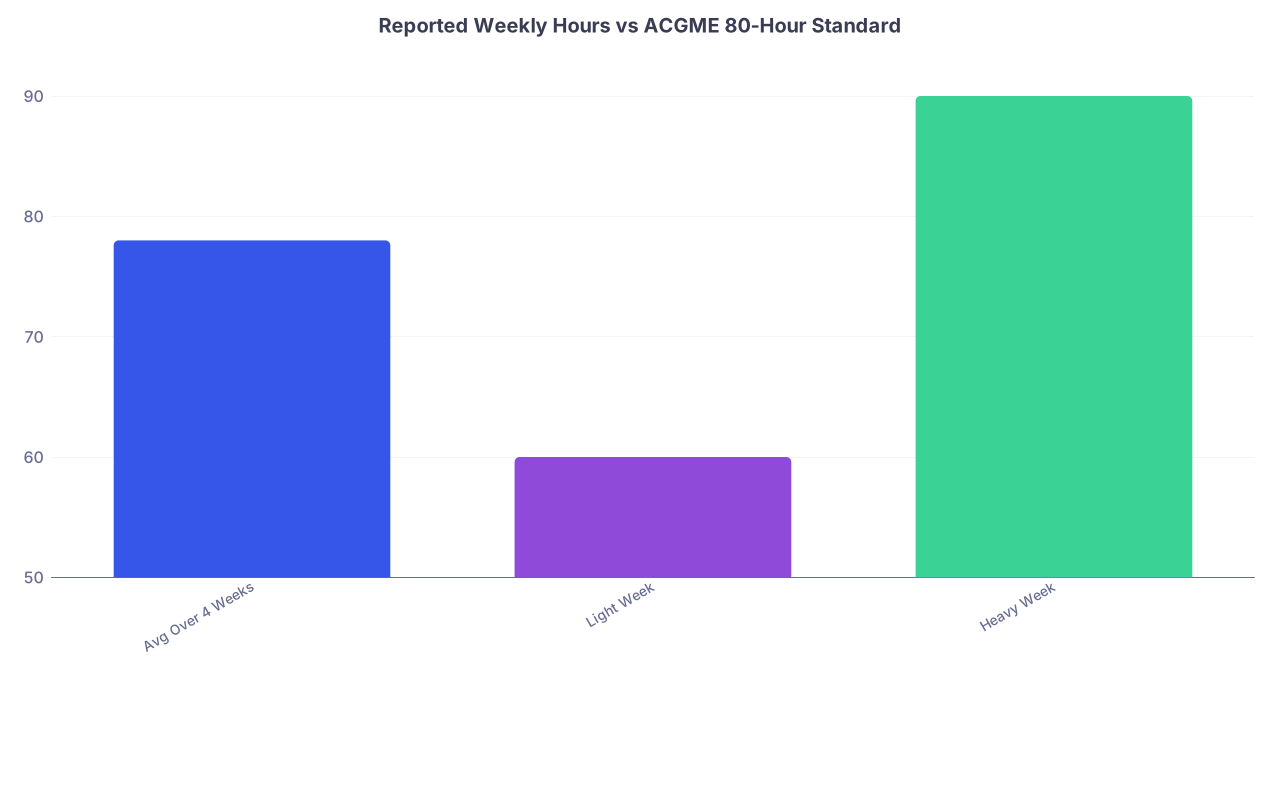
| Category | Value |
|---|---|
| Avg Over 4 Weeks | 78 |
| Light Week | 60 |
| Heavy Week | 90 |
Most residents do not read the standards. They treat “I worked more than 80 hours this week” as “my program is violating ACGME rules.” That’s not how it’s defined.
So when you hear “we had 80‑hour violations,” you need follow‑up questions:
- Was it a few weeks in one brutal rotation?
- Or a chronic pattern across multiple services?
- Did leadership adjust schedules in response?
- Or did they shrug and tell you to stop logging accurately?
The ACGME doesn’t care about one bad week. They care about systems that routinely push residents beyond the standard and then bury it.
What the Data Actually Shows About Hours, Safety, and Training
Let’s talk evidence, not vibes.
There have been a few big trials that changed the duty‑hour discussion:
The 2016 NEJM FIRST Trial (General Surgery)
Flexible vs standard duty hours in surgical residents. Flexible programs allowed some exceptions to strict hour rules (e.g., longer shifts to finish cases), while standard ones followed rigid rules.Result? No difference in patient mortality or serious complications. Residents in flexible programs didn’t show worse outcomes. They did report slightly worse satisfaction on some life‑balance metrics, but also better continuity of care and operative experience.
The iCOMPARE Trial (Internal Medicine)
Similar idea in IM: standard vs more flexible schedules. Again, no major difference in patient safety. Some differences in sleep and well‑being metrics, but not the dramatic harm people predicted.
The takeaway from these trials is uncomfortable if you’re attached to the fairy tale that “80‑hour compliance = safe, humane training” and “violations = dangerous exploitation”:
The relationship between duty hours and resident/patient outcomes is non‑linear and messy.
Very long hours (>90, week after week) are obviously bad. Sleep deprivation destroys cognition; there’s plenty of literature on that. But once you’re in the 60–80 hour range, the signal gets muddier. Program culture, supervision quality, team support, and workload structure start mattering more than the raw hour count.
A malignant program that “meets 80 hours” on paper can still wreck you mentally. A high‑intensity program that occasionally presses 82–84 average, but protects education, backs you up, and doesn’t gaslight you, may actually be a better place to train.
This is the part most applicants don’t want to hear: some of the best training environments are intense. Not gratuitously abusive. But demanding. You will have a few 90‑hour weeks in trauma, or on a tough ICU month. That alone is not a dealbreaker, and the literature does not support the idea that every such week is catastrophic.
How Duty Hours Are Actually Enforced (And Why the Numbers Lie)
Here’s the dirty little secret: duty hour “data” is mostly self‑reported and heavily influenced by fear.
I’ve watched this play out in multiple programs:
- New interns log their real hours faithfully. 88. 92. 95.
- Mid‑year, the chiefs or PD give a “reminder”: “Make sure your hours are accurate, but remember ACGME takes violations very seriously, and we don’t want them to sanction our program.” Translation is obvious.
- Suddenly everybody magically works 78–80 hours on the dot. Every week.
That’s not a conspiracy theory; it’s just what happens when reporting is tied to accreditation threats and residents know retaliation is possible, even if technically prohibited.

So when a program cheerfully tells you, “We’ve never had an 80‑hour violation!” you should not be impressed. You should be suspicious.
That either means:
- They’re slow and underworked enough that no one ever crosses 80 (rare in competitive specialties or busy academic centers), or
- People have learned what numbers they’re expected to enter.
Meanwhile, a program that acknowledges occasional violations may be doing something radical: telling the truth.
When I hear a resident say, “Yeah, on trauma and transplant we sometimes go over 80, we log it, and they’ve actually hired more NPs and added a night float to fix it,” that doesn’t scare me off. That sounds like a system under stress that’s trying to adapt, not hide.
Not All “80‑Hour Violations” Are Equal
You need to separate three very different situations that all get lumped together as “80‑hour problems.”
| Type of Issue | Frequency Pattern | Leadership Response | Risk Level to You |
|---|---|---|---|
| Chronic 85–95 hr weeks | Most rotations, all year | Minimize or deny | High |
| Rotation-specific spikes | 1–2 services, a few weeks | Adjust, add support | Moderate |
| Paper-only manipulation | Real >80, logs show <80 | Implicit pressure | Very high |
1. Chronic 85–95 hour culture
This is the true red flag.
If residents across multiple rotations say things like:
- “Everyone just lives here. It’s always like this.”
- “We just laugh when they say 80 hours. No one reports anything.”
- “If you log over 80, get ready for a meeting with the PD.”
That’s not “intense training”; that’s a broken system. Long‑term sleep debt, constant call, zero recovery. This is where you start seeing:
- Higher burnout and depression rates
- More medical errors
- Residents leaving programs or switching specialties
- Relationships and physical health tanking
This is as close as you’ll get to a dealbreaker. Not because a rule is broken, but because the systemic pattern is unsustainable and leadership is clearly choosing service over education.
2. Rotation-specific spikes with honest reporting
Now contrast that with:
- “Our SICU month is rough. I hit low 80s some weeks.”
- “We were consistently going over on trauma, so they added a PA and one more resident this year.”
- “They actually encourage logging everything; it’s how they got an extra FTE approved.”
Same 80+ hours. Completely different reality.
High‑intensity services will always exist. In surgery. OB. Cards. Heme‑Onc. You do not become competent in those fields without ever having weeks where you are slammed.
The question is:
Do they monitor and respond to overages? Or silently accept them as the price of doing business?
3. Paper compliance, off-the-record reality
This one is worse than straightforward overwork.
If you hear:
- “Just don’t log your home calls.”
- “Make sure your hours are under 80; otherwise, you’re hurting the program.”
- “The chiefs will edit your hours if they’re too high.”
Walk.
That’s a culture that’s comfortable lying to regulators and manipulating data. That attitude doesn’t stay confined to duty hours. It usually bleeds into how complications are documented, how feedback is handled, how you’ll be treated if you get sick or pregnant.
What the Match Data and Resident Surveys Suggest
Residents complain a lot. That’s not data. So let’s look at the more formal stuff.
Surveys from the ACGME, AMA, and specialty boards consistently show a few patterns:
- Most residents in procedural and hospital-based fields report averages in the 60–80 hour range.
- Self‑reported hours tend to cluster just below 80 in more competitive or busy specialties. Shocking, I know.
- Burnout is very high even in fields that report fewer hours (e.g., some outpatient-heavy specialties), which tells you hours are not the only or even dominant variable.
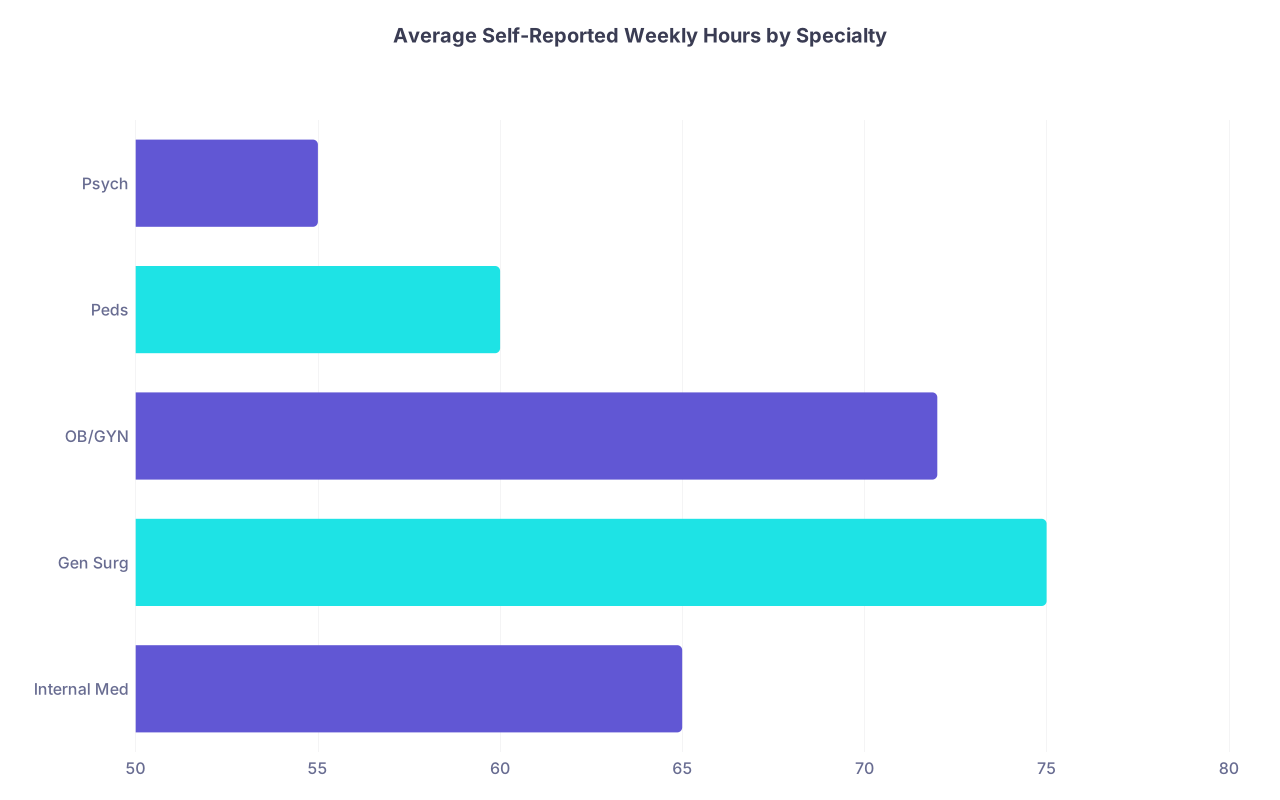
| Category | Value |
|---|---|
| Internal Med | 65 |
| Gen Surg | 75 |
| OB/GYN | 72 |
| Peds | 60 |
| Psych | 55 |
What actually tracks better with resident satisfaction and burnout?
- Perceived support from faculty and leadership
- Sense that education is prioritized over pure service
- Flexibility when life events happen (illness, family issues)
- Whether the clinical workload is efficient or just chaotic
I’ve seen residents in a 70–80 hour surgical program who are exhausted but proud, engaged, and clearly growing. And I’ve seen residents in a 55–60 hour outpatient-heavy program who are utterly burned out because the culture is toxic, feedback is punitive, and the learning environment is miserable.
So no, 80‑hour violations by themselves are not predictive of whether you’ll thrive or crash.
How to Actually Evaluate 80-Hour Issues on the Interview Trail
You want practical? Here you go. Stop asking, “Do you follow the 80‑hour rule?” Every program will say yes.
Ask questions that force specifics:
- “On your busiest rotations, what does a typical week look like? What’s start and end time?”
- “Are there any services where residents often approach or exceed 80 hours?”
- “Has the program made any changes in the last 2–3 years because of duty hour concerns?”
- “If someone logs over 80 for a couple weeks in a row, what actually happens?”
Listen very carefully not just to the content, but the tone.
A healthy answer sounds like:
- “Trauma and transplant can get close; we watch those closely.”
- “We did have some issues a couple of years ago on ICU, so we added an APP and changed the call structure.”
- “We absolutely want you to log accurately; that’s how we justify more support.”
A sketchy answer sounds like:
- “We don’t really have those problems here; people are just efficient.”
- “If you’re always over 80, that’s a time management issue.”
- “We’ve never had any 80‑hour violations.” (said with obvious pride and no nuance)
Also, talk to multiple residents at different levels, not just the most enthusiastic PGY‑3 hand‑picked for you. PGY‑1s will tell you about raw hours. Seniors will tell you how it evolves and whether leadership actually listens.

| Step | Description |
|---|---|
| Step 1 | Ask about busiest rotations |
| Step 2 | Probe for changes made |
| Step 3 | Flag for possible data manipulation |
| Step 4 | High intensity but healthy |
| Step 5 | Chronic overload risk |
| Step 6 | Hear honest specifics |
| Step 7 | Leadership responsive? |
And watch who talks over whom. If a chief starts answering for the interns every time you ask about hours, that’s a tell.
When 80-Hour Violations Are a Dealbreaker
I’m not saying duty hours never matter. They absolutely do. There are scenarios where you should take violations seriously enough to move a program down or off your list.
These are the ones that actually count:
- Residents across multiple PGY levels independently describe chronic, year‑round, 85–95 hour weeks.
- There’s a clear pattern of retaliation or shaming when residents log honestly.
- The program has had recent ACGME citations for duty hours and residents say nothing has changed.
- Residents avoid logging accurately because “it just creates drama.”
That’s not “hard training.” That’s a leadership problem, with a side of dishonesty. You will not fix it from the inside as a PGY‑1.
On the other hand, these are not automatic dealbreakers:
- “Our trauma month is rough, you’ll feel it.”
- “Sometimes we go a bit over 80 on ICU, but they’ve been tweaking schedules.”
- “I had a couple 90‑hour weeks as an intern on nights, but my average was under 80 and they actually pulled in backup when it was too much.”
That’s what a high‑volume teaching environment looks like in the real world.

How to Integrate This Into Your Rank List Strategy
You’re choosing a training environment, not a spa. The goal is not to find the program with the lowest hours; it’s to find the place where the intensity is purposeful, the support is real, and the numbers more or less match reality.
Here’s a more rational framework than “Any 80‑hour violation = red flag”:
- Aim for programs where the average seems plausibly under or near 80, with some variation by rotation.
- Accept that a few brutal weeks or months will happen in most solid training programs, especially in acute care fields.
- Prioritize programs where residents freely admit those rough patches and can also tell you what leadership has done to address them.
- Be very wary of any place that either:
- Brags about never having violations, or
- Blames residents for overages as “time management problems.”
Finally, look broadly at the ecosystem: board pass rates, fellowship placement, how many residents leave early, how people talk about their attendings. Hours are one input. Not the master variable.

The Bottom Line
Three things to walk away with:
- An “80‑hour violation” is not a single long week; it’s a pattern over time—and the evidence does not support treating every over‑80 stretch as catastrophic.
- The real red flags are chronic overload, data manipulation, and retaliation for honest reporting, not honest acknowledgement of a few rough rotations.
- When ranking programs, stop worshipping the 80‑hour number. Look for a culture where hours, workload, and expectations are intense but honest, monitored, and adjustable—that’s where you’ll actually grow without breaking.