The belief that “more surgical cases = better training” is lazy thinking dressed up as rigor.
Program websites brag about “high volume.” Applicants repeat it like gospel on interview days. PDs casually flex, “Our chiefs finish with over 1,500 cases,” as if that number alone proves anything about competence.
It does not. And the data backs that up.
If you’re choosing a residency and you’re using raw surgical case numbers as your main compass, you’re doing it wrong. You’re evaluating the wrong thing, in the wrong way, with the wrong assumptions.
Let’s fix that.
The Case Log Myth: Why “High Volume” Became a Crutch
The myth is simple:
More cases → more experience → better surgeon → better program.
It sounds reasonable. It’s also dangerously incomplete.
Program directors lean on volume because it’s easy to measure and easy to sell. “Our graduates are in the 90th percentile for case volume” sounds impressive on a slide. It doesn’t require any nuance. No mention of how many of those cases were skin lesions and port placements versus complex reconstructions or high-risk oncologic operations.
And applicants, especially MS4s with limited OR experience, don’t yet know what good operative experience actually feels like. So they cling to something countable.
Here’s what the data and actual experience say instead:
- There’s such a thing as a minimum threshold of exposure where more is clearly better. Nobody is arguing that doing 100 hernia repairs is worse than doing 10.
- Beyond a reasonable threshold, type, complexity, autonomy, and structure matter more than raw totals.
- Case logs are self-reported, noisy, and easy to game. “First assist” on a case where you did nothing meaningful still counts the same.
The ACGME knows this. That’s why they don’t only track total case counts; they track categories and require minimums in multiple domains. Even they implicitly acknowledge that “volume” is not one-dimensional.
So if you’re comparing Program A vs Program B by “chiefs graduate with 1,200 vs 1,600 cases” and treating that as decisive, you’re buying into a lazy metric.
What the Evidence Actually Shows About Volume and Outcomes
Let’s walk through what we know from the literature, not from program brochures.
There is a volume–outcome relationship in surgery. But it’s not as simple as “more is always better.”
Studies at the hospital level and surgeon level have shown:
- For complex procedures (esophagectomy, pancreaticoduodenectomy, complex aortic surgery), higher institutional and surgeon volume is associated with lower mortality and better outcomes.
- For routine procedures, the curve flattens quickly. Once a surgeon or center hits a reasonable procedural volume, added volume yields diminishing returns in outcomes.
Now — key point — virtually none of these studies are about residents. They’re about fully trained surgeons. Residency is different.
What we do have from education research:
- There is a learning curve for each procedure. After a certain number of cases, added repetitions produce smaller and smaller gains. Technique refines, but the jump from “unsafe” to “safe” happens relatively early.
- Deliberate practice + feedback changes the slope of that curve far more than just more repetitions with no feedback.
- Simulation and structured teaching can accelerate competency faster than just being present for more cases.
In other words: A resident who did 80 laparoscopic cholecystectomies with real autonomy, structured teaching, and feedback is almost certainly better than a resident who did 200 choles where the attending never let go of the camera and the resident’s main role was to hold retractors and close skin.
Yet both will log those cases as “primary surgeon” or “first assist” in the same database.
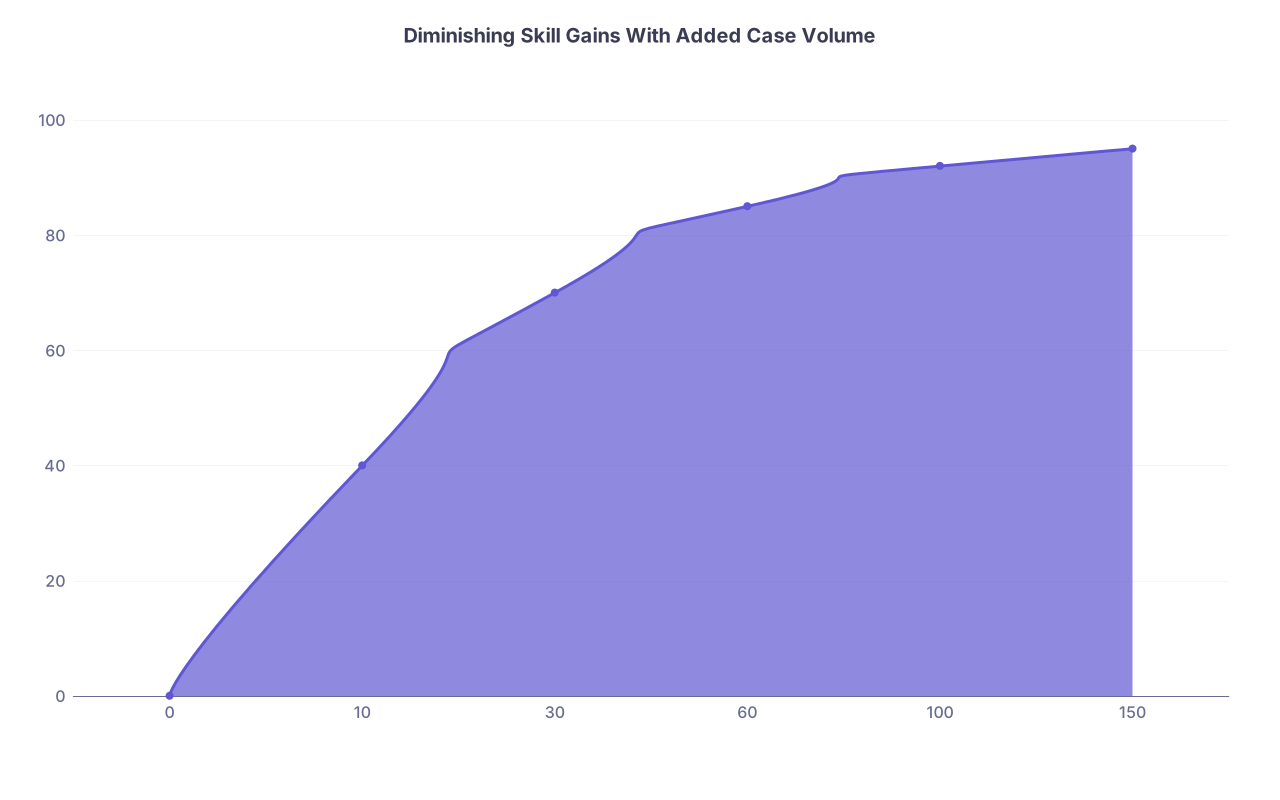
| Category | Value |
|---|---|
| 0 | 0 |
| 10 | 40 |
| 30 | 70 |
| 60 | 85 |
| 100 | 92 |
| 150 | 95 |
That’s the essence of the problem. Case logs give you the illusion of precision with almost no context.
How Case Logs Actually Work (and How They Get Misused)
I’ve watched residents enter cases on their phones in the locker room between cases, half-remembered from the week. I’ve seen people bulk-add series with minimal detail because they’re months behind. I’ve seen “teaching assistant” roles logged as real cases just to bump numbers.
- Self-reported. There’s no standardized, universal, real-time auditing of who did what portion of the operation.
- Categorical, not granular. “Inguinal hernia repair” is one line, whether you did dissection, mesh placement, and closure, or just watched and closed the skin.
- Retrospective and approximate. Residents are busy. Documentation is not perfect. That’s reality.
So a program that boasts “Our residents average 1,800 cases” without telling you the mix or the level of autonomy is either naive or manipulative.
You should be asking:
“1,800 what, and how much of the case did the resident actually do?”
Here is the kind of comparison you should pay attention to:
| Factor | Program X (High Raw Volume) | Program Y (Balanced Volume) |
|---|---|---|
| Average total cases | 1,800 | 1,250 |
| Complex index cases | Moderate | High |
| Resident autonomy | Low–moderate | High |
| Attending teaching time | Limited | Structured and regular |
| Case diversity | Narrow (few services) | Broad (many services) |
If you pick Program X on total numbers alone, you’ve missed the plot.
The Four Things That Matter More Than Raw Case Count
If you want to actually evaluate a program’s operative training, stop obsessing over how many cases the chiefs log and start dissecting the quality of those experiences. Here’s where you should really be looking.
1. Autonomy: Who’s Actually Doing the Operation?
This is the big one.
Residents often conflate “I was in that case” with “I did that case.” The ACGME case log system doesn’t differentiate very well between those two realities.
Ask the hard questions on interview day and during away rotations:
- At what PGY level do residents routinely perform appendectomies, cholecystectomies, hernias, etc., skin-to-skin?
- Are seniors allowed to run their own rooms on bread-and-butter cases, with attending supervision but not micromanagement?
- Do attending surgeons routinely step back on appropriate cases and shift to coaching rather than driving?
I’ve heard versions of this from residents at “big-name” high-volume hospitals:
“We see amazing pathology, but the fellow or the attending does the key parts. As a PGY-5 I’m still fighting to get full cases.”
Translation: That impressive case log? It overstates their real operative independence.
If you’re not getting progressive autonomy, piling on 500 more cases will not magically confer confidence.
2. Case Mix and Complexity: Not All 1,000 Cases Are Equal
A resident with 1,000 cases composed of:
- Skin lesions
- Ports
- Simple hernias
- Drainages
is not better trained than one with 900 cases that include a meaningful share of:
- Complex oncologic resections
- Reoperative abdominal surgery
- Vascular exposures
- Emergencies and trauma
- Minimally invasive and open variants
Programs love to quote impressive trauma numbers or transplant statistics. Those are sexy. But what actually builds a safe, independent general surgeon is a coherent mix of:
- Bread-and-butter general surgery
- Real complexity
- Nighttime emergency cases
- Enough repetition in each domain to achieve mastery, not just exposure
Ask residents:
“What were the most complex cases you did largely yourself as a PGY-4 or 5?”
If all the stories are about watching a star attending or fellow do the cool stuff, that tells you more than any PDF of case statistics.
3. Structure: How Operative Experience Is Distributed
Volume that comes in random, chaotic waves is educationally inefficient.
Programs differ dramatically in how they structure resident experience:
- Are there dedicated junior and senior rotations where the role is clear and progressively more responsible?
- Do you get early exposure to core procedures, or are you watching for two years before you touch anything significant?
- Are key rotations overrun by fellows, leaving residents fighting for portions of cases?
I’ve seen residents who did 1,600+ cases but had huge gaps: almost no breast, limited endoscopy, or almost no independent laparoscopic cases. They checked the total case box, but if you drilled into the report, the holes were glaring.
Ask:
“Are there any areas where recent graduates felt underprepared?”
If the answer is always “no weaknesses, everything is amazing,” someone is spinning you. Every program has soft spots. The honest ones are more likely to have actually addressed them.
4. Teaching Culture and Feedback
If you think surgical skill is built purely by doing a high number of cases without feedback, you’re misunderstanding skill acquisition.
Residents who operate a lot with real-time feedback, post-op debriefs, and clear performance expectations progress faster than those who churn through larger numbers of unstructured, poorly taught cases.
Look for:
- Attending surgeons who operate slowly enough to teach and are known to let residents struggle a bit safely.
- Regular M&M that actually analyzes technique and decision-making, not just paperwork errors.
- Formal skills labs and simulation that are taken seriously, not token offerings to check an ACGME box.
The subtle reality:
A moderate-volume program with a strong teaching culture, solid autonomy, and thoughtful structure will usually turn out better-prepared surgeons than a chaotic “workhorse” factory where chiefs log massive numbers but are never truly in control.
How to Actually Use Case Logs When Comparing Programs
I’m not saying you should ignore case logs. I’m saying you should use them like a scalpel, not a hammer.
Here’s how to evaluate them intelligently.
First, understand baseline expectations. ACGME publishes minimums, and typical graduates are comfortably above them. You don’t need a program that obliterates these by huge margins in every category.
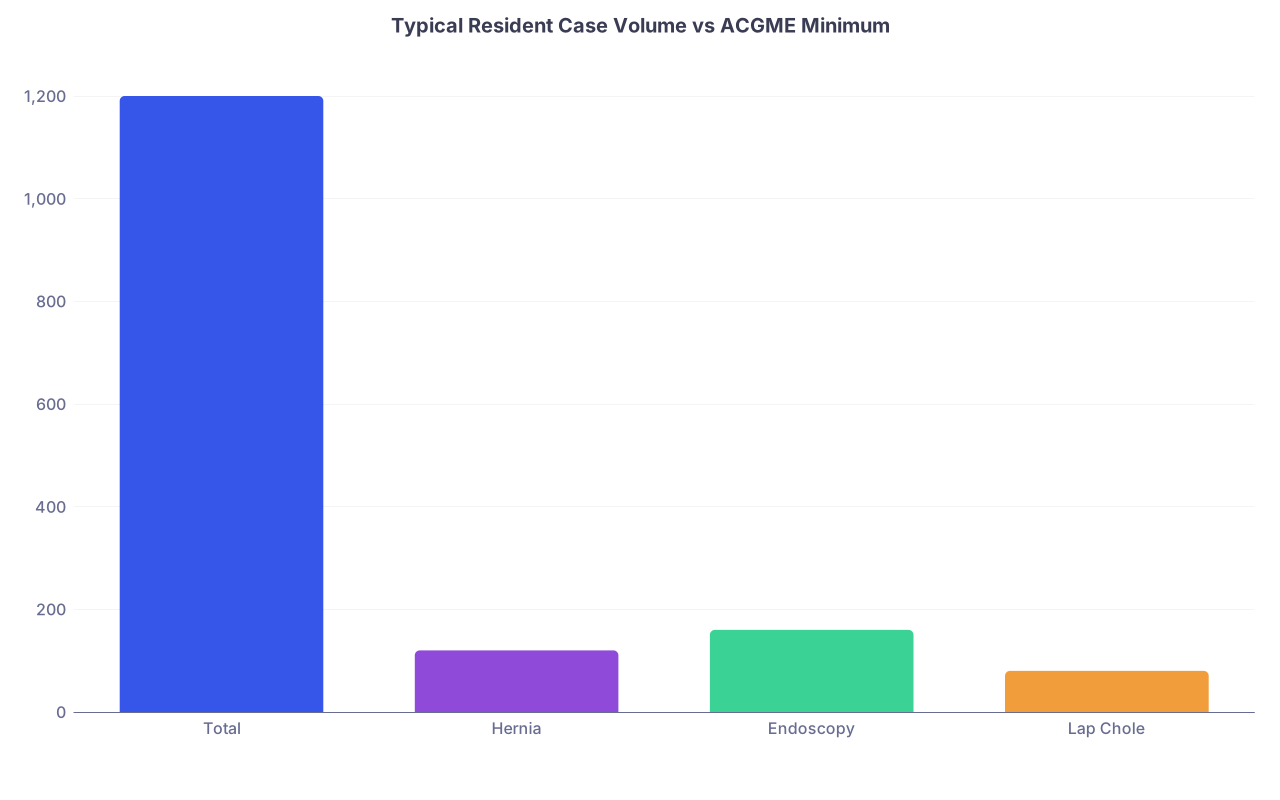
| Category | Value |
|---|---|
| Total | 1200 |
| Hernia | 120 |
| Endoscopy | 160 |
| Lap Chole | 80 |
If a program’s chiefs are consistently just scraping by the minimums in multiple categories, that’s a red flag. If they’re modestly above in a balanced way — fine. The point is not to fetishize the top percentile.
Second, when program leadership shows you their case data (and many will during interview days), pay attention to:
- Distribution across categories. Are there obvious holes? Is it all one service?
- Trends over recent years. Are numbers stable, rising, or falling, especially with new fellows or service changes?
- How graduates feel. Ask them bluntly: “Did you feel comfortable operating independently on day one as an attending? In what areas did you struggle?”
Third, use case logs to trigger questions, not to make decisions in isolation:
- “Your total numbers are on the lower end. How do you ensure residents still get robust operative experience?”
- “I noticed endoscopy numbers are relatively modest. Is that by design? Do graduates who want EGD/colonoscopy competence get that?”
- “You have very high volume in trauma. How much of that is true operative trauma versus nonoperative management?”
The programs that answer clearly, with specifics and self-awareness, are usually the ones that actually think about training. The ones that keep chanting “we’re very high volume” without detail are the ones using volume as a shield.
When More Volume Is a Legitimate Advantage
Let me be fair. There are circumstances where higher volume really does translate into better training.
If you’re choosing between:
- A small community program where grads barely clear ACGME minimums, with obvious gaps in key categories,
versus - A mid- to high-volume tertiary center where grads get a broad-based experience with solid autonomy and structure,
yes, the second is probably better.
Volume is particularly relevant if:
- You want a highly procedural subspecialty (surgical oncology, MIS, vascular) and need a strong operative foundation to be a competitive fellow and competent practitioner.
- You’re aiming to work in a resource-limited setting and need to be comfortable managing a wide range of surgical pathology independently.
- The extra volume reflects a genuine breadth of pathology and increasing resident independence, not just more of the same simple cases.
But “absurdly high volume” at the cost of sleep, teaching, and any semblance of reflection is not a flex. It’s a warning sign. Residents who are overworked, constantly rushed, and functioning as service mules are not magically becoming better surgeons just because they close more wounds at 2 a.m.
The Bottom Line: How You Should Rethink Case Logs
Strip away the marketing, and here’s the reality:
Raw case numbers are a crude, often misleading proxy for operative competence. Above a solid baseline, more is not automatically better; it’s often just more.
Autonomy, case mix, and teaching culture matter more than being in the 95th percentile for total cases. A resident who owns 1,000 well-chosen, well-taught cases will beat a resident who passively logs 1,800 every time.
Use case logs as a starting point, not the final verdict. Ask what those numbers represent in real OR roles, complexity, and independence — and listen carefully to how honest and specific the answers are.
You’re not choosing a case-count factory. You’re choosing the place that will decide what kind of surgeon you become. Treat the numbers accordingly.