
The belief that you must match at a big-city, brand-name residency to land a competitive fellowship is lazy thinking dressed up as wisdom.
I’ve watched residents from “no-name” community programs match into GI, cards, heme/onc, even advanced ICU spots at top academic centers. I’ve also watched residents at big coastal powerhouses quietly strike out on fellowship because they did almost nothing right for three years and thought the ZIP code would save them.
Big city helps. But it’s not the magic key people want it to be.
Let’s dismantle the mythology and replace it with what actually moves the needle.
The myth of the ZIP code: pedigree vs performance
Here’s the story you’ve probably heard in some version during M3 or M4:
“Look, if you want GI/cards/onc, you have to be at a big academic place. Community programs just don’t place into those fellowships.”
Sounds authoritative. It’s also wrong, or at least dangerously incomplete.
What program name and location really buy you is probability, not destiny. They change the slope of the hill you’re climbing, not whether you’re allowed to climb it.
Let me be blunt: fellowship selection committees care about three broad things more than your city size.
| Factor | Typical Weight |
|---|---|
| Strength of letters/mentors | High |
| Research & scholarly work | High |
| Clinical performance/fit | High |
| Program reputation | Moderate |
| City size/location | Low |
Notice what’s not on that list: “Is this residency in a coastal city with a Whole Foods every two blocks?”
Program reputation matters. But it’s a proxy for things that actually matter: volume, acuity, faculty depth, research infrastructure, track record. You can find those inside and outside big cities.
There’s data to back this up.
What the match data and NRMP reports actually show
Look at NRMP fellowship match data and program director surveys. You’ll see repeated patterns:
- Program directors rate letters of recommendation and program director’s statement as top tier factors.
- They care a lot about scholarly activity (publications, abstracts, meaningful QI).
- They care about how you did on rotations, especially in their specialty.
- “Prestige of residency” is present, but it’s not #1. Often not #2 or #3 either.
When the NRMP surveyed fellowship PDs across multiple subspecialties, program reputation was consistently listed as “important,” but it’s nowhere near a veto power. And there is zero mention anywhere of “residency must be in a major metro area.”
Do brand-name residencies correlate with better fellowship outcomes? Yes—because they often select stronger residents up front, have more built-in research, and longer alumni networks. But residents at smaller, less flashy programs routinely match into the same fellowships when they build those same pieces for themselves.
Big-city programs: what they actually give you (and what they don’t)
Let’s be fair. There are real advantages most large academic, big-city residencies give if you want something competitive.
Real advantages of big academic centers
First, they often have a full ladder of fellowships in-house. That means:
- Easy access to subspecialty mentors. Cardiologists, gastroenterologists, oncologists who love putting their name on papers and sending good residents to top fellowships.
- Built-in research pipelines. Ongoing trials, databases, and faculty who already know how to plug a resident into a project and produce an abstract in 6 months.
- Name recognition. When a PD at another institution sees “UCSF,” “Penn,” “MGH,” “UCLA,” there’s instant calibration: this person likely trained in a busy, rigorous environment.
Volume and acuity are usually high. You’ll see sick patients, rare pathologies, niche procedures. This helps in interviews and letters: “This resident managed high-complexity patients independently” carries weight.
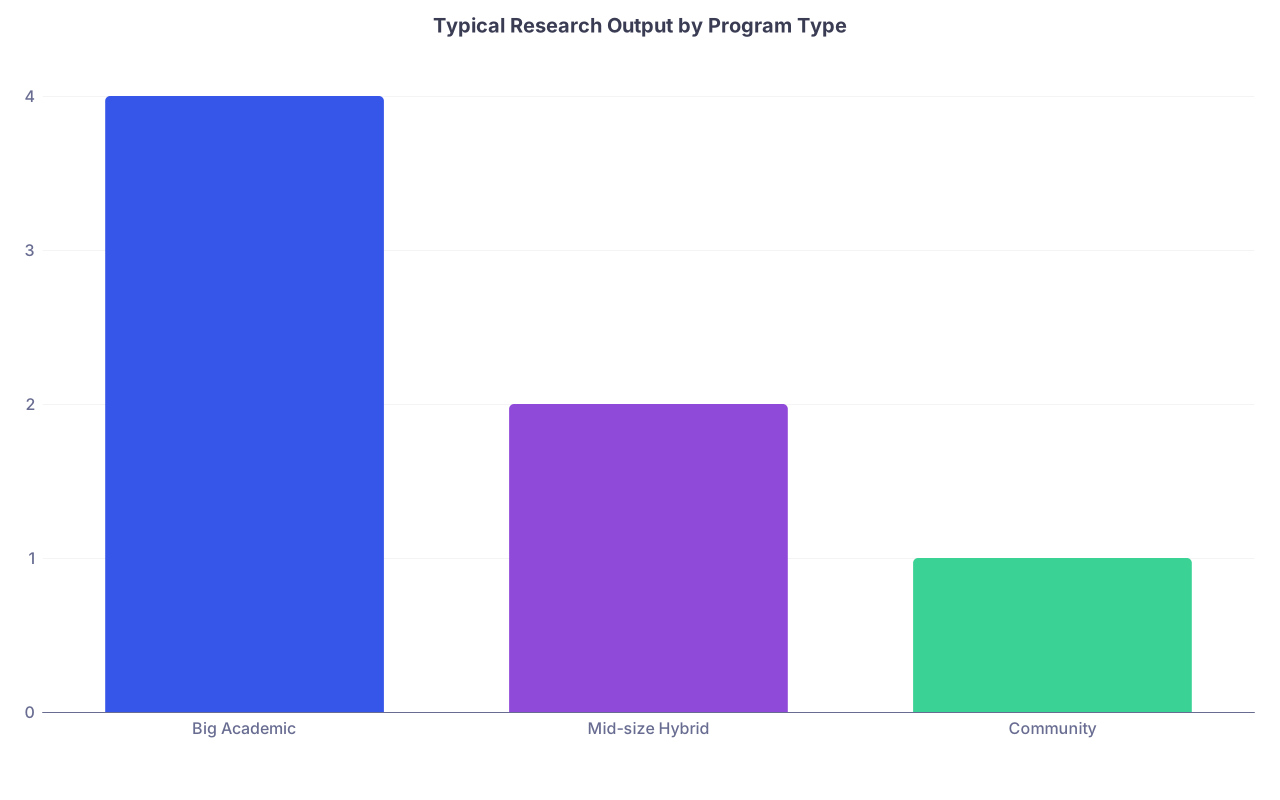
| Category | Value |
|---|---|
| Big Academic | 4 |
| Mid-size Hybrid | 2 |
| Community | 1 |
That’s an oversimplification, but you get the point. You’re more likely to walk out of a big academic center with multiple abstracts or publications without killing yourself to create opportunities from scratch.
The parts people overestimate
Here’s where people get sloppy: they assume big name + big city = guaranteed competitive fellowship. Not even close.
I’ve watched residents at big programs who:
- Avoided research like the plague.
- Never built a real relationship with a subspecialty mentor.
- Performed fine clinically but never stood out.
- Then panicked in PGY-3 trying to “get into cards at a top place” with one case report and generic letters.
Those folks do not magically land at their dream GI or cards program just because their ID badge said “NYU” or “Stanford.” Your fellowship application is not a souvenir from your ZIP code; it’s a dossier of what you actually did.
Big city residency makes the path easier if you’re proactive. It does not make the path for you.
Community and mid-size programs: where the myth falls apart
Now let’s talk about that supposedly fatal “non-big-city” residency.
There are community and mid-size hybrid programs that quietly send one or two people every year into top-tier fellowships—often because those few residents maximized everything available to them.
Here’s the pattern I’ve seen multiple times:
- Resident at a mid-sized “no one’s heard of it” program decides early (PGY-1 or early PGY-2) they want GI or cards.
- They sniff out the one or two research-active attendings and keep showing up: journal club, ideas, data cleaning, anything.
- They push to attend regional or national conferences. They present a poster. Maybe two.
- They become the best resident on the subspecialty team. Nurses, fellows, and attendings all trust them.
- Their letters are glowing and specific, not generic fluff.
Result? They match into competitive fellowships, sometimes at bigger-name institutions than those coming from “famous” residencies who did the bare minimum.
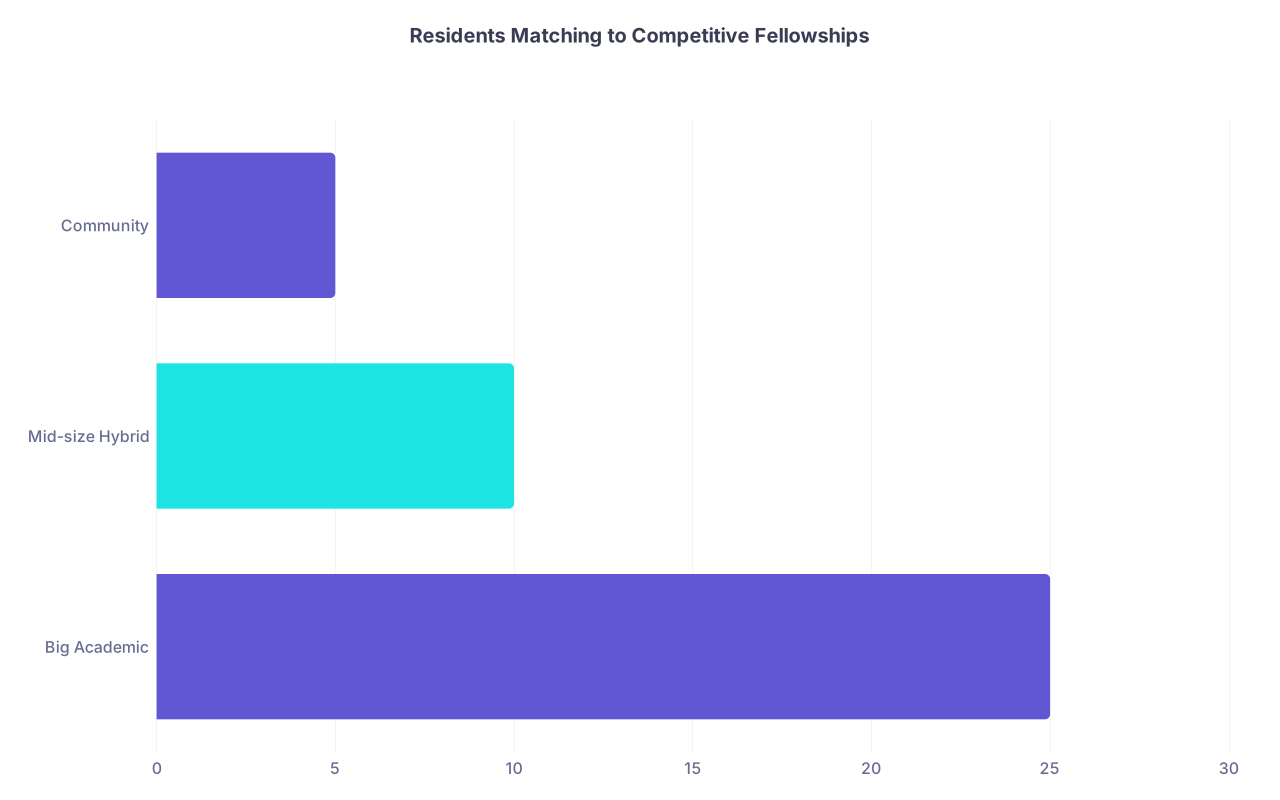
| Category | Value |
|---|---|
| Big Academic | 25 |
| Mid-size Hybrid | 10 |
| Community | 5 |
Yes, the big academic center produces more total fellows—that’s expected. But community and hybrid programs are not zero. Far from it.
What matters more than city size at these programs
If you’re looking at a non-urban or non-famous residency and still care about a competitive fellowship, here’s what should be front and center in your evaluation:
- Track record: Have they sent people to GI/cards/onc/CCM in the last 5–10 years? Where?
- Faculty depth in your area: Do they have at least a few attendings in that subspecialty who like teaching and writing letters?
- Research possibility, not research empire: Do projects exist? Have residents presented at regional or national meetings?
- Volume and autonomy: Are you actually managing complex patients, or just shuffling paperwork and calling consults?
If the answers are decent, you can absolutely get where you want to go. You’ll work harder to build the scaffolding yourself, but it’s doable.
Choosing a residency with fellowship in mind: what you should really prioritize
Let’s get practical. If your goal is a competitive fellowship, here’s how to think about residency choice like an adult, not like a Reddit echo chamber.
1. Look at actual fellowship match lists, not marketing slides
Every program will say, “Our residents go on to excellent fellowships.” Translation: we sent one person to a solid pulm/crit program three years ago and we’re still living off that story.
Ask for or hunt down recent fellowship match lists. Not cherry-picked examples—full lists for the last 3–5 years.
| Program Type | Competitive Matches / Year | Typical Destinations |
|---|---|---|
| Big Academic | 10–20 | Top 25 university centers |
| Mid-size Hybrid | 3–8 | Mix university/community |
| Pure Community | 0–3 | Regional fellowships |
You’re looking for patterns, not unicorns. A community program that sends someone to cards or GI occasionally is already more promising than one that hasn’t sent anyone in a decade.
2. Assess the faculty and mentorship in your field
Do you need a massive, NIH-funded division? No. You need at least a couple of people who:
- Are respected clinically.
- Know your subspecialty community.
- Are willing to mentor.
In a smaller program, that might be one cardiologist who’s done ACC presentations and is known regionally. That can be enough—if you attach yourself, do good work, and get a letter that says, “This resident is better than many fellows I’ve worked with.”
3. Research: depth beats window-dressing
One or two solid projects where you actually contributed, learned, and can discuss the methods beats five ghost-authored case reports your name got stapled onto.
A large academic center makes research easier, but a mid-sized program with:
- A clinical database.
- A QI director who publishes.
- Even a motivated hospitalist with a few publications.
…can give you what you need.
What kills people is not “no research at my program,” it’s “I never did anything until PGY-3.”
4. Clinical training: fellowship PDs can smell fluff
Fellowship directors are tired of residents who look good on paper but fold when facing real responsibility.
They value:
- Strong ICU experience and autonomy in internal medicine.
- Real surgical volume and graduated responsibility in surgery.
- Breadth of pathology, not just brand names of hospitals.
A slightly less-famous program where you carry real responsibility can actually be a plus—if your letters reflect that.
When a big-name, big-city program does matter more
I’m not going to pretend program prestige never matters. For some combinations of goals, it’s more important.
You should lean harder toward a large academic center if:
- You want a very niche, research-heavy fellowship (e.g., transplant ID at a major research institution, advanced EP with heavy research).
- You already know you care about an academic career with major grant funding.
- You want maximal optionality to switch between multiple competitive fields.
Big, urban academic places are “target-rich environments” for these kinds of careers. You can wander into a random noon conference and accidentally meet three potential co-authors. That’s hard to replicate at a 6-resident-per-year community program.
But even here, location (big city vs smaller city) still matters less than level of academic activity. A mid-sized city with a powerhouse university can outclass a huge city with mostly community hospitals.
What you should stop believing right now
Let me spell out some common resident and med student narratives that simply do not map to reality.
“Community program = no chance at GI/cards/onc.”
Wrong. Harder path, yes. Zero chance, no. I’ve watched it happen.
“Big city = better opportunities.”
Sometimes. But I’ve seen big city programs where residents never meet a single research-active attending because the culture is service-heavy and nobody cares about resident development.
“Program name alone will carry me into fellowship.”
No. Fellowship directors are flooded with applicants from famous places. Unimpressive from a top 10 program loses to impressive from a top 75 more often than you think.
“You need X number of publications to match competitive.”
No universal number. They care about trajectory, seriousness, and context. Three real projects with good letters from a smaller program can absolutely beat six low-quality things from a big shop.
How to reality-check a specific residency for competitive fellowship potential
When you interview or research programs, ask sharper questions than “How are your fellowship matches?” That’s an invitation for marketing nonsense.
Ask:
- “In the last five years, where have your residents gone for [my target fellowship]?”
- “Who in [GI/cards/onc/etc.] is most involved with resident mentorship and research?”
- “If I wanted to present at a national conference, what have other residents here actually done?”
- “How many residents per class typically go into subspecialties vs hospitalist/primary care?”
Then pay attention to two things:
- Specificity. Programs with real results can name institutions and graduates. Vague answers are red flags.
- Culture. Do they talk about supporting ambitious residents, or do they look slightly annoyed when you bring up fellowship questions?
If your dream is competitive fellowship, you need both a minimally decent platform and your own sustained effort. Not a particular skyline outside your call-room window.
The bottom line
You do not need a big-city residency to land a competitive fellowship.
You need:
- A program—anywhere—that has at least some track record, some mentors, and some opportunity for scholarly work in your area.
- The discipline to start early and build real relationships, real skills, and real output instead of staring at the name on your ID badge and hoping it’s enough.
- The clarity to separate “prestige theater” from actual training, letters, and performance.
Big-city, big-name residencies tilt the playing field in your favor. They do not decide the game. You do.