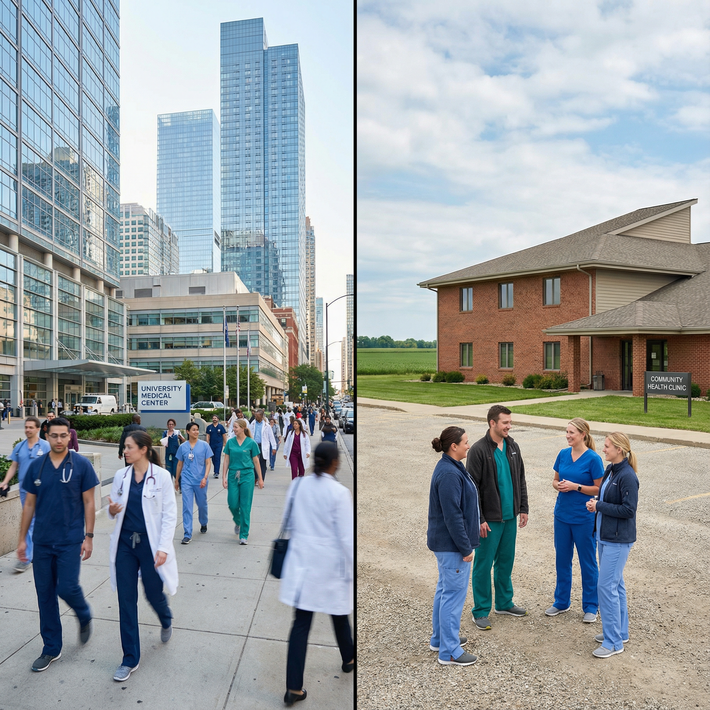
Only 41% of residents who thought they were choosing a “pure academic” or “pure community” career end up in that same bucket 5 years later.
So much for the grand fork-in-the-road moment.
You are being sold a fake dichotomy: that where you match (community vs academic hospital) locks you into a specific career, personality type, and life. The data – and the lived experience of thousands of attendings quietly voting with their feet – says otherwise.
Let’s dismantle this.
Myth #1: “Academic = Teaching + Research, Community = Bread-and-Butter Service Work”
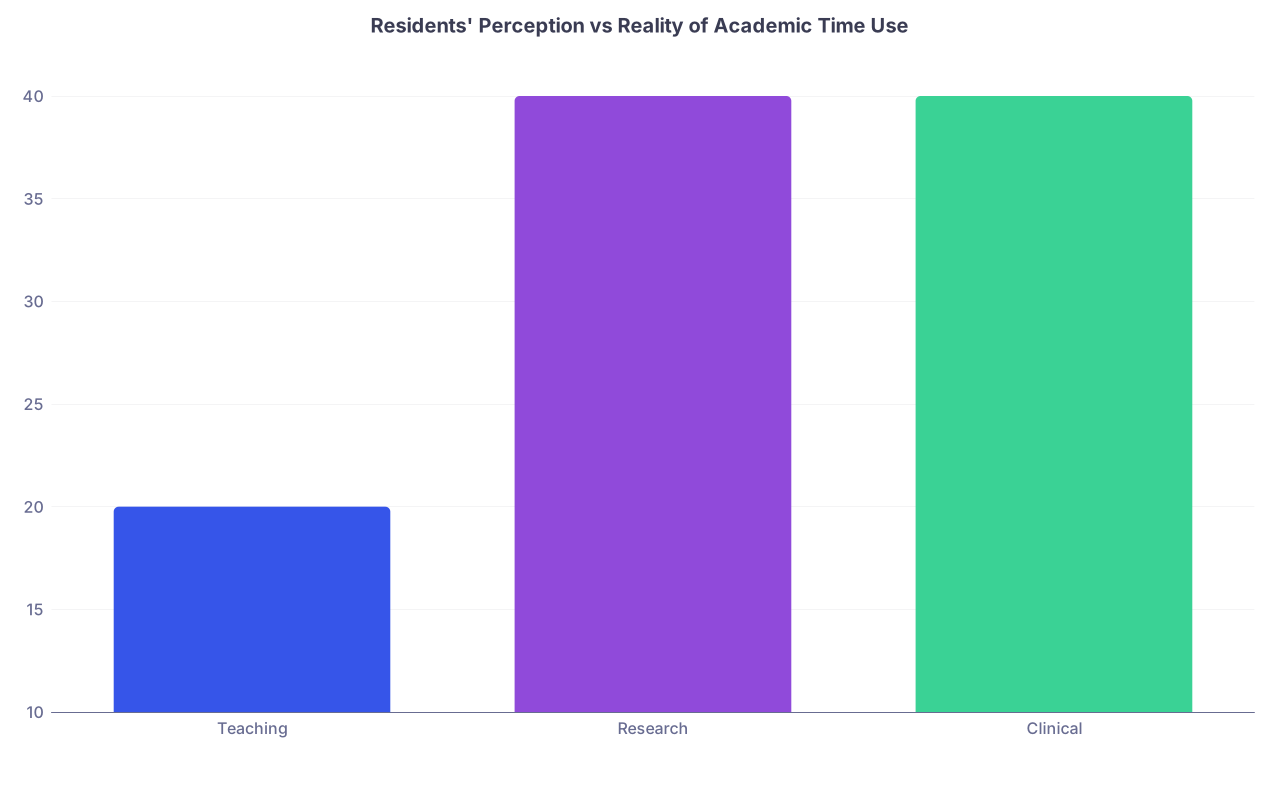
| Category | Value |
|---|---|
| Teaching | 20 |
| Research | 40 |
| Clinical | 40 |
The stereotype is clean: academics teach and do research; community docs grind RVUs and see “basic” cases.
Reality is messy.
At many so-called “academic” programs, residents spend 80–90% of their time doing exactly what community residents do: floor work, call, consults, clinic. Check any PD’s slide deck at interview day; the “research” and “teaching” bars look smaller than the hype.
Meanwhile, plenty of community hospitals:
- Have clerkship students and residents from nearby med schools
- Run residency programs with structured didactics
- Offer QI projects, clinical research, even multi-center trials
You know where a huge percentage of national registry data actually comes from? Community sites. Those “big NEJM trials” often rely on enrollment from non-flagship hospitals.
A more honest breakdown is this:
| Aspect | Academic Flagship | Community Teaching Hospital |
|---|---|---|
| Time on pure service | High | High |
| Formal teaching | High | Moderate–High (varies) |
| Research exposure | Easier access, more volume | Available, usually self-initiated |
| Case complexity | More zebras, referrals | High acuity, fewer rare zebras |
| Students around | Constant | Intermittent or constant |
If you’re imagining that academic residents are in journal clubs and lab meetings all day while community residents are just pre-rounding endlessly, you’re about a decade behind reality.
Where does that leave you?
If you want research, the biggest determinant is not “academic vs community.” It’s whether the specific program has:
- Protected research time
- Mentors who have a track record of residents publishing
- IRB and data support that doesn’t take 18 months to approve a chart review
I’ve seen residents at “no-name” community programs match GI and cards at major academic centers with solid retrospective studies and one decent abstract. I’ve also seen residents at big-name academic centers graduate with zero first-author anything.
So no, choosing community does not mean choosing “service only.” Choosing academic does not automatically mean you’ll be co-first on four R01-funded projects. You have to look at the micro-level: program culture, support, and time.
Myth #2: “Community = Fewer Fellowship Options, Academic = Easy Subspecialty Match”
This one scares applicants the most. People think:
“If I go community, I’m locked out of academics and competitive fellowships.”
Let me be blunt: that story is outdated, and a little lazy.
Here’s what fellowship PDs actually care about when they scan applications:
- Step/board performance
- Strong letters from people they know and trust
- Concrete scholarly work (posters, publications, QI that shows follow-through)
- Evidence you can function independently and not melt on call
None of that is inherently restricted to academic hospitals.
Look at match lists instead of websites. A “mid-tier” university program might send 1–2 residents a year to top-tier fellowships. A strong community program with a hungry class and one well-connected subspecialist can do the same.
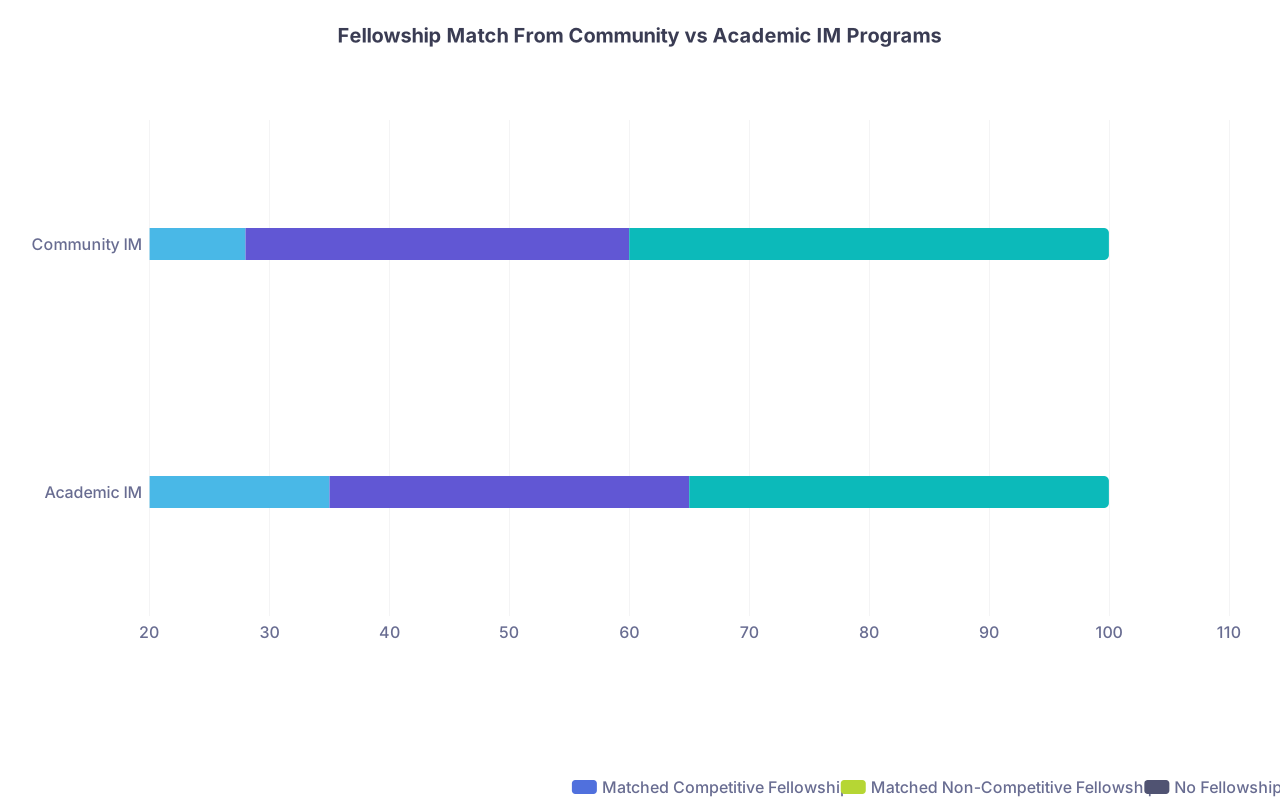
| Category | Matched Competitive Fellowship | Matched Non-Competitive Fellowship | No Fellowship |
|---|---|---|---|
| Academic IM | 35 | 30 | 35 |
| Community IM | 28 | 32 | 40 |
The difference? Academic centers make it easier to stumble into opportunities, because:
- There are more ongoing projects
- People are already in the national network
- The expectation to “produce something” is baked in
Community programs often require more intentionality. You may have to:
- Actively seek a mentor outside your hospital
- Use virtual research collaborations
- Present at regional rather than national meetings first
Is it harder? Slightly. Is it fatal? No.
Where community training can help fellowship applicants:
- More autonomy earlier → stronger ICU or consult experience to talk about
- Better procedural numbers at some sites → especially true in EM, IM, anesthesia
- Letters that describe you as the “workhorse who runs the unit at 2 a.m.” rather than the fifth resident in a team of eight
The worst mistake is believing that an academic name alone will do the work for you. I’ve watched fellowship PDs bypass average residents from big-name university programs for driven, well-documented performers from community hospitals. Frequently.
If you want competitive fellowship, ask each program (community or academic):
- How many residents last year applied to that fellowship?
- How many matched, and where?
- Who are your recent grads I can email who did that path?
You are not choosing “fellowship vs no fellowship” when you pick community vs academic. You’re choosing how much you’ll have to self-engineer your route.
Myth #3: “Academic = Brainy, Community = ‘Less Competitive’ Applicants”
This one’s elitist and wrong.
Yes, on average, ultra-branded academic programs pull higher board scores and class ranks. That’s a selection effect, not a moral judgment. They get 4,000 applications for 20 spots. They cherry-pick stats and honors letters.
But the distribution inside programs is wide. Every academic department has residents who barely passed Step and residents who scored 260. Every community program has one or two absolute killers who chose it for geography, family, visa, or quality-of-life reasons.
The more interesting data point is this: by PGY-3, attending physicians consistently report that they barely remember who had the 260 and who had the 225. They remember who they trust at 3 a.m.
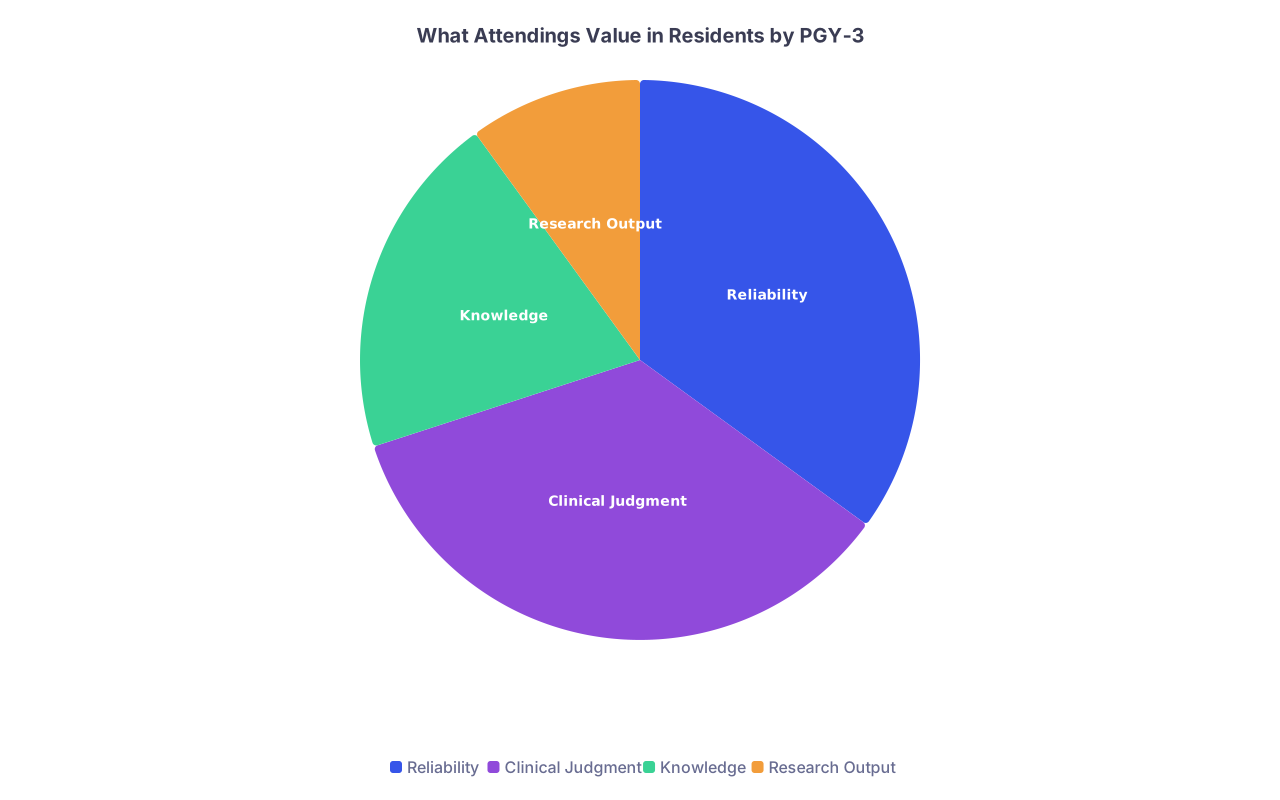
| Category | Value |
|---|---|
| Reliability | 35 |
| Clinical Judgment | 35 |
| Knowledge | 20 |
| Research Output | 10 |
You don’t practice as “an academic score” or “a community score.” You practice as a physician whose judgment has been shaped by volume, supervision, feedback, and your own capacity to reflect and improve.
Another uncomfortable truth: some academic programs lean so heavily on layers of hierarchy and subspecialty services that residents are shielded from making real decisions until late in training. That can blunt growth.
Conversely, some community hospitals throw you into “you and one nocturnist for the whole place” situations. Terrifying at first. But that is where clinical judgment matures fast.
So if your ego is whispering “I’m too strong for community,” you’re asking the wrong question. Ask instead:
- Who actually trains me? Fellows vs attendings vs NPs/PA-heavy staffing
- How much graduated autonomy is there?
- How often do I see my own decisions play out, vs always bumping to subspecialty teams?
Prestige fades. Your habits and judgment stick.
Myth #4: “Community = Easier Lifestyle, Academic = Overworked (or Vice Versa)”
I hear both versions of this myth, depending on who’s doing the marketing.
Reality: resident lifestyle is program-specific, not setting-specific.
I’ve watched academic residents with legitimately humane schedules and protected golden weekends. I’ve also watched academic quaternary centers grind residents into dust with 80+ hour “officially 80” weeks and pages exploding every 30 seconds.
I’ve seen community residents with:
- Wildly malignant call schedules
- No ancillary support at night
- A toxic culture of “we all did it this way, stop complaining”
And I’ve seen community programs where residents actually go home post-call, vacations are honored, and people know your name.
So don’t trust “academic” or “community” as a proxy for lifestyle. It’s garbage.
Instead, force programs to show you specifics:
- Number of in-house call nights per month, actually
- ICU census cap and floor cap, actually
- Realistic documentation expectations (EPIC in-basket, notes length)
- Whether people are constantly violating work-hours off the record
On interview day, listen for phrases like:
- “We’re like a family here” said with dead eyes → red flag
- “We don’t really track duty hours” → they’re violating them
- “People usually stay to help even post-shift” → translation: expectations to stay late
The only semi-predictable trend:
- Academic centers: more meetings, more committees, more required conferences, more QI “projects” that live and die in PowerPoint
- Community centers: more straightforward show-up-work-go-home, fewer administrative extras, but sometimes more raw clinical grind
Neither is automatically better. It depends on what drains you more: endless meetings or non-stop pages.
Myth #5: “Your First Job Will Mirror Your Residency Setting”
This one’s subtle but dangerous. Many residents think:
“If I train academic, I’ll stay academic forever.”
“If I train community, I’ll be ‘stuck’ in community practice.”
That’s not how the attending labor market works.

Look at real careers:
- Plenty of academic-trained physicians burn out on committees, promotion metrics, and RVU pressure and jump to community private groups.
- Plenty of community-trained physicians build solid reputations, publish later, and get hired by academic groups for their clinical chops.
- A huge and growing group live in the gray zone: employed by an academic department but practice at a community affiliate, with 10–20% teaching time.
The real variables your residency influences:
- Who writes your first job recommendation
- How comfortable you are with the spectrum of acuity and complexity
- Whether your CV checks the boxes for formal “academic appointment” right out of fellowship
Your actual day-to-day 5–10 years out is going to be shaped much more by:
- Local job market
- Your willingness to move
- Your tolerance for RVU quotas vs teaching expectations vs research deliverables
I’ve heard more than one hospitalist say some version of: “I trained academic, thought I’d be clinician-educator, then realized I like 7-on-7-off and no committees.” And I’ve seen community-trained docs become outstanding clinician-educators at med schools.
Residency environment is a starting bias, not a permanent identity.
How To Actually Choose Between Community and Academic (Without Getting Played)
You’re trying to choose a residency type, not a religion. So stop asking “Which is better?” and start asking “Which specific program will train me better for what I want in the next 5–10 years?”
Here’s a cleaner decision framework.

| Step | Description |
|---|---|
| Step 1 | Start |
| Step 2 | Check program fellowship match data |
| Step 3 | Focus on clinical training quality |
| Step 4 | Consider both academic and strong community |
| Step 5 | Deprioritize program |
| Step 6 | Look for mentors and protected time |
| Step 7 | Look for med student presence and evals |
| Step 8 | Prioritize autonomy and volume |
| Step 9 | Compare lifestyle, culture, location |
| Step 10 | Rank list by overall fit |
| Step 11 | Need competitive fellowship? |
| Step 12 | Program has strong match in your field? |
| Step 13 | Want research or teaching focus? |
Then you interrogate programs — kindly but directly — for what actually matters.
Ask current residents (not faculty):
- How many graduates in the last 3 years went into your target job (fellowship X, hospitalist, outpatient, etc.)?
- Are you supervised mostly by fellows or attendings? Do you feel you get real decision-making reps?
- What’s the worst part of training here that people don’t talk about on interview day?
Evaluate concrete signals of program strength beyond the label:
- Consistent, transparent fellowship match lists
- Alumni doing what you want to be doing
- A few faculty who clearly enjoy mentoring residents, with a track record to prove it
- A call schedule and workload you can tolerate without becoming a husk of yourself
Do not over-weight:
- Hospital brand name on cafeteria napkins
- Whether the website uses the word “academic” in the first sentence
- Vague promises of “plenty of opportunity for research” with no specifics
And for your own sanity, remember: you can do excellent clinical work, teach, lead, and even publish from both settings. Those are functions of your choices and environment, not the label on the building.
The Real Bottom Line

Community vs academic is not the career cage match you’ve been sold.
Two key points to walk away with:
- The “academic vs community” label predicts far less about your teaching, research, fellowship chances, or lifestyle than the specific program’s culture, structure, and track record.
- Your eventual career is fluid. Residents move between academic and community worlds all the time. Choose the place that will make you a competent, confident physician in three years, not the one that best fits someone else’s stereotype.