
It is mid-September. You are scrolling through two residency program websites that, on paper, look almost identical—same reputation tier, similar board pass rates, both in cities you could tolerate living in. But you open the “Curriculum” tab and suddenly they are not the same at all. One has “4+1” blocks, fixed elective months, and mandatory research time. The other looks like a jigsaw puzzle of night float, X+Y, and “individualized curriculum” buzzwords. You realize you have no idea how to actually compare these structures in a way that aligns with what you want long term.
Let me break this down specifically. Because this is where strong applicants make very avoidable mistakes.
You are not just choosing a brand name and a city. You are choosing how your next 3–7 years of time will be carved up—what you can explore, what you will never see, what you will have energy for, and what doors will quietly close while you are busy surviving Q4 call.
This is how you analyze elective time structures with a cold, career-focused eye.
1. First, get brutally clear on your actual career goals
You cannot judge an elective structure in a vacuum. The same schedule can be fantastic for one person and terrible for another.
Do this before you compare programs:
Write down your likely career direction in one sentence.
Examples:- “I want to be a general internist in an academic center, maybe clinician-educator.”
- “I’m 70% sure I want a competitive fellowship (cards, GI, heme/onc).”
- “I want to be a community EM doc, no fellowship, but I care about procedures.”
- “I want a surgical subspecialty and I will need strong letters and case volume.”
Then force yourself to rank your priorities from this list:
- Competitiveness for fellowship / next step
- Geographic flexibility vs very specific region
- Early exposure to subspecialties vs broad general training
- Protected research time vs maximum clinical reps
- Lifestyle / burnout risk vs “stretch”/high-intensity training
- Teaching/education career vs private practice track
If you cannot answer these with some honesty, you will default to what sounds impressive instead of what fits.
Once you have that, you can look at any program’s elective structure and ask one question: “Does this shape of time help or hurt that specific goal?”
2. Understand the basic building blocks: what “elective time” actually means
Programs love marketing-speak. Strip it down to numbers.
When you review a program:
- Look for “Curriculum,” “Rotation Schedule,” or “Block Schedule” on their website.
- Download / screenshot the PGY-1, PGY-2, PGY-3 (and 4+ if applicable) year schedules.
- Ignore fluff like “innovative” and “customizable” at first. Count blocks.
Most specialties are still in a 13-block-per-year world (4-week blocks). Some use 26 two-week blocks. In either system, you care about:
- Total number of elective blocks across training
- When those electives occur (PGY level and time of year)
- How tightly constrained those “electives” actually are
Let me translate typical language:
- “Elective” – may be any of a long list of rotations, not necessarily subspecialty. Could be hospitalist, ultrasound, extra ED, etc.
- “Selective” – you must choose from a narrow pre-defined list. Often not truly open.
- “Individualized curriculum / tracks” – blocks reserved for track-related experiences; can be very structured or very flexible.
- “Research month” – sometimes true research, sometimes just an “easy” month you are expected to fill with projects and continuity.
Create a simple grid for each program. Something like:
| Year | Program A | Program B |
|---|---|---|
| PGY-1 | 0.5 elective | 0 elective |
| PGY-2 | 2 elective | 1 elective, 1 research |
| PGY-3 | 2 elective | 3 elective |
Already you see—they are not equivalent.
3. The X+Y and 4+1 trap: how clinic models quietly control your electives
Everyone loves to argue about X+Y vs traditional models. What most applicants miss: X+Y models can either protect or cannibalize your elective time depending on how they are built.
Quick translation:
- Traditional: Longitudinal clinic 1 half-day / week, all year. Electives are full blocks with clinic interruptions.
- 4+1 (or similar X+Y): 4 weeks of inpatient/elective + 1 week of ambulatory. Outpatient is chunked.
For career planning, you care about:
- Does the “+1” week count as elective or is it pre-defined ambulatory experiences?
- During your X weeks, are you free of clinic, meaning those blocks are cleaner elective/subspecialty time?
Example:
Program X: “4+1 model, 3 elective blocks PGY-2, 3 PGY-3”
In practice:
- The +1 weeks are all primary care continuity, QI projects, maybe some urgent care.
- Your 3 + 3 elective blocks are beautifully clean: full-time in cardiology, ICU, etc., no clinic interruptions.
Program Y: “6+2 model with integrated specialty clinics, 5 total elective blocks”
In practice:
- Those “2” weeks are sometimes specialty clinics you did not choose.
- Elective blocks may still include longitudinal responsibilities that fragment your day.
For someone aiming at a competitive fellowship, clean, immersive subspecialty blocks are incredibly valuable. Half-days chopped out of your rotation can destroy continuity and limit your chance to impress faculty who write letters.
4. Map elective timing to fellowship and job milestones
This is where applicants either get strategic or just “hope it works out.”
You need your elective timing to line up with:
- When you decide on a field
- When fellowship applications open
- When you need letters and research output
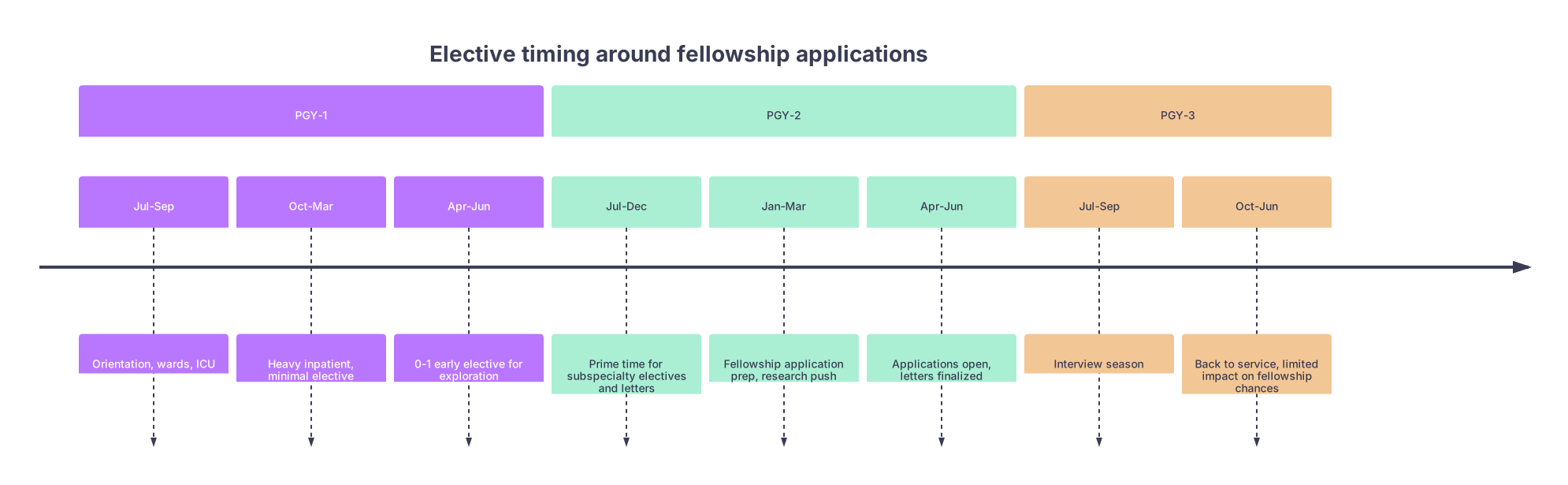
Here is a simplified timeline (3-year residency, internal medicine-type structure):
| Period | Event |
|---|---|
| PGY-1 - Jul-Sep | Orientation, wards, ICU |
| PGY-1 - Oct-Mar | Heavy inpatient, minimal elective |
| PGY-1 - Apr-Jun | 0-1 early elective for exploration |
| PGY-2 - Jul-Dec | Prime time for subspecialty electives and letters |
| PGY-2 - Jan-Mar | Fellowship application prep, research push |
| PGY-2 - Apr-Jun | Applications open, letters finalized |
| PGY-3 - Jul-Sep | Interview season |
| PGY-3 - Oct-Jun | Back to service, limited impact on fellowship chances |
Key principle:
For fellowship-driven people, you want the majority of your relevant electives before July of PGY-3. Electives in late PGY-3 are basically for your skillset and sanity, not your CV.
Concrete checks when looking at programs:
- Are most electives front-loaded (PGY-2 heavy) or back-loaded (PGY-3)?
- Can you take, for example, cardiology, GI, heme/onc, or ICU during early PGY-2?
- Are there explicit statements like “PGY-1 residents do not have elective time” (which delays exploration)?
If you are aiming competitive fellowship and Program A allows 2–3 subspecialty electives in early PGY-2, while Program B pushes most electives to PGY-3, Program A is the better structure. Period.
5. Research time: real, fake, and weaponized
Every program claims to be “supportive of research.” Ignore the adjective. Look at the structure.
Ask these questions:
Is there dedicated research time that is:
- Guaranteed?
- Optional?
- Contingent on being in a “research track” or having a mentor?
How many blocks over training are protectable for research? One? Two? None?
Are research blocks truly non-clinical, or are they “light clinic plus research”?
For a fellowship-driven or academic career track, here is how I categorize programs:
| Type of Program | Research Structure | Best For |
|---|---|---|
| Type 1 | 2–3 guaranteed research blocks, no clinic | Strong fellowship / academic |
| Type 2 | 1 research block, plus project elective flex | Moderate fellowship ambition |
| Type 3 | No true research, only case-report level | Community / non-academic focus |
If your goal is cards at a top institution and you choose a Type 3 program because “the city is cool,” you are making your own life harder.
Also: some programs “weaponize” elective and research time. I have seen places where the unwritten rule is that electives are where you are expected to pump out QI, case reports, and database projects. You get no incremental research blocks unless you already show productivity. This is survivable if you know going in; disastrous if you assume the word “research” means “protected.”
You want to know:
If I show up with zero publications, can I reasonably get at least 1–2 real projects done using the structure they offer? If the answer is no, that program does not match an academic career goal, regardless of its name.
6. Elective breadth vs depth: which actually serves your goal?
Applicants often brag: “My program has 8 elective months!” On closer look, 5 of those are random things: admin, billing, extra wards, “transition to practice.” That is not breadth. That is filler.
You need both:
- Breadth early – to decide what you like and collect general skills.
- Depth later – to become clearly excellent in the thing you choose.
For different goals:
You want competitive fellowship:
Electives should allow:- Repeated exposure in your field (e.g., cards PGY-2, then advanced cards PGY-3).
- ICU and relevant procedural or diagnostic experiences that complement that field.
- Time with high-profile faculty at the home institution.
Three months of cardiology spread out is better than eight random subspecialty electives you will never use.
You want generalist/community practice:
Ideal structure:- Variety of bread-and-butter subspecialties (renal, pulm, GI, ID).
- Some “transition to practice” or hospitalist blocks that actually teach billing, efficiency, and systems.
- Electives that strengthen your weak areas from medical school.
You do not need six subspecialty electives in obscure fields. You need robust exposure to the conditions you will treat every week.
You are undecided:
You want at least:- One early, “choose-anything” elective block PGY-1 or early PGY-2.
- Enough flexible elective volume PGY-2 so you can test 2–3 areas.
- Avoid programs where electives are locked into preset tracks from day one.
If a program’s PDF shows “Elective: Required ICU”, “Elective: Hospitalist”, “Elective: Ambulatory block” under the elective columns, that is not breadth or depth. That is relabeling of required rotations.
7. Hidden constraints: what they do not put on the website
This is where you have to be nosy on interview day. The written block diagram lies by omission.
Common hidden constraints:
- You must do X elective at Y hospital, during Z months only.
- Procedural electives (e.g., ultrasound, anesthesia) capped to 1 block total.
- Away electives discouraged or only allowed PGY-3.
- High-demand electives (cards, ICU, heme/onc) rationed informally by favoritism, not a transparent process.
- Vacation rules that fragment your elective months and make them useless for continuity or research.
When you meet residents, ask very direct, concrete questions. For example:
- “How many true free-choice elective blocks did you have, and in which years?”
- “What electives are hardest to get, and who actually gets them?”
- “If you decided on a new fellowship interest at the start of PGY-2, could you realistically get 2–3 rotations in that field before applications?”
- “Are away electives allowed? How many blocks? Any people blocked from doing them?”
- “Has anyone had to give up elective time to cover service in the last year?”
You want their actual lived experience, not the PD’s polished slide.
8. Matching elective structure to specific career paths
Let me give you concrete patterns. These are not theoretical; I have watched this play out repeatedly.
A. Competitive fellowship (cards, GI, heme/onc, advanced ICU, some surgical subspecialties)
You should favor programs where:
- PGY-1: 0–1 elective block max; that is fine. Heavy inpatient is OK.
- PGY-2: At least 3 blocks of true electives / research that you can align with your target field.
- PGY-3: Some additional, but these are bonus for skill, not applications.
You want:
- At least 1–2 blocks of subspecialty rotation in your target field by Jan of PGY-2.
- 1–2 research blocks across PGY-2/early PGY-3.
- An elective system that allows you to repeat key experiences (e.g., two different cards rotations: consults + CCU; or wards + cath/EP exposure).
Program red flags for this path:
- Most electives are packed into PGY-3 after September.
- “Research” is only available to “scholars track” residents selected at entry.
- Fellows run everything and residents have little direct attending interaction (harder for strong letters).
B. Generalist / community practice
Your priority is broad, repeated exposure to common problems and realistic practice patterns.
Favorable structures:
- Reasonable number of electives, but not at the expense of core rotations.
- Electives in:
- Hospitalist medicine or ED (for IM)
- High-volume community sites
- Practice management, quality, informatics if you are even slightly systems-oriented
You care less about the exact number of “elective” blocks and more about avoiding extremely niche-heavy curriculums that overemphasize research tracks at the cost of basic clinical reps.
Red flags:
- Tiny total inpatient or core service time because “we prioritize customization.”
- Tons of research or niche subspecialty time you will never use clinically.
C. Academic clinician-educator
Your career is not just “get fellowship” but also “teach and maybe run a program.”
You want:
- Balanced elective time, plus:
- Medical education electives (didactics design, simulation).
- QI / curriculum development time.
- Longitudinal blocks where you function as a senior on teaching services, not just pushing notes.
Elective structure should allow:
- Extra time on teaching-heavy services.
- A mix of clinical + education project time (which often masquerades as “elective” or “admin” months).
If a program’s electives are all “more of the same”—just extra wards, extra ED—without any educational or leadership tracks, it may not serve you well.
D. Procedure-heavy future (EM, anesthesia, surgery, some IM/peds tracks)
Here you want elective structures that let you deliberately stack procedural experiences.
Look for:
- Ability to repeat ICU, ultrasound, anesthesia, or procedural rotations.
- Skills-focused electives: airway, POCUS, interventional procedures.
Red flags:
- Ultra-rigid curricula with almost no elective space (very common in surgery and some EM programs).
- “Elective” months that are non-procedural by default (research, admin) with no option to convert into hands-on rotations.
For these fields, sometimes the key variable is not number of electives, but quality and procedure density of those electives. Ask residents specifically how many central lines, airways, LPs, chest tubes, etc., they get on key rotations and whether elective months actually boost those numbers.
9. How to do a side‑by‑side analysis that is not just vibes
You should be comparing programs on something more concrete than “feels academic” vs “feels chill.”
Here is a reasonably efficient workflow:
Build a simple spreadsheet with:
- Rows: Programs
- Columns:
- Total elective blocks
- PGY-2 elective blocks before Jan
- Dedicated research blocks
- Flexibility for away electives (Y/N, how many)
- Presence of tracks (research, global, education, etc.)
- Earliest possible subspecialty rotation in your intended field
Rank each program 1–5 in each category for how well it supports your specific goal. Not generic quality. Specifically: “Supports GI fellowship” or “Supports community generalist path.”
Weight PGY-2 timing heavier than PGY-3 if you have any fellowship intention.
You can visualize something like this:
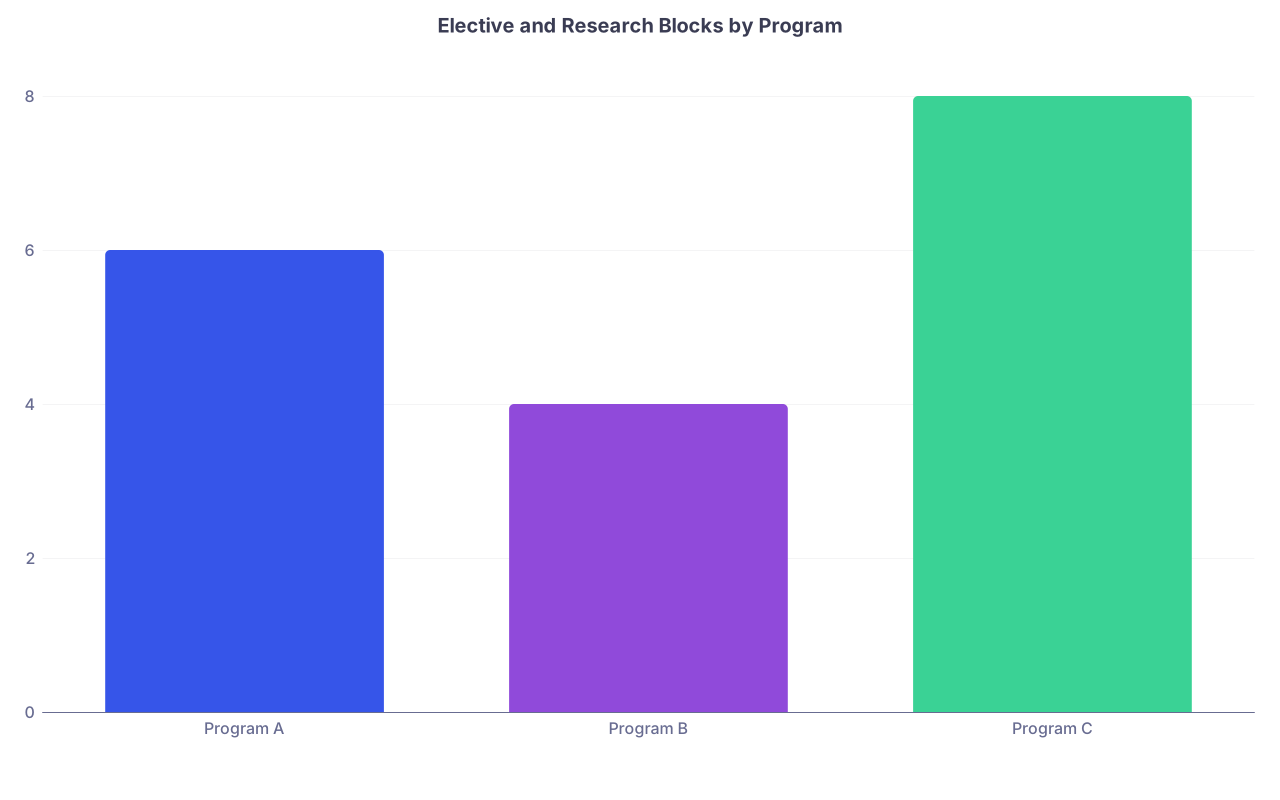
| Category | Value |
|---|---|
| Program A | 6 |
| Program B | 4 |
| Program C | 8 |
Then a separate row/graph for research:
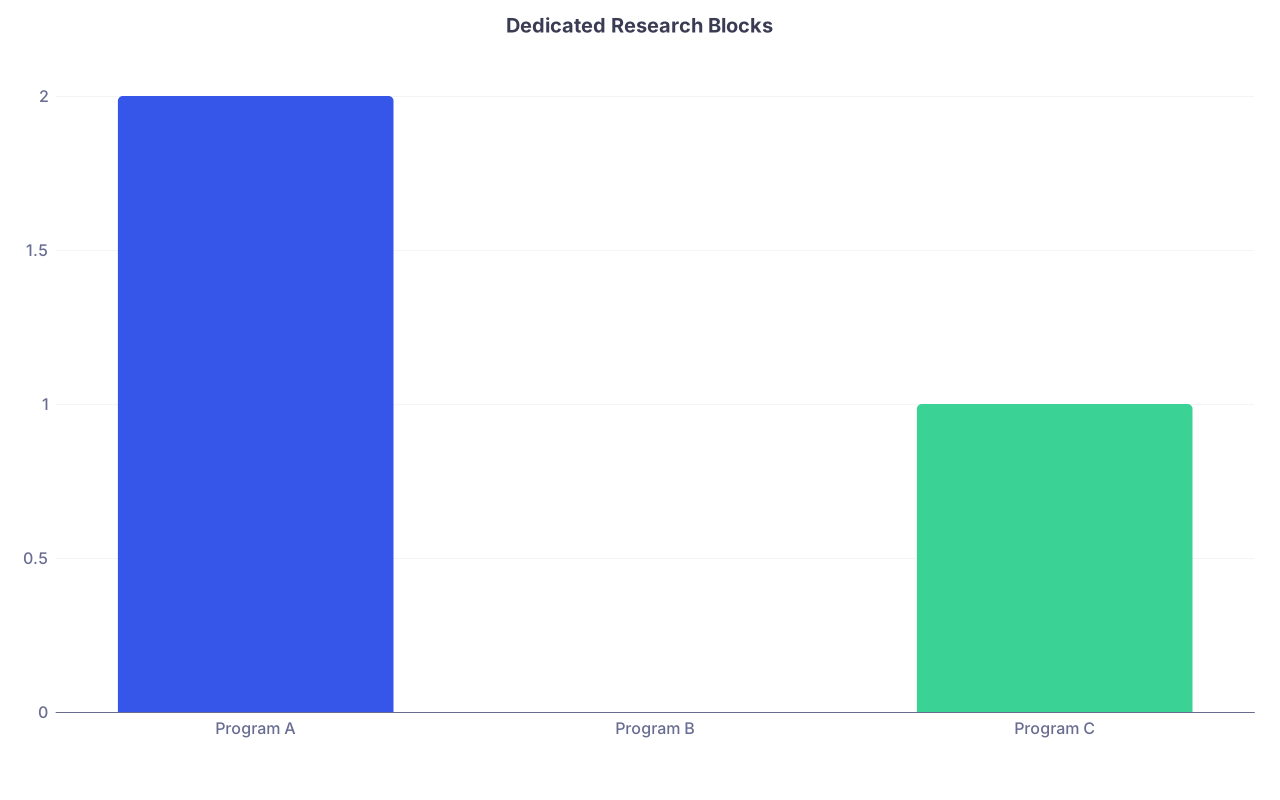
| Category | Value |
|---|---|
| Program A | 2 |
| Program B | 0 |
| Program C | 1 |
Now look at your own goals. If you want a competitive fellowship and Program B has fewer electives and zero research blocks but is in a city you like more, you can still pick it. But at least you are conscious of what you are trading away.
10. Intelligent questions to ask on interview day about electives
Programs often give you five minutes for questions with the PD and longer with residents. Use both strategically.
For the Program Director or APD:
- “Can you walk me through how elective selection actually happens? Is there a lottery, seniority system, or advisor approval?”
- “For residents aiming for [your field], what does a typical sequence of electives and research look like?”
- “How flexible is the system if someone decides to change their intended fellowship after PGY-1?”
For residents (away from faculty):
- “What was your most valuable elective, and how hard was it to get?”
- “Have you ever been pulled from elective to cover inpatient services?”
- “Did you feel you had enough time and support to do research or other projects, or did that all happen on nights and weekends?”
- “If you had to do it over, would you change how you scheduled your electives?”
You are trying to figure out the delta between the official curriculum and the real one.
11. Track systems: when “customized” becomes “locked in”
Many programs now have “tracks”: research, global health, primary care, hospitalist, ultrasound, health equity, etc.
They can be fantastic. Or constraining.
Check:
- When do you have to choose a track? At Match? Start of PGY-1? PGY-2?
- What proportion of “track” time is truly elective vs mandatory for the track?
- Can you leave a track if your interests change?
For career goals that are still evolving, avoid programs where:
- You must commit to a track very early.
- Track-specific mandatory blocks eat up most of your free elective.
On the flip side, if you know you want a specific niche (global health with frequent overseas electives, for example), a strong track with protected time and funding is a huge plus.
12. Lifestyle and burnout: how elective clustering affects survival
You cannot ignore this. Electives are not just about CVs. They are your pressure valves.
Elective clustering patterns matter:
- Programs that front-load all the brutal inpatient work then reward you with a light PGY-3 year can be survivable if you are resilient and very goal-driven.
- Programs that sprinkle electives more evenly can keep you more functional and actually able to use those months productively (for research, board study, etc.).
Watch for:
- “Golden” elective blocks always getting sacrificed for unexpected service needs.
- Electives that are elective in name only but feel like slightly lighter wards.
- Rigid vacation rules that force you to take time off during electives you wanted to use for focused work.
A quick way to sanity check:
Ask a PGY-3 resident:
“When during residency did you feel you had the most control over your time?”
Then:
“If you had had one fewer elective month, would it have changed how ready you feel for your next step?”
If several people say they were barely holding on until their light PGY-3 spring, and electives were mostly survival, not development, factor that into your decision.
FAQ (exactly 5 questions)
1. How many elective months is “enough” for a competitive fellowship?
For most internal medicine-style paths, six total elective months across three years is workable if at least three of those are in your target field or in research closely tied to it, and if several occur by mid-PGY-2. More is nice; poorly timed or fragmented electives are not. A program with 4–5 well-timed, high-yield electives will beat a program with 8 scattered, low-impact ones.
2. Are away electives for residency actually important, or just a nice-to-have?
Away electives are usually a bonus, not a requirement. For fellowship ambitions, they are most useful if your home program lacks a strong division in your chosen field or if you are geographically targeting a new region. But if the home program has robust elective options and known fellowship pipelines, you are often better off building relationships there than chasing shiny away months.
3. Should I prioritize programs that offer research tracks if I might want academics?
Yes, but with nuance. A research track with real protected time, mentorship, and a track record of residents matching academic fellowships is a major structural advantage. A “research track” that consists of one extra elective month and vague promises is just branding. Ask for numbers: publications per year, typical projects, and what residents in that track did after graduation.
4. Do early electives in PGY-1 actually matter for long-term career goals?
PGY-1 electives matter more for exploration than for your CV. You will rarely get meaningful letters or output from a PGY-1 elective, but they can clarify what you enjoy and what you hate. That clarity then lets you use PGY-2 electives much more strategically. Lack of PGY-1 elective time is not a dealbreaker; lack of PGY-2 flexibility often is.
5. If I am undecided about fellowship, should I still optimize around elective structure?
Yes. Being undecided does not mean the structure is irrelevant. You want a program where electives are flexible enough that you can explore a few fields by early PGY-2, then pivot into depth once you choose. That means programs with balanced elective distribution, not everything packed into late PGY-3, and no rigid early-track commitments that lock you into a niche you may abandon.
Key takeaways:
- Do not judge elective time by raw quantity; dissect timing, flexibility, and how many blocks are truly free choice versus relabeled requirements.
- Align the shape of elective and research time with your specific next-step goals—especially the need for early exposure and letters if fellowship is on your radar.
- Use interviews and resident conversations to uncover hidden constraints, then choose the program whose real elective structure, not its brochure, actually supports the career you say you want.