
The way programs talk about “autonomy” is misleading. The way they actually structure autonomy can make or break your early career.
You are not choosing a residency. You are choosing how much you will be trusted with a scalpel, a central line kit, a ventilator, and a crashing patient—and how fast that trust will build. Let me break down how to assess procedural autonomy and graduated responsibility like someone whose future depends on it. Because it does.
1. First Principles: What “Graduated Responsibility” Actually Means
Most program websites copy‑paste the same sentence: “We emphasize graduated responsibility.” Completely useless.
Graduated responsibility, when done right, has three pillars:
- Clear procedural expectations by year – Everyone knows what a PGY‑1 vs PGY‑3 vs PGY‑5 should be doing independently.
- Structured supervision levels – There is a defined path from direct to indirect to independent performance.
- Deliberate assessment and sign‑off – Competence is documented, not just vibes.
If any of those are missing, “autonomy” becomes code for:
- You doing things you are not competent to do
- Or you never being allowed to do anything beyond scut
The four supervision levels you should listen for
ACGME language appears in slightly different forms, but functionally you are looking for:
- Direct supervision – Attending/fellow physically present in room.
- Direct supervision – immediately available – Attending on unit/floor, can enter room quickly.
- Indirect supervision – Attending available by phone/electronically, but not physically present.
- Oversight – Attending reviews after-the-fact (chart review, imaging review, etc).
Graduated responsibility = a planned shift from the first two to the latter two.
On interview day and in program materials, listen carefully for:
- “Interns always have an attending in the room for X” – that is direct supervision, level 1.
- “By second year, residents place lines with attending on the unit but not necessarily in the room” – that is a real step up.
- “Senior residents run the code and call the attending after initial stabilization” – that is oversight/indirect.
If they cannot describe this progression concretely, they probably do not have one.
2. Core Concept: Autonomy is Procedure‑Specific, Not Global
Programs love to say, “Our residents have great autonomy.” That statement is meaningless until you ask: “For which procedures, at which PGY level, under what supervision?”
You should break autonomy down by procedure cluster, not by feel.
Think in clusters like this (adapt for your specialty):
Bedside lines and tubes
Central lines, arterial lines, dialysis catheters (in some IM programs), chest tubes, thoracentesis, paracentesis, lumbar punctures, NG/OG tubes.Airway management
Bag-mask ventilation, basic airway adjuncts, intubation in OR vs ICU vs ED, emergent vs elective.Diagnostic/therapeutic procedures
Bronchoscopy, EGD/colonoscopy, joint aspiration/injection, bone marrow biopsy.OR/Interventional procedures
For surgical fields: appendectomy, cholecystectomy, laparoscopic vs open, trauma ex-lap, C‑section, hysterectomy, fractures, etc.
For IR/EP/other procedurals: central venous access, biopsies, angiograms, ablations, device placements.
Then ask, explicitly:
- Who is the primary proceduralist by PGY level?
- At what point is direct attending presence not routine?
- What are the volume expectations?
If you do not ask at that level of detail, you will be surprised when you discover that at some “strong academic center,” the ICU fellow does every line and bronchoscopy while residents “observe and document.”
3. How to Decode Case Logs, Numbers, and Buzzwords
Every program will flex its case numbers. Half of them are exaggerating utility.
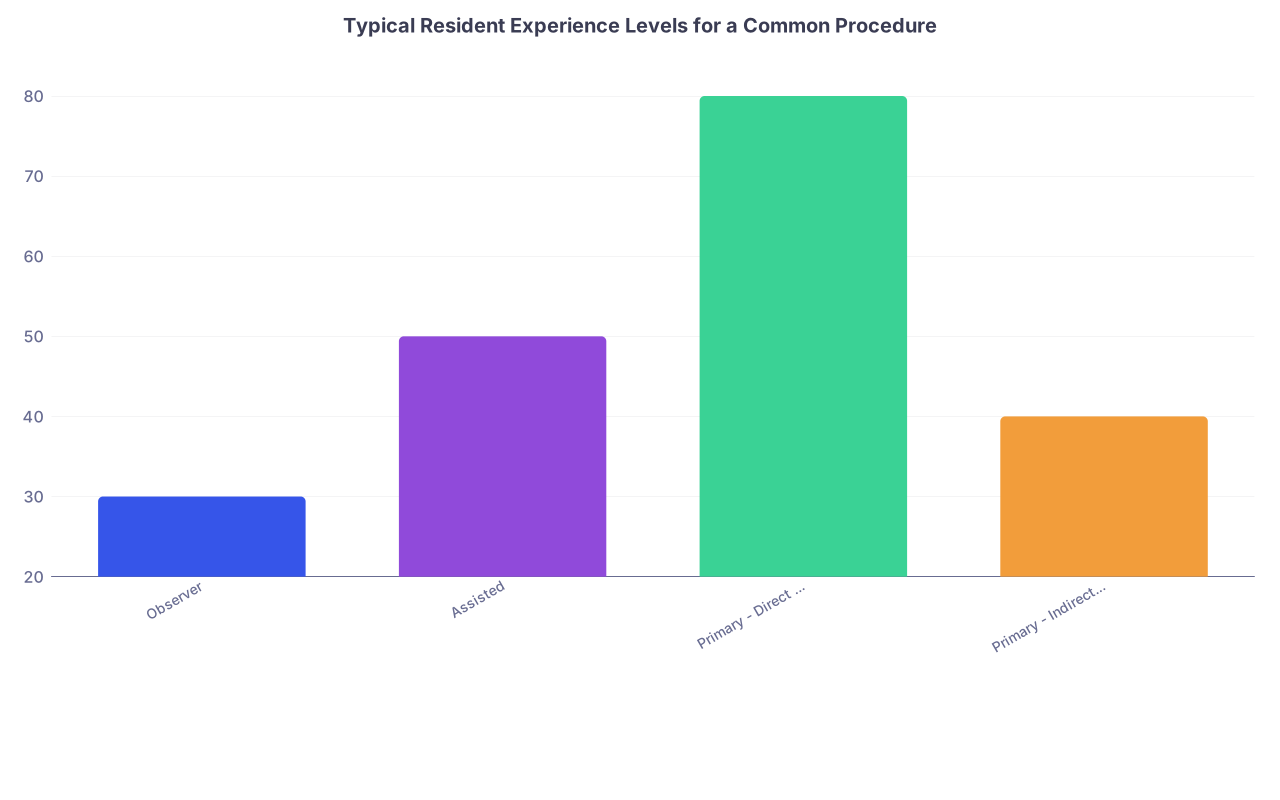
| Category | Value |
|---|---|
| Observer | 30 |
| Assisted | 50 |
| Primary - Direct Supervision | 80 |
| Primary - Indirect Supervision | 40 |
You must separate “being in the room” from “doing the case” and from “owning the case.”
Three useful distinctions:
Participation level
- Observer – You watched. This should not impress you.
- Assistant – You held tools, manipulated the scope occasionally.
- Primary operator – Your hands were on the scope / needle / scalpel for the critical steps.
Supervision level during primary operation
- Primary but with attending scrubbed, controlling most major moves = early training.
- Primary with attending unscrubbed, giving verbal guidance = intermediate.
- Primary with attending out of the room, available PRN = true autonomy.
Ownership
- Did you do the pre‑procedure evaluation and consent?
- Did you manage complications?
- Did you document and communicate the result?
A PGY‑3 who “logged 150 colonoscopies” but:
- Did half of each, never handled complications, never decided on sedation, never scoped without the attending holding the scope at tough segments
is less ready than a PGY‑3 with: - 80 colonoscopies, 50 as true primary with indirect supervision, managing findings and complications.
Case logs do not distinguish this nuance well. You have to ask.
Ask:
“Of the [procedure] cases you list, about what proportion would you say a chief resident is actually the main operator for the majority of the case?”
If the answer is a long, uncomfortable “Well…it depends…,” that is your answer.
4. Specialty‑Specific Signals of Healthy vs Fake Autonomy
This is where programs really separate.
Internal Medicine (and similar non‑surgical fields)
Red flags I have seen repeatedly:
- ICU/CCU fellows do all central lines and bronchs; residents observe “for efficiency”
- Hospitalists or proceduralists run all paracenteses and LP clinics
- Codes run by attending or fellow while resident stands at the foot of the bed writing orders
Healthy autonomy patterns look like:
PGY‑1:
- Paracenteses, LPs, basic bedside procedures under direct/in‑unit supervision.
- Lines: often double‑scrub or attendings in room for first several.
PGY‑2:
- Majority of central lines and thoracenteses as primary operator. Attending in the unit, may be out of the room for simpler cases.
- Running floor codes with attending arriving but not micromanaging initial ACLS.
PGY‑3:
- Lines, thoras, paras, LPs basically independent with oversight.
- Bronchoscopy in some programs as primary with pulmonary attending scrubbed but letting resident do most of case.
- Resident as default code leader in ED/wards overnight with attending available.
You should directly ask:
- “Who places most central lines in your MICU?”
- “Who is the default code leader overnight—resident, fellow, or attending?”
- “Do you have a procedure service? Is it resident‑run or attending‑run?”
General Surgery
This is where “graduated responsibility” gets weaponized: either you learn to operate, or you leave as a PGY‑5 first assist.
Healthy surgical autonomy has a stepped pattern:
PGY‑1 – Hernia repairs, simple laparoscopic cholecystectomies or appendectomies parts, basic open closure, under heavy guidance. Skin to skin only for very simple cases.
PGY‑2–3 –
- Independent laparoscopic appendectomy and cholecystectomy in straightforward cases where attending is unscrubbed but in room.
- Trauma laparotomy: resident doing major portions while attending handles critical segments.
PGY‑4–5 –
- Chief year: primary surgeon for most bread‑and‑butter cases, with attending often unscrubbed, occasionally out of room.
- Running ORs, making intraoperative decisions, managing complications with indirect supervision.
Ask specifically:
- “At your program, which level typically performs a straightforward laparoscopic cholecystectomy as the primary surgeon?”
- “By chief year, are residents closing skin only, or doing skin-to-skin for most bread‑and‑butter cases?”
- “Do fellows take the complex parts of cases, or do chiefs still lead those with fellows assisting?”
Programs with heavy fellows often talk autonomy, but the fellow quietly runs everything that matters.
Emergency Medicine
Here the key autonomy levers are:
- Airway (OR vs ED vs ICU)
- Procedural sedation
- Trauma/medical resuscitation leadership
- Bedside ultrasound and procedures
Healthy patterns:
- PGY‑1: supervised intubations, guided procedural sedations, lines and chest tubes with attending at bedside.
- PGY‑2: majority of common procedures as primary; attending in room for high‑risk (chest tube in crashing trauma) but not for every laceration repair or reduction.
- PGY‑3: runs resuscitations, decides airway plan, attending present for legal safety but not making every micro‑decision.
Questions that expose the truth:
- “Who performs ED intubations during night shifts—resident always, anesthesiology, or mixed?”
- “By senior year, can residents perform procedural sedation with attending elsewhere in department but not in room?”
- “Who runs trauma activations—surgery chief, EM senior, or attending?”
If EM residents are regularly losing airways to anesthesia, autonomy is limited.
5. Procedural Curriculum: How Programs Actually Teach (or Don’t)
You do not want “sink or swim.” You also do not want “watch 200 times, then fellowship.” You want structured progression.
Look for four components:
Simulation and skills labs early
- Central line manikins
- LP/thoracentesis simulators
- Airway labs with video feedback
- Laparoscopic skills lab and FLS for surgery
Formal milestones/competencies
- Written or electronic “sign‑off” process for specific procedures.
- Explicit criteria for being allowed to perform independently or with indirect supervision.
Protected procedural time or rotations
- Procedure services staffed by residents, not just attendings.
- Dedicated endoscopy/bronchoscopy, ultrasound, or OR rotations where resident is the default first operator.
-
- Regular review of your case log with someone who actually cares.
- Remediation plans if you are behind in numbers or skills.
Ask:
- “Do you have procedural milestones, and who decides when a resident is cleared for indirect supervision on central lines/EGD/LP/etc.?”
- “How do you handle residents who are lagging in procedural numbers by mid‑PGY‑2?”
- “Is there a required minimum number of [key procedure] to graduate?”
If they say, “We just ensure everyone is comfortable by the end,” that is code for “We do not track this well.”
6. Reading Between the Lines: What Residents Say vs What They Cannot Say
Residents will not openly trash their program with the PD in the next room. You have to listen for subtext.
Here are phrases and what they usually mean:
| What You Hear | What It Often Means |
|---|---|
| "We get a lot of exposure to procedures" | We’re in the room often, unclear how much we actually do |
| "You can get procedures if you are proactive" | There is no structured guarantee; you must fight for them |
| "The fellows are very hands‑on" | Fellows frequently take the interesting/complex parts of cases |
| "Attendings are very involved in all procedures" | Direct supervision persists longer than it should |
| "By the end, everyone feels comfortable" | We do not track competence systematically |
Now, the opposite:
“Interns start doing X in their first month, with attending in the room, and by second year we usually are doing it with them out of the room unless it’s high risk.”
→ That is a program with real progression.“We run all our own codes; the attending is there but mostly lets us lead.”
→ Good autonomy signal.“Our ICU does not have fellows; residents place almost all lines and manage ventilators day‑to‑day.”
→ Very good for procedural autonomy (though ask about support and burnout).
When you have social time with residents (dinner, pre‑interview zoom), ask:
- “As a PGY‑2, what procedures are you comfortable doing with the attending not in the room?”
- “Is there any procedure where you feel like you are always second‑line because a fellow or attending takes it?”
Watch their face, not just their words.
7. Objective Tools: How to Build a Procedural Autonomy “Scorecard” for Each Program
Stop relying on vibes. Create a simple tracking system.
Before interview season, make a one‑page template. For each program, rate these dimensions:
| Domain | 1 (Weak) | 5 (Strong) |
|---|---|---|
| Early exposure (PGY‑1) | Observe only | Hands-on within first months |
| Progression structure | Vague, anecdotal | Clear milestones by PGY |
| Fellow competition | Fellows take most key cases | Residents are primary operators |
| ICU/procedure services | Attending-run | Resident-run with support |
| Case volume & ownership | Low/assistant only | High/primary with indirect supervision |
On your notes, literally write things like:
- “Central lines: PGY‑1 observe / PGY‑2 do with attending in room / PGY‑3 often solo with attending on unit.”
- “Chest tubes: trauma fellow heavy; seniors get some but not all.”
- “Endoscopy: GI fellows do entire list; IM residents rarely primary → DO NOT RELY ON THIS PROGRAM FOR PROCEDURES.”
When you compare across interviews, patterns emerge. You will see which places consistently offer residents the primary operator role.
8. Graduated Responsibility outside the Procedure Room: The Hidden Part
Procedural autonomy is not just hands‑on technical work. Graduated responsibility also shows up in:
Decision‑making for when to do a procedure
Does the intern call the attending for every paracentesis, or does the PGY‑2 decide, staff the plan, and proceed?Consent and risk discussion
Are you the one explaining risks/benefits and obtaining consent, or does the attending show up just for the signature?Post‑procedure management
Who manages a post-thoracentesis pneumothorax? Who interprets the LP results and calls neurology?Service leadership
Senior residents deciding how to allocate procedures among juniors; responding to urgent consults; running team huddles.
A program that claims “you will do tons of lines” but:
- Attending chooses who gets them
- Attending does the consent
- Fellow handles complications
is not giving you true responsibility. You are technician, not physician.
On interviews, ask something like:
- “When there is a decision about whether to perform a procedure—for example, a questionable thoracentesis—who usually makes that call?”
- “Who typically obtains consent for procedures—the resident or the attending?”
- “If there is a complication, like a post‑LP headache or post‑procedure bleed, who is primarily managing it?”
Residents who are genuinely trained for independence will answer with “Usually us, then we staff it.”
9. The Fellowship Question: How Much Autonomy Do You Really Need?
Not everyone needs the same procedural autonomy.
If you are going into outpatient primary care, you do not need 100 independent central lines, but you do need enough that lines, LPs, and emergent airway issues do not terrify you.
If you are headed for critical care, GI, cards, pulm, EM, surgery, IR, anesthesia, you need:
- Substantial volume
- Progressing from direct to indirect supervision
- Real ownership of decision-making
Do not fool yourself with the “I’ll learn it in fellowship” fantasy if:
- You choose a program where residents barely touch scopes, lines, or airways
- You will be competing in fellowship with people who acted as de facto junior attendings in residency
Fellowship can polish your skills. It should not be the first time you run a code or hold a bronchoscope.
10. How to Ask the Right Questions on Interview Day (And What to Listen For)
You need a short, sharp set of questions you ask at every program. Do not bloat the list. Aim for 5–7 high‑yield ones, tuned to your field.
Examples (modify for your specialty):
- “At your program, who performs the majority of [key procedures]—interns, seniors, fellows, or attendings?”
- “Can you walk me through how supervision changes for procedures from PGY‑1 to PGY‑3/5?”
- “Is there a formal process to be signed off for doing procedures with indirect supervision?”
- “Do you have any procedure services, and are they primarily staffed by residents or by attendings/fellows?”
- “Have recent graduates felt comfortable doing [critical procedures] independently in their first jobs or fellowships?”
- “Are there any procedures residents wish they had more exposure to by graduation?”
Then, during resident‑only time, ask more candidly:
- “Who actually does most of the lines / scopes / OR cases?”
- “Do you ever feel like you are just handing instruments to a fellow?”
- “Do you feel ready, procedural‑wise, to be an attending after this program?”
You are not looking for perfection. You are looking for coherence: what the PD says should line up with what residents describe, and both should make sense for the size, acuity, and fellowship profile of the institution.
11. A Quick Reality Check: Autonomy vs Support vs Safety
There is a balance. Programs at the extremes both cause problems:
Too much autonomy, too early
- You are doing high‑risk procedures in the middle of the night with no meaningful backup.
- Complications are swept under “you need to toughen up.”
- This is where you see traumatized residents and quietly bad outcomes.
Too little autonomy, for too long
- You graduate with pretty case numbers but no actual independence.
- Early attending life or fellowship feels like starting in PGY‑2 again.
- You are anxious about doing basic bread‑and‑butter cases without a senior hand on your shoulder.
Healthy programs:
- Start you with simulation and heavily supervised hands‑on.
- Increase your responsibility deliberately each year.
- Maintain a safety net that is psychologically and physically available, without micromanaging you into paralysis.
One last thing: volume is not everything. A program with moderate numbers but excellent graduated responsibility often creates better independent physicians than a place with crazy volume where you are always second operator.
12. A Simple Mental Model To Use on Rank Day
When you are staring at your rank list, apply this mental test for each program you are seriously considering:
Picture yourself as a PGY‑3 or chief.
Ask: “If I matched here, will I be the person:
- Deciding when a procedure is indicated?
- Obtaining consent and explaining risks?
- Performing the key steps with attending not in the room?
- Managing the immediate complications?
- Feeling comfortable doing this alone three months into my first attending job?”
If the answer requires you to talk yourself into it—“Well, maybe if…,” “Probably, because…”—drop that program below any where the answer is clearly yes.
If you are honest with yourself at that point, your list will be much better aligned with the actual physician you want to be.
Key Takeaways
- “Autonomy” is meaningless unless you pin it down by specific procedures, PGY level, and supervision type. Force programs to speak at that level of detail.
- Strong programs have explicit, structured graduated responsibility: early supervised hands‑on, clear milestones, and seniors acting as true primary operators with indirect supervision.
- You should leave residency having not just “seen” procedures, but owned them—indications, execution, complications, and decisions—so that your first real job does not feel like another residency.