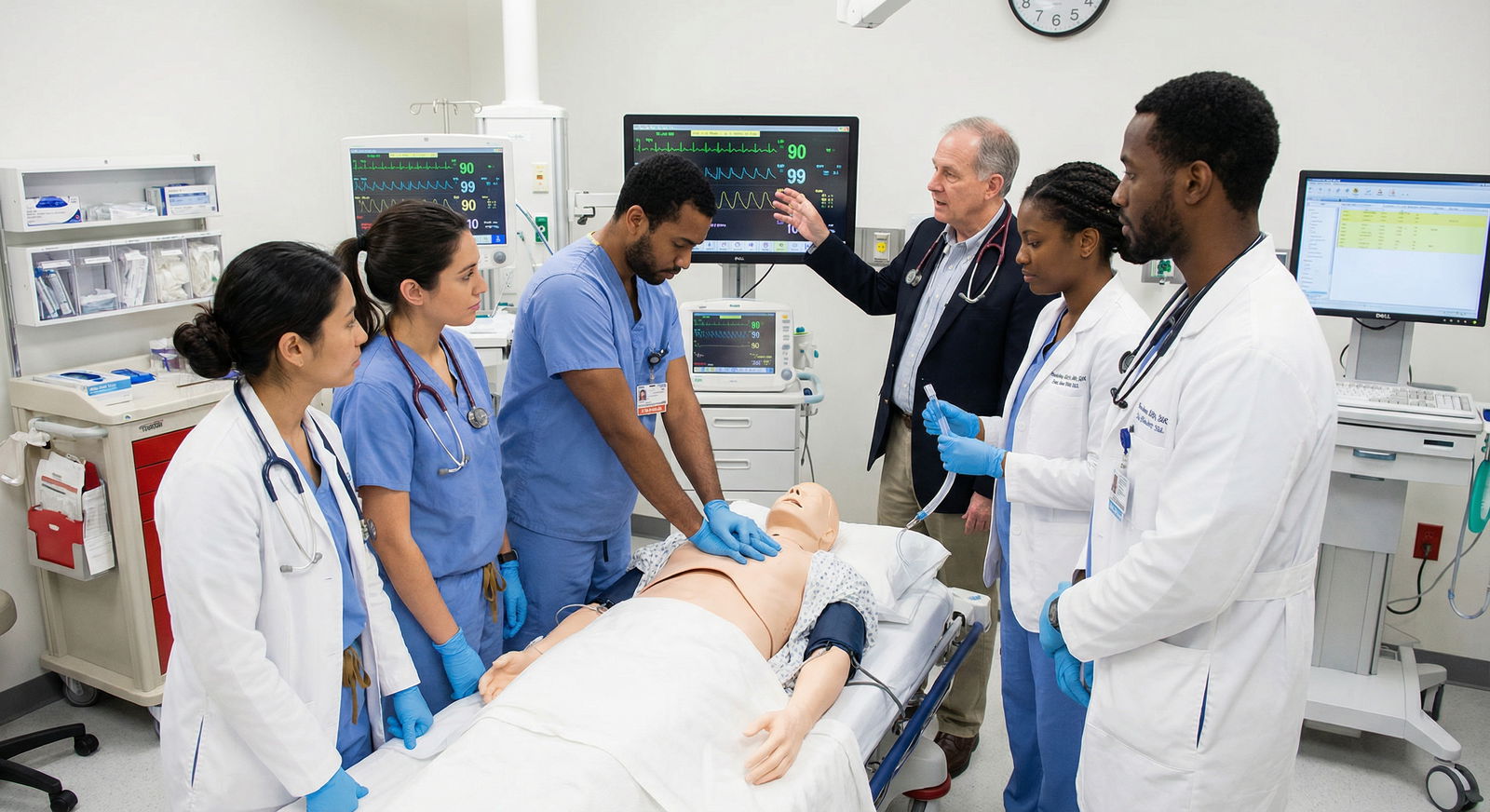
Most applicants obsess over case volume and fellowship match lists and completely ignore the factor that will actually shape their daily life: ancillary support.
Let me break this down specifically: the ratio of nurses, techs, scribes, respiratory therapists, case managers, and other support staff to you and your patients will determine whether you are learning medicine or functioning as an underpaid clerk and transporter.
You can match a “prestige” program with great name recognition and spend three years fighting printers, chasing wheelchairs, and drawing 3 a.m. labs because the system is underbuilt. Or you can train at a place with strong ancillary support, do more actual doctor work, and come out sharper and less burned out.
This is not a soft lifestyle issue. It is a training-quality issue.
What “Ancillary Support” Really Means (Beyond Buzzwords)
Everyone throws around phrases like “strong ancillary support” on interview day. Most applicants nod politely and have no idea what that looks like in practice.
Here is what ancillary support means in real terms.
Core categories of ancillary staff
You are looking at the following buckets:
- Nurses (floor, ICU, step-down, ED)
- CNAs/PCTs (nursing assistants / patient care techs)
- Unit secretaries / ward clerks
- Phlebotomy
- Transport
- Respiratory therapy
- Physical and occupational therapy
- Case management / social work
- Pharmacists / clinical pharmacy
- Scribes (in ED, some inpatient teams)
- Radiology techs
When I say “staffing ratios,” I mean two things simultaneously:
- Staff-to-patient ratio. Example: nurse-to-patient ratio on a med–surg floor: 1:4 vs 1:7.
- Staff-to-physician workload. Example: how many residents is a unit secretary covering, or how many teams share one case manager.
Both matter. A unit can technically “have” a respiratory therapist, but if that RT is covering three ICUs and the ED, good luck getting help with that BiPAP setup at 2 a.m.
How poor ancillary support shows up in your day
You will know a place has weak ancillary support when:
- You are constantly drawing your own labs because phlebotomy is “off the floors after 11 p.m.”
- You are pushing beds to CT because transport is “backed up” for 2 hours.
- Nurses are each covering 6–8 patients and page constantly because they do not have time to pre-triage problems.
- Discharges stall until 5–6 p.m. because there are not enough case managers or social workers to arrange home health, SNF, or DME.
- Every admission requires 30 minutes of phone tag because there is no unit secretary and the nurses are slammed.
On paper, programs will sell this as “autonomy” or “ownership.” Let’s be honest. There is a line between meaningful responsibility and being the only functioning cog in a broken system.
How Staffing Ratios Shape Your Actual Training
The residency brochure will talk about “robust clinical exposure” and “graduated responsibility.” I want you to instead translate schedules and ratios into the following question:
How many hours per day will I be thinking like a physician versus doing tasks someone else could do better and faster?
Cognitive work vs. scut work
Strong ancillary support shifts your time distribution. Roughly:
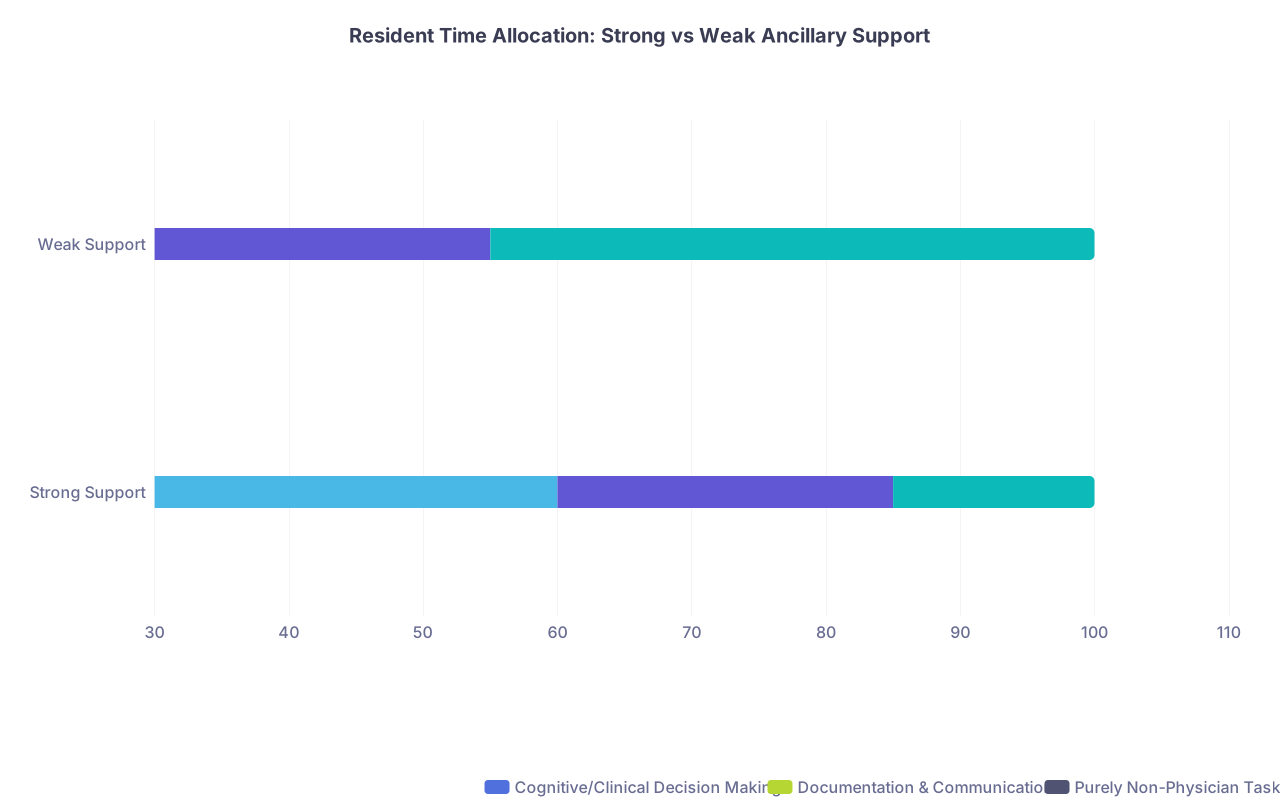
| Category | Cognitive/Clinical Decision Making | Documentation & Communication | Purely Non-Physician Tasks |
|---|---|---|---|
| Strong Support | 60 | 25 | 15 |
| Weak Support | 30 | 25 | 45 |
At a well-staffed program, your non-physician tasks (transport, blood draws, calling for beds, hunting equipment) might be 10–20% of your day. At a poorly staffed one, it can hit 40–50%. Over three years, that is thousands of hours diverted away from honing your brain.
This affects:
- Diagnostic reasoning. Less time on problem lists, more on logistics.
- Reading and self-study. If your “golden hour” post-rounds is consumed by admin nonsense, you will read less, period.
- Feedback loops. If you are constantly behind, you get fewer teaching moments because no one wants to slow the machine down.
Procedural opportunities
There is a myth that poor ancillary support leads to “more procedures.” Sometimes true. Often wrong.
Real pattern I have seen:
- Strong RT and nursing, but no dedicated procedure team → residents do central lines, arterial lines, LPs, paracenteses, thoracenteses, supervised and scheduled. Ideal.
- Weak ancillary support overall → chaos, delays, and by the time you are free, IR or anesthesia has already done the procedure because the patient could not wait.
Good support does not mean procedures disappear. It means:
- RT manages vents, but you still decide vent settings and weaning.
- Phlebotomy draws routine labs, but you do emergent sticks and lines.
- Transport moves patients, but you learn to prioritize who moves first and why.
The right question is not “Do residents do their own labs?” It is “Do residents get the right kind and number of procedures without being buried in tasks others could do?”
Autonomy vs abandonment
Programs misuse the word “autonomy” to cover for unsafe workloads.
True autonomy:
- Attendings trust you to make decisions and back you up.
- Nurses and ancillary staff are competent and collaborative, so you function as the doctor, not the runner.
- You are busy, but the system does not routinely fail around you.
Abandonment:
- You are cross-covering 60+ patients at night with one intern because “that is how we have always done it.”
- Case management is 9–5 only, so safe discharges get delayed, ED is backed up, and admissions come up at 10 p.m.
- Nursing ratios are unsafe, so you get 20 low-value pages a night: “FYI BP 138/78, what do you want?” because they are too slammed to filter and escalate appropriately.
On interview day, almost no one will say “Our night float is brutal and case management is MIA after 4 p.m.” You have to infer it from ratios and behavior.
How to Read Ratios and Red Flags Across Settings
You cannot ask, “So, are your staffing ratios bad?” and expect a real answer. You have to ask targeted, concrete questions and connect the dots.
Floor and ICU nursing ratios
This is foundational. A few rough benchmarks (reality varies by region and union presence):
| Unit Type | Excellent Ratio | Concerning Ratio |
|---|---|---|
| Med–Surg Floor | 1:3–1:4 | 1:6–1:7+ |
| Step-down/Tele | 1:3–1:4 | 1:5+ |
| Medical/Surgical ICU | 1:1–1:2 | 1:3+ |
| ED (per RN) | 1:2–1:3 acute | 1:4–1:5+ acute |
Questions you actually ask:
- “What are your typical nurse-to-patient ratios on the floor and in the ICU?”
- “Do those ratios change significantly on nights or weekends?”
- “Have there been recent issues with travel nurses or chronic understaffing?”
Listen for hedging: “It varies,” “Depends on census,” “We do our best.” Every hospital says that. Push a little: “On a typical Tuesday nights on gen med, what does an RN assignment look like?”
If they dodge three times, you have your answer.
Techs, phlebotomy, and transport
These staff determine whether you move quickly or drown in micro-tasks.
Ask:
- “Is there 24/7 phlebotomy? If not, who draws overnight labs?”
- “Do floor nurses have CNA/PCT support on nights?”
- “Who typically transports patients to CT/MRI after hours?”
If the honest answer is “residents do most after-hours labs and transport,” you are looking at a system that leans heavily on you to make up for staffing gaps.
Now, there is a nuance: occasionally drawing your own labs or transporting a crashing patient is fine. That is medicine. Routinely doing it because the system is underbuilt is lazy administration.

Case management and social work
This is where many programs quietly fall apart. Disposition is half of inpatient medicine. If case managers and social workers are thin, you will:
- Spend your mornings doing clinical work.
- Spend your afternoons begging for SNF beds, home oxygen, IV antibiotics setups.
- Discharge patients late, which backs up the ED and loads your call nights.
Ask:
- “Are case managers and social workers on every floor? Are they 7 days a week?”
- “What time do they typically leave for the day?”
- “Do residents participate in multidisciplinary rounds with case management daily?”
Highly functional systems will talk about morning interdisciplinary rounds, weekend coverage, and proactive disposition planning. Dysfunctional ones will say, “Our case managers are amazing, but they are stretched thin” while residents roll their eyes in the corner.
Respiratory therapy (RT) and procedural coverage
Especially key for IM, EM, anesthesia, pulm/crit, and surgery.
Ask:
- “Is there dedicated RT coverage in the ICUs 24/7?”
- “Who manages non-invasive ventilation setups overnight?”
- “Do residents commonly have to troubleshoot vents themselves due to limited RT?”
A healthy answer: residents know how to manage vents, but RT is present, responsive, and collaborative. Unhealthy: “You will become very independent” said with that tired laugh that really means “You are alone on nights.”
ED scribes and clerical support
For EM especially, but also relevant if you are on off-service ED rotations.
Ask:
- “Do attendings or residents have scribes? For what proportion of shifts?”
- “Who handles bed requests, consult pages, and call-backs to families?”
No scribe support means more time typing, less time seeing patients. Not necessarily a dealbreaker, but if there is also poor nursing and tech coverage, that is a triple hit.
Concrete Ways Staffing Ratios Change Your Day (Specialty by Specialty)
Let me make this painfully real. Same resident competency. Different systems.
Internal Medicine (categorical or prelim)
Scenario A – Strong ancillary support:
- Census: 12 patients on a day team with an intern + senior.
- Nursing: 1:4, CNAs on days and nights.
- Phlebotomy and transport: 24/7.
- Case management: Daily rounds, including weekends.
Your day:
- Pre-rounds with actual time to examine, think, and pre-chart.
- Rounds with focused discussions, teaching, and real diagnostic reasoning.
- Post-round: you place orders, coordinate with consultants, call a few families, maybe do a paracentesis.
- Discharges mostly out before 2–3 p.m., new admits spaced reasonably.
You leave tired but feeling like you practiced medicine.
Scenario B – Weak ancillary support:
- Census: “Cap is 16” but regularly hitting it.
- Nursing: 1:6–1:7 on the floor. CNAs inconsistent.
- Phlebotomy: 5 a.m. draws only. Anything else is on you.
- Case management: M–F only, out by 3:30 p.m. No weekend coverage.
Your day:
- Pre-rounds are partial chart reviews. No time to see everyone properly.
- Rounds are rapid-fire dispo arguments: “Can we get home O2?” “Case management is out today.”
- Post-round: you spend 3 hours coordinating SNF placement, drawing “add-on” labs, and chasing imaging slots.
- Discharges push to after 5 p.m., ED is backed up, you admit into the night.
You leave exhausted and weirdly undertrained because your brain has been idle while your body runs constantly.
Emergency Medicine
Staffing in the ED is brutally honest: you either have enough nurses, techs, and RTs, or you drown.
Strong support:
- RN and tech coverage sufficient so vitals, IVs, EKGs, and initial labs happen quickly.
- RT in-house 24/7 responding to respiratory calls promptly.
- Scribes for at least a subset of shifts, especially during peak hours.
You see more patients per hour without shortchanging your cognitive work. You can step away from the computer, stay at the bedside, practice procedures, and learn flow.
Weak support:
- One nurse covering too many rooms, constantly triaging between tasks.
- Techs are floating across units or short-staffed, so you are doing your own EKGs, IVs, and sometimes even transports.
- No scribes, documentation done after the fact, charts lag behind real-time care.
On paper, your “patient numbers” might be high because you are technically assigned many charts. In reality, throughput is poor, and you spend more time fighting the system than learning medicine.
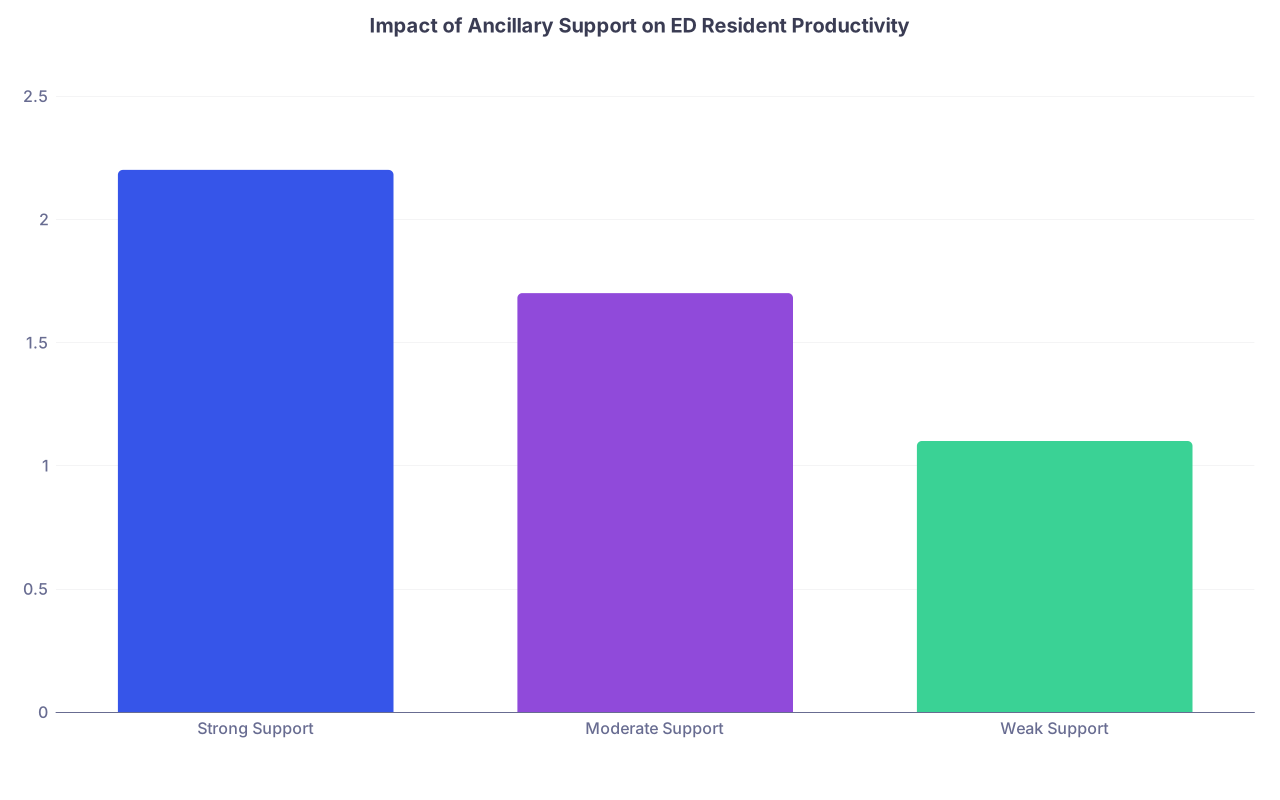
| Category | Value |
|---|---|
| Strong Support | 2.2 |
| Moderate Support | 1.7 |
| Weak Support | 1.1 |
(Approximate patients per hour with adequate teaching; numbers illustrative, not universal.)
Surgery (general and subspecialties)
Many surgical residents assume ancillary support “does not matter” because “I am in the OR all day.” Wrong.
Poor staffing hits you when:
- Floor nursing is stretched. You are constantly paged out of cases for low-level issues because nurses have no bandwidth to triage.
- There are no dedicated wound/ostomy nurses, so you do all dressing changes, teaching, and equipment troubleshooting.
- Case management is too thin, so post-op discharge planning falls on you, and your clinic days become dispo days.
Good ancillary staffing:
- Frees you to be in the OR actually operating, not running back to the floor for minor issues.
- Makes night float survivable because nurses handle basics and escalate appropriately.
- Supports ERAS pathways, early mobilization, and smooth discharges, which means more time on education and less on chaos.
Psychiatry
Psych residents sometimes think they are insulated. They are not.
Ancillary support here = nursing, social work, therapists, and security.
Understaffed unit:
- Nurses covering too many patients, cannot run groups or do adequate observation.
- Social workers overloaded, so dispo for complex cases (homelessness, substance use, poor supports) stalls.
- Security thin, so staff are more risk-averse about admissions and may push inappropriate discharges.
You end up:
- Repeating social work tasks.
- Spending time on housing and insurance logistics instead of therapy and psychopharmacology.
- Dealing with more unit behavioral crises because staff are stretched.
Again, not “beneath” you to help. But if you are effectively doing two jobs every day, your training suffers.
How to Interrogate Ancillary Support During Interviews and Rotations
You are not powerless. You can extract real signal if you know what to look for.
On interview day: what to ask and who to ask
Do not waste your time with “Tell me about your program.” You want targeted questions, preferably to residents without faculty hovering.
Ask residents:
- “What tasks are you routinely doing that you feel could be done by ancillary staff at better-staffed hospitals?”
- “On a bad call night on gen med / ICU / ED, what actually makes it bad? High volume, or system issues like transport, labs, or dispo?”
- “Are you ever stuck doing discharges or coordination late in the day because of limited case management or social work?”
Ask specifically about nights and weekends:
- “What is different on nights and weekends in terms of phlebotomy, transport, RT, case management, and nursing ratios?”
- “Do you ever feel unsafe because staffing is so thin?”
Pay close attention to body language. The quick glance between residents, the forced laugh, the “It builds character.” That is your warning.

| Step | Description |
|---|---|
| Step 1 | Start Interview Day |
| Step 2 | Ask Residents About Night Coverage |
| Step 3 | Dig Deeper on Specific Units |
| Step 4 | Confirm With Multiple Residents |
| Step 5 | Reassess Program Rank |
| Step 6 | Observe During Preinterview Dinner |
| Step 7 | Finalize Impression of Support |
| Step 8 | Red Flags? |
On away rotations / sub-Is
This is where you see the truth. Watch for:
- How long does it take from order entry to action? (Labs drawn, meds given, imaging completed.)
- Are nurses constantly running, visibly behind, and apologizing? Or is there bandwidth for them to help problem-solve?
- Do case managers join rounds and speak up? Or are they ghosts you hear about but never see?
Ask interns off to the side:
- “What part of your day feels like the biggest waste of your training time?”
- “If you could add one type of support staff, who would it be and why?”
You will hear the patterns fast: “We could really use more case managers,” “Transport kills us,” “Nights are brutal because we draw all our own labs.”
Comparing Programs: When Does Poor Support Become a Dealbreaker?
You are not going to find a utopia. Every hospital has gaps. The point is not perfection. The point is avoiding programs where staffing ratios fundamentally distort your training.
Here is a brutally honest way to think about it.
| Domain | Green Flag Example | Red Flag Example |
|---|---|---|
| Floor Nursing | 1:4 ratio, CNAs present nights | 1:6–1:7 routinely, high turnover |
| ICU Nursing | 1:1–1:2 stable staff | 1:3+ or frequent travelers |
| Phlebotomy/Transport | 24/7 service, residents rarely draw labs | Limited hours, residents do most off-hours |
| Case Management/SW | 7 days/week, daily rounds | M–F only, limited visibility |
| RT/Procedural Support | Dedicated ICU RT, prompt ED response | One RT covering multiple units overnight |
Patterns where I would strongly consider dropping a program on my rank list:
- Chronic unsafe nursing ratios on floor and ICU with no plan to improve.
- No weekend or evening case management, leading to systemic discharge delays and ED boarding.
- Residents consistently describe their worst days in terms of “the system falling apart” rather than “we were just clinically slammed.”
Programs where I would be more forgiving:
- Occasional night lab draws by residents, but daytime support is strong.
- Mixed scribe coverage in the ED, but good nursing and tech staffing.
- Some under-resourced rotations balanced by others with excellent support.
You are ranking an ecosystem, not a single metric.
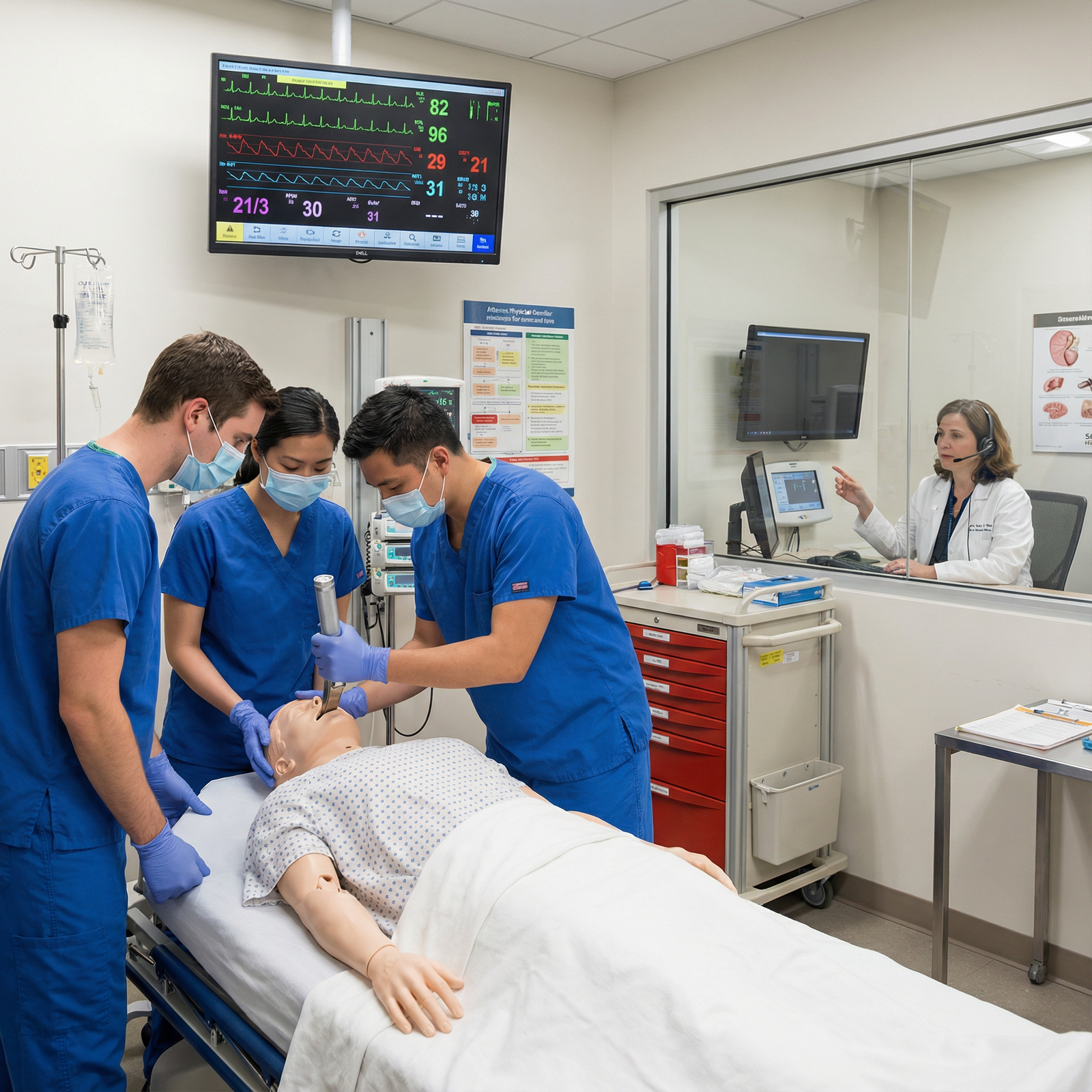
How Ancillary Support Affects Burnout, Safety, and Your Future Self
Let’s pull back from the day-to-day and look long-term.
Burnout and moral injury
Residents do not burn out just from working hard. They burn out from working hard on the wrong things while feeling they are failing their patients.
Poor ancillary support creates:
- Constant friction: delays, miscommunications, duplicated work.
- Unsafe feeling: you know the care could be better if the system were not broken.
- Loss of professional identity: you feel more like logistics staff than a physician in training.
Over three to seven years, that grinds your enthusiasm down. I have watched sharp interns become cynical third-years purely from this.
Strong ancillary support:
- Does not remove stress. It channels it toward meaningful clinical decisions.
- Preserves your bandwidth for learning and growth.
- Lets you leave a day tired but satisfied instead of exhausted and ashamed.
Patient safety and outcomes
This is not just about your experience. Staffing correlates directly with safety.
Understaffed units see:
- More falls, missed vitals, and delayed recognition of deterioration.
- More medication errors.
- Longer lengths of stay and more readmissions due to rushed, poorly coordinated discharges.
As a trainee, you are the last line of defense. When the system is brittle, you are compensating constantly. That is not sustainable, and it is not fair to you or your patients.
Your future practice habits
The system you train in will recalibrate your sense of “normal.”
If you train in chaos, you learn to accept:
- Constant multitasking with shallow thinking.
- Minimal reading and self-education.
- Reactive rather than proactive care.
If you train where ancillary support is robust, you internalize:
- Deep work on complex cases.
- Coordinated, interdisciplinary care.
- Appropriate delegation and team leadership.
You will carry those habits into your future job. Whether you realize it or not.
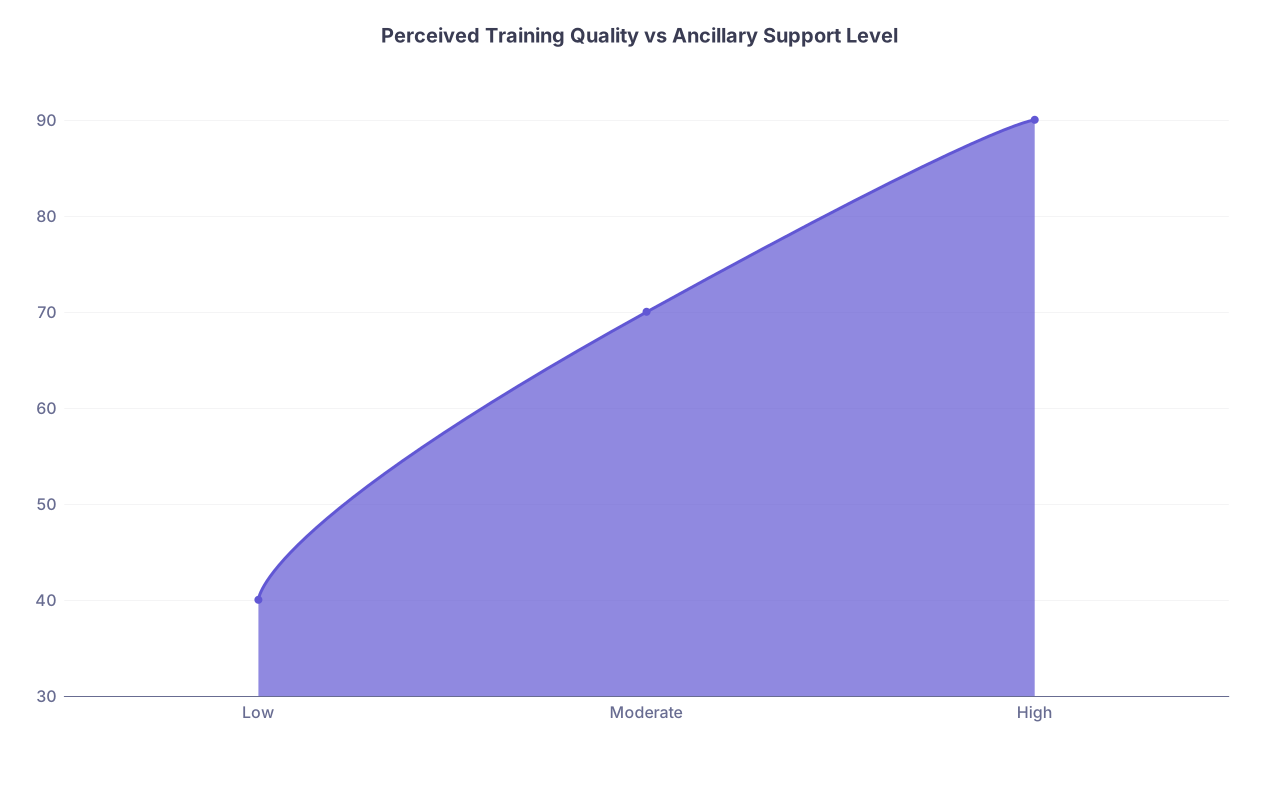
| Category | Value |
|---|---|
| Low | 40 |
| Moderate | 70 |
| High | 90 |
(Illustrative scale of resident-reported training quality, 0–100.)
Bottom Line: How to Actually Use This When Ranking Programs
You are not going to get a neat spreadsheet labeled “Ancillary Support Index.” You have to piece it together.
Here is a practical approach:
During interviews, ask at least 3–4 concrete questions about:
- Nursing ratios (day vs night).
- Phlebotomy and transport coverage.
- Case management and social work hours.
- RT and ED support.
During preinterview dinners and socials, ask residents:
- “What makes your worst days bad?” and listen hard to the answers.
- “What tasks feel like the biggest waste of your training time?”
During any away rotation:
- Time how long basic orders take to execute.
- Observe whether residents seem to be mostly doing clinical work or fighting the system.
After each program, rate it informally in your notes:
- Nursing support: 1–5
- Phlebotomy/transport: 1–5
- Case management: 1–5
- RT/procedural: 1–5
- Overall “am I mostly acting like a doctor here?”: 1–5
Patterns will emerge. Believe them.

FAQs
1. Is doing my own labs and basic tasks always a bad thing for training?
No. Drawing a few emergent labs, placing your own IVs in difficult cases, or transporting a crashing patient teaches ownership and basic procedural skills. The problem is when those tasks become the bulk of your day due to chronic understaffing. Occasional hands-on work is useful. Systemic reliance on residents for routine tasks is exploitation, not education.
2. How do I ask about staffing without sounding entitled on interview day?
Frame questions around patient care and learning, not your comfort. For example: “How do nursing and case management staffing levels affect your ability to discharge patients safely and on time?” or “What support systems are in place overnight to help residents manage high acuity?” That signals maturity, not laziness.
3. Should I avoid every program with any staffing issues?
No, that would leave you with almost no options. Every hospital has pain points. You are looking for patterns: are staffing challenges acknowledged and being addressed, or are they minimized and normalized? A program that says, “We have had floor nursing shortages, but here is what we changed,” is far better than one that pretends nothing is wrong.
4. Does community vs academic make a big difference in ancillary support?
Sometimes, but not predictably. Some community hospitals have superb nursing and case management because they compete regionally and are tightly run. Some big-name academic centers coast on reputation while neglecting frontline staff. Do not assume. Ask the same concrete questions at both. Let data and resident stories, not branding, guide you.
5. How heavily should ancillary support factor into my rank list compared to fellowship match, reputation, or location?
Higher than applicants usually place it. Reputation and fellowship match matter, but they are downstream of how well people are actually trained and supported. If two programs are similar academically, but one clearly has stronger ancillary support and happier residents, that one will usually produce a better, less burned-out version of you. If a program’s support is so poor that residents are chronically drowning, I would drop it down your list no matter how shiny the name.
Key points:
- Ancillary support is not a side detail; it directly shapes how much real medicine you practice versus how much system scut you absorb.
- You can and should probe staffing realities with specific questions to residents and by observing workflows on the ground.
- When ranking programs, treat consistent understaffing and system chaos as serious threats to your training, not just “part of residency.”