The most dangerous mistake in residency selection is ignoring the call model.
Not prestige. Not fellowship match lists. The call model. Because that is the structure that dictates how exhausted you are, when you learn, how safe you feel, and ultimately how burned out you become.
Let me break this down specifically: “night float,” “24‑hour call,” and “hybrid” are not just scheduling styles. They are three different ways of living for 3–7 years. If you do not understand them before you rank programs, you are gambling with your sleep, your safety, and your sanity.
1. The Three Call Models in Plain Language
Forget the glossy brochure versions. Here is what these actually look like on the ground.
Night Float
Night float = dedicated night shifts for a block of time, no days in between.
Standard patterns you will see:
- 5–6 nights per week, often Sunday–Thursday or Monday–Friday
- Shifts usually 12–14 hours (e.g., 7 p.m.–7 a.m., 6 p.m.–6 a.m.)
- Block length: 1–4 weeks of nights at a time
- No daytime duties those same days (in theory – some places violate this)
Core features:
- You are the “night person” for that service. You cross-cover multiple teams, admit new patients, and handle overnight issues (codes, sepsis, pain, confusion, family calls).
- Your body flips to a nights schedule. Then flips back when the block ends.
- The day teams go home; you own the patients overnight.
Who uses it heavily:
Internal medicine, pediatrics, neurology, psych, some surgery and OB programs, especially at larger academic centers.
24‑Hour Call
24‑hour call = long call days where you work a full day and stay overnight, then go home. In practice, it is often 26–28 hours.
Typical structure:
- Start around 6–7 a.m.
- Full day of rounding, consults, OR, clinic, or L&D
- Stay overnight admitting, cross-covering, managing events
- Leave by late morning or early afternoon next day (if duty hours are actually respected)
Call frequency often described as:
- Q3 = every third night
- Q4 = every fourth night
- “2–3 calls per 2‑week block” etc.
Reality:
You will have post‑call days (you go home after morning work), but those “days off” are usually spent sleeping and barely functioning.
Common in:
General surgery, neurosurgery, OB/GYN, some medicine programs that resist night float, trauma services, some ICUs.
Hybrid Call
Hybrid = some mix of traditional long call and dedicated night float or shorter night shifts.
Versions you will actually see:
- Interns on night float, seniors on 24‑hour call
- Days: “short call” and “long call” systems (e.g., long call admits until 7–9 p.m.; short call until 5 p.m.)
- Weekdays: evening “twilight” shifts; weekends: 24‑hour shifts
- ICU: 24‑hour calls plus occasional week of night float
Hybrid is not standardized. Programs love to call themselves “hybrid” because it sounds modern without actually telling you how painful the schedule is. You need specifics.
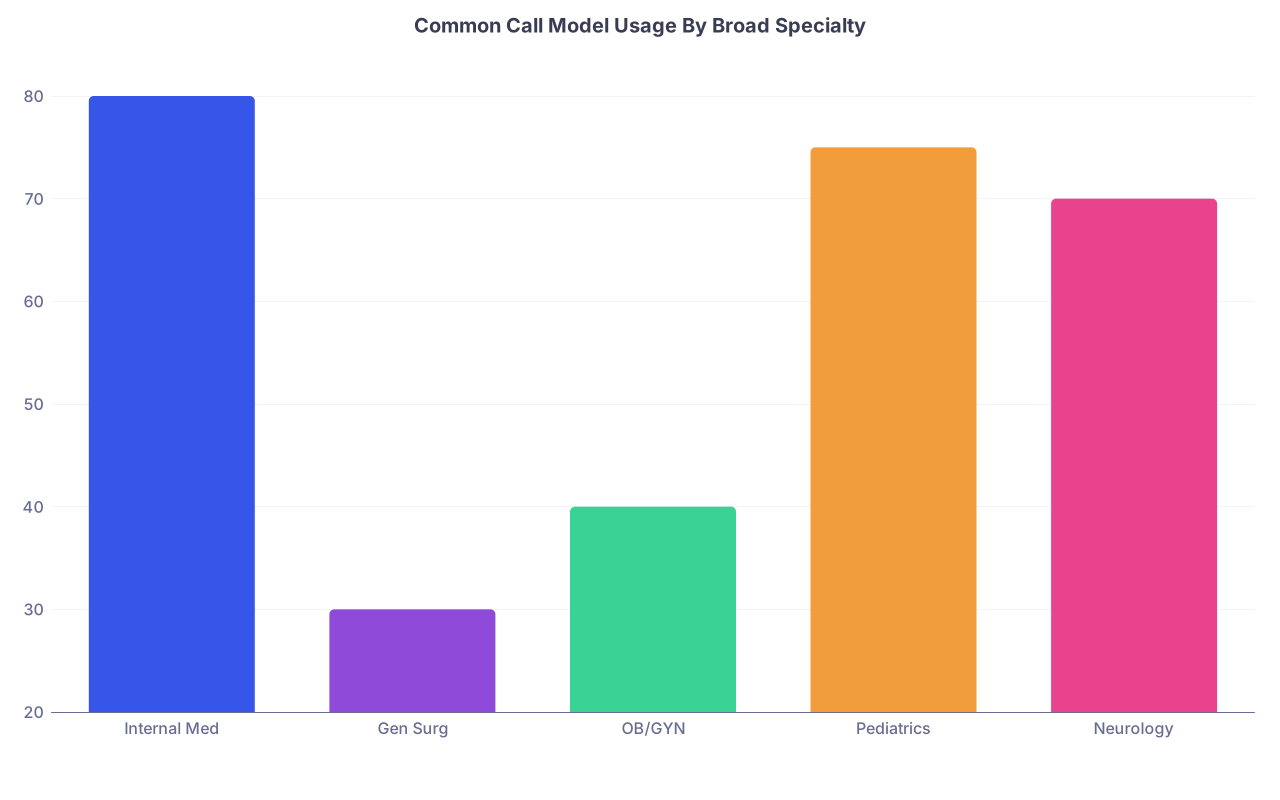
| Category | Value |
|---|---|
| Internal Med | 80 |
| Gen Surg | 30 |
| OB/GYN | 40 |
| Pediatrics | 75 |
| Neurology | 70 |
(Interpretation: higher bars roughly reflect how commonly programs in that specialty use some form of night float; surgery/OB still lean heavier on 24‑hour calls.)
2. How Each Model Shapes Your Life (Not Just Your Sleep)
You are not choosing “schedule aesthetics.” You are choosing:
- When you learn
- When you see attendings
- How your relationships function
- Whether you feel constantly behind or occasionally rested
Let’s go model by model.
Night Float: Pros, Cons, and Hidden Traps
Upsides
Predictable sleep chunks
You usually sleep during the day for 4–7 hours. That is often more consistent than the choppy, random pseudo-sleep of 24‑hour call. If your program protects post‑night sleep, you can plan a bit.Clear mental separation
You know which weeks are bad. “I am on nights this week” tells friends/family/emotional brain what to expect. Then you switch off nights and rejoin daylight humans.Efficiency with night skills
You become very sharp at cross-coverage: chest pain at 2 a.m., sudden hypotension, delirium, code calls. You see dozens of these clustered in a few weeks. That accelerates pattern recognition.Less circadian chaos month-to-month
Instead of constant “one night here, one long call there,” your circadian rhythm flips to nights for a defined block. For many residents, that is less brutal overall than random night smatterings.
Downsides
Isolation and limited attending teaching
Night float can be lonely. Attendings are often at home, available by phone, or covering from a distance. Less bedside teaching, more “do your best and call if you are drowning.”
I have seen interns do a full 2‑week night block where they physically see their attending for 10 minutes total at sign‑out.Social life destruction in bursts
When you are on nights, you are gone. Family dinners, partners, kids, friends – all in the opposite time zone. Some people can handle 1 week. Four weeks? Repeatedly? That is different.Turnaround days are brutal
The transition back to days is miserable. You either:- Stay awake after your last night and crash in the afternoon (zombie day); or
- Sleep a few hours and then cannot fall asleep that night, dragging through the next day.
Cognitive fatigue plateaus
After a few consecutive nights, performance declines then stabilizes at a lower level. You feel “functional enough,” but your executive function and empathy are thinner. You are not at your best.
What to ask on interview day about night float
Do not ask, “Do you have night float?” They will proudly say “yes.” Ask:
- Who does night float – interns vs seniors vs both?
- How long are the blocks? (1, 2, 3, 4 weeks?)
- Typical weekly schedule – 5 vs 6 nights? Weekends?
- Do night float residents ever have required daytime conferences or clinics during that block? (Huge red flag if yes.)
- How many admissions per night? Rough range, not the PR version.
You want concrete numbers, not vibes.
24‑Hour Call: Pros, Cons, and Reality Checks
Upsides
Continuity of care and learning
You admit the patient during the day, manage them through the acute night events, then present them post‑call. That “own the patient all the way through” aspect is powerful for learning, especially in surgery, OB, ICU. You see the entire trajectory.Team cohesion
Your call team becomes your family. You suffer together. You learn each other’s moves. You get a feel for the service in all time zones without flipping schedules every few weeks.Real preparation for some fellowships / jobs
Surgical subspecialties, trauma, some intensive care setups: 24‑hour or near‑24‑hour coverage is reality. A solid call experience can help you feel competent later, not like you were protected into incompetence.Fewer full-night flips
You might have 2–6 24‑hour calls per month instead of 14 straight nights. That matters if your body truly cannot handle prolonged nocturnal schedules.
Downsides
Sheer exhaustion
Let’s stop pretending. 26–28 hour shifts are not “fine.” You will make decisions on 2 hours of fragmented sleep. You will sign chemotherapy orders, call families, manage sepsis, take patients to the OR while cognitively impaired. There is research backing performance decline; you will feel it personally.Your “post‑call day off” is fake
Post‑call is theoretically your “day off.” Functionally, it is: crash at noon, wake at 4–5 p.m., stare at wall, scramble to do laundry or call your parents, go back to bed. That is not a meaningful “day off.”Unpredictable nights
Some calls you admit nonstop until 4 a.m. Some nights you get 3–4 hours of sleep. Some nights you fail to sit down even once. Recovery is wildly variable.Greater risk of errors and burnout
Fatigue correlates with medication errors, missed diagnoses, irritability, and emotional outbursts. You see more crying-in-the-call-room and “I am done with medicine” moments in chronically overcalled residents. I have yet to see a program with heavy Q3 28‑hour calls that does not also have significant burnout.
Key interview questions for 24‑hour call
- What is the actual max shift length – 24, 26, or 28 hours?
- True call frequency by PGY level?
- How often are duty hours violated on call months? (Ask residents privately.)
- Where do you sleep on call? Is there a protected call room or are you on a hallway couch?
- What tasks keep you at the hospital post‑call (formal rounds, sign‑out, notes)? Until when?
You are trying to determine: is this survivable, or is it a relic no one has updated since the 1990s?

3. Hybrid Systems: Where Programs Hide the Pain
“Hybrid” sounds nice. Balanced. Reasonable. Often that is marketing cover for, “We stitched together several painful systems and hope you do not notice.”
Common Hybrid Structures
Day call + night float
- Interns on night float admit all night.
- Day teams have “short call” or “long call” until 7–9 p.m.
- Seniors might do 24‑hour calls on certain services (ICU, specialty floors).
Weekdays night float; weekends 24‑hour call
- Mon–Thu: night float coverage
- Fri–Sun: 24‑hour “weekend call”
This looks civilized on paper and feels awful during that Fri–Sun stretch.
Shift-based ED-style nights on some rotations; 24‑hour call on others
- MICU: 24‑hour call
- Wards: night float
- ED: fixed 8–12‑hour shifts
- OB: laborist-style night shifts, but 24s on gyn onc or special services
The problem is not that hybrid is inherently bad. It can be the best of both worlds if designed well. Or the worst.
How to dissect a “hybrid” program
When a PD or resident says “we use a hybrid call model,” you need to pin them down:
- On every major rotation (wards, ICU, ED, OB, surgery, subspecialty consults):
- Are nights covered by float, 24‑hour calls, shift work, or something else?
- Who covers them (intern vs senior vs night team)?
- How many nights/calls per month for each PGY year?
You want details rotation by rotation, year by year. If they cannot answer cleanly, the schedule is probably chaotic.
| Feature | Night Float | 24-Hour Call | Hybrid |
|---|---|---|---|
| Typical Block Length | 1–4 weeks nights-only | Ongoing, scattered call days | Mixed blocks / scattered nights |
| Shift Duration | 12–14 hours | 24–28 hours | 8–28 hours, rotation-dependent |
| Continuity of Care | Moderate | High | Variable |
| Attending Presence Nights | Limited | Often limited | Variable |
| Social Life Disruption | Intense, in blocks | Recurrent, post-call cycles | Sporadic but persistent |
4. How Call Models Impact Learning, Wellness, and Performance
Residency is not just about surviving. You are supposed to come out competent. The call model shapes that more than people admit.
Learning and Teaching
Night float:
- Fewer attendings in-house = less real-time supervision, more phone consults.
- Great for learning acute management of decompensating patients; poor for diagnostic reasoning with attending feedback.
- Learners often say: “I saw a ton, but I am not sure if what I did was the best choice.”
24‑hour call:
- Best for longitudinal learning: admit → stabilize → reassess next morning.
- More attending interaction post‑call when you present “your” patients.
- But cognitive fatigue means the later-night learning is degraded – you are just trying not to miss anything catastrophic.
Hybrid:
- Can give you structured days with didactics and clinics plus concentrated nights for acute care.
- Or it can fragment you so much that you never feel fully caught up in either world.
Ask yourself: how do you learn best?
- Do you retain information when you have fewer, longer, integrated experiences (admission → night course → follow‑up)? 24‑hour call helps.
- Do you prefer repeated shorter, focused exposures to similar problems (lots of cross-cover at night; many acute events)? Night float accelerates that.
Wellness and Burnout
No call system “fixes” residency. But some are clearly better aligned with human physiology.
Basic truths:
- Chronic circadian flipping wrecks mood and cognition.
- Fragmented, unpredictable sleep is worse than short but predictable sleep.
- Residents tolerate short, intense suffering better than endless low‑grade misery.
Rough patterns I have seen:
Night float-heavy programs:
- Residents feel “wrecked” during night blocks but often better on day rotations with fewer random calls.
- Social lives take hits in discrete chunks instead of constant small hits.
- People complain about losing touch with attendings and feeling invisible at night.
24‑hour call-heavy programs:
- More chronic fatigue and cynicism, especially PGY2–3 when call frequency peaks.
- Residents bond more tightly as teams but also share burnout more visibly.
- Lots of “I love the cases, hate the hours” feelings.
Hybrid programs:
- Completely dependent on specifics.
- Can produce a “never stable” feeling if you are constantly switching from nights to evenings to days.
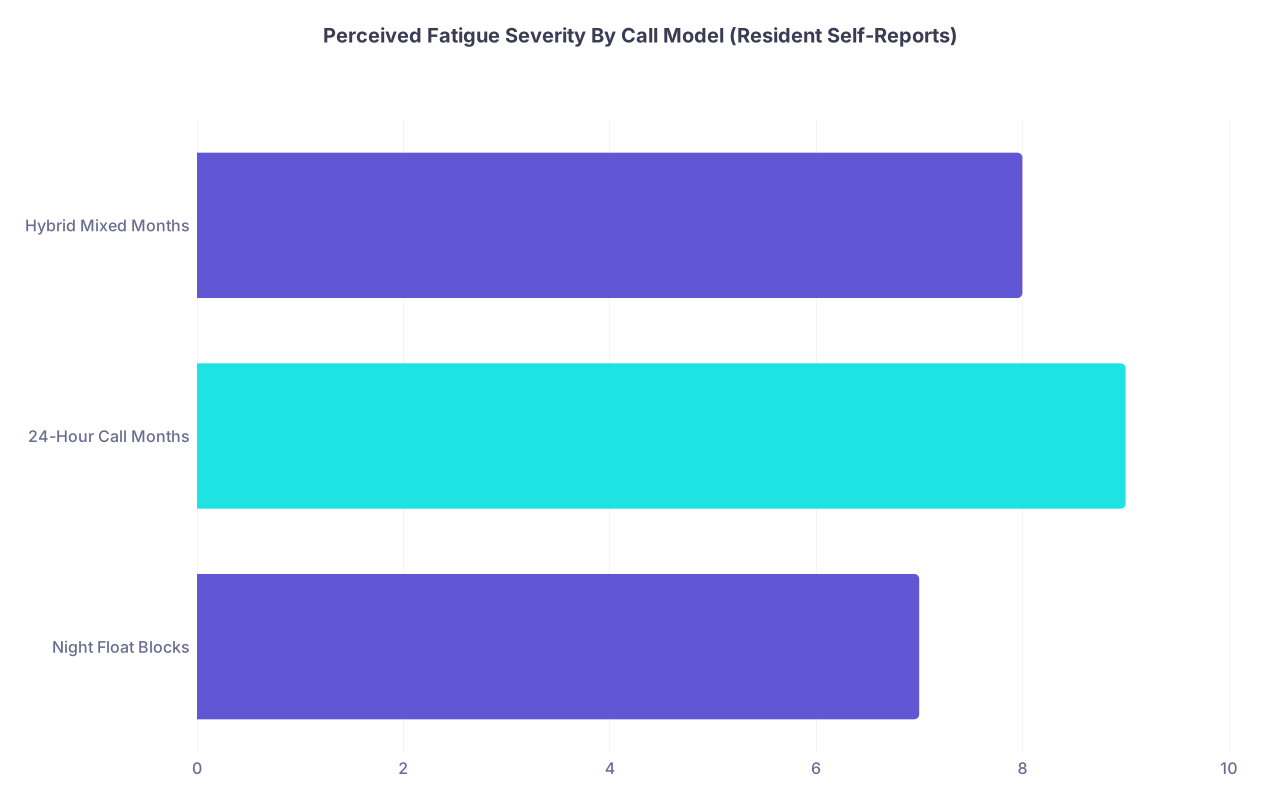
| Category | Value |
|---|---|
| Night Float Blocks | 7 |
| 24-Hour Call Months | 9 |
| Hybrid Mixed Months | 8 |
(Scale 1–10: a rough synthesis of what residents typically report when you ask honestly. Not a RCT, but it matches what many of you will feel.)
5. Call Models by Specialty: What Actually Matters
You cannot transplant an internal medicine call philosophy directly onto neurosurgery. Different fields have different realities.
Internal Medicine / Pediatrics
Most competitive academic IM and peds programs now use heavy night float with limited true 24‑hour call on wards.
Patterns:
- Interns:
- 2–4 weeks of night float per year (per major hospital)
- Day ward rotations with one “long call” evening per week
- Seniors:
- More nights or “admitting shifts”
- Occasional 24‑hour call on MICU or specialty services
What matters for you:
- Total number of nights per year per PGY level
- How many admissions you carry at night (capped vs “as many as they send”)
- How much post‑night, post‑call recovery time you truly get
A medicine program that advertises “night float” but has you doing 6 nights per week, plus mandatory conferences at noon, plus continuity clinic on your “day off” – that is not a humane schedule.
General Surgery / Neurosurgery
You will not escape 24‑hour call. It is baked into the culture and the workflow.
Patterns:
- Q3–Q4 24‑hour trauma or gen surg call as junior resident
- Trauma / transplant / SICU nights that are basically nonstop
- Seniors sometimes get slightly lighter call but higher responsibility
Key questions:
- Exact call frequency by PGY year, with real numbers (push for this from residents, not just PDs).
- How much of that call is “in-house with real cases” vs sitting and waiting?
- Does the program actually monitor and enforce duty hours or quietly encourage violation?
If you are going into surgery, you are signing up for long calls. The question is whether the program uses you as a body to plug holes or as a learner who needs rest to operate safely.
OB/GYN
Often mixes everything:
- L&D shifts that feel like night float
- 24‑hour calls for gyn, gyn onc, or general call
- Some programs moving to “laborist” models with more shift-like schedules
Critical points:
- How many 24‑hour calls per month in PGY1–2?
- How many nights on L&D per year? How often are you alone vs with senior/attending?
- Post‑call rules: do you leave by noon, or are you holding pager for “just a couple more hours”?
EM, Anesthesiology, Psychiatry, Neurology
Emergency medicine:
Pure shift work. But residents rotate on off-service (ICU, medicine, OB) where call models vary. Do not ignore those months; they can make or break your year.
Anesthesia:
Increasingly shift-based, but call exists – especially in cardiac, trauma, transplant, OB. Understand whether your nights are Q4 24s vs night float vs random weekends.
Psych / neuro:
A lot of smaller programs still use 24‑hour call for acute psych units, neurology wards, and stroke coverage. Ask particularly about stroke night coverage – it can be relentless.

6. How to Interrogate Call Models on Interview Day (Without Sounding Clueless)
If you ask, “How is your call schedule?” you will get: “It’s busy, but manageable!” Useless.
You need specific, quantitative questions that force real answers.
Questions to Ask Residents (Not PDs)
Ask these in small resident-only rooms, not in front of leadership:
“How many 24‑hour calls did you personally take in PGY1? PGY2?”
Do not accept ranges like “oh, it depends.” Push for approximate numbers.“How many nights per month are you in the hospital past midnight?”
This includes night float, 24‑hour call, and weird evening shifts.“What does your last hour of a 24‑hour call actually look like?”
Listen for: still admitting? Pre-rounding? Operating? Or sitting and waiting for sign-out?“How often do duty hours get violated? And what kind of violations? Leaving late? Too many hours per week?”
Residents will either laugh darkly or say “rarely and we actually report them.” Big difference.“If you had to pick the single worst rotation for call, which is it and why?”
You always get the truth here. MICU? Trauma? L&D? How bad is “bad”?
Questions to Ask PDs / Chiefs
“For wards, what is your primary night coverage system – full night float, 24‑hour calls, or a mix? Can you walk me through the structure?”
Make them outline it.“What changes have you made to call structure in the last 3–5 years, and why?”
Progressive programs tweak schedules based on survey data, ACGME feedback, or resident requests. Stagnant ones say “It works fine; we have not changed it.”“How are residents involved in redesigning the call schedule or giving feedback about it?”
You want some formal mechanism, not just “our doors are open.”“What are your protections for post‑call or post‑night rest?”
Real protections: “No clinic after night float,” “Mandatory post‑call home by 11 a.m.,” “We audit this.”
Fake protections: “We encourage residents to go home” with a wink.

| Step | Description |
|---|---|
| Step 1 | Learn Call Model Terms |
| Step 2 | On Interview Day |
| Step 3 | Quantify nights and calls |
| Step 4 | Identify worst rotation |
| Step 5 | Clarify structure by rotation |
| Step 6 | Ask about recent schedule changes |
| Step 7 | Decide if call model is acceptable |
| Step 8 | Ask Residents Privately |
| Step 9 | Ask PD / Chiefs |
| Step 10 | Compare to your priorities |
7. Matching the Call Model to Your Personality and Life
There is no universally “best” call model. There is only what fits you, your specialty, and your life outside the hospital.
Be honest with yourself:
If you prioritize stability and circadian sanity
Night float–heavy programs may actually treat you better. Short, defined night blocks where you can plan: meal prep, blackout curtains, communication with family.
Your risks:
- Feeling cut off from attendings and long-term patient follow-up
- Hating the week-long social disappearance multiple times per year
What you should look for:
- 1–2 week night float blocks instead of 3–4 weeks
- Clear rules: no clinic, no noon conference requirements while on nights
- Reasonable patient caps and cross-cover numbers
If you care deeply about continuity of care and autonomy
You may actually prefer some 24‑hour call, especially in:
- Surgery
- OB/GYN
- ICU-based careers
You want the experience of: admit, operate/procedure, manage complications overnight, re-evaluate in the morning. That is powerful.
You must accept:
- Real fatigue
- Emotional volatility post‑call
- Missed life events sprinkled across the entire year
Choose programs that:
- Enforce post‑call leaving times
- Are honest about call being heavy, not pretending it is “chill”
- Have strong team culture (misery without camaraderie is a nonstarter)
If you have major outside-of-work obligations
Examples: young kids, caregiving for parents, partner with inflexible schedule.
In that case, the fine print of call matters even more. You are not just choosing your suffering; you are choosing your family’s.
You should:
- Map out a sample month from each program (residents will help)
- Ask, “What happens if daycare calls at 4 p.m. and I am on long call?”
- Clarify parental leave + schedule reshuffling policies beyond the brochure
Many residents incorrectly assume night float is “better for parenting” because days are free. Reality: sleeping all day when kids are awake is brutal. A 24‑hour call Q4 might paradoxically allow more full days with your child in between, if the rest of the rotation is humane. There is no easy answer; there is only what you and your support system can tolerate.
8. How to Use Call Models in Your Rank List
You are going to get seduced by prestige and fellowship match lists. That is predictable. But if two programs are otherwise similar, the call model should be a tiebreaker – or a deal-breaker.
Here is a blunt hierarchy I use when advising students:
- Toxic culture + horrible call model = do not rank. I do not care about name brand.
- Supportive culture + heavy call = acceptable for surgical/ICU-heavy careers if you know what you are signing up for.
- Supportive culture + thoughtful, transparent call design = ideal, even if the program is not “top 10.”
- Hidden or evasive call model answers = red flag, regardless of prestige.
If you finish interviews and cannot clearly describe how call works at your top 3 programs, you have not done enough homework. Email current residents. Ask for clarity. You are allowed to ask again.
Boiled down to essentials:
- Call models – night float, 24‑hour call, hybrid – are structurally different ways of living, not cosmetic schedule choices. They drive your fatigue, learning, and life outside the hospital.
- Do not accept vague descriptions. Force programs to give you concrete numbers: nights per month, 24‑hour calls per year, block lengths, and actual enforcement of post‑call rest.
- Rank programs not just by name and fellowship output, but by whether their call model and culture are something you can survive – and still become the physician you want to be.