
Most applicants ask the wrong questions about “acuity” in residency interviews. They fixate on prestige and case volume, but ignore the single most telling piece of training reality: what actually happens when a patient is crashing at 3 a.m. and you are the only doctor on the floor.
Let me break this down specifically. Rapid responses, codes, and ED coverage are the hard edges of residency. They define:
- How much real responsibility you get
- How supported (or abandoned) you will feel
- How confident you will be when you graduate
If you do not ask targeted, uncomfortable questions about these three domains, you are choosing a program with your eyes half closed.
We will walk through exactly what to ask, what answers should raise your eyebrows, and how the patterns differ between community and academic, big tertiary centers and smaller hospitals, medicine vs surgical vs other specialties.
Why These Questions Matter More Than You Think
Recruitment dinners and glossy program brochures will never show you the 4 a.m. code in a decompensating GI bleed with no attending in the building. But that scenario, or some version of it, is where you either learn to function as a real physician or you get traumatized and burned out.
Resident roles in:
- Rapid response teams (RRTs / MET calls)
- Code blues (inpatient and ED)
- ED coverage / admissions / cross-coverage overnight
tell you:
- How autonomously residents practice
- How quickly attendings back them up
- How the hospital actually functions when everything goes sideways
- How much procedural and resuscitation experience you will have by graduation
You cannot infer this from “we’re a Level 1 trauma center” or “we have 900 beds.” Those numbers are marketing. The actual workflows are what matter.
Core Concepts: Who Owns the Crashing Patient?
You need a mental model for how different hospitals structure acute care. There are a few common patterns.
| Model Type | Who Runs Most RRT/Codes | Typical Setting |
|---|---|---|
| Resident-driven | IM or Anesthesia residents | Large academic centers |
| Hospitalist/APP-driven | Hospitalist or NP/PA | Community hospitals |
| ICU team-driven | ICU fellow / resident | High-acuity tertiary centers |
| ED-driven | ED team for all events | Smaller hospitals, some community sites |
In reality, programs blend these. But one pattern usually dominates.
Your goal when interviewing is to figure out:
- Who leads the response?
- Who physically shows up?
- Who writes the orders and runs the algorithm?
- How that changes by PGY level and time of day
If you leave an interview day without knowing those four things, you did not ask the right questions.
Rapid Response: “Sick but Not Dead Yet” – Your Primary Training Ground
Rapid responses (RRT/MET calls) are where you learn to recognize and reverse deterioration before it becomes a code. This is where good residents separate themselves. A robust rapid response role is educational gold; a weak or chaotic system is a red flag.
Concrete questions to ask about rapid responses
Do not ask, “Do residents respond to rapid responses?” That is too easy to spin. Use questions that force them into specifics.
Ask:
- “Who is expected to respond to rapid responses during the day and at night?”
- “Is there a dedicated rapid response team, or is it covered by whoever is on the floor?”
- “For an intern on wards, if there is a rapid response on their patient, what exactly do they do and who joins them?”
- “Is there always a senior resident present? An ICU fellow? What about weekends and nights?”
- “Roughly how many rapid responses would a typical PGY-2 or PGY-3 run in a month on wards or ICU?”
- “Are residents ever the sole physician at a rapid response?”
- “Who writes the notes and orders for RRT events?”
Those questions cannot be hand-waved away. You’ll force them to describe the real-life workflow.
What good answers sound like
At a strong academic IM program, you might hear something like:
- “During the day, the rapid response team is an ICU fellow, ICU nurse, respiratory therapist, and the primary team resident. Night float seniors respond to any RRTs on their service. Interns always have a senior there.”
- “PGY-2s and 3s often run the initial evaluation and stabilization, but the ICU fellow is quick to the bedside.”
- “We probably see 10–20 RRTs per resident month on ICU and 5–10 on wards. You get comfortable fast.”
Translation: real responsibility, real repetition, real backup.
At a community program with hospitalist-driven RRT:
- “The hospitalist is paged for all RRTs, they come immediately and lead. The resident comes if it’s their patient or if they are on the admitting team.”
- “Residents participate but rarely run the whole thing alone.”
This can still be good training, but your leadership role is smaller. Less ideal if your goal is being extremely independent by graduation.
Red-flag answers
Watch out for:
- “Rapid responses are mostly handled by nursing and respiratory; residents come if needed.”
- “There is a team, but it depends who is around.”
- “I am not really sure who is technically responsible; it kind of varies.”
If a current resident cannot clearly tell you who owns the RRT process, that usually means the process is chaotic, under-resourced, or residents are marginal in it.
Also be suspicious of: “We do not really have many rapid responses.” In any real hospital with sick patients, there are plenty. That kind of answer usually means either low acuity or poor recognition of deterioration.
Codes: Who Runs the Room When a Patient Arrests?
Resuscitation experience is non-negotiable. You are not a fully trained internist/emergency physician/anesthesiologist if you have never actually run a code from start to finish.
There is a huge range of resident responsibility here. You need to map it for every program you care about.
Exact questions to ask about code blues
Aim for operational detail:
- “Who responds to code blue pages in the hospital – which residents, which services?”
- “Who is expected to run the code at different PGY levels? Is there a specific ‘code leader’ role?”
- “Are attendings or fellows always physically present? Days vs nights?”
- “What is the approximate number of codes a resident leads by the end of training?”
- “Is there any simulation or formal training specifically on code leadership and running ACLS in a room full of people?”
- “If there are simultaneous codes, how is that handled?”
- “Can you walk me through the last code you personally ran and who was there?”
That last question, directed at a current resident, is extremely revealing. You will hear the truth in how they describe it.
What strong code culture looks like
You want a place where:
- Codes are not rare
- Residents are primary leaders at some point in training
- There is psychological safety but real responsibility
A good pattern often looks like this:
- PGY-1: Chest compressions, meds, airway assistance, line placement, documentation; learning the choreography.
- PGY-2: Running segments under supervision; calling rhythm checks, assigning roles, deciding on escalation.
- PGY-3: Full code leadership on floor/ward codes, sometimes ICU codes, with attending/fellow present but not micromanaging.
A solid answer from a senior resident:
“By the end of PGY-3, I had probably led around 15–20 codes independently, more where I was co-leading. There is always at least an ICU fellow or hospitalist present, but they usually let seniors run things unless it’s very complex.”
This is what you want to hear.
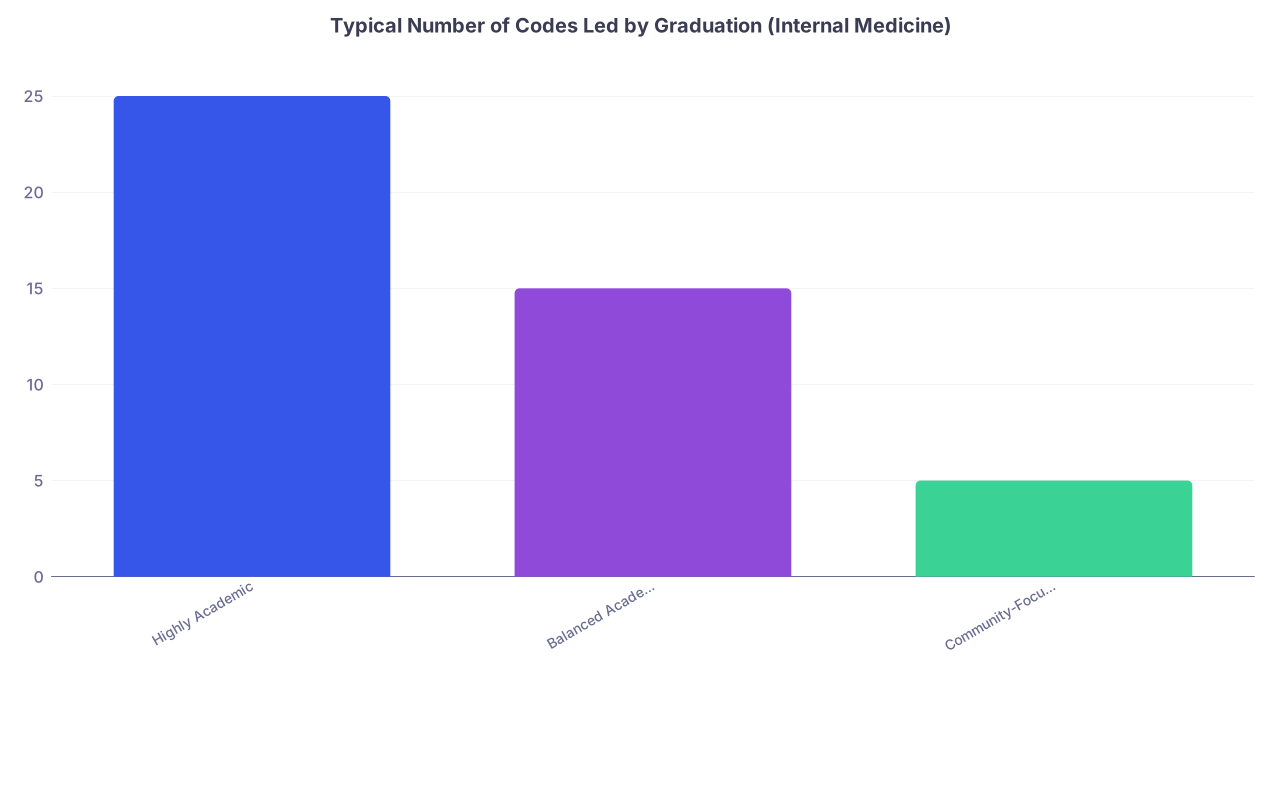
| Category | Value |
|---|---|
| Highly Academic | 25 |
| Balanced Academic-Community | 15 |
| Community-Focused | 5 |
Problematic patterns and how they sound
Common scenarios that should make you probe further:
Attending always runs the code, residents observe or do tasks only.
Sounds like: “The attending or ICU fellow runs all the codes. We help but do not usually lead.”
This is safer in theory, but it undercuts your leadership training. You graduate never having actually commanded a resuscitation.No clear leader; chaos.
Sounds like: “Either the ED attending or ICU team or medicine senior might take over, it kind of depends who gets there first.”
That is a safety issue and a training problem.Very low code volume.
Sounds like: “We do not actually have many codes — maybe 1 every few months.”
Either acuity is very low (not necessarily bad, but limited training), or resuscitation is being offloaded elsewhere.
Subtle but critical follow-ups
If you get generic or vague answers, push with:
- “On nights, is there ever a time when the senior resident is the only physician in the room for the first several minutes?”
- “Have you ever felt unsafe or over your head in a code here? If so, what happened and how did the program respond?”
A program where everyone insists they “never” felt over their head is lying or their residents are heavily shielded. Neither is good.
ED Coverage: Admissions, Cross-Coverage, and “Who Owns the Sick Patient?”
This is where many applicants get surprised. You imagine “we admit from the ED” and think that tells you the structure. It does not.
You need to know:
- Are residents embedded in the ED (rotating, seeing unassigned patients)?
- Do residents get called only when the ED has already decided to admit?
- Who manages boarding patients in the ED waiting for beds?
- How much resuscitation (pre-ICU) happens under resident care?
Targeted questions to ask about ED coverage
You should ask:
- “When a patient comes in hypotensive and septic, who is primarily managing them – ED, medicine resident, or ICU team? How does that differ by time of day?”
- “Do medicine residents have a physical presence in the ED (like an admitting resident stationed there), or do they respond only when called for admissions?”
- “Who writes the initial orders on admitted patients – ED or admitting team?”
- “When ICU beds are tight and sick patients board in the ED, are residents involved in ongoing care?”
- “What is the handoff process from ED to inpatient team for unstable patients?”
- “During your ED rotation, are you seeing patients independently with supervision, or mostly shadowing/doing tasks?”
Listen for specifics: “The senior is in the ED from 4 p.m. to midnight taking all admits” vs “We just get pages about admissions and see them when they come up to the floor.” Huge difference in exposure.
Different common models
Let me sketch three broad types you will encounter.
ED-dominant model
- ED runs everything until the patient is physically leaving the department
- Residents may be minimally involved in acute resuscitation of non-ICU admits
- Good for ED autonomy, weaker for medicine resident acute care exposure
Shared-responsibility model
- ED stabilizes, medicine residents heavily involved early for admissions, ED boarding, step-down/ICU decisions
- Great training environment if communication is strong
Resident-admitter model
- A dedicated admitting resident in the ED manages admits from the moment the decision is made
- Heavy responsibility, high workload, excellent preparation for hospitalist practice
Which is “best” depends on your career goals. But you need to know which you are signing up for.

| Step | Description |
|---|---|
| Step 1 | ED Physician Evaluates Patient |
| Step 2 | Page Admitting Resident |
| Step 3 | Joint Bedside Evaluation |
| Step 4 | ICU Team Consult |
| Step 5 | Admitting Resident Places Orders |
| Step 6 | ICU Admission |
| Step 7 | Floor Bed Available |
| Step 8 | Patient Transferred |
| Step 9 | Admit Needed |
| Step 10 | ICU vs Floor |
What strong ED-related answers sound like
For medicine:
“We have a senior admitting resident physically in the ED from 2 p.m. to midnight. They see all potential medicine admits, work closely with ED attendings, and are the face of inpatient medicine downstairs. You will resuscitate a lot of borderline ICU patients before they get to the unit.”
For EM:
“Interns see their own patients from day one, with direct attending oversight. By PGY-3, you are often the first physician in the room for traumas, strokes, and STEMIs at night, with attendings present but letting you run portions of the resuscitation.”
If the ED answer is:
- “Residents mostly chart and do orders while attendings see the patients.”
- “Most of our ED time is fast track, we do not see as many resuscitations.”
you are getting less robust acute care training.
Differences by Program Type and Specialty
You cannot ask the same questions in the same way to every program. A few reality checks.
Academic vs community
Academic centers:
- Often have ICU fellows, ED fellows, anesthesia residents, etc. Everyone wants a piece of the code.
- Residents usually see higher acuity but may share leadership more.
Community hospitals:
- More likely that medicine residents are the only in-house physicians at night.
- Great for autonomy if staffed and supervised properly; dangerous if not.
You want to calibrate your expectations:
- If you are going into critical care, EM, hospitalist work at large centers → prioritize volume, complexity, and real leadership opportunities.
- If you want outpatient-heavy careers → you still need core competence, but you may accept a more attending- or hospitalist-driven acute care model.
Internal medicine vs emergency medicine vs others
For internal medicine:
- Rapid response roles and inpatient codes are your bread and butter.
- You want to know how many total RRTs and codes you will participate in and lead.
- You also want to know about ICU rotations and how much hands-on resuscitation you get there.
For emergency medicine:
- The ED is the center of the storm; you should be leading almost all ED-resuscitations by senior year.
- Ask about trauma activations, medical resuscitations, strokes, STEMIs, and pediatric codes. Find numbers.
For surgery / OB-GYN / pediatrics:
- Your codes may cluster around specific perioperative or peripartum events.
- Ask how often you are first-called for post-op decompensation, obstetric hemorrhage, shoulder dystocia with neonatal resuscitation, etc.
- Also ask how often you participate in general inpatient codes (or if medicine/anesthesia “owns” those).
How to Ask These Questions Without Sounding Clueless or Neurotic
There is a social skill aspect here. You want to sound like someone who understands acute care, not like someone fishing for horror stories.
A few framing tips:
Anchor your interest to your career goals.
- “I am very interested in hospitalist/critical care work, so I am trying to understand how much real code and rapid response responsibility residents have here.”
Ask for stories, not just policies.
- “Can you tell me about a recent rapid response or code you were involved in and how the team functioned?”
Ask different people the same question.
- Program director, chief resident, random PGY-2 at lunch. See if the stories line up or conflict.
Use PGY-specific probes.
- “What does this look like for an intern on their first month?”
- “How does it change when you are a senior on nights?”
Programs are surprisingly candid when you show you understand what you are asking about.
Interpreting What You Hear: Matching Culture to Your Risk Tolerance
The right answer for you is not the same as for everyone else. You need to know your own threshold for:
- Being the first and only physician at the bedside for several minutes
- Running a code with an attending leaning in the doorway but not saying much
- Being called constantly from the ED to evaluate sick admits
Some people thrive on that. Others will be miserable.
Here is a crude but useful framework.
| Feature | High-Responsibility Program | Low-Responsibility Program |
|---|---|---|
| Who leads most codes? | Senior residents | Attendings/fellows |
| Intern role at RRT | Present with senior, active decisions | Mostly observer or task-doer |
| Overnight in-house attendings | Sometimes absent on floor codes | Typically present at all events |
| ED resident roles | Admitting/resuscitation heavy | Orders and paperwork focused |
| Graduating resident confidence | Very high for independent practice | Variable, often fellowship-dependent |
You want a program where you will sometimes feel stretched and uncomfortable but not chronically unsafe or abandoned. That balance point is different for everyone, but the questions above will help you locate where each program sits.
Practical Script: What to Ask on Interview Day
Let me give you a compact script you can adapt.
With a resident at lunch:
- “When you are on wards and there is a rapid response on one of your patients, what exactly happens? Who comes? What is your role as an intern? As a senior?”
- “Who usually runs codes here on the floors and in the ICU? By the time you graduate, about how many have you personally led?”
- “On nights, have you ever been the only physician at the bedside initially for a crashing patient? How long did it take for backup to arrive?”
- “During your ED months, how much of the resuscitation of really sick patients do you handle vs the attendings or ICU team?”
With the program director or APD:
- “How intentionally have you structured resident roles in rapid response and code events? Are there milestones for when residents are expected to lead?”
- “Have there been recent changes to overnight coverage or ED admission workflows based on safety events or resident feedback?”
Then compare answers. Programs with a strong, thought-out acute care structure will give consistent, detailed responses. Programs that have not really owned this will give vague, contradictory ones.
Bottom Line
Three key points to leave with:
Rapid response, code, and ED coverage roles define your real-world training far more than brochure metrics like “Level 1 trauma center” or bed count. If you do not interrogate these, you are guessing about the core of your residency experience.
Ask specific, operational questions about who shows up, who leads, how it changes by PGY level, and what actually happens at night. Push for stories, not slogans.
Match the program’s responsibility profile to your goals and risk tolerance. You want enough exposure and leadership to graduate competent and confident, but with a structure that does not routinely leave you unsafe or unsupported.
If you get this piece right when evaluating programs, you will avoid a lot of regret that applicants only discover after they are the ones holding the code pager.