
It is late November, you are on your fifth Zoom interview, and the PD has just said the line you keep hearing: “We use a 4+1 block model with protected continuity clinic.”
You nod. You smile. You have no idea if that is good for you or not.
This is where people quietly lose the residency game. Not on scores. Not on letters. On not understanding what they are actually signing up for when they rank programs.
Let me break this down specifically.
You are not just choosing a name brand and a city. You are choosing:
- How often you switch services.
- How fragmented your weeks feel.
- How reliably you can see your own clinic patients.
- How exhausted you will be on your “days off.”
- How ready you are for boards, fellowship, and real life.
Rotation structure drives all of that. So if you cannot clearly explain to yourself what “4+1 vs traditional structure” really means, you are flying blind.
We are going to fix that.
1. The Core Designs: What “Block” Actually Means
Programs throw around numbers: 4+1, 6+2, 3+1, “continuity half-days,” “Y-blocks,” “X+Y.”
Underneath the jargon, they are just describing how they divide inpatient and clinic time.
A. The Classic Traditional Model
This is the “old school” system many of your attendings trained in.
Structure:
- You are on an inpatient service (medicine wards, ICU, night float, etc.)
- During that same month, you also have 1–2 half-days of continuity clinic each week.
- After the month ends, you switch to a different service, but clinic continues every week.
So a “typical” traditional month on wards might look like:
- 5–6 days a week of inpatient medicine
- 1–2 afternoons per week you leave the hospital, rush to clinic, see your panel, then rush back or hand off.
Core issue: you are constantly juggling inpatient + outpatient in the same week.
Pros:
- Realistic to actual practice (especially for outpatient-focused specialties).
- You see clinic patients regularly (every 1–4 weeks).
- Less risk of losing continuity if the schedule is well managed.
Cons:
- Fragmentation. You are on call on wards and also trying to run clinic.
- You will do clinic tired, post-call, or between pushes on the wards.
- On heavy rotations, clinic feels like punishment, not learning.
When this works:
- Programs with sane ward caps, real staffing, and protected time for clinic (e.g., they cap your floor list lower on clinic days, or they truly excuse you from admissions during clinic).
When it is miserable: - Busy county hospitals with “yeah yeah go to clinic, your co-intern will handle your five new admissions.”
B. The X+Y Block Model (4+1, 6+2, 3+1, etc.)
This is the “modern” solution to that fragmentation. X weeks inpatient, Y weeks ambulatory. Alternating.
Summary:
- X = weeks on inpatient, ED, ICU, nights, electives without weekly continuity clinic.
- Y = dedicated outpatient / ambulatory “clinic block” where your continuity clinic and often other ambulatory experiences live.
- You repeat X+Y cycles throughout the year.
Common patterns:
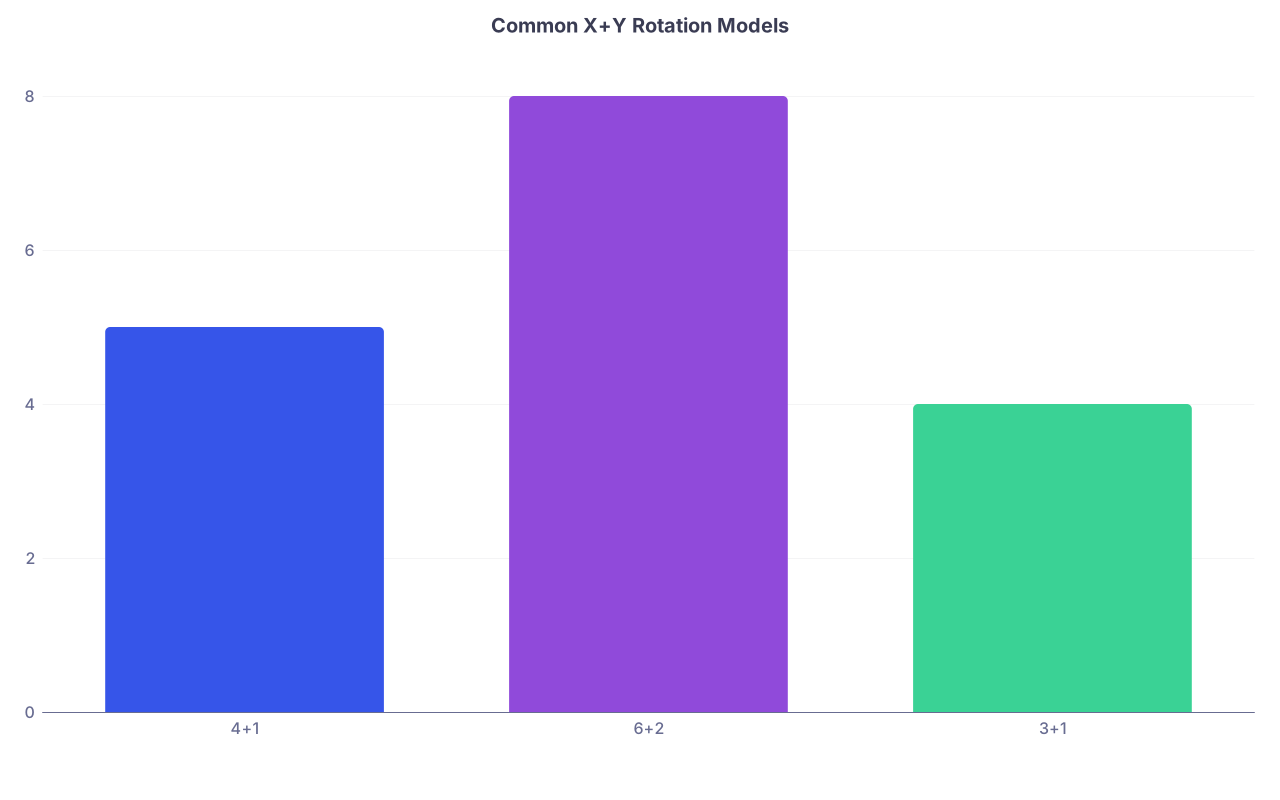
- 4+1: 4 weeks inpatient/other, then 1 week ambulatory.
- 6+2: 6 weeks inpatient/other, then 2 weeks ambulatory.
- 3+1: 3 weeks inpatient/other, then 1 ambulatory, repeating more frequently.
| Category | Value |
|---|---|
| 4+1 | 5 |
| 6+2 | 8 |
| 3+1 | 4 |
(Values = total weeks per full cycle.)
What this actually feels like:
On a 4+1 system:
- Weeks 1–4: You are on wards, ICU, ED, nights, etc. No weekly clinic tug-of-war.
- Week 5: You are off inpatient. You have clinic most days, plus didactics and sometimes subspecialty half-days.
Then you repeat.
Pros:
- True mental separation between inpatient and clinic.
- No mid-ward sprints to clinic. Your inpatient teams are stable.
- Clinic time is more predictable and often less exhausted.
- Easier to plan life around your Y weeks (appointments, adulting, etc.).
Cons:
- Clinic continuity is stretched: your patients may see you every 5–9 weeks instead of every 1–4 weeks.
- For some people, that translates into weaker outpatient confidence.
- Your clinic panel may feel “less yours” if access scheduling is poor and they see whoever is available.
Key nuance: X+Y is only as good as how protected the Y block actually is. Programs can easily poison this by stuffing Y weeks with nonsense.
C. Hybrid / Modified Models
Some programs use a mix:
- X+Y for PGY1, then add a regular half-day clinic during senior years.
- Or they keep an X+Y skeleton but sprinkle some mid-block clinics on electives only.
- Or they split your Y block between your own continuity clinic and “float” or coverage roles.
Translation: You need to ask exactly what “X+Y” or “traditional with modifications” means in numbers, not buzzwords.
2. Continuity Clinic: What You Actually Want (And What Sounds Good But Is Trash)
Everyone tells you they have “strong continuity clinic.” That phrase is almost meaningless by itself.
Continuity clinic is about three things:
- How often you see your panel.
- How much control you have over those visits.
- How much the system respects that time.
A. Frequency and Real Continuity
In a traditional model:
- You might see clinic patients once weekly or every other week.
- If your session is full and access is good, your panel can see you at reasonable intervals.
In a 4+1:
- A patient who needs follow-up in “4–6 weeks” after an admission might see you in your next Y week. That could be 5 weeks. Or 10, if scheduling or your block timing is bad.
You want to dig into:
- Do my patients usually see me or “my team”?
- When a patient calls and asks for me, what happens?
- How often do I, the resident, feel like “their doctor,” not just whoever is free?
That last question is what actually separates strong continuity from marketing fluff.
B. Ownership and Panel Size
Ask for specifics. Hard numbers. For example:
- Panel attribution: Do patients get formally assigned to you? Or to the clinic as a whole?
- Panel size: Are you expected to reach a specific number (e.g., 150–200) by graduation?
- Tracking: Do you see performance / outcome data on “your” panel? Blood pressure control, A1c, vaccination rates?
| Metric | Strong Clinic Signal |
|---|---|
| Panel size target | ~120–200 by PGY3 |
| Visit attribution | Majority booked with you |
| Follow-up intervals | 2–6 weeks feasible with you |
| No-show rate | Monitored and addressed |
| Outcome tracking | You see your panel's metrics |
If a program cannot answer those questions clearly, their continuity structure is probably weak, no matter what they call it.
C. Protection: Does Clinic Trump Inpatient?
This is where many “good on paper” schedules break.
Red flags I have seen:
- “You have protected clinic… unless the census is high.” (The census is always high.)
- “We try not to page you in clinic.” Translation: You will still be paged.
- “You may have to occasionally help out with discharges post-clinic.” On wards, occasionally = regularly.
Concrete questions:
- Are you pulled from clinic to cover wards, ED, or cross-cover? How often last year?
- On busy inpatient rotations, do you still leave on time for clinic, or do you “finish work then go”?
- Are admissions capped / re-routed on your clinic days?
If interns smirk or look away when this is asked on a breakout room Q&A, pay attention.
3. How X+Y vs Traditional Changes Your Actual Life
Now let us get specific about how these designs feel week-to-week.
A. Cognitive Load and Burnout
Traditional model:
- Monday: On call.
- Tuesday: Post-call, but you have clinic in the afternoon. You drag yourself there. Notes pile up.
- Wednesday: Team is mad because you left early yesterday, so you “make it up” by staying late.
- Repeat.
If your inpatient rotations are humane, this can be perfectly workable and even helpful for continuity. If they are brutal, this is how burnout incubates.
X+Y model:
- Wards weeks: You are “all in” on inpatient. No mid-week clinic to break you out.
- Y week: You switch to outpatient mode. Notes are lighter, call is usually less or none, your brain has a break from codes and cross-cover.
For many residents, especially in high-acuity programs, that Y week is what keeps them functional.
B. Learning and Skill Development
Traditional:
- You are constantly toggling between hospital medicine and clinic.
- That can build better long-term skill integrating inpatient and outpatient care, especially for generalists.
- But you may learn neither deeply if you are always exhausted.
X+Y:
- You get focused chunks of inpatient medicine—faster growth early in PGY1 on wards and ICU.
- You get immersive ambulatory weeks that can be structured with didactics, QI projects, special clinics.
- But your outpatient learning may feel “bursty.” You do two weeks of clinic, then do not touch outpatient for 6 weeks.
For board prep, X+Y often helps. If the program uses Y weeks to deliver structured ambulatory curriculum, it can hugely improve your exam readiness.
C. Schedule Predictability and Real Life
Look at this from the “actual human” side.
In 4+1:
- You know every 5th week will be outpatient and generally more predictable.
- You can schedule dentist / PCP / car appointments in those Y weeks.
- Many programs minimize weekend duties during ambulatory blocks.
In traditional:
- Your clinic days are the same weekly, which can be useful for routine.
- But they might be post-call or during heavy elective blocks.
- Your ability to plan life depends heavily on the rotation of the month.
Neither is inherently better. What matters is your tolerance for fragmentation vs delayed follow-up.
4. How to Read a Sample Schedule and Not Get Fooled
Most interview days include a “sample schedule” slide that looks reasonable at first glance. The trick is to decode it.
Let us say you see a 4+1 IM schedule:
- 13 blocks per year (each block = 4+1, about 5 weeks)
- They show: 4 ward blocks, 2 ICU, 1 night float, 3 electives, 1 ED, 2 ambulatory-heavy.
This sounds balanced. But you need to reverse engineer the year.

| Step | Description |
|---|---|
| Step 1 | PGY1 Year |
| Step 2 | 4 Wards X blocks |
| Step 3 | 2 ICU blocks |
| Step 4 | 1 Nights block |
| Step 5 | 1 ED block |
| Step 6 | 3 Elective blocks |
| Step 7 | 2 Ambulatory blocks |
Key questions to ask while looking at this:
- Are the Y weeks the same “ambulatory block” or just continuity clinic plus random filler?
- During “elective blocks,” do I have clinic? Weekly? None?
- Are nights mostly in X time, or shoved into Y weeks too?
Similarly, for a traditional program:
- You might see a 13-block year with months labeled “Wards”, “ICU”, “Elective”, “Clinic”, “ED”, etc.
- You have to ask: which of those blocks also include weekly continuity clinic? Usually, almost all of them.
Look for:
- Total number of true elective weeks where you are not simultaneously on a heavy service and do not have extra cross-cover responsibilities.
- Number of golden weekends (true full weekends off) per month on average.
- Distribution of nights: are they bundled (night float blocks) or scattered “24-hour calls” through ward months?
5. Matching Rotation Structure to Your Career Goals
This is the part most applicants never explicitly do: matching schedule design to their actual future.
A. If You Want Outpatient Primary Care
You should prioritize:
- Strong traditional or modified traditional continuity, or a very well-run X+Y that protects real relationships with your panel.
- Frequent clinic touchpoints with the same patients.
- Ambulatory curriculum that goes beyond basic chronic disease: practice management, coding, population health.
Ask:
- Do graduates feel comfortable going straight into clinic-heavy jobs?
- How many graduates go into outpatient jobs vs hospitalist/fellowship?
- How many clinic half-days per week by PGY3?
Traditional models with well-protected clinic can be excellent for this. Some 4+1 programs do outpatient very well too, but you need to see evidence: strong ambulatory exposure, high outpatient job placement, high clinic volumes.
B. If You Want Hospitalist Medicine
You benefit from:
- Heavier inpatient X blocks, clear responsibilities on wards and nights.
- Less midweek clinic fragmentation so you can focus your energy on inpatient skills.
- Reasonable but not obsessive continuity clinic expectations.
An X+Y system usually pairs well with this. Hospitalist-heavy programs will often advertise strong ward exposure, high-acuity ICUs, and large hospitalist job placement.
Ask:
- How many total weeks of wards + nights do PGY2/3 do?
- Do grads feel comfortable working without backup as hospitalists on day one?
- Are there inpatient electives (e.g., advanced heart failure wards, transplant, etc.)?
C. If You Want Fellowship (Cards, GI, Heme/Onc, etc.)
You need:
- Enough inpatient and subspecialty exposure to build letters and competence.
- Protected clinic but not at the expense of wards / ICU volume.
- Schedule flexibility for research blocks or scholarly time.
Sampling how X+Y can help or hurt:
- Pros: Clear Y weeks can house research time, outpatient subspecialty clinics, procedure clinics.
- Cons: If Y weeks are overloaded with generic ambulatory nonsense, you might struggle to fit in meaningful scholarly work.
Ask specifically:
- How are research blocks scheduled relative to X+Y or traditional rotations?
- Can I stack ambulatory blocks in a subspecialty area PGY2/3?
- How many clinic sessions are in my desired subspecialty?
Programs that regularly place residents into competitive fellowships will have a structured answer to this. Not vague handwaving.
6. The Questions You Should Actually Ask on Interview Day
Most applicants ask: “Do you use a 4+1 or traditional model?” That is level 1.
You want level 3 questions.
Here is what you should be asking, with the subtext of what you are really trying to uncover.
A. About X+Y Programs
“During X weeks, do we ever still have continuity clinic, or is clinic only in Y weeks?”
– You want to know if they sneak clinic into inpatient months anyway.“What does a typical Y week schedule look like, hour by hour?”
– You are checking how many continuity sessions vs random clinics or float time.“How often are residents pulled from Y weeks to help with inpatient coverage?”
– One of the most important questions. Watch the residents’ faces.“How many days in Y week are fully free of call or inpatient duties?”
– Some places sneak in night float or cross-cover shifts into Y weeks.
B. About Traditional Programs
“On a busy wards month, are clinic sessions ever cancelled or shortened due to census?”
– That tells you whose priorities rule: inpatient or continuity.“On average, how many post-call clinics do interns have in a typical month?”
– Too many post-call clinics = set up to fail outpatient.“Do the inpatient caps change on clinic days?”
– If caps are identical, you will routinely be underwater.“Who covers my inpatients while I am in clinic, and how formal is that system?”
– You want a real, structured cross-cover system, not “people just help out.”
C. For Either Model
“How do patients get scheduled with me versus my co-residents?”
– This reveals what continuity actually looks like.“Can you show or describe a screenshot of the resident clinic schedule template?”
– If they cannot, that usually means they do not give it much thought.“Do residents get data on their panel outcomes, and is there time to act on those in clinic?”
– Strong clinics treat you like a physician, not a warm body with a stethoscope.
7. Matching Structure to Your Personality and Limits
Forget perfection. You are trying to prevent obvious mismatches.
Ask yourself honestly:
- Do I handle fragmentation well, or do I need focus?
- Does seeing “my” patients regularly matter a lot to me emotionally?
- How much chaos can I tolerate on any given day?
A. If You Hate Being Pulled in Ten Directions
You will probably be happier in:
- A clean X+Y system where Y weeks are truly ambulatory and not service-heavy.
- Programs that explicitly brag about “no clinic during ICU / wards” and have residents who confirm it.
Your risk with a traditional model is that you will constantly feel like you are failing someone—your ward patients or your clinic patients.
B. If You Crave Longitudinal Relationships
You are more likely to accept:
- The tradeoffs of a traditional system with strong protection.
- Some fatigue and busyness in exchange for regular clinic with the same people.
But you must be picky. A bad traditional system will give you neither good continuity nor humane hours.
C. If You Are Extremely Exam- or Fellowship-Oriented
You might want:
- X+Y or any model that provides predictable ambulatory/didactic blocks that can be used to concentrate board prep.
- Programs with structured board review built into Y weeks or ambulatory blocks.
| Category | Value |
|---|---|
| Primary care focus | 2 |
| Hospitalist focus | 4 |
| Fellowship focus | 4 |
| High continuity preference | 3 |
| Low fragmentation tolerance | 4 |
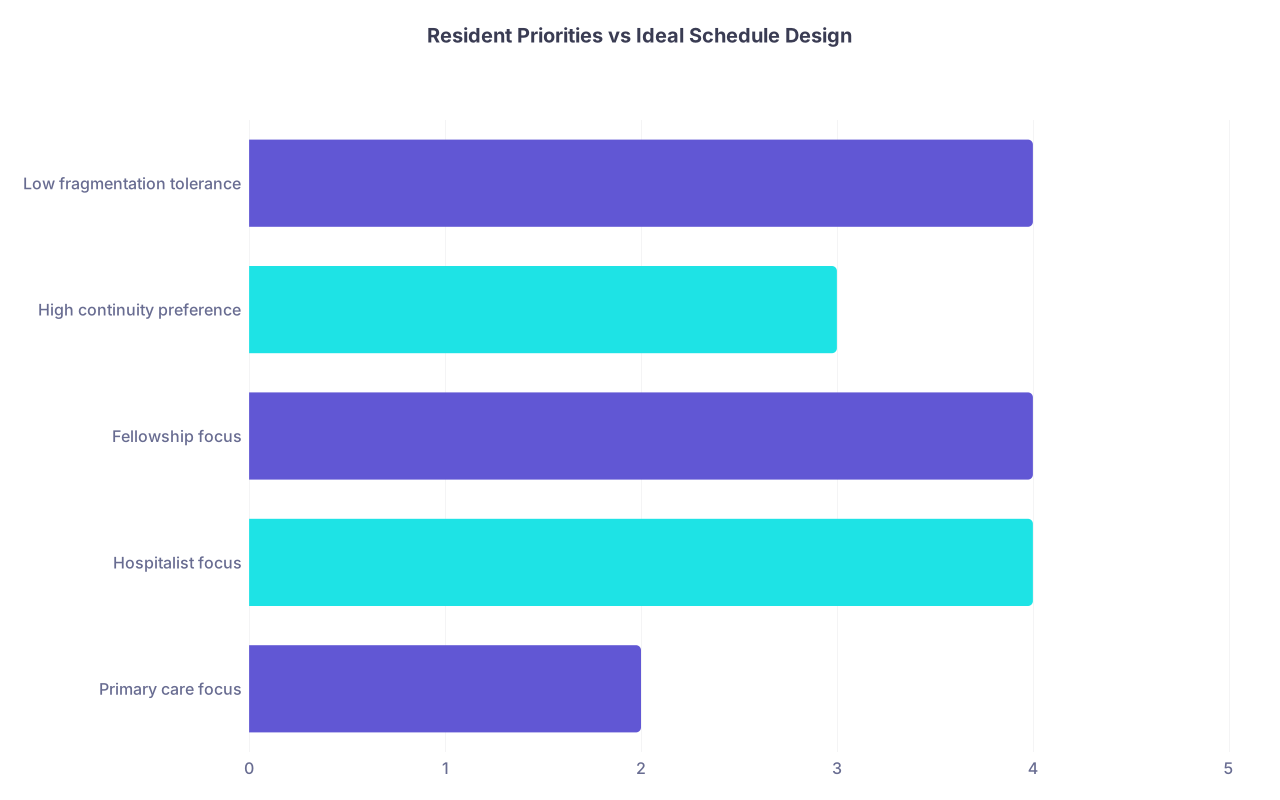
(Values ~ how often X+Y tends to be a better fit, higher is better.)
This is not rigid. There are excellent traditional and X+Y programs in all categories. But if you do not know your own threshold for chaos before you rank, you are gambling.
8. When Programs Oversell Their Schedule: Red Flags
You will hear a lot of glowing language. Here is where my patience gets thin.
Pay attention when you hear:
- “Protected clinic time” followed by residents quietly adding, “Well, mostly.”
- “We have 4+1 so you never have clinic during wards” yet they later admit to urgent add-on clinics or admin work bleeding into X weeks.
- “We are moving to X+Y next year; details to come.” Translation: you will be the experimental cohort.
Blunt red flags:
- Nobody can cleanly explain how many clinic sessions you will have in a typical month/year.
- Sample schedules are vague, tiny fonts, or suspiciously generic.
- Residents disagree with each other on basic facts of the schedule.
- Words like “flexible” and “we all pitch in” show up when you ask who covers what.
I have watched residents burn out badly in programs that marketed gorgeous X+Y schedules that, in reality, were Swiss cheese.
9. How to Compare Programs Side-by-Side
When you get down to building a rank list, make a small table for yourself. Not for the NRMP, for your brain.
For each program, try to answer these in one line:
- Model: Traditional / 4+1 / 6+2 / Hybrid
- Continuity: Strong / Medium / Weak (your assessment, not theirs)
- Clinic protection: Strong / Medium / Weak
- Inpatient intensity: Light / Moderate / Heavy
- True elective time (weeks per year): Number
- Nights structure: Float vs 24-hr vs hybrid
| Program | Model | Continuity | Clinic Protection | Inpatient Intensity | Elective Weeks/Year |
|---|---|---|---|---|---|
| A | 4+1 | Medium | Strong | Heavy | 10 |
| B | Trad | Strong | Medium | Moderate | 8 |
| C | 6+2 | Medium | Weak | Heavy | 6 |
You will see patterns quickly. The “vibes” you felt on interview day will start to match or clash with the structure on paper. That is where good decisions happen.
10. Final Step: Use Residents, Not PDs, To Sanity-Check
Program leadership will sell the blueprint. Residents live the building.
On a second look or informal chat, ask current residents:
- “What part of the schedule do you think applicants underestimate?”
- “If you could change one thing about the rotation structure, what would it be?”
- “Is there any rotation or block design that regularly burns people out?”
- “Are there any quiet, unadvertised perks in the schedule that you love?”
Listen especially to PGY2s. They have seen the worst of it but are no longer deer-in-headlights interns.
And if you hear: “Honestly our X+Y saved my sanity,” or “Clinic during wards is rough but makes me feel like a real primary care doctor,” that tells you a lot more than another slide deck ever will.



| Step | Description |
|---|---|
| Step 1 | Identify your priorities |
| Step 2 | Consider strong traditional or well-protected hybrid |
| Step 3 | Favor clean X+Y with truly protected Y |
| Step 4 | Either model OK, compare specifics |
| Step 5 | Check resident comments on clinic |
| Step 6 | Verify Y weeks not used as coverage |
| Step 7 | Use electives, nights, and call to decide |
| Step 8 | Continuity priority high |
| Step 9 | Low tolerance for fragmentation |
Key Takeaways
- “4+1 vs traditional” is not a buzzword choice. It determines how fragmented your days are, how real your continuity clinic feels, and how you experience burnout.
- Do not accept vague descriptions. Ask for concrete numbers: how many clinics per month, how often you are pulled, who covers what, how often patients actually see you.
- Align the structure with you: your future plans (primary care, hospitalist, fellowship) and your tolerance for chaos. Rotation design will shape your three years more than the hospital logo on your badge.