
How to Interpret Resident Case Logs and Board Pass Data Like a PD
It is late November. You are staring at two residency program websites.
Both say the same thing:
- “100% board pass rate last 3 years”
- “Graduates exceed ACGME minimums for index cases”
- “Extensive operative experience in all key areas”
You know that is marketing copy. A PD would never make a rank list decision based on that alone. You should not either. But you probably have no idea how to dig underneath those lines and actually judge how strong (or weak) their training really is.
Let me walk you through how program directors actually look at case logs and board data. What is impressive. What is a red flag. And what is just noise.
Step 1: Stop Looking for a Single “Magic” Number
You are not going to find one metric that answers “Is this a good program?” PDs do not do that either.
They triangulate across:
- Case volume and case mix (resident case logs; sometimes program summaries)
- Autonomy and level of participation (PGY-year breakdown, role in case)
- Board performance (certifying exam and in‑training exam patterns)
- Context (program size, patient population, fellowship vs community orientation)
The mistake most applicants make: they latch onto a single statistic. “100% board pass rate” or “residents log 1,500 cases.” That is how you get fooled by mediocrity wrapped in good PR.
You need to think like this instead:
- “Does the case log profile match the kind of surgeon/psychiatrist/internist I want to be?”
- “Is the board performance consistent over time and across the whole program, not just cherry-picked years?”
- “Is there any sign residents are underexposed in key areas or barely meeting minimums?”
We will break that down.
Step 2: Understand What Case Logs Actually Are (and Are Not)
Case logs are not perfect truth. They are self-reported by residents, subject to:
- Under-logging (too busy, forgetful, documentation fatigue)
- Over-logging (counting marginal cases, double-counting in gray areas)
- Differences in what “assistant” or “primary” actually means across sites
Program directors know this. They do not obsess over single numbers for one resident. They look at patterns across classes and over years.
You, as an applicant, almost never get full raw logs. But you can (and should) seek:
- Program‑generated summaries shown on interview day
- Slide decks with “average graduating chief case volume”
- ACGME resident case log reports if they show them (surgery/anesthesia/OB‑GYN often do)
- Direct, specific answers from residents when you ask targeted questions
If a program cannot or will not discuss typical resident case volume and exposure across core areas, that is not “mysterious.” That is a red flag.
Step 3: Know the ACGME Minimums vs What Good Looks Like
PDs start from ACGME minimums, then ask: how far above these are we, and in what pattern?
Let me show you what that means with a simplified example. (Numbers are illustrative, not exact current requirements.)
| Field (Example) | ACGME Minimum | Solid Program Range |
|---|---|---|
| Gen Surg - Total Cases | ~850–900 | 1100–1500+ |
| OB‑GYN - Vaginal Deliveries | ~200 | 250–350+ |
| Anesthesia - Total Cases | ~2000 | 2200–2800+ |
| EM - Adult ED Patients | Program threshold | Above minimum by 20–40% |
How PDs think:
- Barely meeting minimums = risk. They worry the next site visit will highlight deficiencies.
- Consistently exceeding minimums by a reasonable margin = comfort. Residents are seeing enough volume.
- Massive outliers in some categories (e.g., tons of trauma, but weak in bread‑and‑butter routine) = potential imbalance to manage.
You, as an applicant, want to ask:
- “Where do your grads typically fall relative to ACGME minimums across the major categories?”
- “Have there been any areas where residents were close to minimums in the last 5 years? What did you change?”
A serious PD has those answers in their head. Or very close.
Step 4: Volume Is Useless Without Mix and Autonomy
High total numbers can hide thin experience in key areas. This is the nuance PDs care about that applicants usually miss.
Take surgery. Two residents both log 1,300 cases.
Resident A (healthy mix):
- 250 basic laparoscopy (cholecystectomy, appendectomy, hernia)
- 80 colorectal
- 60 vascular
- 40 endocrine
- 50 breast
- 30 complex HPB
- Robust peds, endoscopy, and trauma spread
Resident B (distorted mix):
- 400 basic laparoscopy
- 300 endoscopy
- 300 lumps and bumps / minor cases
- Minimal vascular, complex GI, or oncologic work
On paper: same total. In reality: totally different surgeons.
How PDs interrogate this:
- Look at category breakdowns: Are residents getting exposure to the full breadth of the specialty?
- Look at roles: How many cases as primary surgeon vs first assistant vs observer?
- Look by PGY level: Are juniors doing enough basic bread‑and‑butter; are seniors leading the complex cases?
You will not see this in a glossy brochure. But you can extract pieces of it by how you ask.
Good questions to residents:
- “By chief year, what cases are you doing skin to skin without staff scrubbed?”
- “Are there any areas where you feel underprepared and have to chase cases?”
- “Do fellows ever take cases that could be resident cases? Where do they help, where do they compete?”
If answers across multiple residents sound hesitant, vague, or contradictory, that tells you more than a slide saying “Residents exceed minimums.”
Step 5: Use Patterns by PGY Year
Here is how PDs scan case logs for developmental progression. You should mimic this mentally.
Healthy progression typically looks like this (again, surgery is a clean example, but pattern applies broadly):
PGY‑1:
- Focus on basic procedures, assisting on bigger cases
- Lots of floor/ICU exposure
- Growing number of “primary” on simple cases near the end
PGY‑2–3:
- Surge in case volume as primary for bread‑and‑butter
- Increasing complexity, some subspecialty exposure
- Shift from mostly assisting to a mix of assisting and leading
PGY‑4–5 (if 5‑year):
- Majority of core index cases as primary
- Complex cases with attending unscrubbed or as assistant
- Refinement rather than first‑time exposure
PDs get very worried when:
- Seniors still have large portions of index cases logged as assistant, not primary.
- Complex categories spike only in the last 3–4 months of training.
- Large variability between residents in the same class (one resident with 1,800 cases, another with 900).
As an applicant, phrase it like this:
- “How does operative autonomy progress from PGY‑1 to chief? Can you give me concrete examples?”
- “Do chiefs ever leave feeling light in any particular case type? Which ones?”
If all you hear is generic “autonomy increases as competence increases,” that is non‑answer territory.
Step 6: Common Case Log Red Flags (That PDs Actually Worry About)
You want to train yourself to think like the PD who is anxious before an ACGME site visit. Those anxieties will protect you.
Worry when you see or hear patterns like:
“We meet the minimums in everything.”
Translation: “We are not proud of any particular strength, and some categories may be close to the line.”“Our volume is great, but we do not have the exact numbers handy.”
Either they are disorganized, or they know the raw data will not impress. Neither is ideal.One superstar resident slides with huge volume, others are just above minimums.
This suggests uneven case distribution, weak oversight of experience, or politics in the OR.Sudden recent drops in certain categories.
Example: loss of a service line (cardiothoracic, transplant, peds) or closure of an affiliated hospital. This can take years to stabilize.Fellow-heavy environment without a clear resident–fellow boundary.
Fellows are not inherently a problem. In some places they enhance education. The red flag is when residents say, “We often give those cases to fellows,” about bread‑and‑butter operations.
Watch for this especially in big tertiary centers with multiple fellowships.
Step 7: How PDs Really Interpret Board Pass Data
Now, the other half of the equation: boards. Applicants tend to treat “100% board pass” like a gold star. PDs are a lot more nuanced.
There are three very different things wrapped into “board data”:
- ABMS final certifying exam pass rates (e.g., ABIM, ABS, ABPN)
- In‑Training Exam (ITE) performance during residency
- Remediation / extensions / residents who never sat the boards
A savvy PD asks:
- Is our pass rate stable over time (5–10 years), or are we cherry‑picking a 3‑year window?
- Are we just above the ABMS required threshold, or comfortably above?
- Is there a tail of residents who pass late, fail multiple times, or quietly disappear from the denominator?
You, as an applicant, want the same information.
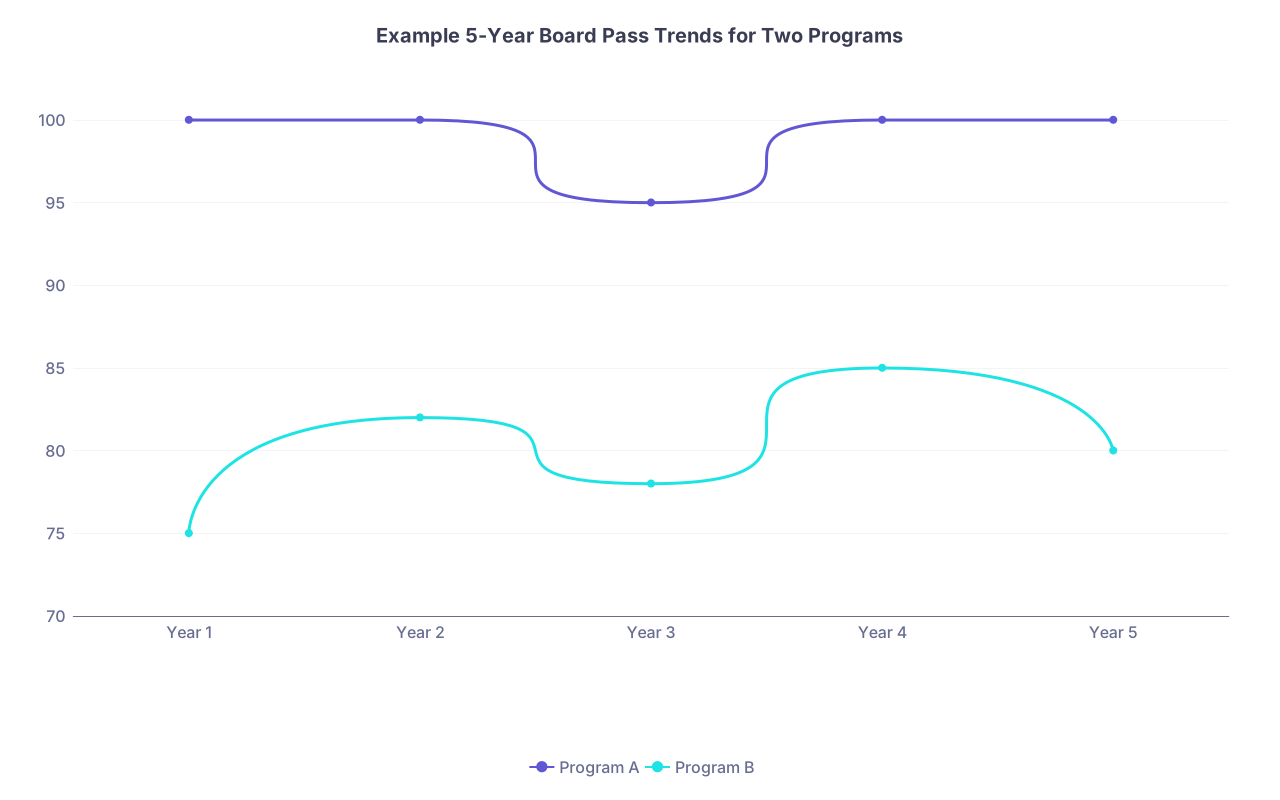
| Category | Program A | Program B |
|---|---|---|
| Year 1 | 100 | 75 |
| Year 2 | 100 | 82 |
| Year 3 | 95 | 78 |
| Year 4 | 100 | 85 |
| Year 5 | 100 | 80 |
Program A: solid, one off-year but otherwise very steady.
Program B: chronically marginal. A PD in Program B is nervous every time the board data report arrives.
When you read “Our board pass rate equals or exceeds the national average,” translate it:
- “Equals” usually means “we are fine, not stellar.”
- “Exceeds” can be good, or it can reflect heavy resident selection and a test‑coaching culture.
You should be much more impressed by:
- Long‑term consistency.
- Honest discussion about a bad year and what changed after.
Step 8: The Hidden Metric – In‑Training Exam (ITE) Culture
Program directors obsess over ITE trends. Why?
Because:
- ITE scores predict board performance fairly well.
- They reveal whether the program is teaching effectively or just throwing residents at service.
- They show if there is a culture of ongoing learning versus last‑minute panic.
You probably will never see ITE score graphs, but you can absolutely ask about them.
Good questions:
- “How does the program use in‑training exam scores?”
- “What happens if a resident scores low on the ITE?”
- “Have you noticed any trend in ITE performance over the last few years?”
Healthy program answers sound like:
- “We review scores with each resident, look at trends, and give them protected time/resources if they are struggling.”
- “We track class averages year to year; they have been steady or improving.”
- “If someone is significantly below the class, we involve the CCC early and support them.”
Worrisome answers:
- “ITE does not matter here; we do not really look at it.” (Translation: maybe they do not teach, or they are in denial.)
- “Residents handle it on their own; we expect self‑directed learning.” (That is code for “no structured support.”)
Step 9: Recognize When High Boards ≠ Good Training
There is an uncomfortable truth PDs know: you can game board pass data.
Ways programs “look good” without truly strong clinical training:
Select only high‑stat applicants with strong test histories.
Great for scores; not a guarantee of strong teaching.Aggressive test prep: mandatory question banks, board review courses, multiple days off before exams.
Helpful, but can mask weak day‑to‑day education.Quietly counseling out weak PGY‑1s before they ever reach boards.
Those residents never count in the denominator. You will not see their story.Keeping residents for research years when performance is weak, then separating them later.
Again, they disappear from board statistics.
A strong program does not just have high pass rates. It has:
- Transparent conversation about how they support weaker residents.
- Reasonable, not extreme, emphasis on test prep.
- Graduates who feel clinically confident, not just “good test‑takers.”
Ask residents:
- “How much is the program focused on ITE/boards versus clinical teaching?”
- “Has anyone in recent years struggled with exams? How did the program respond?”
Listen for concrete examples. If they say, “Someone failed, and the PD sat with them, created a structured plan, they retook and passed,” that is a good sign.
Step 10: How To Synthesize Case Logs + Board Data Like a PD
Here is how program directors mentally merge the two data streams. You should copy this algorithm.

| Step | Description |
|---|---|
| Step 1 | Case Volume and Mix |
| Step 2 | High Risk - Weak Exposure |
| Step 3 | Imbalanced Training |
| Step 4 | Good Breadth |
| Step 5 | Autonomy by PGY Level |
| Step 6 | Limited Autonomy |
| Step 7 | Strong Clinical Experience |
| Step 8 | Board and ITE Data |
| Step 9 | Academic Support Concerns |
| Step 10 | Robust Training Program |
| Step 11 | Above minimums? |
| Step 12 | Balanced across key areas? |
| Step 13 | Chiefs leading complex cases? |
| Step 14 | Stable pass rates 5+ yrs? |
What you are aiming for is alignment:
- Case logs show high enough volume, good mix, and clear progression in autonomy.
- Board/ITE data show stable performance and a track record of catching and helping strugglers.
- Resident stories match the data.
Misalignment patterns to watch for:
- High volume, poor board performance → likely service heavy, weak teaching, little academic time.
- Great board pass rates, low case exposure → academic test factory with fragile clinical confidence.
- Minimal data shared, heavy marketing language → assume they are hiding mediocrity until proven otherwise.
Your job on the trail is not to be polite. It is to collect enough detail to see which pattern you are dealing with.
Step 11: Concrete Questions To Ask (That Reveal the Truth)
You do not need to ask 30 questions. You need to ask 6 good ones with precision.
For case logs and autonomy:
- “Where do your typical graduating residents fall relative to ACGME minimums in the major categories? Any areas that have been close in the last 5 years?”
- “Can you walk me through how operative/autonomy responsibilities change from intern year to chief year with specific examples?”
- “Are there any fellowships here that meaningfully affect resident case volume? How do you ensure residents still meet or exceed targets?”
For boards and ITE:
- “What have your board pass rates looked like over the last 5–10 years, not just the last 2–3?”
- “How does the program use in‑training exam results? What happens if someone significantly underperforms?”
- “Have there been residents in the last few years who struggled academically or clinically? How did you support them, and how did it turn out?”
Watch their body language. Listen for:
- Specific numbers or ranges vs vague “we do well.”
- Concrete examples of struggling residents who were helped vs “We do not really have that problem here.”
- Consistency between what faculty say and what residents whisper later.
If there is a mismatch, trust the residents.
Step 12: Weighing Different Program “Profiles”
PDs know not all strong programs look the same. You should sort what you see into rough archetypes.
| Profile Type | Case Volume/Mix | Boards/ITE | Good Fit For |
|---|---|---|---|
| High-Volume, High-Boards | Strong and broad | Stable, high | Most applicants |
| High-Volume, Weak-Boards | Strong but service-heavy | Variable, marginal | Very self-directed learners |
| Lower-Volume, Strong-Boards | Adequate but narrower | Very strong | Academic/fellowship-bound |
| Minimums-Only, Marginal-Boards | Barely adequate | At or below threshold | Avoid if you have options |
You want to end up in the first column if possible. You may accept the second or third if it aligns with your learning style and goals. The fourth is where careers quietly get limited.
Step 13: Reality Check – What You Will Actually See as an Applicant
Let us be honest: you will not have full ACGME downloads and 10‑year board reports for every program. But you are not powerless.
You will see:
- Website claims: “100% pass rate,” “exceed minimums.”
- Interview day slides with “average case numbers” or cherry‑picked graphs.
- Resident anecdotes during social events.
- The way PDs respond when you ask for specifics.
Use that to build a mental scorecard, something like:
- Case volume: Low / Adequate / Strong
- Case mix: Narrow / Balanced / Exceptionally broad
- Autonomy: Weak / Adequate / Strong
- Board track record: Unclear / Stable average / Consistently strong
- Academic support: Minimal / Reactive / Proactive and structured
If two programs both claim “100% board pass and high case volume,” but:
- Program X: residents describe lots of teaching, regular conferences, structured OITE prep, and they rattle off specific case numbers.
- Program Y: residents talk only about being exhausted, “great trauma,” but seem vague and surprised by your board questions.
They are not equal. Program X is run like a PD who is paying attention. Program Y is hoping volume alone will carry everyone.
You can guess which PD I would trust with my own training.
Quick Recap – The 3 Things To Remember
Do not be impressed by single numbers. Think like a PD: look for patterns over time, by category, and by PGY level, and for alignment between case logs, autonomy, and boards.
Push for specificity. “Above minimums” and “great pass rate” are marketing. Ask for ranges, trends, concrete examples, and how they handle residents who struggle.
Trust consistency between data and lived experience. When the numbers, the PD narrative, and resident stories all point in the same direction—good or bad—that is your most reliable signal of how you will actually be trained.