
The biggest mistake applicants make with ACGME data is treating “Accredited” like it means “All clear.” It does not.
If you want to choose the right residency program, you need to learn how to read ACGME citations the way a seasoned PD or core faculty does: as a risk profile, a culture snapshot, and a forecast of the program’s next 3–5 years. Not just a bureaucratic label.
Let me break this down specifically.
1. What ACGME Citations Actually Are (And Are Not)
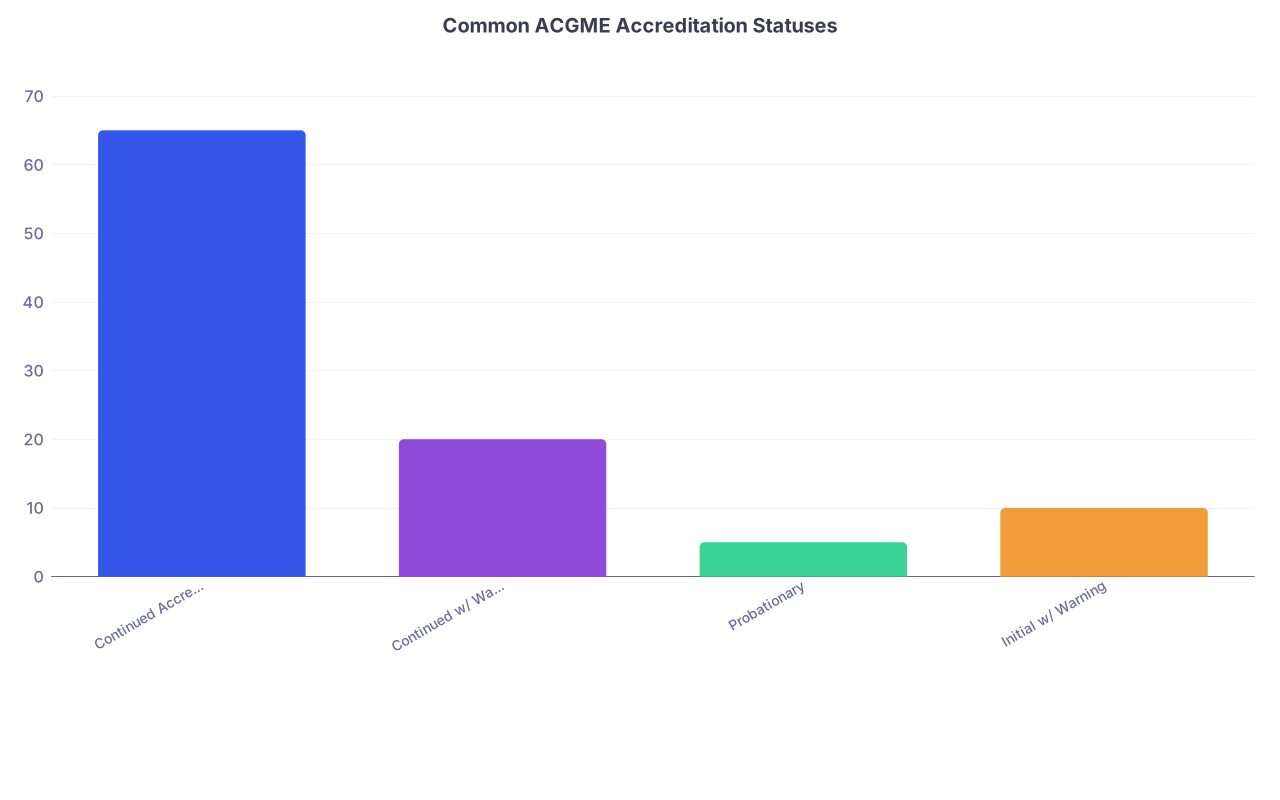
| Category | Value |
|---|---|
| Continued Accreditation | 65 |
| Continued w/ Warning | 20 |
| Probationary | 5 |
| Initial w/ Warning | 10 |
ACGME citations are the written record of where a program failed to fully meet one or more accreditation requirements. They are the “you did not do this adequately” statements in the ACGME’s official eyes.
They are not:
- A Yelp review.
- A resident’s anonymous complaint.
- A casual suggestion.
They are structured findings tied directly to the ACGME Program Requirements and Common Program Requirements.
In practical terms, a citation usually means one of three things happened:
- There is a pattern of noncompliance with a requirement (e.g., persistent duty hour violations).
- There is a missing or inadequate structure (e.g., no functioning CCC, no scholarly oversight).
- The data (surveys, case logs, outcomes) show something is off, and leadership has not convincingly fixed it.
Programs can have citations and still be excellent. Healthy programs occasionally get slapped with a citation when they grow too fast, lose faculty, or stumble on documentation. The red flag is not that citations exist; it is how many, on what, and for how long.
2. How Accreditation and Citations Actually Work

| Step | Description |
|---|---|
| Step 1 | Annual Data Collected |
| Step 2 | ACGME Review Committee |
| Step 3 | Continued Accreditation |
| Step 4 | Site Visit or Focused Review |
| Step 5 | Follow up and Citation |
| Step 6 | Warnings or Probation |
| Step 7 | Program Action Plan |
| Step 8 | Reassessment Next Cycle |
| Step 9 | Concerns Found |
| Step 10 | Noncompliance? |
Here is the real workflow, stripped down:
Every year, programs feed data to ACGME:
- Resident and faculty surveys.
- Case logs (procedure numbers, etc.).
- Board pass rates.
- Faculty FTE, scholarly activity, educational infrastructure.
- Major changes (leadership turnover, mergers).
The Review Committee for that specialty looks for:
- Outlier data (bad survey scores, low logs, <80% board pass rates).
- Missing items (no CCC, no QI participation, etc.).
- Repeated old issues that were supposed to be fixed.
If concerns are nontrivial:
- They assign citations.
- They may change accreditation status (e.g., “with warning”).
- They may order a site visit.
The program must:
- Submit a formal response.
- Implement a specific action plan.
- Show improvement on the next review.
The important point for you: citations always exist in a timeline. A single citation this year is less worrisome than the same one, rephrased, appearing in review after review. That is how you distinguish a program in transition from a program in denial.
3. Where You Actually See Citations as an Applicant
You will not get a neat “citation list” in your ERAS packet. The system is not built for applicant transparency.
So you have to be tactical.
3.1 What you can see directly
Some states or institutions are surprisingly open. A few concrete examples:
- Certain GME offices post their ACGME letters of notification on institutional websites, often buried under “GME policies” or “program information.”
- For osteopathic or smaller programs, the sponsoring institution sometimes posts accreditation correspondence to show they are legitimate.
You will find PDFs with titles like “ACGME Letter of Notification – Continued Accreditation” and, inside those, language that clearly says:
- “The Review Committee cited the following areas of noncompliance…”
- “The program must submit a progress report addressing…”
If you can find even one such letter from the last few years, you get a direct look at their problems.
3.2 What you infer indirectly
Most of the time, you get indirect hints:
- The public accreditation status on ACGME’s Accreditation Data System (ADS) public site (which programs can choose to show or hide).
- Program websites mentioning things like “transitioning leadership” or “restructuring our didactics.”
- Word of mouth from current residents and recent graduates.
If a program is on “Continued Accreditation with Warning” or “Probationary Accreditation,” the residents know. Faculty know. The GME office knows. If no one mentions anything, that is usually deliberate.
So you ask.
4. The High-Yield Types of Citations You Should Care About
Not all citations hit the same. Missing a faculty CV update is not the same as “residents do not achieve expected operative autonomy.”
Here is how I triage them when I advise students.
| Category | Risk for Applicants |
|---|---|
| Duty hours / supervision | High |
| Case logs / clinical volume | High |
| Board pass rates | High |
| CCC / evaluation structure | Moderate–High |
| Didactics / curriculum | Moderate |
| Documentation / paperwork | Low–Moderate |
4.1 Duty Hour and Supervision Citations
These are big. And they usually signal deeper culture problems.
Typical language:
- “The program must ensure that residents do not regularly exceed 80 hours per week.”
- “The program must provide appropriate supervision commensurate with resident level of training.”
Translation: residents are either working unsafe hours or being left alone without backup. Both are structural, not cosmetic.
Questions this should trigger on interview day:
- “How often do you submit duty hour violations?”
- “Who is in-house overnight and what is the escalation pattern?”
- “Has the program ever had ACGME concerns about duty hours or supervision, and how were those addressed?”
If you get:
- Nervous laughter.
- “We work hard, but we get the job done.”
- “We do not really log violations unless it is extreme.”
That is a program where a citation either already exists or is waiting to be written.
4.2 Case Log / Clinical Volume Citations
These affect your training quality directly.
You might see or hear language like:
- “Residents in this program perform fewer than the national average number of [key procedures].”
- “Residents must have sufficient patient volume to achieve competency in essential conditions.”
In surgery, OB/GYN, EM, anesthesia, ortho, you live and die by case numbers. If the ACGME has already flagged low volume, it usually means:
- Competition with fellows or another residency.
- Service contraction (losing trauma designation, losing OB volume, etc.).
- Residents acting as ward labor instead of procedural trainees.
You want specific numbers:
- “What were last year’s median case logs in [core procedures] for graduating chiefs?”
- “Have there been ACGME concerns about case volume? What has changed since then?”
If they answer with vague assurances and no numbers, treat that as a silent red flag.
4.3 Board Pass Rate Citations
This is one of the clearest metrics ACGME cares about: usually ≥80% rolling pass rate over 3–5 years.
A citation might read:
- “The program must improve performance on the ABIM Certification Examination; the pass rate is below the minimum threshold.”
Chronically low pass rates correlate with:
- Weak educational infrastructure.
- Poor didactics.
- Misaligned resident mindset (everyone just aims to survive, not master).
Ask:
- “What is your three-year board pass rate?”
- “Did ACGME ever comment on exam performance? What did you change in response?”
A good program answers like this: “We were cited 4 years ago, pass rate was 70%. We overhauled morning report, integrated in-training exam remediation, and the last three years have been 95%, 94%, 92%. That citation is now removed.”
That is a program you can work with. The presence of an old citation is not the problem. The trend is.
4.4 CCC / Evaluation Structure Citations
These fall into the “structural but very fixable” category—unless they repeat.
Typical issues:
- No properly functioning Clinical Competency Committee (CCC).
- No individualized learning plans for struggling residents.
- Delayed or missing semiannual reviews.
On paper this sounds bureaucratic, but functionally a broken CCC means:
- Strugglers flail for years without help.
- Stars are not pushed to excel.
- Documentation is not there when someone needs remediation or support.
This is a quiet kind of dysfunction that burns people out.
You ask:
- “How often does the CCC meet and who is on it?”
- “What does remediation look like here?”
- “Do residents see their milestone evaluations and use them to modify their learning plans?”
If they cannot explain their own CCC process, odds are the ACGME has already called them on it or will soon.
4.5 Curriculum / Didactics Citations
These matter, but they usually are not existential unless severe.
Things like:
- No structured didactics.
- No protected educational time.
- Lack of required experiences (geriatrics, QI, systems-based practice).
Programs can patch this in a year or two. But pay attention to how they talk about it:
- “We got cited for didactics and just added a few lectures to satisfy the requirement.” Weak.
- “We rebuilt the entire curriculum, added board review, simulation, and case conferences.” Strong.
You are trying to see if leadership takes education seriously or just puts on a show for the ACGME.
5. Reading Between the Lines: Patterns That Matter
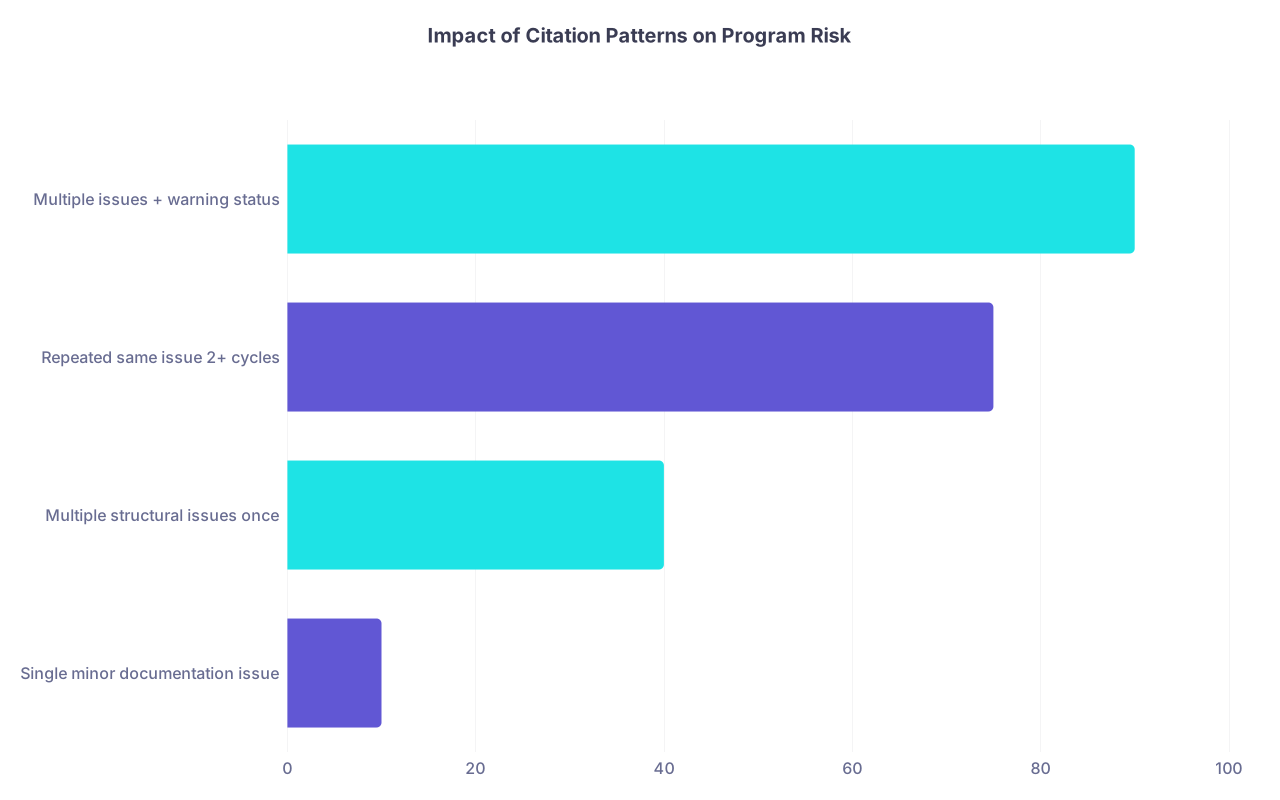
| Category | Value |
|---|---|
| Single minor documentation issue | 10 |
| Multiple structural issues once | 40 |
| Repeated same issue 2+ cycles | 75 |
| Multiple issues + warning status | 90 |
The real insight is not the text of a single citation. It is the pattern over time and how the program responds.
Here is how to decode those patterns.
5.1 Single, specific, resolved
Example pattern:
- 2019: “Program cited for lack of structured QI participation.”
- 2021: “Citation resolved; residents now complete QI curriculum.”
This is low-risk. Sometimes even reassuring. It shows the ACGME can pressure a program into creating good infrastructure.
On interview day you might hear, “We were cited a few years ago for not having formal QI projects. We built out a longitudinal QI curriculum and now everyone graduates with at least one project.” That is competent leadership.
5.2 Multiple domains in one cycle
Example:
- Duty hours.
- Board pass rates.
- Case volume.
All in the same window.
This is a program that drifted badly or went through a major destabilizing event (merger, key faculty loss, change in chair, new sponsor). You need more context.
Ask senior residents privately: “There was a period a few years ago with a lot of instability. Do you feel like things have genuinely stabilized now?”
If PGY-4s say, “Things are infinitely better now,” and can give examples, that is one thing. If they say, “We are still losing attendings and trying to cover holes,” I would rank that program cautiously.
5.3 Repeated versions of the same issue
This is the one I do not excuse.
If the 2018 letter mentions supervision, the 2020 letter says “ensure appropriate supervision remains a priority,” and by 2023 residents are still hinting that night coverage is thin, you have a culture problem. Leadership is either powerless or uninterested.
Repeated citations in:
- Duty hours.
- Supervision.
- Case logs.
- Board performance.
Are strong reasons to drop a program lower on your rank list unless there is overwhelming, concrete evidence of change.
6. How to Extract This Information Without Seeing the Letter
You are not on the Review Committee. So you use indirect tools.

6.1 ADS Public Information and Program Websites
Check:
- ACGME public ADS page for the specialty and institution.
- Program websites for phrases like “continued accreditation with warning” (rare, but some are honest).
- GME office pages that sometimes list accreditation actions.
If you see “Continued Accreditation with Warning” or anything that hints at recent “significant changes,” you mark that program for deeper questioning.
6.2 Targeted questions on interview day
Do not ask “Do you have ACGME citations?” That is clumsy and often shuts people down.
Better:
With leadership:
- “What have been the biggest areas of ACGME feedback over the last few years, and how have you responded?”
- “Were there any recent changes driven by accreditation review—didactics, supervision, or duty hours?”
With residents:
- “Have there been any major ACGME or institutional concerns recently? Did that affect your schedules or training?”
- “Do you feel the program improves when issues are raised, or does it just patch things for site visits?”
You are listening for alignment. If the PD says, “We restructured nights to improve supervision,” and residents say, “Night coverage is so much better than before; we no longer cross-cover 80 patients,” that is believable change.
If leadership says, “No major concerns,” and residents vent about chronic duty hour issues and being left alone in the ED, you know which version of reality to trust.
6.3 Back-channel intel
Talk to:
- Recent alumni (1–3 years out).
- Fellows at other institutions who trained there.
- Faculty at your medical school who know the reputation of the program.
Straight question: “Have they had any ACGME trouble recently? Would you send your own kid there?”
You will be surprised how candid seasoned faculty are when you ask that last part.
7. Special Situations: New Programs, Mergers, and Warnings
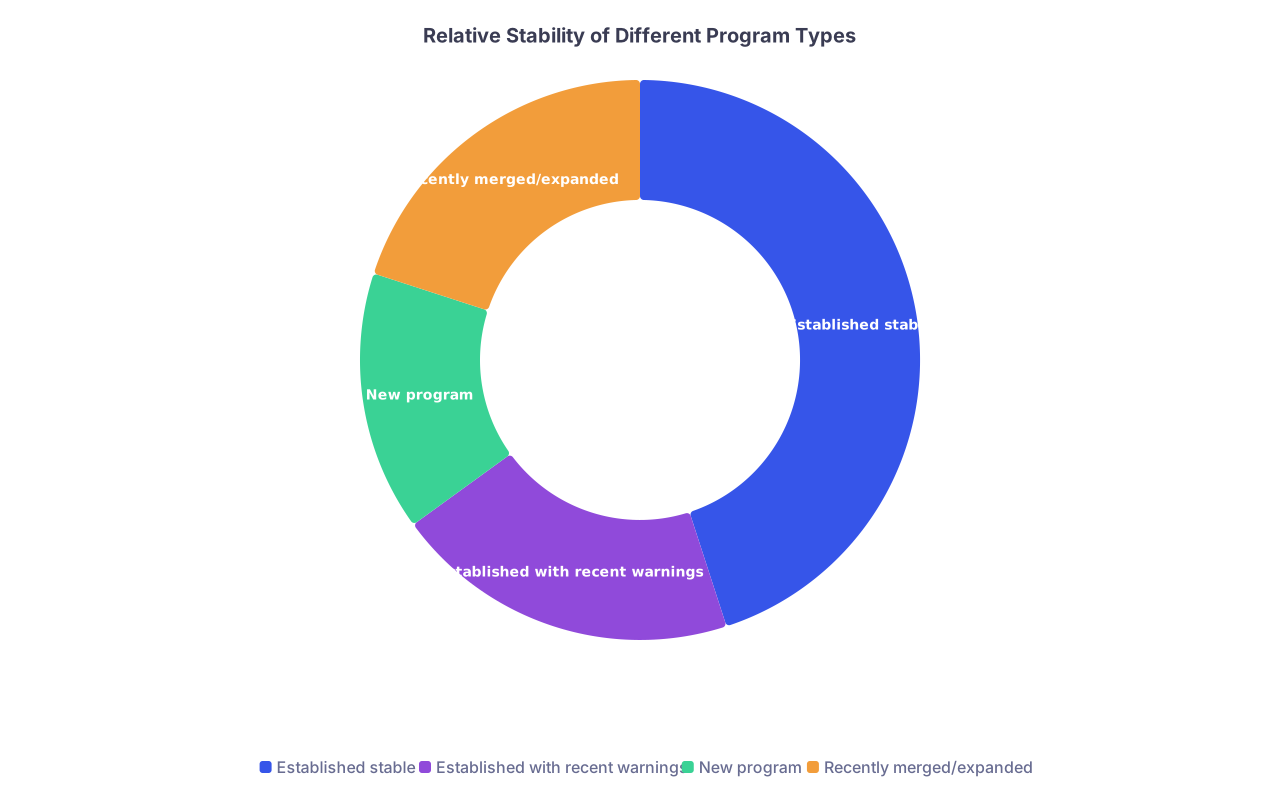
| Category | Value |
|---|---|
| Established stable | 45 |
| Established with recent warnings | 20 |
| New program | 15 |
| Recently merged/expanded | 20 |
7.1 Brand-New Programs
New programs often start under “Initial Accreditation.” They may not yet have full cycle reviews or a long history of citations.
You cannot rely on historical ACGME letters because there are none. So you ask about:
- Who the PD is and where they trained / worked previously.
- Support from the sponsoring institution (money, faculty FTE, call coverage).
- The timeline for their first full site review.
A strong new program has:
- Clear curriculum.
- Committed faculty.
- Honest acknowledgement that they are building systems and will get feedback.
A weak new program brushes off questions and hand-waves about “we will figure it out as we go.” That is exactly how you earn citations in the first 3 years.
7.2 Recently Merged or Greatly Expanded Programs
Hospital systems merge, residencies absorb community sites, or programs expand class size rapidly. ACGME cares when:
- Case volumes per resident drop.
- Supervisory structures fracture.
- Didactics become logistically impossible.
Ask specifically:
- “How has the merger/expansion changed resident workload and supervision?”
- “Has the ACGME commented on this expansion?”
If leadership talks about proactive planning and residents confirm, you worry less. If no one seems to understand the impact, you stay cautious.
7.3 “With Warning” or “Probationary” Status
This is where you have to be brutally honest with yourself.
A program on “Continued Accreditation with Warning” or “Probationary Accreditation” is, by definition, on thin ice with the ACGME. It does not mean they will close. It does mean:
- They must demonstrate fast, concrete improvement.
- The training environment may be in flux for several years.
Would I ever rank such a program? Yes, but:
- Only if residents and faculty both give consistent, convincing narratives of real change.
- Only if the alternative is not matching or going to a truly unsafe program.
If you are choosing between a stable, moderately strong community program with no drama and a “big-name” program currently on warning for supervision and duty hours, I would pick the stable one ten times out of ten.
Prestige does not help you if you are undertrained, unsupported, and burned out.
8. Turning This Into a Practical Shortlist Strategy

You do not have time to do an investigative report on every program. So here is a sane approach.
8.1 Before interview season
For each program on your ERAS list:
- Check their website and GME office pages for any explicit mention of:
- Accreditation status.
- Recent revamps to curriculum, call structure, or leadership.
- Note:
- New PD in the last 1–2 years.
- Recent expansion or merger.
- Any public letters or PDFs you can find.
Flag:
- New programs.
- Programs bragging about “restructuring” after “feedback” (you will ask what feedback).
- Any mention of “warning” or “probation” (rare but occasionally present).
8.2 During interviews
For flagged programs, ask 1–2 pointed but professional questions to PD/APD and 1–2 to residents, as above. You are triangulating three things:
- What the ACGME was worried about.
- What the program actually did about it.
- Whether residents feel the changes are real.
You do not need verbatim citation text. You need a coherent story.
8.3 Ranking time
On your rank list spreadsheet, add columns:
- “Stability / ACGME history” (1–5).
- “Leadership responsiveness” (1–5).
- “Resident confidence in program trajectory” (1–5).
Programs with:
- High stability + high responsiveness + residents optimistic → safe bets.
- Low stability + low responsiveness + residents uneasy or divided → drop lower unless necessary.
Do not be fooled by a brand name or a shiny website if the underlying pattern screams chaos.
9. How to Talk Openly Without Burning Bridges

One last point: there is an art to asking about this without looking like a walking malpractice suit.
A few phrases that work in real life:
- “What have been the biggest areas of external feedback—ACGME or institutional—that have shaped how this program changed over the past few years?”
- “Can you give an example of a time the program received critical feedback and how that turned into a concrete improvement for residents?”
- To residents: “Have you felt the program responds well when problems are raised, either by you or by outside bodies like ACGME?”
Those questions:
- Signal that you are thoughtful.
- Do not accuse or assume.
- Still give you the information you need.
If a program becomes visibly defensive when you ask a mature, neutral question like that, you have learned something important, regardless of what their letter says.
FAQ (Exactly 6 Questions)
1. Can I directly access a program’s ACGME citation letters as an applicant?
Usually no. Full letters are sent to the program and sponsoring institution, not posted publicly by default. A few institutions voluntarily post them on GME websites. Most of the time you are working with indirect information: public accreditation status, program changes, and what leadership and residents tell you.
2. Is a program on “Continued Accreditation with Warning” automatically unsafe to rank?
Not automatically, but it is higher risk. You need to know what triggered the warning (duty hours vs. paperwork), what concrete changes were made, and whether residents actually feel improvement. I would be cautious about ranking a “with warning” program above stable, decently training options unless the context and trajectory are clearly positive.
3. Should I ask directly, “Do you have ACGME citations?” in my interviews?
I would not. It tends to shut people down and sounds adversarial. Instead, ask about “recent ACGME feedback” or “areas the Review Committee has pushed you to improve.” You will often get the same information, but in a more open and honest way.
4. How worried should I be about citations related only to documentation or minor administrative issues?
Mildly, not catastrophically. A single citation for documentation or committee structure that is promptly fixed is low risk. What worries me is a pattern: repeated structural citations or “minor” issues that linger over multiple review cycles, which suggests leadership that does not take accreditation seriously.
5. Are new residency programs at higher risk of ACGME trouble?
Yes, simply because they have not battle-tested their systems yet. New programs can be excellent if they have strong leadership and institutional backing, but they are more vulnerable to growing pains that lead to citations. If you consider a new program, scrutinize leadership quality, educational planning, and how transparent they are about upcoming reviews.
6. How much should ACGME history matter compared to other factors like geography or prestige?
It should matter more than most applicants let it. Geography and name recognition will not protect you from poor supervision, low case volume, or a chaotic educational structure. I would prioritize: 1) training quality and safety (which ACGME citations directly reflect), 2) leadership responsiveness and trajectory, and only after that layer in geography, lifestyle, and prestige.
Key takeaways: ACGME citations are not just bureaucratic noise; they are signals about culture, structure, and risk. Do not obsess over their mere existence—focus on patterns, severity, and how programs respond. And when in doubt, trust aligned stories from residents and leadership more than any single line in a letter you will never see.