
The most dangerous threat to your operative experience is not the robot. It is the embedded fellow you did not realize you were signing up for.
Let me break this down specifically, because programs gloss over it and applicants keep getting burned. “Embedded fellowship” sounds benign and academic. In practice, it often means: a fifth- or sixth-year trainee, structurally prioritized over you, living inside your service and quietly siphoning off the exact cases you thought you were coming to residency for.
If you are choosing a residency in any procedural specialty—surgery, anesthesiology, EM, radiology, OB/GYN, some IM subspecialties—you need to understand how these fellowships work, how they change case allocation, and how to read between the lines on interview day. This is not optional background noise. This is your daily operative reality for 3–7 years.
What “Embedded Fellowships” Actually Are
Programs love friendly language: “integrated,” “cohesive training environment,” “vertical mentorship.” Strip the marketing. Functionally, an embedded fellowship looks like this:
- The fellowship is on the same core clinical service as residents, not rotating in and out occasionally.
- Fellows are scheduled on the same cases, same call pool, same clinics, often with separate “fellow cases” quietly built into the schedule.
- Attendings are contractually or culturally expected to prioritize fellows for index and complex cases.
- Residents become the support staff. First assist, line/airway tech, scut collector.
You see this in:
- General surgery with vascular, MIS, HPB, colorectal, breast, ACS, trauma fellowships buried into the main service.
- OB/GYN with MFM, Gyn Onc, REI, FPMRS that never truly “leave” the resident’s case pool.
- Anesthesiology with cardiac, regional, critical care, OB anesthesia fellows who own room assignments.
- EM with ultrasound, critical care, peds EM, toxicology fellows running the best shifts.
- Radiology with IR, MSK, neuro fellows doing all the procedures and advanced studies.
Here is the core problem: senior trainees have priority. Always. The default assumption in most academic cultures is “fellow first, chief second, everyone else watches.” Unless a program has explicitly designed around that, you are signing up for leftovers.
The Real Impact On Your Training (Not the Brochure Version)
Programs will tell you, “Fellows enhance the educational environment.” Sometimes true. But you are not going into training to observe enhanced education. You are going into training to do.
Let’s walk through how embedded fellowships practically change your life.
1. Case Volume and Case Mix
People obsess over total case numbers. That is naïve. What really matters is:
- Your primary operator cases.
- Your index case mix (for boards, for fellowship, for competence).
- Your progression from assistant to surgeon.
Embedded fellows blunt that progression.
Vascular embedded in a general surgery program:
- Fellows do all the distal bypasses, complex endovascular, redo carotids.
- Chiefs get the occasional straightforward AV fistula and a handful of non-complex fem–pops.
- Juniors hold retractors and tie knots, then graduate having “seen” a ton but owned very little.
MIS/bariatric fellowship embedded:
- Fellows run the robot, do the stapling, dock and undock.
- Residents are bedside assistants, then PGY-5s “get a few sleeves at the end of the year.”
- Your graduates log enough cases on paper but have minimal unassisted decision-making.
You must separate three numbers in your head:
- Total cases you scrub
- Cases where you are primary surgeon / primary proceduralist
- Number of key index cases at senior level
Embedded fellows often inflate #1, minimally affect #2, and quietly starve #3.
2. Autonomy and Decision-Making
Another subtle but huge effect: who is the default “senior decision-maker” in the room?
In a strong resident-centric model, by late PGY-4/PY-5 you:
- Consent the patient.
- Lead the brief.
- Make intraoperative decisions with the attending.
- Call the moves.
In an embedded-fellow model, that entire role shifts one step up:
- Fellow does the consult.
- Fellow pre-op plans and discusses with attending.
- Fellow stands at the head of the bed and calls the shots.
- You stand one level down and execute orders.
By the time you hit graduation, you may have “done” a lot of steps, but you have not actually been the surgeon in charge. That shows immediately your first month in practice or fellowship. I have watched fresh graduates who trained under heavy embedded fellow cultures freeze when a case takes an unexpected turn, because they have never been the actual decision-maker when things went badly.
3. Scheduling and Access to the Good Stuff
The other quiet reality: OR and procedural schedules are political documents.
When there is an embedded fellow:
- Cases get pre-assigned at the attending–fellow level days before the schedule is “published.”
- “Educational” cases for residents are often low-risk, low-complexity, repetitive.
- High-impact index cases (aneurysms, radical cancer resections, complex endoscopy, advanced imaging, high-risk OB, big trauma) default into the fellow column.
On anesthesia, for example:
- Cardiac fellows gets all the pumps.
- Regional fellows take all the advanced blocks and continuous catheters.
- OB fellows take all the complex parturients and difficult epidurals.
Residents then graduate technically competent at the basics but shallow in high-stakes procedures. Which, ironically, are the ones that make you valuable.
Types of Embedded Models: Some Are Worse Than Others
Not all fellowships are created equal. Some actually improve resident education without cannibalizing cases. The trick is knowing which is which.
| Model Type | Resident Impact | Risk Level |
|---|---|---|
| Resident-first, fellow-light | Resident autonomy high | Low |
| Parallel-track embedded | Mixed | Moderate |
| Fellow-first embedded | Residents sidelined | High |
| Fellowship-heavy department | Residents peripheral | Very High |
1. Resident-First, Fellow-Light
These are rare but excellent.
Features:
- Only one or two small fellowships.
- Explicit policy: index cases go to senior residents first.
- Fellows focus on niche or overflow, not core bread-and-butter.
Example patterns:
- Vascular fellowship where residents are primary on straightforward carotids and AV access. Fellows do complex endovascular, thoracoabdominal work.
- MIS fellowship where residents get a robust volume of sleeves and anti-reflux as primary surgeon, and fellows focus on revisional, complex foregut, and research.
These programs advertise fellows as “augmenting volume,” and it is actually true. Residents graduate strong.
2. Parallel-Track Embedded
Both residents and fellows share the environment, but with some separation.
Features:
- Dedicated “resident rooms” and “fellow rooms.”
- Resident chiefs own certain service lines or days.
- Fellows have concentrated blocks, often for complex cases.
This model can work if:
- Residents still hit ACGME and specialty board case targets by a healthy margin.
- There is clear protection of resident senior roles on general and moderately complex work.
It fails when the “resident rooms” quietly become hernia, port, lap chole, D&C all day, every day. While fellows sit on all the cancer, all the complex reconstruction, all the real decisions.
3. Fellow-First Embedded
This is where training goes to die for residents.
Features:
- More fellows than senior residents on key services.
- Fellows listed on the schedule for almost every complex case.
- Chiefs constantly “float,” first-assing multiple cases instead of owning a full primary room.
The department line is, “Our volume is so high, there is plenty for everyone.” Not true in practice. Senior residents forever share cases with fellows. That means:
- Half cases.
- Stepwise participation.
- Limited continuity.
You leave knowing fragments of many procedures instead of end-to-end mastery of enough.
4. Fellowship-Heavy Departments
Some places are, frankly, pipeline factories for fellowships, not residencies.
Typical pattern:
- General surgery with 5–6 different fellowships, each with 2–4 fellows.
- EM departments with multiple concurrent admin, US, critical care, peds, and research fellows.
- Radiology groups with large IR and neuro fellowships, plus “advanced fellow” staff.
Residents become the glue. They keep the service from collapsing, but are rarely at the top of the learning hierarchy. You do the workup, admit, staff, follow up, document. Somebody with “fellow” in the title gets the high-yield procedural or interpretive moments.
If the department brags more about its fellowship match list and fellowship placement than about resident case numbers and autonomy, be cautious. You may just be labor.
How To Recognize Case Competition Before You Sign
Programs will not say, “Our fellows will eat your cases.” You have to look for it. And you can, if you stop being polite and start being forensic.
1. Read the Room on Interview Day
You can hear tension if you listen.
Red flags I have heard verbatim:
- From a PGY-3: “Oh, the vascular fellow is really hands-on.” Translation: they take everything.
- From a junior: “We definitely get exposure to robotic cases by assisting.” Translation: you are bedside.
- From an anesthesia resident: “We see all the cardiac cases.” Translation: “see,” not “run.”
Pay attention when residents talk about:
- “Opportunities” instead of responsibilities.
- “Exposure” instead of primary experience.
- “Seeing a lot of X” versus “by chief year, you are running X.”
Language choice reveals hierarchy.
2. Ask Residents These Specific Questions
Do not ask, “How is your operative experience?” That invites a canned answer. Ask things they cannot spin.
Concrete questions:
- “On a standard elective day with a big cancer case and a few smaller ones, who is usually the primary: chief resident or fellow?”
- “How many [key index] cases did your last graduating class log as primary surgeon?”
- “By the time you finish, are there any procedures you still do not feel comfortable doing independently?”
- “If there are both a chief and a fellow available, who consents and runs the case?”
- “Has any resident ever had to scramble in their last year to meet case minimums?”
If the resident looks away, hedges, or says, “Well, it depends,” that is your answer.
For EM, anesthesia, radiology:
- “On a shift with an US fellow, who is actually scanning patients?”
- “In IR, do residents ever get to be primary operator on standard procedures, or is that always the fellow?”
- “On cardiac days, are residents running those rooms or second chairing to fellows?”
You are not trying to be aggressive. You are trying to protect years of your life.
3. Study Case Logs and Graduates, Not Just Brochures
Programs sometimes show “typical” graduating case logs on interview day. Look carefully:
- Total case numbers can be high even if index cases are low.
- Ask for breakdowns: how many major cases as primary in PGY-4 and PGY-5.
- Look at spread among graduates. If one chief has solid numbers and others are thin, that usually means they had to compete against fellows and only the aggressive/connected ones won.
If they will not show you any real case log data and only offer generic statements (“we easily exceed ACGME minima”), assume the minima are all you will get.
4. Check the Ratio: Seniors vs Fellows vs Attendings
Do some quick math.
| Scenario | Seniors | Fellows | Attendings | Risk |
|---|---|---|---|---|
| Balanced resident-first | 6 | 2 | 10 | Low |
| Parallel track | 6 | 4 | 10 | Mod |
| Fellow-first tendency | 4 | 6 | 8 | High |
| Fellowship-heavy | 3 | 8 | 9 | Very High |
If key services have equal or more fellows than chiefs, residents will lose many case assignments. Simple arithmetic.
Also check:
- Number of independent ORs / procedure rooms per day.
- How many of those are routinely run by fellows versus residents.
- Whether chiefs have “protected” rooms or just bounce around.
5. Listen to How Program Leadership Talks About Fellows
Program directors and chairs will reveal priorities in 2–3 sentences.
If they say:
- “Our fellows are primarily here for advanced research and niche procedures. Residents remain the backbone of our operative services.” Good sign.
- “Our fellows help cover the increasing complexity of our caseload, and residents get exposure to that environment.” Translation: residents will be spectators at the interesting parts.
- “We are very proud of the growth of our fellowship programs.” Ask: growth out of what?
Watch who they highlight on their slides:
- Do they show residents presenting at grand rounds, or fellows?
- Do they talk about resident-fellow teaching, or fellow-led services?
- Do they brag about “our trauma fellow handles all the penetrating trauma.” That might sound great. It is not, if you came for trauma.
Specialty-Specific Patterns You Should Know
This is where nuance matters. Embedded fellowships hit specialties differently.
General Surgery
High-risk fellowships: vascular, HPB, MIS, colorectal, surgical oncology, trauma/critical care.
Classic traps:
- HPB and surg onc fellows doing all pancreas, liver, and major gastric resections.
- Trauma fellows running resuscitations while senior residents push the stretcher and write notes.
- MIS fellows monopolizing the robot console.
Safeguards that actually work:
- Written rotation goals that guarantee chiefs a minimum number of index cases as primary (e.g., X Whipples, Y lobectomies, Z complex hernias).
- Protected “chief weeks” or “chief rooms” where no fellows can take the primary role unless a resident declines.
- Explicit department culture: “Fellows are here to extend our capacity, not to replace resident cases.” You know it when you see it.
OB/GYN
High-risk fellowships: MFM, Gyn Onc, FPMRS, REI.
Common reality:
- MFM fellows manage all complex antepartum and intrapartum cases; residents handle low-risk L&D.
- Gyn Onc fellows perform all debulking, radical hysterectomies, advanced laparoscopy.
- FPMRS fellows do all the prolapse and continence surgeries.
Healthy signs:
- Residents have their own GYN OR days with major cases, not just same-day hysteroscopies and simple procedures.
- Chiefs routinely primary on C-sections for high-risk patients with attending backup, not automatically bumped by fellows.
- Graduates feel ready for community GYN surgery and manage high-risk OB without panic.
Anesthesiology
High-risk fellowships: cardiac, regional, critical care, OB anesthesia, peds.
Danger pattern:
- Cardiac fellow always “room one.” Resident observes or does line placements and then stands back.
- Regional fellows doing every block, residents intubate and leave.
- OB anesthesia fellow owns the sickest patients; residents run healthy epidurals and straightforward C-sections only.
You want programs where:
- Cardiac months are resident-focused blocks with fellows present but not default primary.
- Residents have minimum case requirements for TEEs, thoracic, major vascular, high-risk OB, advanced pain techniques that actually get met by everyone.
- Attendings deliberately rotate complex cases to senior residents when safe.
Emergency Medicine
High-risk embedded fellowships: ultrasound, critical care, peds EM, toxicology, admin, “education” fellows.
Subtle problem:
- US fellows run all the probes; residents drop orders and glance at images.
- ED-ICU or critical care fellows manage the crashing patients at the bedside; residents do the charting.
You want:
- Culture where residents are encouraged to do all primary US, with fellows teaching and reviewing—not replacing hands-on scanning.
- Complex resuscitations led by senior residents with fellows acting as extra brains, not as replacement leaders.
Radiology and IR
In DR programs with strong IR, neuro, MSK fellowships:
- Fellows grab all the advanced procedures and complicated reads.
- Residents park at workstations and review basic studies.
Healthy model:
- Dedicated resident IR rotations with scheduled primary operator time.
- Reading list structures where senior residents get first pass at complex cases, with fellows only taking overflow or special requests.
How To Factor This Into Your Rank List Without Losing Your Mind
You are not going to find the mythical “no fellows, infinite autonomy, huge volume” program in a major academic center. The question is balance.
Here is a simple mental model:
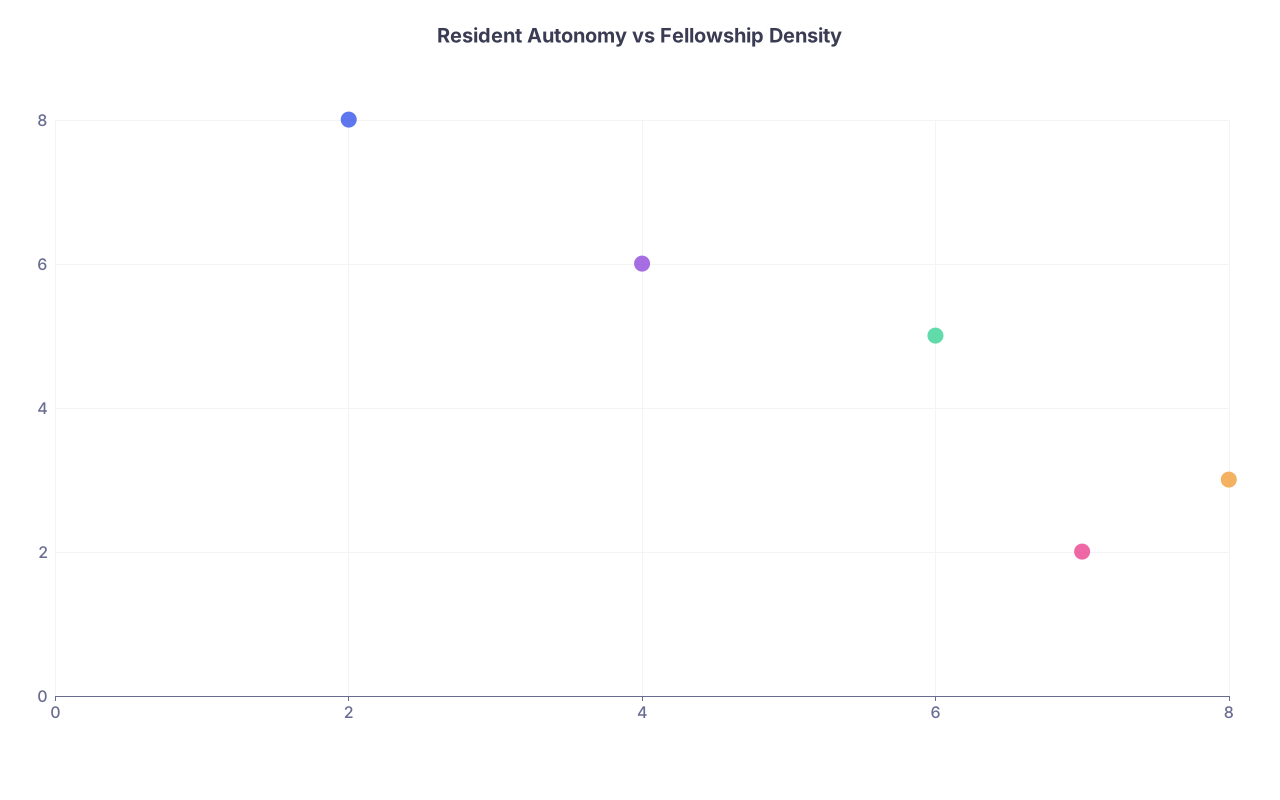
| Category | Value |
|---|---|
| Program A | 2,8 |
| Program B | 4,6 |
| Program C | 6,5 |
| Program D | 8,3 |
| Program E | 7,2 |
Think of programs as sitting on two axes:
- X-axis: Resident autonomy and case protection (1–10)
- Y-axis: Fellowship density / embeddedness (1–10)
You are aiming for higher autonomy and moderate fellowship density. Fellowship presence is not automatically bad. It becomes bad when it pushes your autonomy below about a 6.
Priorities When Ranking
- Safety and professionalism first. A malignant but resident-heavy place is still terrible.
- Among safe programs, bias toward:
- Clear, resident-first case assignment norms.
- Transparent case logs.
- Honest residents who admit limitations instead of reciting the party line.
- Only after that, consider:
- Prestige.
- Fellowship match rates.
- Research output.
Programs love to say, “Our fellows do not take away from residents.” Your job is to determine if that is actually true, or if it just feels true from their end of the hierarchy.
Practical Scripts and Moves On Interview Day
Let me make this painfully concrete. Here are questions and follow-ups you can actually use.
To residents:
“Yesterday’s OR schedule—who was primary on the biggest case?”
If they say, “The fellow, but we got to help,” note that.“Do chiefs ever bump fellows off cases, or is it the other way around?”
Watch their face, not their words.“Have any chiefs recently felt underprepared in any area because of fellows taking cases?”
A resident who answers, “Yeah, our trauma fellows definitely hurt senior experience,” is giving you gold. Believe them.
To faculty / PD:
“How do you operationalize resident autonomy in the presence of multiple fellowships?”
Sophisticated answer = they have thought about it. Vague “Oh, we just work it out” = they have not.“Can you share approximate primary case numbers for your last graduating class in [index procedure]?”
If they hand-wave, assume the numbers are not impressive.“Have you adjusted resident schedules since expanding fellowships to protect resident cases?”
Good programs will say yes and give examples.
And then, when you go home and make your rank list, be ruthless:
- If two programs are otherwise equal, choose the one where chiefs actually run the show.
- If a program is prestigious but fellow-heavy and evasive about case allocation, drop it a few spots. You are not going there for name only. You are going there to learn to function.

| Step | Description |
|---|---|
| Step 1 | Identify Programs With Fellowships |
| Step 2 | Lower concern |
| Step 3 | Ask residents targeted questions |
| Step 4 | High competition risk |
| Step 5 | Moderate or low risk |
| Step 6 | Check case logs and autonomy |
| Step 7 | Adjust rank list accordingly |
| Step 8 | Same service as residents |
| Step 9 | Fellows take key cases |
Core Takeaways
- Embedded fellows change everything about your case experience unless a program has explicitly built resident-first protections. Do not assume that “high volume” saves you.
- You can detect problematic embedded fellowships before you match by asking hard, specific questions about who is primary on key cases, how many index procedures chiefs actually log, and what happens when a chief and fellow both want the same room.
- When ranking, favor programs where senior residents clearly own important cases and decisions, even if there are fellows in the building. You are not there to staff someone else’s fellowship. You are there to become independently competent.