
The biggest mistake applicants make is treating “mentorship available” on program websites as if it means anything. It usually does not. You have to dissect the actual mentorship structure: dyads, pods, and advisor models are not the same thing, and they do not produce the same outcomes.
Let me walk you through how to evaluate each model like someone who has seen them work… and fail.
1. First, Be Clear On What You Actually Need From Mentorship
Before you compare dyads vs pods vs advisor systems, you need to know what you are optimizing for. “Good mentorship” is vague. Career survival is not.
You can think of residency mentorship needs in four buckets:
Survival and advocacy
- “I am on an unsafe rotation, my schedule is not compliant, my eval is unfair.”
- You need someone who has positional power and will actually go to bat for you.
Career and scholarship development
- Specialty choice refinement.
- Research or QI/education projects.
- Fellowship strategy and letters of recommendation.
Skills and performance coaching
- Clinical reasoning, efficiency, communication, leadership.
- Honest feedback, not just “you’re doing great.”
Identity, wellness, and belonging
- Being a first-gen physician, parent, IMG, underrepresented in medicine, LGBTQ+, etc.
- You need people who “get it” and can normalize your experience.
Different mentorship structures serve these buckets with wildly different effectiveness. Your job during interview season is to map: structure → actual function.
2. The Dyad Mentorship Model: One Mentor, One Mentee
Dyads sound great on paper. They can also be dead weight if they are purely ceremonial.
What a dyad model usually looks like
Common implementation:
- Incoming PGY-1 is assigned a single faculty mentor.
- Sometimes you meet at orientation, then “at least twice per year.”
- Matching is usually based on:
- Declared career interest (cards, ICU, OB, etc.)
- Random assignment
- Or worse: “who volunteered”
The superficial pitch you will hear on interview day:
“You’re assigned a dedicated faculty mentor from day one.”
That line means nothing without follow‑up questions.
When dyads work extremely well
Dyads are powerful when:
The mentor actually does:
- Proactive outreach (emails you to meet, not the other way around).
- Real-time coaching about rotations and opportunities.
- Concrete advocacy (emails PD, connects you to chiefs, plugs you into projects).
The pairing is aligned:
- Career area matches your genuine interest, or the mentor is well-connected enough to help you pivot.
- Personality fit is at least neutral (no obvious clash).
The program culture backs the dyad:
- Protected time exists for mentor-mentee meetings.
- The PD regularly asks faculty, “How are your mentees doing?” and expects a real answer.
- The dyad relationship is part of evaluation and promotion for faculty.
When this is done well, I have seen residents walk into fellowship season with:
- 3–4 strong letters.
- Multiple first-author abstracts or at least meaningful involvement.
- Early identification for chief or leadership roles.
When dyads are performative and useless
You will spot the fake version quickly if you ask the right questions.
Red flags:
- Mentors assigned “for life” in PGY-1 with no easy rematch process.
- Residents say, “We meet once a year… to sign something.”
- Faculty have 10+ mentees each. That is not mentorship. That is a spreadsheet.
The failure modes:
- Misalignment: You get assigned to a basic scientist and you want to do community primary care. No one fixes it.
- Invisibility: Your mentor is a name on paper. They do not know your Step 2 score, family situation, or fellowship interest.
- Non-advocacy: When you actually need help (failed rotation, professionalism complaint, schedule crisis), they “suggest you talk to chief” instead of picking up the phone themselves.
Programs love to show a dyad slide in their recruitment deck. Your job is to find out if they actually live the dyad model.
3. Pod Mentorship: Small Groups, Multiple Mentors
Pods are the “team-based care” of mentorship. Done right, they solve many of the dyad model’s weaknesses. Done badly, they become therapy circles without power or follow‑through.
What a pod model usually looks like
Typical structure:
- A small group of residents (3–8) with:
- 1–3 faculty mentors.
- Sometimes a chief or senior resident included.
- The group meets periodically:
- Quarterly dinners.
- Debrief sessions after major rotations.
- Fellowship planning workshops.
Sometimes pods are organized by:
- Clinical “firm” system (e.g., blue team, gold team).
- Thematic grouping (e.g., primary care pod, research pod).
- Class-year mix (PGY-1 to PGY-3/4 in same pod).
This gives you:
- Peers to normalize struggles.
- Multiple adults in the room with different strengths.
- A built-in support micro-community within a larger program.
Where pods shine
Pods are excellent for:
Belonging and wellness
- You see the same small group regularly.
- You hear PGY-3s say, “Yeah, PGY-1 winter was rough for me too.”
- You are less likely to disappear quietly when struggling.
Distributed expertise
- One faculty is research-heavy.
- One is a proceduralist.
- One is more “life logistics” oriented (mortgages, childcare, visas). You get a portfolio of mentors rather than betting everything on one person.
Resilience against misfit
- If you do not click with one mentor, you still have others in your pod.
- Switching your “primary” mentor within the pod is usually low-drama.
Scalable support
- Faculty can realistically meaningfully mentor 3–6 residents in a pod format.
- Programs can avoid burning out a handful of “super mentors.”
Pods, when structured intentionally, are often the healthiest model for resident mental health and career exploration.
Where pods quietly fail
The usual problem: no one is clearly responsible for you.
Common breakdowns:
- Meetings devolve into casual chat 100% of the time. You feel good after. But nothing changes in your career trajectory.
- No single faculty is accountable for writing your letters, advocating for your promotion, or noticing you are behind on research goals.
- Sensitive issues (struggling with a co-resident, borderline evaluations, pregnancy planning) feel unsafe to bring up in a group, so you just do not.
In weak pod systems, you get social support but poor career navigation. The structure is group‑based, but the stakes in residency are deeply individual: your fellowship app, your remediation plan, your visa status. Those require focused advocacy.
4. Advisor Models: Program-based, Career-based, or Both
“Advisor model” is a vague term. Under the hood, there are very different flavors. You need to figure out which version a program is actually using.
Common advisor structures
You will usually encounter one or a combination of these:
Program advisor / clinical competency advisor
- One assigned faculty monitors your progress, milestones, and evaluations.
- Meets at set intervals to ensure you are on track to graduate.
- Often part of, or reports to, the Clinical Competency Committee (CCC).
Career advisor
- Assigned or self-selected mentor focused on long‑term career goals and fellowship.
- Helps with networking and letters.
- Less focused on remediation or duty hour compliance; more on where you land after residency.
Scholarly / research advisor
- Often assigned to those in research tracks.
- Primary function: get you abstracts, manuscripts, and a CV that looks like you belong in an academic career.
Some programs blend all three roles in one person. Others intentionally split them to avoid conflicts of interest.
When advisor models are powerful
The advisor model can be the most “mature” structure when:
Advisors have:
- Clear, written responsibilities.
- Access to your milestone data, in‑service scores, duty hour logs, and 360 feedback.
- Protected time and explicit expectations from the PD.
There is a defined schedule:
- Example: “Every resident meets their advisor twice per year formally, plus ad hoc as needed.”
- These meetings have structure: progress review, goal setting, documentation of discussion.
There is separation of roles where it matters:
- Your CCC-facing advisor may not be the best emotional support person, and that is acknowledged.
- You have permission (and encouragement) to build extra mentors beyond your formal advisor.
In this setup, advisors act like attending physicians for your entire training journey: reviewing data, intervening early, making a plan, and documenting.
When advisor systems become bureaucracy
The weak version of the advisor model is easy to spot:
- Residents describe advisor meetings as “check box” or “to sign the ACGME form.”
- Advisors do not know your actual goals; they are “surprised” when you say you want a competitive fellowship.
- No one helps you find a different advisor when your interests change.
- The advisor is part of disciplinary decisions, but never seen as a support person. You hide problems from them.
In that world, the advisor is more like HR than a mentor. Functional for compliance. Useless for growth.
5. How Dyads, Pods, and Advisor Models Really Compare
Let me put the models next to each other in practical terms you can interrogate on interview day.
| Feature | Dyad Model | Pod Model | Advisor Model |
|---|---|---|---|
| Primary focus | Individual pair | Group support | Oversight and planning |
| Best at | Deep 1:1 advocacy | Belonging and peer support | Tracking progress, formal plans |
| Vulnerable to | Misfit, neglect | Diffuse responsibility | Bureaucratic check-boxing |
| Ideal mentee experience | Consistent champion | Supportive micro-community | Clear roadmap and early flags |
| Fix if broken? | Needs rematch process | Needs clearer roles | Needs real power & time |
None of these structures is inherently superior. What matters is:
- How they are implemented.
- How easy it is to supplement them.
- How quickly you can change course if a relationship is not working.
A program with a mediocre dyad system but strong informal mentoring culture will beat a program with a gorgeous pod slide deck and zero follow‑through.
6. How To Evaluate Mentorship Structures On Interview Day
Now the part nobody teaches you: how to interrogate these systems without sounding hostile.
Step 1: Decode the official language
Every program will say one of these:
- “We assign you a faculty mentor on day one.”
- “We use a pod/firm system where you have a small mentorship group.”
- “You’re paired with an advisor who follows you through training.”
Your internal translation:
- “Assigned faculty mentor” → dyad.
- “Small group mentorship” or “learning communities” → pod.
- “Advisor” or “CCC advisor” → advisor model.
Your first job is to name what you are hearing. Then drill down.
Step 2: Ask residents targeted, experience-based questions
You will get real answers from residents if you are specific. Ask:
“Who is actually your go‑to person when something is going wrong?”
- Watch if they say:
- “My assigned mentor”
- “Honestly, the chiefs”
- “A random attending I clicked with”
- That tells you whether the formal structure matters.
- Watch if they say:
“How hard is it to switch mentors or advisors if you are not clicking?”
- Good programs: “Very easy, we just email X and they help us rematch.”
- Bad programs: awkward silence, then “I do not know anyone who has done that.”
“Do your mentors ever reach out first, or is it always you initiating?”
- If residents consistently say “they email us to schedule,” that is a positive sign of real engagement.
“Have your mentors helped you concretely? For example, with projects, letters, or schedule changes?”
- Listen for concrete stories:
- “She called the PD when I was struggling on nights.”
- “He connected me with the hepatology team and now I have two abstracts.”
- If responses are vague (“they’re very supportive”), assume low impact.
- Listen for concrete stories:
Step 3: Ask faculty questions that expose structure and accountability
With faculty (especially PDs and APDs), you can be more direct:
- “How do you make sure the mentorship dyads/pods stay active rather than just symbolic?”
- “What happens if a resident’s interests change halfway through – how do they find new mentors?”
- “Are mentor roles part of faculty evaluation or promotion criteria?”
- “How do mentors get information about mentee performance – do they see evals or in‑service scores?”
If they cannot answer without hand-waving, the system probably exists more on paper than in practice.
7. Stress-Testing Mentorship Models Against Real Scenarios
Let us run three realistic resident situations through each model. This is how you think like a senior resident choosing a program, not like an MS4 impressed by glossy brochures.
Scenario A: You pivot specialties halfway through
You come in “100% cards,” then fall in love with pulm/crit during PGY-2.
Dyad model
- Strong version: Your mentor is either flexible and well-connected or actively helps you find a new mentor, then gracefully steps back.
- Weak version: Your cardiology mentor keeps pushing cards projects. You waste a year on the wrong research.
Pod model
- Strong version: Multiple mentors in your pod expose you to other fields early; you have someone in pulm/crit in the same pod or nearby.
- Weak version: Pod is generic and not discipline-focused; you still have to independently chase down specialty mentors.
Advisor model
- Strong version: Advisor sees your evals and comments, recognizes your interests shifting, and formally helps you reorient your plan and connect to the new division.
- Weak version: Advisor’s only function is to make sure you have enough procedures and clinic numbers; they do not care what you do after.
Scenario B: You are struggling with performance on a tough rotation
You get borderline evaluations on ICU and are terrified about your standing.
Dyad model
- Strong version: Mentor reviews your evals with you, calls ICU leadership to get specifics, sets up targeted shifts with supportive attendings, and documents a remediation plan, not just “try harder.”
- Weak version: “I am sure you are fine, everyone struggles on ICU,” and nothing else happens.
Pod model
- Strong version: Senior residents in the pod share strategies; a faculty mentor with ICU experience offers to observe you on a shift.
- Weak version: Problem never comes up in the group; you do not want to admit it in front of peers.
Advisor model
- Strong version: Advisor sees the concerning eval pattern early, before it hits the CCC for formal action, and intervenes with extra support.
- Weak version: You only find out it was a big issue when CCC puts you on formal remediation.
Scenario C: You are targeting a highly competitive fellowship
You want derm, ortho, GI, or cardiology at a top program.
Dyad model
- Strong version: Mentor is in that specialty or close to it; they know exactly what the fellowship PDs want and start your CV building PGY-1.
- Weak version: Mentor is generalist with no network; you are left figuring out the fellowship game from online forums.
Pod model
- Strong version: One pod mentor has high-octane academic connections and is explicit with expectations: “You need 2–3 solid projects and strong letters; let us map that out now.”
- Weak version: Pod is more vibes and wellness than strategy. You feel supported but underprepared.
Advisor model
- Strong version: Advisor is looping in subspecialty mentors, tracking your scholarly output, watching for Step 3 timing and in‑service scores, and helping structure your application portfolio.
- Weak version: Advisor treats everyone like they are going to local community practice, giving you generic career advice.
Ask residents in your target specialty at each program how their mentorship structure either helped or got in the way.
8. Watch For Hidden Mentorship Ecosystems Beyond The Formal Model
Some of the best mentorship you will get in residency will be informal. The structure only sets the stage. Culture fills it.
Here is what you want to detect:
Chief residents as de facto mentors
- Healthy programs: Chiefs are explicitly available for career and performance counseling, not just schedules.
- Toxic programs: Chiefs are purely admin, no mentoring bandwidth.
Subspecialty “hubs”
- In many academic centers, GI, cards, heme/onc, or ICU divisions have their own internal mentorship structures for residents:
- Journal clubs.
- Research-in-progress meetings.
- Fellows who informally coach residents on applications.
- Ask: “For residents going into X, is there a specific group or track they join?”
- In many academic centers, GI, cards, heme/onc, or ICU divisions have their own internal mentorship structures for residents:
Affinity and identity-based mentoring
- Ask residents: “Are there mentoring groups for women in medicine, URiM residents, LGBTQ, parents, IMGs?”
- Programs that think ahead on this usually have more psychologically safe learning environments.
Alumni engagement
- Do alumni come back to speak and mentor?
- Are there WhatsApp or Slack groups with former residents who now sit on fellowship selection committees?
You are not just picking dyads vs pods vs advisors. You are picking an ecosystem.
9. How To Rank Programs Using Mentorship As A Real Criterion
You are not going to build a giant spreadsheet scoring “mentorship” to three decimals. But you should at least be systematic.
Here is a simple mental scoreboard that works.
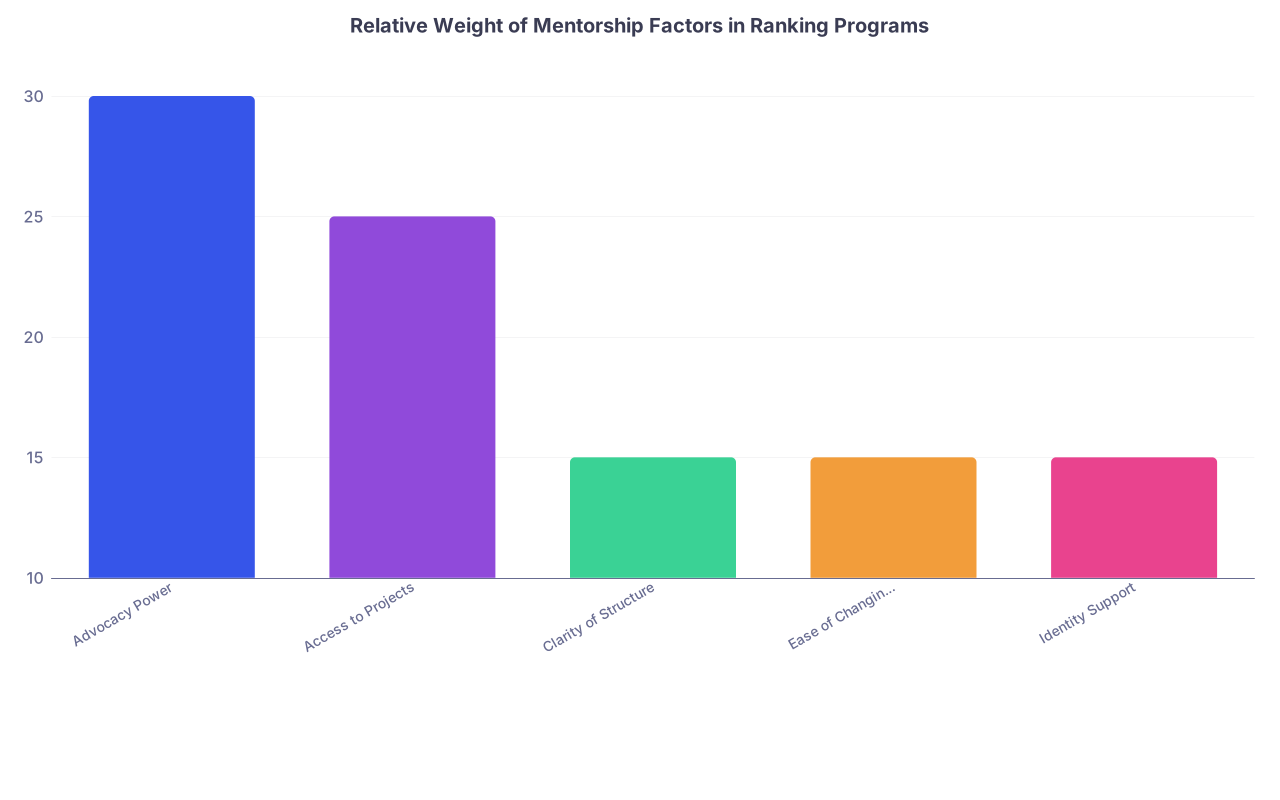
| Category | Value |
|---|---|
| Advocacy Power | 30 |
| Access to Projects | 25 |
| Clarity of Structure | 15 |
| Ease of Changing Mentors | 15 |
| Identity Support | 15 |
Focus most on:
Advocacy power (30%)
- When things go sideways, who actually has your back?
- Can any mentor pick up the phone and influence your trajectory?
Access to projects and opportunities (25%)
- How quickly can you get plugged into meaningful scholarly work?
- Are there mentors who reliably convert “interested resident” into “presenting at national meeting”?
Clarity of structure (15%)
- Do you know who is responsible for what?
- Are expectations for mentors and mentees clear?
Ease of changing mentors (15%)
- Switching is not a sign of failure. It is a sign of a mature system.
- If swapping mentors sounds taboo, that is a bad sign.
Identity and wellness support (15%)
- Do you see residents like you thriving?
- Are there formal or informal structures acknowledging your specific context?
After each interview day, ask yourself bluntly:
- “If I matched here and had a disaster year, who would be my person?”
- “If I decided to aim as high as possible in my specialty, would there be someone to show me the actual path?”
- “Did residents talk about mentors with energy and specifics, or just polite generalities?”
Write down the names of mentors mentioned. If you keep hearing the same 2–3 names at a big program, that tells you the system is resting on a few heroes, not a reliable structure.
10. Red Flags And Green Flags You Should Not Ignore
Green flags
Residents spontaneously reference mentors during their stories:
- “My mentor helped me pull back from overcommitting.”
- “Our advisor group did a fellowship prep session for us.”
Clear, low-friction rematch process:
- “We just email Dr X and it is done. No drama.”
Program leadership involved:
- PD can tell you how they track mentor-mentee meeting rates or outcomes.
- Faculty are trained on how to mentor; it is not assumed everyone knows.
Multiple overlapping options:
- Dyad + pod + career advisor, but not in a confusing way.
- Informal culture that encourages “build your own board of mentors.”
Red flags
- “We have a mentorship system…” followed by vague description and no examples.
- Residents say “I do not really use my assigned mentor” and shrug.
- No clarity on how to change mentors or advisors.
- Mentorship is framed only around remediation, not growth.
- Faculty say “our door is always open” as the primary mentorship strategy. That usually means no structure.
11. Putting It All Together: How To Decide What Fits You
You are not going to find a program with a perfect mentorship design. You are looking for enough structure plus enough cultural proof that people actually use it.
If you:
Already have concrete academic goals and a niche:
- You will benefit from strong dyads or a robust advisor model, with clear specialty‑specific mentors.
- Make sure there is an easy way to realign if your assigned mentor is off.
Are undecided on career path:
- Pods and broad advisor models with exposure to multiple specialties and career types will serve you well.
- You need space to explore without being locked into one mentor’s worldview.
Come from an underrepresented or non-traditional background:
- Look hard at identity-based mentorship, affinity groups, and alumni representation.
- A “neutral” dyad with someone who does not understand your context will not magically solve those gaps.
Underneath all of this is one question:
“Will this program help me build a small group of adults who know me well enough, and care enough, to push and protect me over three to five years?”
Dyads, pods, and advisor models are just different blueprints for answering that. Examine the building, not the blueprint.
With that lens sharpened, you are better prepared to sort glossy recruitment claims from real support. Once you combine this mentorship analysis with your evaluation of case volume, fellowship placement, and call structure, you will have a ranking list that actually reflects your future, not just your interview day impressions. How to weigh those other factors against each other—that is the next layer of strategy, and a conversation for another day.