
You’re sitting on Zoom with a program coordinator. You’ve rehearsed your answer to “Tell me about yourself.” You’ve looked up their call schedule. But the one question burning a hole in your brain is: “Will you sponsor my visa?”
You manage to ask it. They say, “Yes, we sponsor.” Or worse: “We sponsor J-1 only, no H-1B.” The coordinator moves on. Interview ends. You close the window and realize: you actually have no idea what “yes, we sponsor” means in real life.
This is where people get burned. I’ve seen applicants match into programs that technically “sponsor visas” but:
- Have never actually filed an H-1B for anyone
- Make you pay every single immigration cost personally
- Delay paperwork so badly that interns miss orientation
- Have no clue about 212(e), NIW, waiver jobs, or long‑term implications
If you need a visa, you are not just choosing a residency. You’re choosing your first three to seven years of legal life in the U.S.
Here’s how to handle that situation like a grown adult instead of a desperate applicant.
1. The Baseline: What You Should Know Before You Ask Anything
Before you start grilling programs, you need your own foundation straight. Otherwise you’ll ask weak questions and miss landmines.
At minimum, you should clearly understand:
- The basic differences between J‑1 and H‑1B
- Your own long‑term goals (stay in the U.S. vs maybe return home)
- Your realistic Step scores / profile (for H‑1B competitiveness)
If you cannot explain to yourself, in one sentence each, what these mean, fix that tonight:
- J‑1: Training visa through ECFMG; usually requires two‑year home return or waiver job; relatively standardized.
- H‑1B: Work visa; tied to the hospital; more complex, more expensive; some hospitals avoid it; sometimes needs Step 3 before starting.
Here’s a fast side‑by‑side view, so you stop treating “visa” as one word:
| Aspect | J-1 (ECFMG) | H-1B (Work Visa) |
|---|---|---|
| Common in GME | Very common | Less common |
| Step 3 needed | Not required to start | Often required |
| 2-year rule (212e) | Usually yes | Usually no |
| For fellowship | Generally fine | Depends on employer |
| Cost to program | Lower | Higher (legal + fees) |
If none of that makes sense right now, you do some reading before interviews. Because during interviews you are not asking “What is J‑1?” You’re asking: “How does your program handle J‑1 residents in practice?”
2. What To Research Before the Interview (Quietly)
You should not walk into an interview blind and then ask, “Do you sponsor H‑1B?” when their website already screams “J‑1 only.”
Do this before you ever talk to them:
Check the program’s official website
Look under “International Medical Graduates,” “Visa Sponsorship,” or FAQ. Screenshot pages. They vanish or get “updated.”Look at current residents
If all international grads list “ECFMG J‑1 visa” on LinkedIn and zero mention H‑1B, believe that pattern. If multiple say “H‑1B” or “O‑1” at the same hospital, good sign.Ask quietly in alumni / IMG groups
WhatsApp, Facebook, school alumni channels. Ask: “Anyone here at [Program X]? What visa are you on? Would they sponsor H‑1B for a strong applicant?” You’ll get more honest answers there than in any interview room.Check institutional patterns
Some universities are allergic to H‑1B for residents but happily give it to faculty. Others use H‑1B commonly because their legal department is efficient. If their cardiology fellows list H‑1B all over LinkedIn, but residents are all J‑1, that tells you something about where they draw the line.
That background lets you ask smarter, pin‑pointed questions instead of “Hello, do you sponsor?” like it’s 2010.
3. Core Question #1: “What Visa Types Have You Actually Used In The Last 3 Years?”
Do not ask: “Do you sponsor H‑1B?”
Ask: “In the last 3 years, what types of visas have your non‑U.S. citizen residents been on?”
Why? Because “we sponsor” is cheap talk. Actual history is not.
Good follow‑up variations:
- “Do you currently have any residents or fellows on H‑1B?”
- “Could you share roughly how many J‑1 vs H‑1B residents you’ve had recently?”
- “If you support H‑1B, is that for all specialties or only for certain ones here?”
You’re trying to figure out if their “H‑1B possible” is:
- Real and routine: They do it every year; PD knows the process.
- Rare and painful: “We did one 8 years ago for a superstar applicant.”
- Fiction: “Our GME office might allow it but we’ve never actually done it.”
If they say: “We only sponsor J‑1, no exceptions,” you have your answer. At that point, your questions shift to life on J‑1 (more on that below).
4. Core Question #2: “Who Handles The Visa Process And How Early Do You Start?”
This sounds boring. It’s not. The most common disaster scenario I’ve watched:
Program matches you → GME drags feet → paperwork late → DS‑2019/H‑1B approval delayed → your start date is at risk.
Ask them directly:
- “When do you typically start the visa process for matched residents?”
- “Is visa processing handled by GME, an outside attorney, or both?”
- “Have you ever had incoming residents delayed because of visa issues? What happened?”
You want a program that says something like:
“We start everyone’s paperwork in late March. GME has a dedicated visa coordinator. We use the same immigration attorney every year. We have not had a resident miss their start date because of visa issues in the last several years.”
Red flags:
- “I’m not sure, GME takes care of that.” (PD has zero clue.)
- “Sometimes there are delays, but we’ll see.”
- “We generally start in May or June.” (Way too late for someone abroad needing consular processing.)
5. Money and Risk: “Who Pays For What?”
People avoid this topic because it feels awkward. You cannot afford that luxury.
There are direct costs: SEVIS fees, attorney fees, filing fees, premium processing (H‑1B), visa stamping travel. Some hospitals pay essentially everything. Others dump 90% on you.
You ask:
- “For residents on H‑1B, which costs are covered by the hospital and which are the resident’s responsibility?”
- “Is premium processing used routinely, and who pays for it?”
- “Are there any repayment or clawback clauses if a resident leaves early related to visa costs?”
If they look surprised at the word “clawback,” that’s good. Some places write contracts that say, “If you break your contract early, you owe us $X for immigration costs.” You need to know that before you sign your life away.
On J‑1, ask:
- “Does the institution assist with any dependents’ visa‑related costs?”
Do not accept “I think so” or “probably.” If they’re vague, ask if they can connect you with their visa coordinator or an IMG chief.
6. Long‑Term Reality: “What Happens After Residency?”
Visa novices only think: “Can I start residency?” Experienced applicants think: “What happens to me in 3 years?”
The right questions depend on whether you’re J‑1 or H‑1B focused.
If you’re likely J‑1:
You should ask:
- “Do you have recent graduates on J‑1 who are now in fellowship in the U.S.? Any examples?”
- “Do you have graduates who found J‑1 waiver jobs after residency? In which states or systems?”
- “Do your faculty or GME office help residents understand the J‑1 waiver process and timeline?”
You’re trying to figure out if previous J‑1 residents successfully:
- Matched into fellowship
- Got waiver jobs (e.g., Conrad 30, VA, academic hospitals)
- Transitioned to H‑1B or permanent residency later
If the PD says, “Most of our J‑1 grads leave the US,” that is a completely different path than, “Our last 3 J‑1 grads all found waiver jobs in rural internal medicine groups.”
If you’re aiming for H‑1B:
Ask:
- “For residents who start on H‑1B, have they been able to stay in the same institution for fellowship or faculty roles?”
- “Does the institution sponsor employment‑based green cards (EB‑2 / NIW or employer‑sponsored) for graduates?”
You’re mapping out whether this institution is just three temporary years, or potentially a longer‑term home.
7. Program Culture Toward IMGs: Look Past the Official Line
Visa policy on paper is one thing. Daily reality is another.
A program that grudgingly “accepts J‑1 because we have to” feels very different from a program that actually values international residents and knows what they’re dealing with.
In the interview and social events, pay attention:
- How many current residents openly share that they are on visas?
- Do chiefs or seniors from abroad seem relaxed talking about it, or guarded?
- Does the PD know basic vocabulary (J‑1 waiver, Step 3 for H‑1B) or look confused every time?
You can ask softer culture‑gauging questions to residents:
- “Did you feel supported by the program when dealing with visa paperwork and timelines?”
- “If you had any immigration‑related problems, did leadership advocate for you?”
- “Do you ever feel your visa status affected rotations, moonlighting, or other opportunities?”
If someone says, “Honestly, they treat us differently because they know we can’t easily leave,” believe them. That power imbalance can be real in some places.
8. Concrete Question List You Can Use On Interview Day
Let me give you a script you can adapt. Don’t read it like a robot, but you should have your own version of this ready.
Pick 3–5 of these per program, not all of them.
To Program Director / Coordinator:
- “In the last few years, what visas have your non‑U.S. citizens typically trained on here?”
- “Do you currently have any residents on H‑1B? If so, roughly how many?”
- “When in the spring do you usually start visa processing for incoming residents?”
- “Who in your institution is the main point person for resident visas—GME office, HR, outside attorney?”
- “Have you had any residents in recent years whose start date was delayed due to visa issues?”
- “For residents on H‑1B, which fees are covered by the institution and which fall to the resident?”
- “Do you typically use premium processing for H‑1B? Is that automatic or case‑by‑case?”
- “Do any of your employment contracts include repayment clauses related to visa costs if someone leaves early?”
To Current Residents (especially IMGs):
- “What visa are you on now, and was the process smooth with this program?”
- “Did you feel the program was proactive about starting paperwork, or did you have to push?”
- “For those who have graduated recently, what have J‑1/H‑1B folks gone on to do?”
- “If you had to decide again as a visa‑needing applicant, would you still choose this program?”
Be direct but not aggressive. You’re not interrogating; you’re protecting your future.
9. Ranking Programs When Visa Is A Factor
At the end of the day, you’ll have a list. Some programs are your dream clinically but vague on visa issues. Others are visa‑friendly but maybe less impressive on paper.
To compare, you can literally score them on a few dimensions:
| Factor | Score 1-5 |
|---|---|
| Actual visa history | |
| Clarity of policies | |
| Financial support for visa | |
| Start-timeline reliability | |
| Long-term outcomes for IMGs |
Where 1 = terrible, 5 = excellent.
A mediocre university program with rock‑solid H‑1B support, clear policies, and strong J‑1 waiver alumni may be a much better life choice than a “big name” that shrugs and says, “We’ll see what GME allows.”
Also remember:
- Specialty matters. Competitive surgical fields may just not touch H‑1B in some places. Don’t fantasize your way around that.
- Your scores matter. Some programs will say bluntly: “We only do H‑1B for very high Step scores or hard‑to‑fill specialties.” That is reality, not discrimination.
10. Red Flags That Should Push A Program Down Your List
I’m going to be blunt. If you hear or see this, think very hard before ranking them high:
- “We don’t really know until after Match what we can do about visas.”
- “We used to do H‑1B but it got too complicated, so now it’s case‑by‑case.”
- “We expect residents to cover most visa expenses themselves; that’s just how it is.”
- Multiple residents saying, “My start date almost got delayed because GME was late,” or “I had to email 10 times to get anything moving.”
- PD clearly uncomfortable talking about long‑term paths for J‑1s (“Most people just figure it out on their own.”)
You are not just choosing an education. You’re choosing a legal partner. If they’re sloppy or evasive about your immigration status, that’s not a small issue.
11. A Simple Visa Strategy By Applicant Type
Let’s simplify this, because everyone is different.
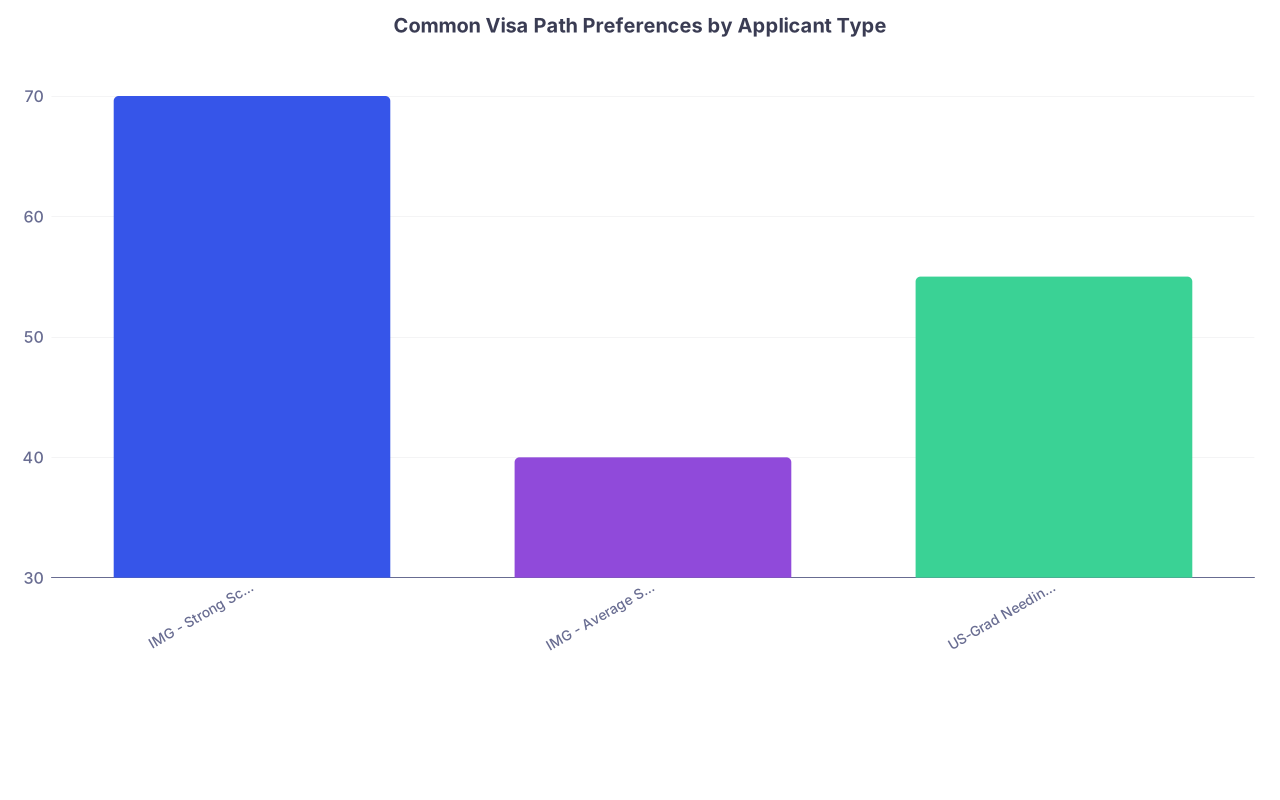
| Category | Value |
|---|---|
| IMG - Strong Scores | 70 |
| IMG - Average Scores | 40 |
| US-Grad Needing Visa | 55 |
Interpretation (loosely): higher value = more likely to prioritize H‑1B when feasible.
If you’re an IMG with strong scores (e.g., 250+ Step 2, strong CV)
You can realistically push for H‑1B in programs that sometimes do it. You should:
- Target programs with a history of H‑1B
- Ask pointed, specific questions about H‑1B usage and timing
- Be willing to rank a slightly less prestigious program higher if their visa history is solid
If you’re an IMG with average scores or red flags
You might not have the leverage to demand H‑1B in selective places. In that case:
- Focus on J‑1‑friendly programs with lots of IMGs
- Ask about J‑1 graduates’ waiver and fellowship outcomes
- Build a mental map: “If I match here on J‑1, I can realistically get a waiver job in X region.”
If you’re a U.S. grad needing a visa (rare, but happens)
You may get more flexibility for H‑1B at some institutions, but don’t assume. You still ask the same hard questions. Don’t get lazy just because you’re a U.S. grad.
12. The One Often‑Ignored Angle: Your Family
If you have a spouse or kids, their life will also run through your visa.
Ask yourself and, if appropriate, the program:
- On J‑1, your spouse will be J‑2. Will they be able to work with EAD?
- On H‑1B, spouse is H‑4. Working might be difficult or impossible unless you reach certain green card milestones.
You probably won’t grill the PD about your spouse’s EAD. But you can ask residents privately:
- “Any of you here on J‑1 or H‑1B with families—how has that been in this institution and city?”
If multiple people say, “My spouse cannot work here and childcare costs are brutal,” that matters more than an extra research month.
13. Timeline & Process Visual: How Visa Fits Into The Match Year
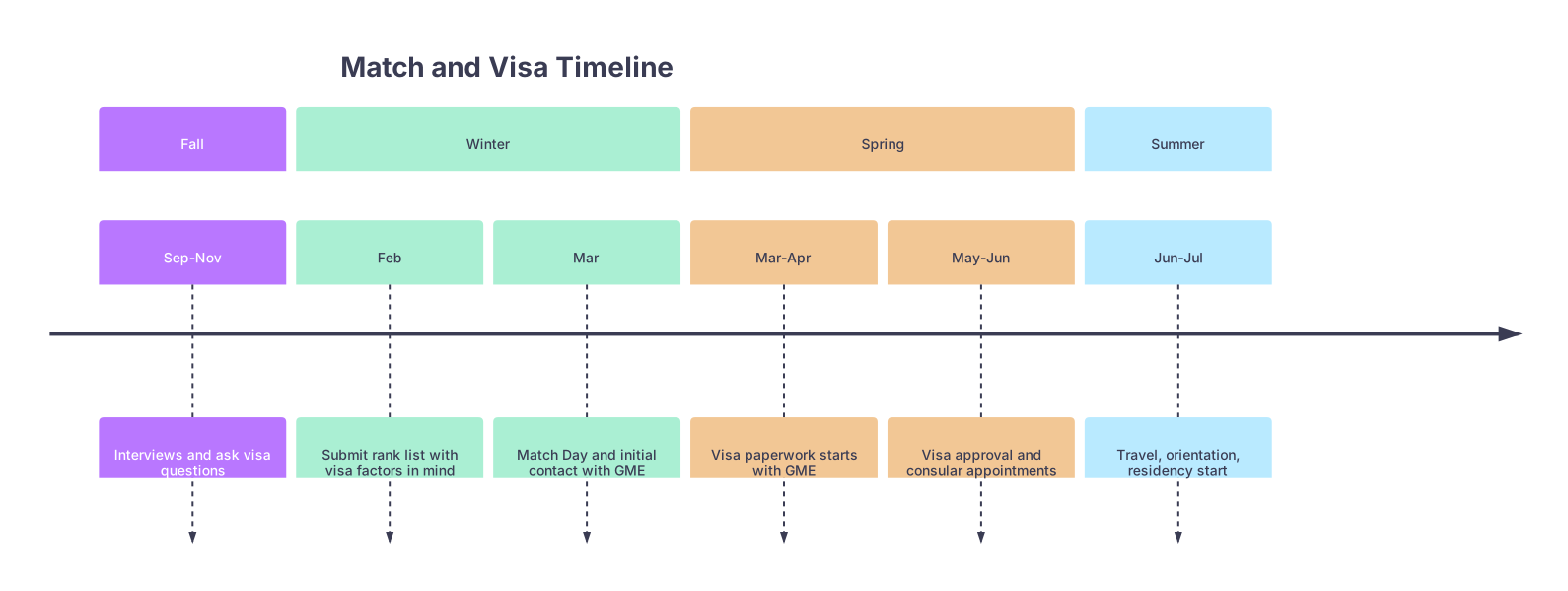
| Period | Event |
|---|---|
| Fall - Sep-Nov | Interviews and ask visa questions |
| Winter - Feb | Submit rank list with visa factors in mind |
| Winter - Mar | Match Day and initial contact with GME |
| Spring - Mar-Apr | Visa paperwork starts with GME |
| Spring - May-Jun | Visa approval and consular appointments |
| Summer - Jun-Jul | Travel, orientation, residency start |
If a program tells you they “usually start” your visa work in late May, you see the problem immediately on this timeline.
14. How To Ask Hard Questions Without Sounding Like A Walking Visa
Some applicants worry: “If I ask too many visa questions, I’ll look difficult.” That’s not wrong. You need balance.
Tactics:
- Mix visa questions with normal ones. Ask about education, research, mentorship, then a visa question. Not only visas.
- Use neutral language:
“Could you help me understand how your institution handles visas for residents?” sounds better than “Will you pay for my H‑1B?” - Save the most detailed financial questions for an email to the coordinator or a private chat with residents.
If a program seems annoyed by reasonable, concise questions about the thing that literally determines your legal status in their country, that tells you something about them.
FAQ (Exactly 4 Questions)
1. If a program says “H‑1B is possible for exceptional candidates,” should I still rank them high?
Only if you have concrete evidence they’ve actually done H‑1B recently, and your application is genuinely strong for that specialty (high Step scores, strong letters, sometimes research). “Possible” without history usually means “unlikely.” If H‑1B is crucial for you, give more weight to programs with multiple current or recent H‑1B residents.
2. Is J‑1 always a bad idea if I want to stay in the U.S. long term?
No. That’s an internet myth pushed by people who don’t understand waivers. Plenty of J‑1 grads get Conrad 30 or VA waiver jobs, work in underserved areas for 3 years, and then move on to better positions, sometimes on H‑1B or with a green card underway. J‑1 is a constraint, not a death sentence. The key is training at a program with a track record of J‑1 grads getting good waiver or fellowship positions.
3. Can I ask directly for H‑1B in my interview?
You can, but do it smart. Instead of “I only want H‑1B, will you give it to me?” try: “Given my situation and long‑term goals, H‑1B would be strongly preferred. Based on your past experience, is that a realistic possibility here if I match?” That gives them room to be honest. If they hedge or say “we can’t promise anything,” assume J‑1 unless later written communication says otherwise.
4. What if I only find out about bad visa policies after I match?
You’re largely stuck. Once you match, backing out is extreme and can get you reported to NRMP. At that point your best move is to build relationships early with GME and the visa office, push for timely paperwork, and network aggressively to set up good J‑1 waiver or post‑H‑1B options. This is exactly why you ask the uncomfortable questions before ranking, not after Match Day.
Today’s next step is simple: pick three programs you’re seriously considering, open their websites, and search “visa” and “IMG.” Write down exactly what they say and what they do not say. Then draft 3 specific visa‑related questions you’ll ask each of those programs on interview day.