
The residency that looks perfect on paper can be a disaster in real life—and that risk triples when you’re moving across the country without ever seeing the place.
You’re not just choosing a program. You’re choosing a town, a commute, a grocery store, a dating pool, a daycare, a support system. Sight unseen. While working 60–80 hours a week.
Here’s how to assess community fit when you can’t just hop on a plane and “get a feel for it.”
Step 1: Get Real About Your Non‑Negotiables
Start here or you’ll drown in irrelevant data.
You’re not picking a city for a vacation. You’re picking a place you can survive (and maybe even like) while exhausted, stressed, and broke.
Grab a piece of paper. Make three columns:
- Non‑negotiable
- Strong preference
- Nice to have
Then pressure test them against your actual life, not your fantasy life.
Typical non‑negotiables I see for residents:
- Car vs. no car: “I do not drive / I hate driving / I can’t afford a car.”
- Kids / partner: “Need reliable daycare within X distance / partner needs job market in Y field.”
- Safety: “I won’t live somewhere where I don’t feel safe walking from the hospital to parking at night.”
- Cost: “Max rent $X for studio/1BR within Y minutes of the hospital.”
- Climate constraints: Extreme heat with asthma, severe seasonal depression, etc.
- Religious or cultural needs: Access to a particular community, worship, or food.
Be specific. “Affordable” is useless. “Rent under $1,600 with in‑unit laundry or at least building laundry” is actionable.
You’ll use this list to filter later. Without it, everything looks both fine and terrible.
Step 2: Build a Quick‑and‑Dirty City Profile
You can’t visit, but you can absolutely profile the city like you’re stalking an ex on social media.
Do this before you get emotionally attached to any program.
| Category | Useful Tools |
|---|---|
| Cost of living | Numbeo, Zillow, Rentometer |
| Commute reality | Google Maps, Street View |
| Safety | City crime map, AreaVibes |
| Weather | NOAA climate data, WeatherSpark |
| Culture/social | Reddit, local Facebook groups |
Cost, Commute, and Reality Check
Do not trust “cost of living is low” or “easy commute” from program websites. That copy is usually written by someone who hasn’t paid rent on a resident salary in 10 years.
Here’s what to do:
- Look up the hospital address on Google Maps.
- Draw a mental radius based on how far you’re realistically willing to commute:
- No car and you’ll be post‑call? Aim for 0–30 min by transit/foot.
- Car owner? 0–30 min door to door in rush hour.
- For that radius, check:
- Typical rent for studios/1BRs on Zillow/Trulia/HotPads.
- Transit routes and frequency using Google Maps (set time to 6:30 am and 7 pm on a weekday to simulate real shifts).
- Street View around the hospital and likely housing zones.
Then ask: “Can I actually live nearby without going broke or losing 2 hours a day commuting?” If the honest answer is no, your “community” includes your car interior.
Step 3: Understand the Hidden Schedule + City Interaction
You don’t experience a city as a normal person. You experience it as a resident with weird hours.
This is where most people get community fit wrong. They imagine weekend brunch and evening runs by the river. Reality: post‑call naps, grocery runs at 10:30 pm, and walks to the car at 4:45 am.
Use this mental model: What is this city like at the hours I’ll actually be awake and free?
Think through:
- Safety and lighting around hospital and housing at 4–6 am and 9–11 pm.
- Late‑night food options that are not just gas stations and McDonald’s.
- 24‑hour or late‑open pharmacies, groceries, and urgent care.
- Weekend options within 20–30 minutes for decompression: parks, coffee shops, gyms, faith communities.
Then map it to your call-heavy blocks. For example, if you’re doing ICU nights, that gym across town might as well be on Mars.
Step 4: Use Residents as Your Community Intel (Without Wasting Their Time)
If you’re moving across the country sight unseen, residents are your best—and most honest—source of community data. But only if you ask the right questions.
Do not ask: “Do you like the city?” That invites a vague, polite answer.
Ask questions that force them to reveal specifics. Here’s how to structure it:
Housing and Commute
- “Where do most interns live? What’s their ballpark rent and commute?”
- “If you were starting as an intern this July, where would you look first?”
- “How long is your commute door‑to‑door, and how does it feel after a 28‑hour call?”
- “Are there any areas people avoid living in, for safety or just hassle?”
Listen for patterns like:
- “Most people live 25–35 minutes away because closer is too expensive.”
- “Everyone parks far away at night because the garage doesn’t feel safe.”
- “Nobody lives downtown after intern year; too loud, too pricey.”
Daily Life and Practicalities
- “Where do you actually grocery shop after work?”
- “What’s open when you get off a typical evening shift?”
- “Do people mostly cook, order in, or eat at the hospital?”
Ask for one or two concrete examples: “If you got off at 9 pm on a Wednesday, where would you grab dinner within 10–15 minutes?”
Social and Support Systems
- “What do interns actually do on a rare free Saturday?”
- “Do residents mostly hang out with co‑residents, or do people find friends outside the hospital?”
- “If someone moved here knowing no one, what have you seen them do that worked well to build a life?”
You’re not just listening for the words—you’re listening for tone. The deep sigh before, “Well, there’s not that much to do…” is data.
Step 5: Read Between the Marketing Lines
Programs will describe their community like a tourism brochure. That’s fine. Your job is to translate.
Watch out for these phrases and what they often actually mean:
| Program Phrase | Possible Translation |
|---|---|
| "Low cost of living" | Cheap if you have a spouse with income |
| "Easy access to outdoors" | 30–60 min drive each way on your rare days off |
| "Up and coming neighborhood" | Gentrifying; mix of great and sketchy |
| "Tight‑knit resident family" | People rely heavily on each other because city is isolating or transplant‑heavy |
| "Diverse patient population" | Good; now check if there’s matching community support / resources |
Cross‑check every glowing description with:
- Reddit threads about living in that city/neighborhood.
- City‑specific Facebook or Discord groups (young professionals, residents, grad students).
- Google Maps reviews of places within 1 mile of the hospital.
If the program brags about “amazing restaurants and nightlife,” but all the nearby spots have 2.9‑star reviews and comments about fights or car break‑ins, adjust your mental picture.
Step 6: Use Social Media and Forums Like an Adult, Not a Tourist
Reddit, Instagram, and TikTok can actually help—if you’re looking for the right things.
Don’t just search “fun things to do in [city].” That gives you tourist traps and influencer nonsense.
Search for:
- “moving to [city] alone”
- “[city] cost of living 2024”
- “rent in [neighborhood]”
- “[city] med resident,” “[city] young professionals”
- “is [neighborhood] safe at night”
Then filter out extremes. The person who says “this city is unlivable” because they couldn’t find oat milk at 11 pm is not your benchmark. You’re about to be a resident. You’ll put up with a lot more than that.
Also: Instagram geotags are useful. Search the hospital and surrounding neighborhoods. See who’s actually there, what it looks like at night, what the sidewalks, lighting, and parking look like.
Step 7: Try a Virtual “Day in the Life” Simulation
If you can’t be there, simulate it.
Take one program you’re seriously considering and run this exercise:
Pick a typical day:
“On wards. Start at 6:30 am. Done around 6–7 pm. One weekend day off every other week.”Map the day:
- Alarm time. Commute time.
- Parking/transit situation.
- End of day: where do you eat, where do you pick up that prescription, where do you walk in the dark.
Now ask:
- If I lived in X neighborhood that residents mentioned, what time am I actually home?
- When do I realistically see sunlight in winter?
- What’s walkable from my apartment when I’m too tired to drive?
Do it again for a q4 call night:
Home post‑call at 10–11 am. Need to crash, then wake up groggy at 4–5 pm. Where are you walking? What can you do that doesn’t require a full brain?
If this mental run‑through leaves you thinking, “I’d be alone in a box with DoorDash and nothing else,” that’s a red flag.
Step 8: Account for Your Personality and Vulnerabilities
People screw this up: they assume they’ll suddenly become a different person once residency starts.
If you hate big cities now, you will not magically thrive in Philadelphia just because the program is “strong.” If you crumble in gray winters, moving from Phoenix to Rochester for “prestige” is how you end up depressed and disengaged.
Be blunt with yourself:
- Introvert who refuels at home? You may tolerate a more boring city if your apartment is comfortable and safe.
- Extrovert who needs community? A small town where everyone is in bed by 9 might leave you isolated.
- History of anxiety or depression? Weather and sunlight matter. Proximity to a therapist matters. Having at least one way to feel human (gym, church, hobby group) matters.
You are not weak for factoring this in. You’re smart. Burned‑out, miserable residents do not magically become excellent physicians.
Step 9: Ask Programs Directly for Specific Community Info
You’re allowed to ask for help assessing community fit. Just don’t be vague.
During interviews or follow‑ups, ask program leadership or chief residents:
- “Do you have a housing guide or list of where residents typically live, with average rents?”
- “How do interns who move here without any family usually find community, inside or outside the hospital?”
- “Are there particular neighborhoods you strongly recommend or advise against for residents?”
- “What support does the program offer for residents relocating from out of state?”
Watch how they respond:
- If they immediately have a PDF, a residents’ Google Map, or a Slack channel—good sign.
- If they shrug and say, “People figure it out,” that tells you something. You’ll be on your own.
Step 10: Weigh Program Quality vs Community Fit Like an Adult, Not a Ranking Slave
Here’s where people get stuck. “Program A is more prestigious, but the city sounds miserable. Program B is solid but in a place I could actually live.”
Let me be clear:
Living in a community that actively undermines your mental health to chase a marginally “better” name on your badge is usually a bad trade.
When deciding, write it out. Literally. One page per program:
- Program pros / cons.
- Community pros / cons.
- “What my life actually looks like here on a random Tuesday in February.”
Then ask:
- Am I okay being here for 3–7 years?
- Do I see any way to build a life here that is more than work–sleep–scroll–repeat?
- If this program were in a random mid‑tier city I didn’t care about, would I still rank it this high?
You’re not choosing a forever home. But you are choosing the place where a big chunk of your adulthood happens. Treat that seriously.
Step 11: If You’re Truly Flying Blind, Build a “Risk Mitigation” Plan
Sometimes you just can’t get enough data. Maybe it’s a smaller town without much online presence. Maybe every resident you talked to was vague.
Then your question becomes: “If this city turns out to be a poor fit, can I buffer it enough to survive residency?”
Think about:
- Can I afford to live in the best, safest, most walkable part of town, even if that means a smaller place?
- Is there at least one nearby hub city or area I could drive to once a month to feel like a person?
- Can I bring or build community—partner, friend, family visits, online groups, faith communities?
- Worst case, can I transfer? (Rare, but not zero. I’ve seen it happen when someone was truly drowning.)
You don’t need perfection. You need “good enough that I won’t be miserable and unsafe.”
Step 12: Quick Diagnostic: Red, Yellow, Green Flags for Community Fit
Use this as a sanity check for each program you’re ranking.
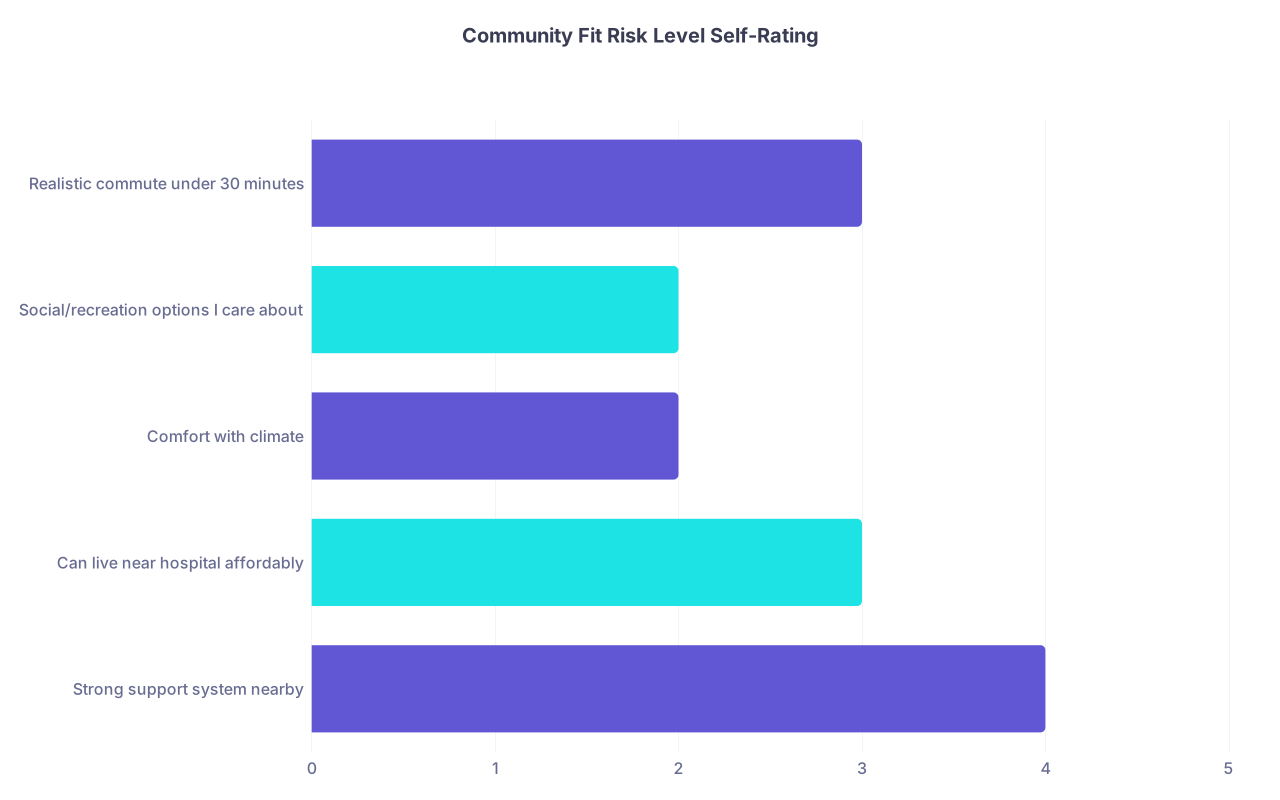
| Category | Value |
|---|---|
| Strong support system nearby | 4 |
| Can live near hospital affordably | 3 |
| Comfort with climate | 2 |
| Social/recreation options I care about | 2 |
| Realistic commute under 30 minutes | 3 |
Ask yourself, 1–5 scale (1 = terrible, 5 = great) for each:
- Can I afford safe, reasonable housing within 30 minutes of the hospital?
- Do I have at least one realistic way to find “my people” here?
- Is the climate something I know I can handle?
- Do my core non‑negotiables (kids, partner, faith, no car, etc.) have viable solutions?
- Does at least part of this city’s vibe match who I am?
If you’re consistently putting 1s and 2s, and you have another option with 3s and 4s, you know what to do.
Sample Case Study: Two Internal Medicine Programs
Let me make it concrete.
You have:
- Program X: Big‑name academic center in a small, cold, somewhat isolated city.
- Program Y: Mid‑tier academic program in a mid‑sized, warmer, more diverse city.
You’re single, no kids, extroverted, hate cold, and know you spiral in dark winters. You want outpatient‑leaning IM, maybe heme/onc.
Program X pros:
- Strong brand name.
- Big fellowship list.
- Heavy research.
Program X community:
- Residents mostly live 20–30 minutes away due to costs.
- Winters are brutal; everyone talks about “surviving” from November–March.
- Not much going on socially outside bar culture.
Program Y pros:
- Solid training, regional reputation.
- Reasonable fellowship placements.
Program Y community:
- Walkable areas near hospital where residents live.
- Lots of young professionals, year‑round outdoor stuff.
- Multiple cultural and social communities that match your background and interests.
If you’re honest, your odds of thriving—and therefore performing—are higher at Program Y. But people still pick Program X for the name, then wonder why they feel empty and disconnected by PGY‑2.
Don’t be that person.

| Step | Description |
|---|---|
| Step 1 | Identify non negotiables |
| Step 2 | Profile city costs and commute |
| Step 3 | Talk to residents for specifics |
| Step 4 | Simulate day in the life |
| Step 5 | Rank program with confidence |
| Step 6 | Lower program or remove |
| Step 7 | Can I build a livable life here? |

FAQs
1. Is it reckless to rank a program highly if I’ve never been to the city?
Not automatically. What’s reckless is ranking it highly without doing your homework. If you’ve:
- Talked to multiple residents about where they live and what life looks like,
- Checked housing costs and commutes around the hospital,
- Honestly compared your needs (climate, social life, family, safety) to the community’s reality,
then ranking it high can be reasonable. If your decision is based on “it’s a top‑20 name and the pictures looked nice,” that’s blind optimism, not a plan.
2. How much should I let community fit matter versus program reputation?
Enough that you don’t sabotage yourself. If two programs are in the same ballpark training‑wise, let community fit break the tie. If there’s a major training gap (like one doesn’t support your specialty interest at all), you still cannot ignore community fit, but you may choose the stronger training with eyes open and a coping plan. When reputation differences are marginal and community differences are huge, I’d choose the place where you can function as a human. Every time.
3. What if my partner or family hates the idea of the city where my top program is?
Treat that as real data, not background noise. You’re not doing residency in a vacuum. Ask your partner/family to go through the same structured assessment: housing, job market for them, support systems, climate. Then you decide together what level of sacrifice is acceptable for 3–7 years. Sometimes that means prioritizing a slightly less “fancy” program in a place where your whole life doesn’t fall apart. That’s not weakness; that’s long‑term thinking.
Key points:
- Do not romanticize or catastrophize a city you’ve never lived in; profile it ruthlessly against your real life and non‑negotiables.
- Use residents as targeted intel for housing, commute, and daily life, not vague “do you like it?” questions.
- When in doubt between similar programs, choose the one where you can actually build a livable, sustainable life—not just the one with the shiniest name.