
The worst mistake undecided residents make is picking a residency that silently shuts doors they have not even decided they want yet.
If you’re not sure about fellowship, you should not be picking programs for “vibes” or location alone. You should be picking for optionality. For leverage. For the ability to pivot in PGY-2 or PGY-3 without having to climb out of a hole.
Here’s how you actually do that.
Step 1: Admit You’re Undecided – and Plan Like It
Most people mumble something in their personal statement like, “I’m open to fellowship in the future,” then choose programs as if they’re 100% primary-care-for-life or 100% future cardiologist. That’s how you end up trapped.
You’re in one of three camps:
- “I have no clue what I want.”
- “I have 2–3 fields in mind (cards vs pulm/crit vs heme/onc, for example).”
- “I think I’ll do fellowship but I’m not married to a specific one.”
The strategy is different depending on which bucket you’re in, but the core rule is the same:
Choose residency programs where strong people routinely do fellowships and where strong people can also get excellent jobs right out of residency.
You’re buying flexibility. Not a brand name. Not a perfect city. Flexibility.
Step 2: Know Which Specialties Actually Care About Program Pedigree
Let me be blunt: some fellowships care a lot where you train. Some mostly care what you did while you were there.
If you’re undecided, you want programs that don’t make you fight an uphill battle in the competitive fields.
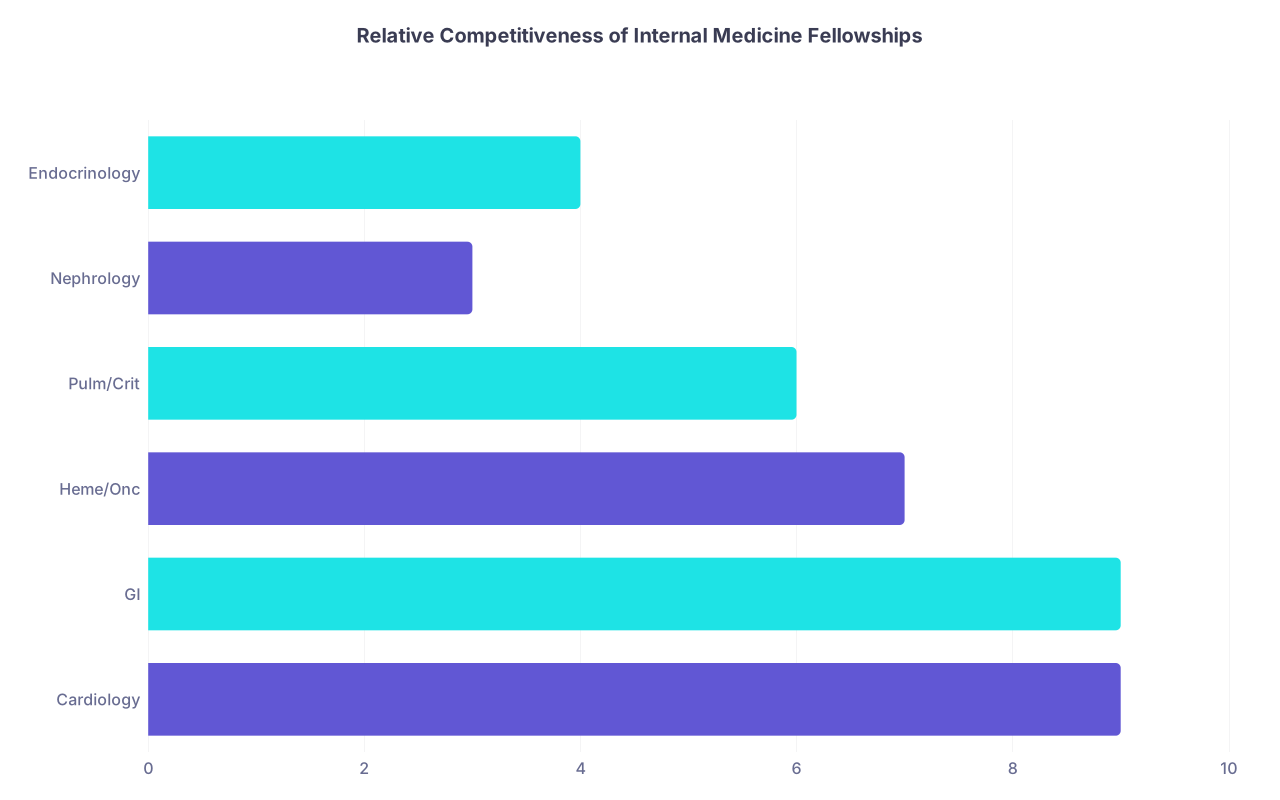
| Category | Value |
|---|---|
| Cardiology | 9 |
| GI | 9 |
| Heme/Onc | 7 |
| Pulm/Crit | 6 |
| Nephrology | 3 |
| Endocrinology | 4 |
(Scale 1–10: higher = more competitive nationally.)
For internal medicine, for example, the ones that care most about your residency “tier” and reputation:
- Cardiology
- Gastroenterology
- Hematology/Oncology
The ones where it’s still competitive but more doable from a wide range of programs:
- Pulm/crit
- ID
- Endo
- Geriatrics, hospitalist fellowships, etc.
If any part of you thinks, “Maybe cards. Maybe GI. Maybe heme/onc,” then training at a residency with:
- A fellowship in that area on site, and
- A track record of matching residents into that field
…matters a lot.
If you’re dead certain you’ll never do fellowship, fine, you have more leeway. But you’re here reading this, so I’m assuming you are not dead certain.
Step 3: The Core Question – Does This Program Keep Doors Open?
When you’re combing through program websites, Step scores, anonymous forums, you should be screening residencies with one simple filter:
“From this program, can people reasonably match into the 2–3 fellowships I might want, and can they get decent jobs if I skip fellowship?”
That’s it. Everything else—schedule, city, free meals—is secondary.
Turn that vague idea into something concrete. For each program on your list, try to answer:
Where did recent grads go?
Not the brochure version. The actual last 3 years of graduates. Many programs list this. If they don’t, that’s already data.Do they have the fellowships I might want in-house?
Not required, but a serious advantage if you’re undecided.Do they send people outside the institution for fellowship?
If every cardiology fellow at their program is homegrown, and no one ever leaves for big-name external programs, that’s a mild red flag about external visibility.
Here’s how to organize what you find.
| Program | In-house Cards/GI/HemeOnc | External Fellowship Matches | Research Infrastructure | Hospitalist Jobs After |
|---|---|---|---|---|
| Program A | All three | Yes, multiple big names | Strong (funded projects) | Strong local network |
| Program B | None | Rare, mostly community | Minimal | OK, mostly local |
| Program C | Cards + HemeOnc only | Some regional, some big | Moderate | Strong |
If a program looks like “Program B” and you’re undecided? I wouldn’t rank it highly unless location or personal reasons are absolutely non-negotiable.
Step 4: Interpret the Fellowship Match List Like an Adult, Not a Premed
Programs love to list a couple of shiny matches and hope you stop reading there.
Your job is to read patterns, not headlines.
Look at their “Recent Graduates” or “Fellowship Matches” pages and ask:
Are the competitive fellowships one-offs or consistent?
One cardiology match 5 years ago vs one every year are very different things.Are people matching where they trained (internal fellowships) or leaving for strong places?
Internal matches are good, but if no one ever leaves, that can signal weak external reputation.Are the matches clustered in just one subspecialty?
Example: tons of pulm/crit, almost no GI. That tells you what the program is actually strong in, not what they say they are.
If you can, build a quick mental scoreboard for each program:
- Competitive subspecialties: cards / GI / heme-onc
- Moderate: pulm/crit / ID / endo
- Less competitive: geri, hospice/pall, hospitalist fellowships
If you see zero competitive matches for several years, and you might want those fields, that program is not “keeping doors open” for you.
Step 5: Hunt for Hidden Signals on Program Websites
You won’t get everything from official pages. But there are tells.
Here’s what I’d scan for on each program’s site:
Faculty bios
How many faculty in your core subspecialties? How many actually mention research, grants, multi-center trials, leadership in societies?
If every GI doc’s bio is “enjoys running and spending time with family” with no clinical or academic interests, you’re looking at a service-heavy, low-academic program. That’s fine if you want community practice. It’s a problem if you’re flirting with GI fellowship.Resident research page
Is there a list of recent resident publications, posters, or presentations? Are they actually in your possible interests?
Seeing multiple residents present at ATS (for pulm/crit) or ASCO/ASH (for heme-onc) or ACC (cards) tells you there’s at least some pipeline there.Tracks and pathways
Look for research tracks, clinician-educator tracks, QI tracks. You don’t have to join them, but they’re another lever you can pull if you decide you want fellowship later.Fellowship page cross-check
If they have in-house fellowships, read those pages too.
Do fellows have real scholarly work? Where did those fellows do residency? If very few residents from outside programs become fellows there, it might be largely a closed system.
Step 6: Use Interviews to Expose Reality (Not to Impress Them)
Interview day is where people waste their best opportunity. They nod through the PowerPoint, ask a generic “what’s your favorite thing about the program,” then leave.
You should be asking targeted questions that tell you exactly how many doors are actually open.
Ask residents (privately, away from leadership):
- “How easy is it to get involved in research if you’re starting from zero?”
- “If someone decides on cards in PGY-2 here, do they scramble, or is that pretty normal?”
- “Who are the go-to letter writers for subspecialty fellowships?”
- “Do people ever match competitive fellowships from a non-research-heavy starting point?”
You’re listening for specific names and processes, not generic fluff like “lots of opportunities.”
Ask program leadership (politely but directly):
- “Can you walk me through what a typical fellowship applicant’s path looks like here—mentors, projects, timing?”
- “Where have your residents gone for cardiology / GI / heme-onc in the last 3–4 years?”
- “How do you support residents who decide on fellowship later in training?”
If they’re vague, dodge the question, or keep saying “we support whatever you choose” without examples—you’ve learned something.
Step 7: Pick the Right Type of Program for an Undecided Applicant
Let’s talk about structure. Because the type of program you choose will either give you slack to explore or lock you into service grind with no oxygen for anything else.
The big buckets:
Big-name, research-heavy academic centers
Great if you think you might go into a highly competitive fellowship.
Tradeoff: higher expectations for research, often heavier workload, maybe less handholding. You can feel like a small fish.Mid-tier academic / university-affiliated community programs
Sweet spot for a lot of undecided folks.
Typically have in-house fellowships in core areas, real research if you seek it out, and more balanced clinical + academic life. Better for exploring.Pure community programs with minimal academic infrastructure
Best if you’re leaning strongly toward hospitalist or outpatient practice and only casually considering fellowship.
You can still match fellowship from here, but it’s more on you to hustle: find mentors, cold email, do projects on your own time.
If you’re truly undecided about fellowship, I’d bias toward bucket #1 or #2. Bucket #3 only if there’s some compensating factor (location near spouse’s job, kids’ schools, visa support) and you’re honest with yourself that you’ll have to grind harder if you flip to “I want GI” in PGY-2.
Step 8: Protect Your Future Self’s Schedule
Nobody thinks about rotation structure when ranking. Then they hit intern year and realize they have zero elective time until the end of PGY-2…and suddenly fellowship deadlines are staring them in the face.
You want to know:
- How much elective time is there total?
- When do those electives occur? Are some available in PGY-1 or early PGY-2?
- Can you do away rotations in subspecialties you might want?
A simple rule:
If you can’t get meaningful time with cards / GI / heme-onc / whatever by mid-PGY-2, your ability to build a competitive application for that field is limited.
Ask current residents:
- “If I decide on a fellowship during intern year, can I rearrange electives to get subspecialty time and research early?”
- “Are schedule changes actually allowed, or is that just theoretical?”
You want a program where rearranging electives for fellowship prep is “painful but doable,” not “absolutely impossible.”
Step 9: Research Expectations – Enough to Help You, Not Drown You
You do not need to love research to care about its availability. You just need it as a lever—something you can pull if you end up chasing a competitive fellowship.
Look for:
- Somebody on faculty who actually publishes in your maybe-fields.
- A clinician-educator or QI mentor path if lab work is not your thing.
- Prior residents who did “just enough” research to land solid fellowships (e.g., a few abstracts, one middle-author paper).
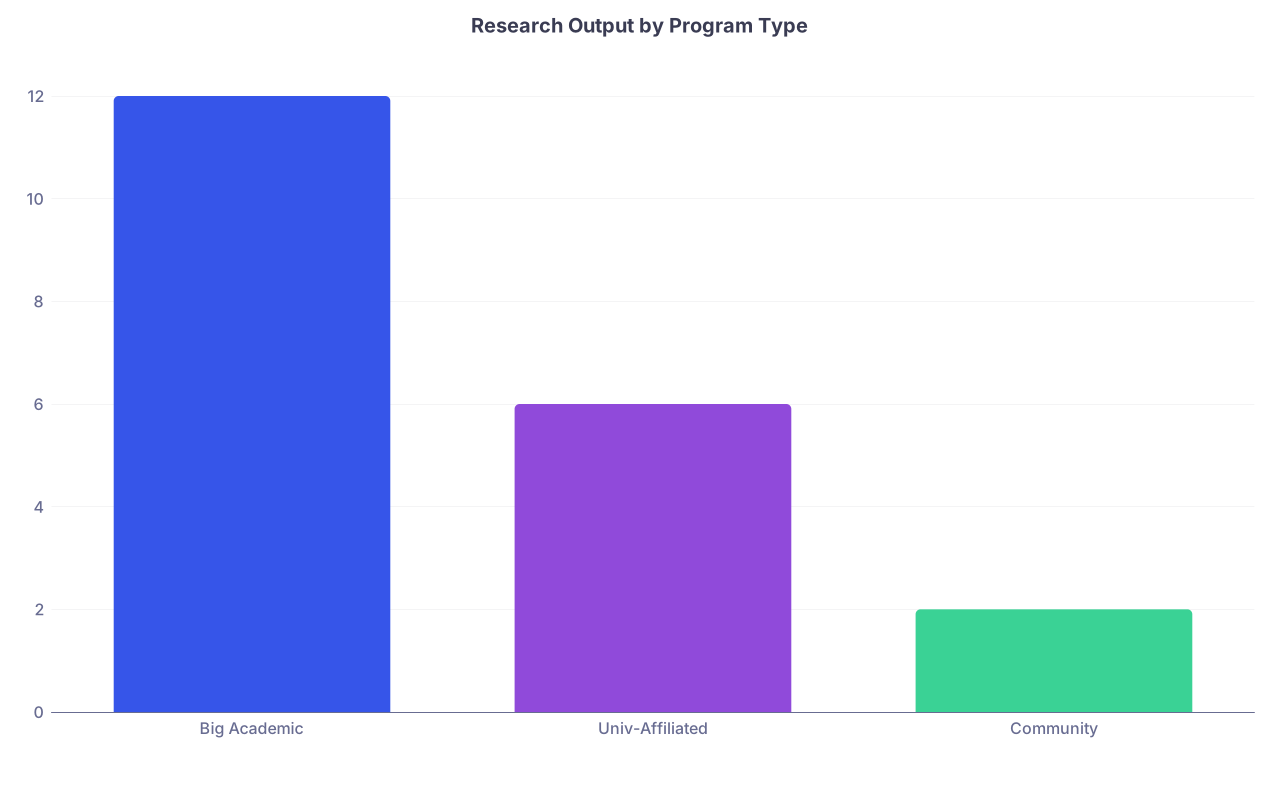
| Category | Value |
|---|---|
| Big Academic | 12 |
| Univ-Affiliated | 6 |
| Community | 2 |
(Approximate average resident publications/posters during training.)
If you absolutely hate research, choose a program where:
- People have matched your maybe-fellowship from mostly clinical strength plus letters and strong rotation performance.
- OR where the fellowships you’d want are at a level where a modest amount of QI or case reports is enough.
If you think there’s any chance you’ll want cards/GI/heme-onc at a strong academic place, you need at least access to:
- One or two substantive projects
- A mentor who actually answers email
- Protected time (even half-days) to work on it
Again: you’re buying options, not committing to live in a lab.
Step 10: Geography vs Optionality – Be Honest With Yourself
Sometimes the “best” program for options is in a city you hate or three flights from your support system. That trade-off is real. And it matters.
This is where you have to be brutally honest:
- If you choose a cushy, low-academic community program in your hometown, will you actually be okay if you decide you want GI and your chances drop?
- If you pick a big-name program in a miserable city, will you burn out so much that you stop caring about fellowship halfway through?
There isn’t one right answer. But don’t lie to yourself.
If you’re truly split, I’d usually advise:
- Slight bias toward better optionality in your early career.
- But do not choose a program that will crush your mental health just to chase a hypothetical future fellowship.
What often works: a solid mid-tier academic program in a tolerable (not perfect) location, where you can realistically do either: strong hospitalist job or fellowship from a decent launching pad.
Step 11: Adjust Your Rank List Like a Person Keeping Doors Open
By the time you’re ranking programs, you should:
- Have a rough hierarchy in your head: “max optionality” → “solid but narrower” → “mostly primary-care/hospitalist-focused.”
- Know which fellowships you might care about, even if it’s 3 of them.
Then, when two programs feel “similar,” you break ties using questions like:
- From which one could I more easily match into the most competitive of my maybe-options?
- From which one could I still land a good local job if I bail on fellowship?
- Where are there more mentors in my range of interests, not just one narrow field?
If all else is equal, rank higher the programs that:
- Have in-house fellowships in at least 1–2 fields you’re considering
- Have recent grads matching those fields
- Offer early electives and accessible mentors
- Aren’t so malignant that you’ll hate your life

| Step | Description |
|---|---|
| Step 1 | List all programs |
| Step 2 | Check fellowship match history |
| Step 3 | Lower on list |
| Step 4 | Check research and mentorship |
| Step 5 | Evaluate location and fit |
| Step 6 | Rank based on balance of options and livability |
| Step 7 | Competitive options present? |
| Step 8 | Accessible for average resident? |
Step 12: What To Do If You’re Already Matched and Still Unsure
Some of you are reading this after the Match, staring at a program you’re not sure about, still undecided on fellowship. That’s okay. Your job shifts from “pick the right program” to “play the hand well.”
Your moves:
First 3–6 months – explore broadly
Get a feel for which rotations energize you vs drain you. Watch the fellows: whose day-to-day seems bearable?By end of intern year – pick 1–2 “maybe” fellowships
Not a binding contract. Just enough to start lining up mentors and electives.Early PGY-2 – lock in the infrastructure
Rearrange electives if you need to. Ask for a research or QI project. Identify 2–3 letter writers.
Even if you change your mind later, you’ll have built relationships and experiences that still help.If your program is weak in your chosen fellowship
You’ll need to:- Do away rotations if possible
- Network at conferences
- Overperform clinically and get powerful letters from any subspecialists you do have access to
Is it harder from a low-optionality program? Yes. Impossible? Usually not, if you’re realistic about target programs and you hustle.
A Quick Visual: How “Open” Is This Program, Really?
Here’s a simple way to think about optionality for an undecided applicant.
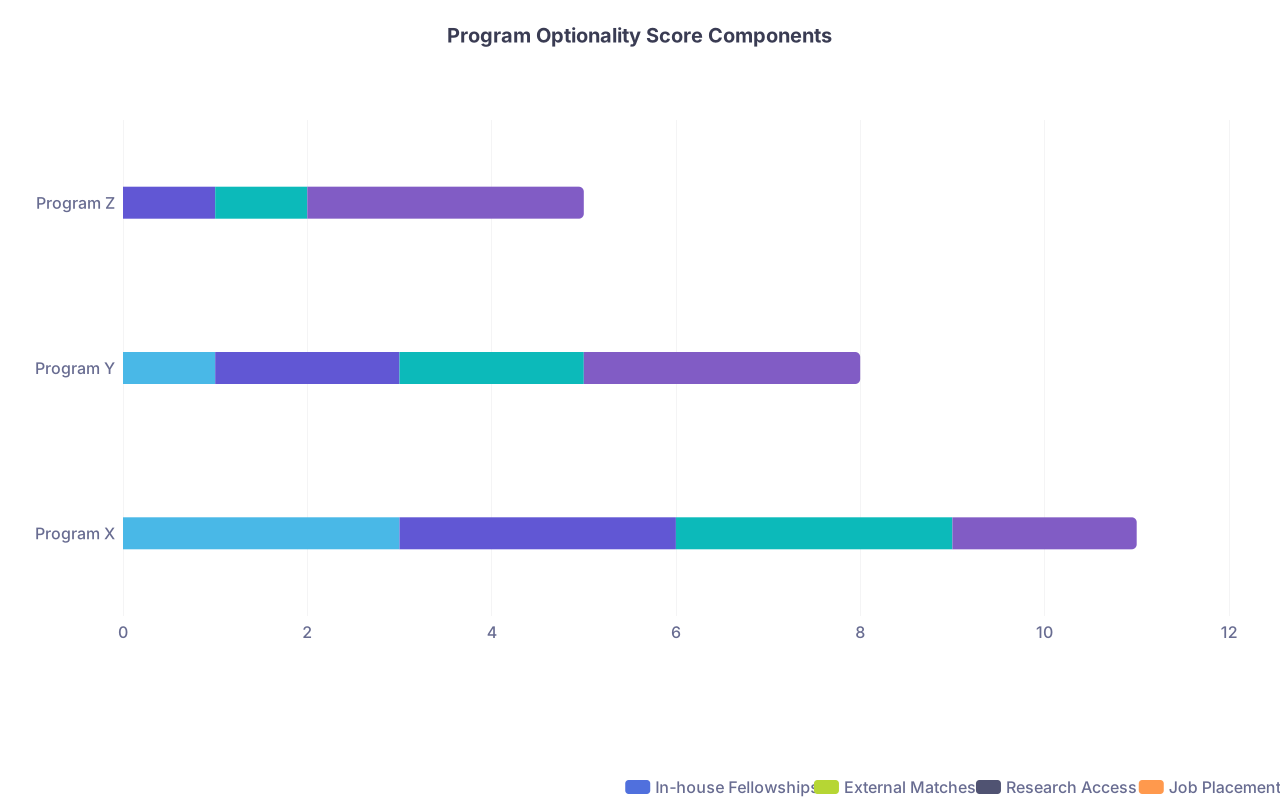
| Category | In-house Fellowships | External Matches | Research Access | Job Placement |
|---|---|---|---|---|
| Program X | 3 | 3 | 3 | 2 |
| Program Y | 1 | 2 | 2 | 3 |
| Program Z | 0 | 1 | 1 | 3 |
You don’t need hard numbers in real life, but mentally you’re doing something like this—adding up:
- In-house options
- External match history
- Research/mentorship access
- Job placement without fellowship
Programs with more “bars” in that stacked sense keep more doors open.
Final Thoughts
If you’re undecided on fellowship, your job is not to predict your exact future. Your job is to avoid locking yourself out of futures you might want.
Remember:
- Pick residency programs where both strong fellowships and good jobs are achievable outcomes. That’s real optionality.
- Use match lists, faculty bios, research output, and elective structure to see which doors are actually open vs just marketed as open.
- When in doubt between similar options, rank higher the program that gives you more realistic paths in more directions—not just the one with better free food or a shinier brochure.