
The couples match does not ruin relationships. Poor planning does.
If you are couples matching, your biggest risk is not “we won’t match together.” Your biggest risk is: “we matched… but one or both of us quietly resent the outcome for years.”
Here is how you avoid that.
Step 1: Get painfully clear on each person’s non‑negotiables
Most couples start with, “We want to be in the same city,” and “We’d like to be near family.” That’s vague. Vague is how you end up in a program one of you hates but no one can admit it because “at least we’re together.”
You need specifics. For each of you, separately, write down:
Career non‑negotiables (content)
- Example: “I need strong critical care exposure” vs. “I want outpatient heavy with minimal ICU.”
- “I must be competitive for cardiology fellowship” vs. “I’m ok general IM, fellowship optional.”
Environment non‑negotiables (context)
- Example: max call schedule you can tolerate.
- City size you actually want (not what sounds impressive).
- Distance from key supports (family/partner’s job opportunities/childcare).
Absolute deal‑breakers
- Example: “I will not do surgery at a community program with no fellows.”
- “I will not move to a city where my partner has effectively zero job prospects.”
- “We are not living more than 60–90 minutes apart.”
Then you compare lists.
You’re looking for:
- Overlaps: easy wins (e.g., both want medium cities in the Midwest).
- True conflicts: one of you wants high‑powered academic, the other wants chill lifestyle in small town.
Do this early, before ERAS is even open if you can. Not in October when interview invites are already dictating your life.
This is the conversation where one of you might have to admit, “If I have to choose between top‑tier program and being in the same city, I will choose the top‑tier program.” That sounds brutal. It’s actually honest. And you can work with honest.
Step 2: Decide your couple’s “meta‑priority hierarchy”
Every couples match needs a shared rulebook for tiebreakers. Otherwise every conversation dissolves into vibes and guilt.
You’re going to rank these four buckets as a couple:
- Being physically close (same city vs. drivable vs. long‑distance)
- Individual program quality / career prospects
- Lifestyle & cost of living
- Proximity to family / social support
You cannot have all four maximized. You have to decide your order.
A few common hierarchies I’ve seen:
Ambitious couple, both competitive:
- Program quality
- Same city
- Lifestyle
- Family location
One very competitive, one average applicant:
- Same city / commutable distance
- Anchor partner’s program quality (the more competitive one)
- Other partner’s program quality
- Lifestyle/family
Burnout‑aware couple, maybe with kids:
- Same city
- Lifestyle & cost of living
- Program quality
- Family
There is no “correct” order. There is only “we both agreed to this before things got emotional.”
Write your hierarchy down. Literally in a shared note. You will refer back to it when you’re tempted to put some random shiny coastal program ahead of your agreed‑upon plan.
Step 3: Define anchor vs. flex partner
Most couples secretly operate like this but never say it out loud. Say it out loud.
The “anchor” person is:
- The one in the more competitive specialty
(Derm, ortho, plastics, ENT, ophtho, competitive rads, etc.) - Or the one with significantly stronger application
(much higher Step 2 CK, AOA, big‑name research, etc.)
The “flex” person is:
- In a less competitive specialty (FM, peds, psych, IM at baseline)
OR - Has a more average/safer application.
This does not mean the flex partner’s career does not matter. It means the couple acknowledges reality: there are 10 solid peds programs in most major cities. There might be 1–2 solid ENT programs.
If you pretend both have equal constraint on geography and prestige when they clearly do not, you set yourselves up for chaos.
For each target city, your question is:
- Does this city have realistic options for our anchor partner?
- Does this city have at least acceptable options for our flex partner?
If answer is “yes” to both, that city goes in the “prime territory” bucket.
| City | Anchor Specialty (ENT) | Flex Specialty (Peds) | Couple Feasibility |
|---|---|---|---|
| Chicago | 2 strong programs | Many programs | Excellent |
| Nashville | 1 mid program | Several programs | Good |
| Portland | 0 programs | Few programs | Poor |
Step 4: Build three lists before ERAS: Dream, Realistic, Sacrifice
You’re not just applying as “two people.” You’re applying as a system. That means you pre‑define your buckets.
Dream list (high risk / high reward)
- Cities where both can potentially thrive, but at least one partner’s match is more of a stretch.
- Example: Boston, SF, NYC at name‑brand institutions.
Realistic list
- Cities and programs where data + honest appraisal say: both of you are solid fits.
- This is the backbone of your rank list.
Sacrifice list
- Places that are not ideal for one or both of you, but you’d still rather match there together than be separated.
- Or cities where one partner gets the dream and the other settles.
Be explicit: which partner is sacrificing, and what exactly they’re giving up (research, location, prestige, lifestyle). That makes it easier to course‑correct later (fellowship, jobs, etc.).
This is where people lie to themselves. They say, “I’m fine with any program as long as we’re together,” then three months into intern year, one person is dying in a malignant program while the other is coasting at their dream hospital. That is resentment fuel.
Call sacrifices what they are. Then you can weigh them like adults.
Step 5: Understand how the Couples Match algorithm actually boxes you in
You do not need to be a statistician, but you do need a working understanding of what you’re doing when you couple.
Key points:
- You submit pairs of ranks: (Program A for you, Program X for partner), (Program A for you, Program Y for partner), and so on.
- The algorithm looks for the highest pair on your list where both applicants get placed.
- That means you can both match lower than you would have solo.
So practically, you must:
Over‑apply relative to a solo applicant.
- More programs. More geographic spread. Especially if you’re both in competitive fields.
Include a real tail of safer pairs.
- Not 2–3 “safety cities.” 10–20+ realistic back‑up pairs, depending on specialties.
Accept that some lower‑ranked pairs might mean one of you “punching below your weight.”
- This is the trade you’re making to stay together.
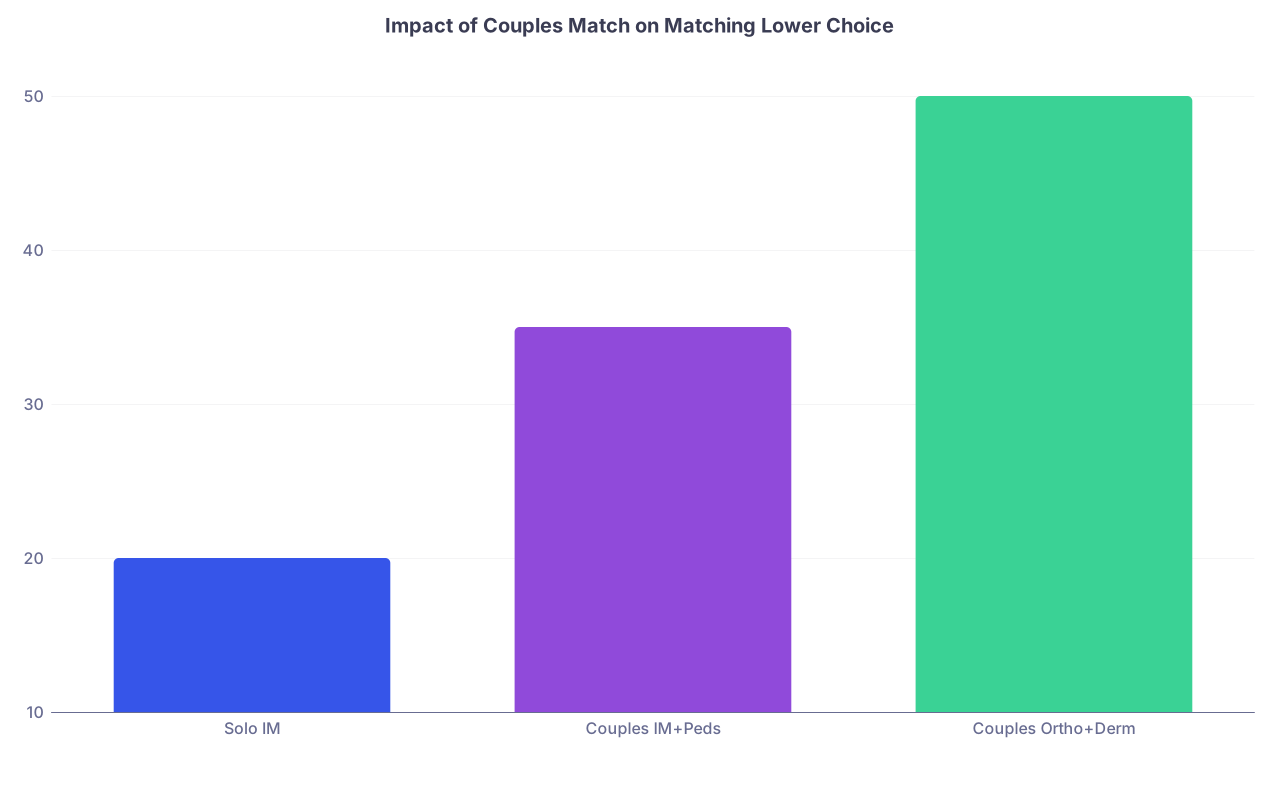
| Category | Value |
|---|---|
| Solo IM | 20 |
| Couples IM+Peds | 35 |
| Couples Ortho+Derm | 50 |
(Values above are illustrative: generally, couples—especially in competitive specialties—have a higher chance of landing at lower ranked options compared with their solo potential.)
If someone tells you “just rank where you’d be happy and the algorithm will take care of you,” they either do not understand the couples match or they matched in a very low‑pressure specialty/market. You need intentional structure, not magical thinking.
Step 6: Decide your “distance tolerance” before ranking
This is where regret lives.
You must answer before interview season:
- Would we rather:
- Be in the same city even if one program is clearly worse for career/lifestyle?
- Or be 1–3 hours apart if it means both have strong programs?
Define distance buckets:
- Same hospital
- Same city / <30 minutes
- Same metro area / 30–60 minutes
- Drivable long‑distance / 1–4 hours
- Flight‑required long‑distance
Now agree on your hierarchy:
Example:
- Same city preferred over anything else.
- If same‑city options are clearly harmful to one career, we accept 1–3 hours apart.
- We will only accept flight‑required distance as a last‑ditch tail option, not above any same‑region pairs.
Do not pretend a 2.5‑hour drive is the same as “same city.” It changes your daily life, call coverage coordination, and social circle. Be honest about whether you’re actually willing to do it.

| Step | Description |
|---|---|
| Step 1 | Start Rank Discussion |
| Step 2 | Prioritize same city pairs |
| Step 3 | Mix same city and 1-3 hr pairs |
| Step 4 | Consider long distance pairs |
| Step 5 | Include as tail options |
| Step 6 | Do not rank these pairs |
| Step 7 | Same city options exist |
| Step 8 | Both programs acceptable |
| Step 9 | 1 to 3 hour options exist |
| Step 10 | Worth it for careers |
Step 7: Translate all this into real rank list rules
Once interviews are mostly done, you sit down with your notes, your anchor/flex decisions, your hierarchy, and you make actual rules like this:
- Rule 1: Any city where anchor partner has no viable program is off the table.
- Rule 2: Same‑city pairs where both programs are at least “good enough” go above any cross‑city pairs.
- Rule 3: Big sacrifice pairs (one person clearly taking a hit) never go above pairs where both are at least satisfied, even if the city is more appealing.
- Rule 4: We will only include long‑distance options in the bottom 10–15 pairs.
Then you build the list mechanically.
Example (IM + Peds couple, IM partner is anchor):
Tier 1 (top pairs)
- (IM Boston Academic #1, Peds Boston Academic #1)
- (IM Boston Academic #1, Peds Boston Community #1)
- (IM Chicago Academic #1, Peds Chicago Academic #1)
- (IM Chicago Academic #1, Peds Chicago Community #1)
Tier 2 (same city, one partner minor sacrifice)
- (IM Chicago Academic #2, Peds Chicago Academic #1)
- (IM Chicago Academic #2, Peds Chicago Community #1)
Tier 3 (1–2 hour separation, both at strong programs)
- (IM Big City Academic, Peds Nearby City Academic)
- (IM Big City Academic, Peds Nearby City Community)
Tier 4 (sacrifice / backup cities)
- (IM Mid‑Tier Midwest, Peds Mid‑Tier Midwest)
- (IM Lower‑Tier Community, Peds Solid Community)
Notice what’s missing: random pairs thrown in because “we liked the vibe.” You don’t have that luxury when couples matching.
Use a spreadsheet. Color code by:
- City
- Same‑hospital vs same‑city vs distance
- Sacrifice flag (who is sacrificing and how much)
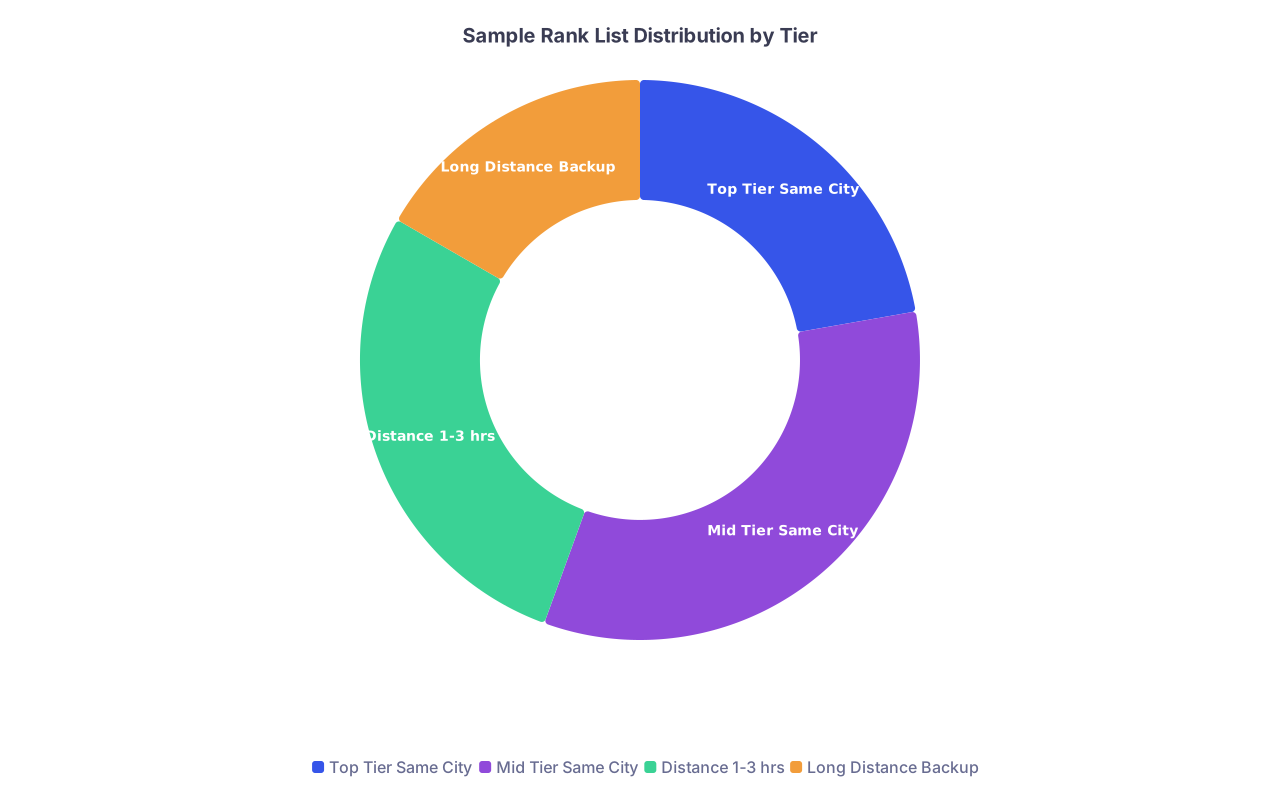
| Category | Value |
|---|---|
| Top Tier Same City | 8 |
| Mid Tier Same City | 12 |
| Distance 1-3 hrs | 10 |
| Long Distance Backup | 6 |
Step 8: Manage emotions and avoid hidden resentment
Here’s the part people do not like to talk about.
You will not both get everything you want. One or both of you will compromise. There are three practical rules I’ve seen help couples avoid nuclear fallout:
The sacrificing partner must say the words.
Not, “I guess we can rank that higher if you really want.” That breeds resentment. Instead:
“I understand this program is a better career move for you. I am choosing to put this pair higher, even though the program is weaker for me. I’m saying yes to this.”If you cannot say that convincingly, do not put that pair above a more balanced option.
The beneficiary partner must own the future payback.
That means:
- You don’t get to forget the sacrifice three years later when it’s job/fellowship time.
- You openly agree now: “You’re bending for my residency. I will bend for where we go for fellowship/attending jobs/next city.”
No “we” language for individual desires.
Catch yourself saying “we really want an East Coast city” when what you mean is “I really want Boston.” Be precise:
- “I want East Coast academics because of research.”
- “You prefer Midwest cost of living and family access.”
Then you can actually trade and balance. Vague “we” language manipulates the other person and muddies decision‑making.

Step 9: Use interview season strategically, not emotionally
A common mistake: each person interviews as if they are solo, falls in love with their individual favorite program, then tries to retrofit a couples plan after the fact.
Instead, you:
Pre‑decide priority cities.
- If you both love Chicago on paper, and one partner gets more interviews there, the other should preferentially accept Chicago invites over random places where the couple has no chance of both landing well.
Debrief after each interview block with structure.
- 0–10 rating for:
- Training quality
- Fit with your career goals
- Partner feasibility (does your partner have options here?)
- Lifestyle factors
- Your “10/10 training, 3/10 partner feasibility” program may end up ranked below “8/10 training, 9/10 partner feasibility.”
- 0–10 rating for:
Be ruthless about time and money.
- You do not need to interview at 15 programs in a city where your partner has zero interviews and zero realistic shot.
- Redirect that effort toward cities where the couple concept actually works.

Step 10: Planning for “what if we don’t match together?”
You don’t want to think about this, but you will regret it if you don’t.
Have this talk before rank submission:
If one of us matches and the other doesn’t:
- Does the matched person still go?
- Does the unmatched person reapply next cycle from that city?
- Are we ok with temporary distance?
If we match in different cities despite our list:
- Under what circumstances would one consider reapplying or transferring after PGY‑1?
- Are we financially and emotionally prepared for that?
What is our floor?
- Is there a geographic or program situation where we’d rather not match than match there? If so, do not rank it. Even as a pair.

| Step | Description |
|---|---|
| Step 1 | Match Day Outcome |
| Step 2 | Proceed with plan |
| Step 3 | Discuss reapply and distance |
| Step 4 | Both unmatched |
| Step 5 | Consider SOAP or reapply |
| Step 6 | Decide to stay together or long distance |
| Step 7 | Both matched together |
| Step 8 | One matched, one unmatched |
Talking about this upfront lowers anxiety. It also makes you more disciplined with your rank list. People rank programs “just in case” that they would actually be miserable at. Don’t do that.
Quick reality checks by scenario
Scenario 1: Both in highly competitive specialties (e.g., Ortho + Derm)
You’re in a high‑risk category. That means:
- Broad geographic list. You do not get a “coastal cities only” fantasy.
- Real, unflinching sacrifice tail — including smaller cities you never dreamed you’d consider.
- Probably more interviews than your classmates. Budget and plan accordingly.
Your meta‑priority might have to be:
- Match at all
- Same city / drivable
- Program quality
If either of you isn’t actually okay with that, reconsider couples matching or your specialty choice.
Scenario 2: One competitive, one not (e.g., ENT anchor + FM flex)
You protect the competitive specialty’s viability first, or you risk both ending up in marginal places.
Tactics:
- Build rank list around cities with ENT options first.
- Then within those cities, rank best FM options.
- Only after exhausting ENT cities do you start adding “FM dream, ENT compromise” cities, and label them honestly as sacrifices.
Scenario 3: Both average competitiveness, primary care specialties
You have the most flexibility, but also the most temptation to be lazy.
Use that flexibility to:
- Optimize for city + lifestyle without wrecking training.
- Stay rigorous: still define non‑negotiables and sacrifices. Don’t just say yes to any big name coastal program if it clearly worsens training or cost of living for one of you.
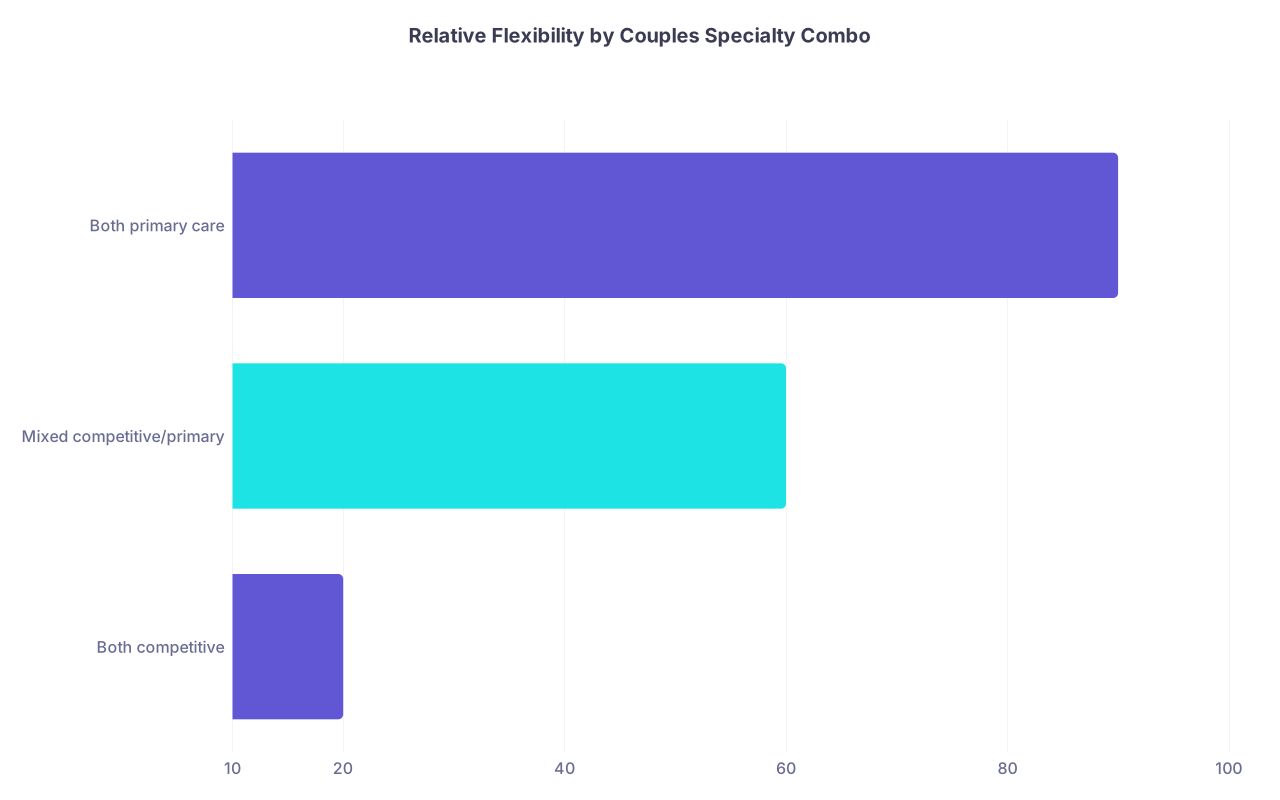
| Category | Value |
|---|---|
| Both competitive | 20 |
| Mixed competitive/primary | 60 |
| Both primary care | 90 |
(Values represent relative flexibility, not match chances.)
FAQs
1. How many programs should couples apply to compared to solo applicants?
In most pairings, you should both apply to more programs than you would solo. As a rough starting point: if a solo applicant in your specialty would normally apply to 30–40 programs, a couples applicant might be safer in the 50–70 range, depending on competitiveness and geography. The goal is not to blanket the country randomly, but to ensure that in each target region, you both have enough shots to create several viable pairs.
2. Should we ever rank programs where one of us would be truly miserable?
No. Do not rank places you would rather go unmatched than attend. People convince themselves to rank everything because “matching somewhere is better than unmatched.” That’s not universally true. If your gut response to a program is “I would be miserable there,” and you’ve thought it through, do not put it on the list—solo or coupled.
3. Is it better for the less competitive partner to “take the hit” every time?
Not every time. The anchor/flex concept is about constraints, not value. In some cities, the flex partner can get a fantastic program while the anchor partner takes a slight downgrade that doesn’t hurt their career materially. You want trades that are roughly equivalent over the whole training journey, even if one person takes a bigger hit at residency and the other at fellowship or attending job stage.
4. How honest should we be with programs about couples matching?
Generally, you can and should mention that you’re couples matching when it’s relevant, especially if you’re both interviewing at the same institution or affiliated hospitals. Many programs will at least try not to sabotage reasonable couple arrangements, and some will actively coordinate. You don’t need to lead every email with it, but at pre‑interview socials or in an appropriate moment with the PD or coordinator, a straightforward “I am couples matching with my partner in X specialty” is normal.
5. We keep disagreeing on priorities. Is that a sign we shouldn’t couples match?
Not automatically. Disagreement is normal; hidden expectations are what blow things up. If, after multiple honest talks, you still have fundamentally opposing non‑negotiables (e.g., one refuses to leave the East Coast, the other refuses to give up a narrow, location‑limited dream program), then yes, you should at least consider whether couples matching makes sense. Some couples do choose to match independently and then regroup for fellowship or attending jobs. The key is that both of you are fully informed and actually agree to whatever strategy you pick.
Bottom line:
- Make your priorities explicit, written, and shared before emotions take over.
- Accept the anchor/flex reality and use it deliberately, not secretly.
- Build a rank list that reflects your real trade‑offs, not your wishful thinking, so neither of you wakes up three months into intern year wondering, “How did we let this happen?”