
The worst residency decision you can make with six‑figure debt is pretending money does not matter.
If you are staring at $250k, $350k, even $500k in loans and trying to rank residency programs, you are not choosing “where you’d like to train.” You are choosing your financial life for the next decade. You either treat that like a real constraint or you pay for it later in stress, burnout, and doors quietly closing.
Let me walk you through how to use your debt load—very specifically—to shape your specialty and program list without blowing up your career happiness.
Step 1: Get Brutally Clear on Your Debt Reality
You cannot make smart choices off vibes and rough guesses. You need numbers.
Sit down one evening and pull everything:
- Federal loans: balances, interest rates, and whether they’re Grad PLUS or Direct Unsubsidized
- Any private loans: balances, variable vs fixed rates, refinance options
- Your partner’s student loans if they exist (you’re a financial unit whether you like it or not)
Now do three things.
1. Build a simple debt snapshot
You can do this in 20 minutes in Excel/Sheets:
| Loan Type | Balance | Interest % | Monthly Interest (est) |
|---|---|---|---|
| Direct Unsub | $180,000 | 6.8 | $1,020 |
| Grad PLUS | $90,000 | 7.2 | $540 |
| Private | $40,000 | 8.0 | $267 |
Monthly interest is roughly: Balance × Rate ÷ 12.
That is what your loans grow by every month during residency if you are not covering interest.
2. Classify your situation
Use these rough tiers (post‑med school):
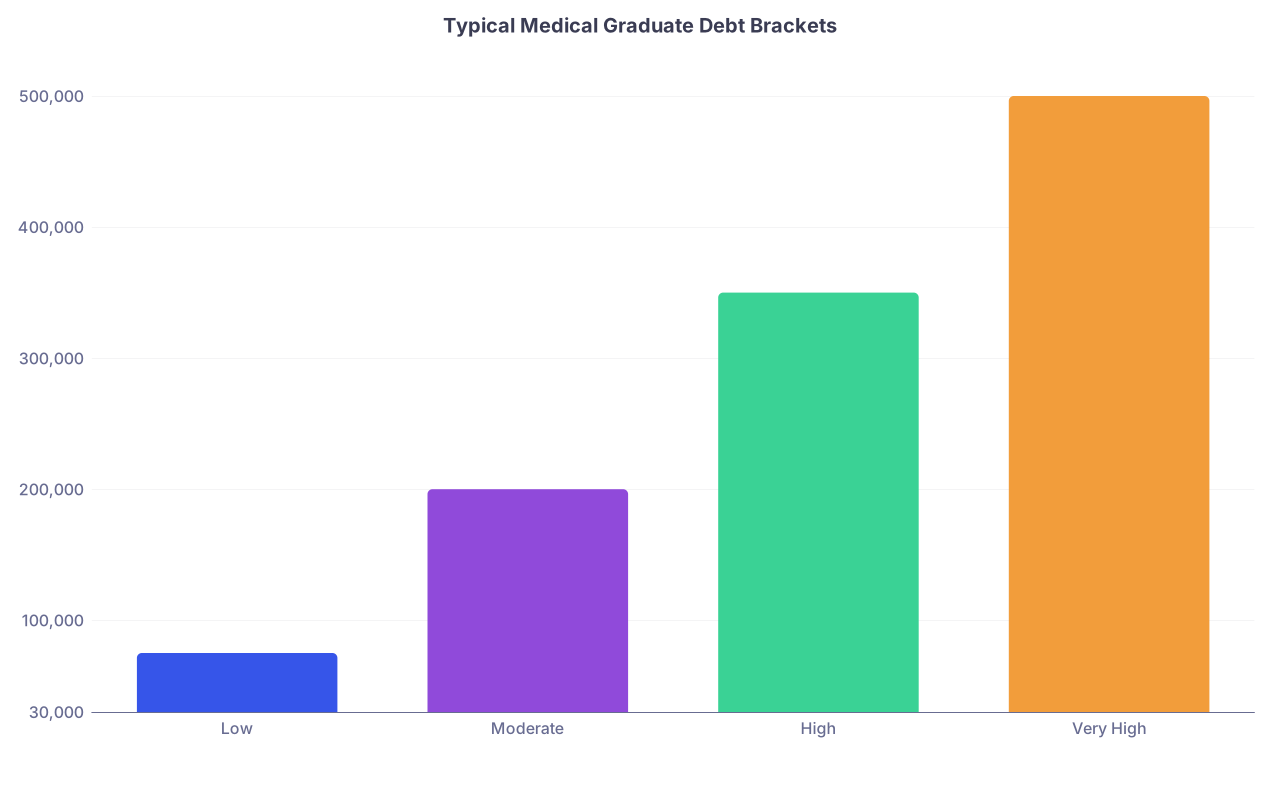
| Category | Value |
|---|---|
| Low | 75000 |
| Moderate | 200000 |
| High | 350000 |
| Very High | 500000 |
- Low: < $100k – You have flexibility. Money still matters, but it won’t strangle you.
- Moderate: $100–250k – You need to be intentional, but many paths work.
- High: $250–400k – Your choices must align with either high future income or strong forgiveness plans.
- Very high: > $400k – You are playing on hard mode. Every major decision should factor your loans.
3. Decide your likely repayment path (for now)
Don’t overcomplicate it, just pick the most likely:
- Aggressive payoff (no PSLF): You expect to pay this off yourself in 10–15 years after residency.
- PSLF or other forgiveness: You plan to work 10 years in non‑profit/public systems and pay via IDR.
- “I honestly don’t know yet”: That’s fine, but you should at least rule out clearly bad fits.
Your residency choices will look different depending on this answer. We’ll come back to it.
Step 2: Understand How Specialty and Geography Hit Your Wallet
People love to say “follow your passion.” People with no debt say that. With major loans, you follow passion within boundaries.
Specialty choice with serious debt
Here’s the uncomfortable reality: some specialties make your loan problem trivial, some make it your permanent roommate.
| Specialty Group | Typical Range (early attending) |
|---|---|
| Primary Care (IM, FM, Peds) | $200k–$280k |
| Hospital-based (EM, Anes) | $320k–$450k |
| Surgical subspecialties | $450k–$800k+ |
| Psych / Neuro / Others | $230k–$350k |
You do not pick a specialty solely on income. That’s how people end up divorced and burned out. But if you’re choosing between two fields you like, your debt should break the tie.
Example:
- You like IM and Derm.
- You have $450k in loans, no interest in PSLF, you want a house and kids in your 30s.
- Choosing IM in an expensive coastal city is signing up for a decade of financial stress.
- If you genuinely enjoy Derm and can match there, that choice solves 80% of your loan anxiety.
Geography matters more than most residents admit
People obsess over prestige and ignore cost of living. That is backwards if you’re underwater in loans.
Resident salaries are mostly the same regardless of location. Cost of living is not.
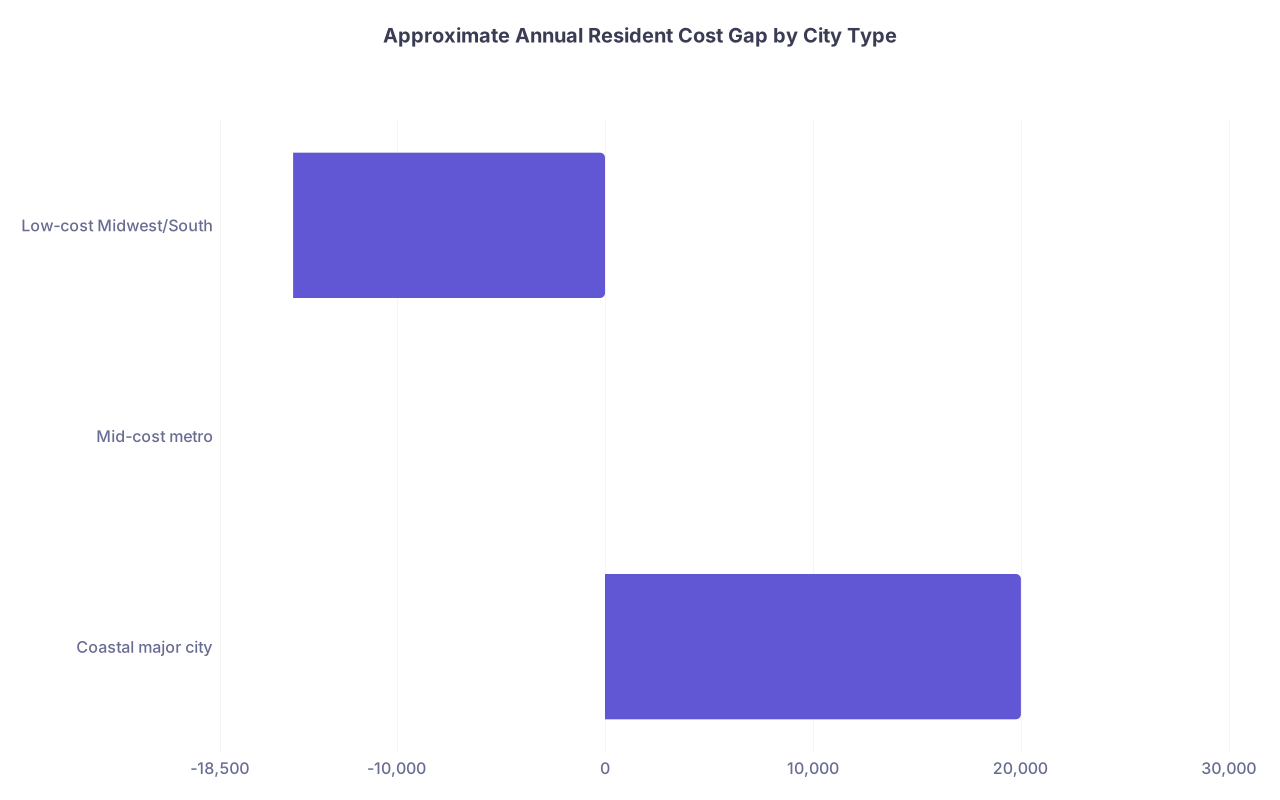
| Category | Value |
|---|---|
| Coastal major city | 20000 |
| Mid-cost metro | 0 |
| Low-cost Midwest/South | -15000 |
That rough $20k–$35k/year difference in expenses between NYC/Bay Area/Boston and, say, Midwest/South doesn’t sound huge—until you realize that over a 3–5 year residency, that’s $60k–$150k that could have gone toward:
- Preventing your loans from ballooning
- Building a 3–6 month emergency fund
- Starting retirement contributions early
If you have very high debt and no strong geographic ties, you should be ranking at least some solid, lower‑COL programs higher than equivalently good programs in ultra‑high COL cities.
Step 3: Use Your Debt Load to Filter Programs
Now we move from abstract to concrete. You are looking at a list of 40–80 programs. How do you use your loans to shape that list?
Think in three lenses:
- Residency paycheck reality
- Moonlighting opportunities
- Future earning potential / PSLF compatibility
1. Residency paycheck reality
Pull this from program/state GME data or PGY salary PDFs. Then do a rough after‑tax calculation and overlay your likely expenses.
For each program you are seriously considering, you want answers to:
- PGY‑1 salary? PGY‑3/4 salary?
- State income tax level?
- Typical rent near the hospital? (Ask current residents, not the brochure)
- Parking costs? Required car?
Do a quick monthly breakdown for a couple of “representative” programs:
| Category | Coastal City A | Midwest City B |
|---|---|---|
| Take-home pay | $3,900 | $3,700 |
| Rent | $2,000 | $1,000 |
| Utilities/Net | $200 | $200 |
| Car/Transit | $350 | $350 |
| Food | $500 | $450 |
| Remaining | $850 | $1,700 |
Now ask: with that “remaining,” can you:
- Cover at least the monthly interest on your loans?
- Put away anything for savings or retirement?
- Live like an adult, not a hostage?
If the answer is no for Program A and yes for Program B, your rank list should reflect that.
2. Moonlighting options
If you have high or very high debt, moonlighting is not “nice to have.” It can be the difference between $30k in saved interest and $0.
You want to explicitly ask or research:
- Does this program allow moonlighting? From which PGY year?
- Are there in‑house moonlighting shifts (easier/logistically better)?
- Are outside gigs realistically available in the area?
- What do current senior residents actually do?
I have watched residents in flexible IM programs earn an extra $20k–$40k/year PGY‑3 and beyond through in‑house moonlighting, while friends at rigid programs did zero.
Over 2–3 years, that can mean $60k–$100k. It absolutely should move programs up or down your list if you’re drowning in loans.
3. Future earning potential and PSLF compatibility
This is where your repayment path from Step 1 returns.
If you’re leaning non‑PSLF, aggressive payoff:
- Look for specialties and job markets with strong private‑practice or productivity pay options.
- Choose programs in regions where your field is in demand and starting salaries are higher.
- Do not ignore regional ties—training where you want to practice often gets you better offers later.
If you’re leaning PSLF:
- Prioritize academic or large non‑profit systems for residency.
- Make sure the employer is PSLF‑eligible (non‑profit status), even as a resident.
- Check that they use qualifying repayment plans and that you’ll be able to submit ECF forms consistently.
- A program inside a big non‑profit health system gives you a “launch pad” for PSLF‑eligible attending jobs.
Step 4: How to Directly Ask Programs the Money Questions
You do not need to be shy here. You just need to be specific and professional.
Here’s how you ask current residents and leadership without sounding weird:
To a chief resident or current PGY‑3 on interview day:
- “How livable is the salary here once you factor in rent and parking?”
- “Do many residents moonlight? Around how much extra do people typically make?”
- “Are there residents here on PSLF or IDR plans? Has the GME office been supportive with paperwork?”
- “If you had $300k+ in loans, would you still feel okay financially in this program and city?”
To the program coordinator or GME office:
- “Could you share your PGY salary scale and any annual step increases?”
- “Is there a resident benefits summary that shows retirement match, health premiums, and parking costs?”
If someone gets defensive or “we don’t discuss money here”—that’s data. Financially mature programs are not afraid of these questions.
Step 5: Building a Rank List When You’re Deep in Debt
Let’s turn this into an actual approach.
Step 5A: Decide your non‑negotiables
These go first. For example:
- “I will not choose a program where I cannot at least cover monthly loan interest.”
- “I will not live in a city where I’m forced into dangerous housing just to make rent.”
- “I must be at a PSLF‑eligible institution because my loans are >$450k.”
Write your top 3–4. Anything violating these goes to the bottom automatically, regardless of prestige.
Step 5B: Create a simple scorecard
Use something like this, then actually fill it out:
| Factor | Weight (1–5) | Program X Score (1–5) |
|---|---|---|
| Cost of living vs salary | 5 | |
| Moonlighting allowed/available | 4 | |
| PSLF eligibility/support | 4 | |
| Future earning potential in region | 3 | |
| Family / support proximity | 3 |
Do this for your top 10–15 programs. Your feelings are still valid, but the data keeps you from doing something financially reckless.
Step 5C: Two concrete example scenarios
Scenario 1: $500k debt, wants PSLF, likes IM
- You should prioritize large academic IM programs in non‑coastal cities, within big non‑profit systems.
- Your rank list should put “boring‑but‑solid” Midwestern academic centers above flashy NYC/Boston places unless housing is inexplicably cheap for you (spoiler: it won’t be).
- During residency, you stay on an IDR plan, file PSLF forms every year, and aim for an attending job in a non‑profit hospitalist role.
Scenario 2: $300k debt, no PSLF interest, likes EM and FM
- If you truly like EM and FM, your debt probably pushes EM to the top because of income potential.
- Within EM programs, you might rank a strong community program in a mid‑cost city above a “name brand” in San Francisco.
- You actively seek moonlighting during senior years and target post‑residency jobs that let you crush principal in the first 5–7 attending years.
Step 6: Common Mistakes People with Big Loans Make
I’ve watched versions of these play out over and over:
Ignoring COL because “I’ll figure it out”
Translation: I will live stressed and resentful, take on credit card debt, and let my loans balloon.Overweighting prestige when you’re not going into academia
A mid‑tier, low‑COL program that trains you well is often a better financial and life decision than an elite brand in an insane housing market, if you’re heading to community practice.Not planning for a partner’s career and debts
Two people with loans + one high‑COL city + childcare = total financial chokehold. Your match decision affects both of you.Assuming PSLF will “just work out” without checking details
PSLF is powerful but fragile. Wrong employer type, wrong repayment plan, missing forms—you waste years of qualifying payments. Your residency choice can either make that process smooth or painful.Believing “future attending money” guarantees safety
Attending salaries get eaten by taxes, childcare, houses, and lifestyle creep. If you come out of residency already behind because of avoidable choices, you’ll feel that for a decade.
Step 7: How to Think About “Happiness vs Money” Without Lying to Yourself
You are not a spreadsheet. Finances are one part of real life. But with major loans, they are a loud part.
Here is the balance I’d push you toward:
- Do not pick a specialty you hate just for money. That’s a slow-motion disaster.
- Within a specialty you like (or a couple you like), let debt and money be major tiebreakers.
- Within programs you’d be okay training at, let cost of living and moonlighting be major tiebreakers.
- Accept that sometimes the “smaller name” program in a less glamorous city gives you a much better life + financial trajectory.
And remember: residency is 3–7 years. Loan repayment is 10–25. You’re not choosing a 3‑year experience. You’re choosing the next quarter of your financial life.
Quick Decision Flow: How Debt Should Shape Your Choices
Use this as a mental checklist:

| Step | Description |
|---|---|
| Step 1 | Know total debt and interest |
| Step 2 | Choose specialty by fit |
| Step 3 | Prioritize non profit academic programs |
| Step 4 | Favor higher earning specialties you like |
| Step 5 | Check if salary covers interest and basic life |
| Step 6 | Rank lower COL programs higher |
| Step 7 | Ask about moonlighting and benefits |
| Step 8 | Build rank list weighting money + fit |
| Step 9 | Debt > 250k? |
| Step 10 | PSLF likely? |
| Step 11 | High COL city? |
Print that mentally when you start dragging programs up and down your list “just because it feels right.” Make it feel right and make sense.
FAQs
1. Should I ever choose a lower‑paying specialty if I have very high debt?
Yes, but only with eyes wide open and a real plan. If you truly love pediatrics or psychiatry, you can still make it work with $300k+ debt, but you need: a lower‑COL city, aggressive budgeting, possibly PSLF, and ideally a partner plan that doesn’t double your financial burden. What you cannot do is pick a low‑paying specialty, in a high‑COL city, with no forgiveness strategy, and then be shocked when the numbers hurt.
2. Is it worth ranking a “worse” program higher just because it’s in a cheaper area?
If “worse” means slightly less name recognition but solid training, yes, it can absolutely be worth it. If “worse” means malignant, unsafe, or doesn’t prepare you to pass boards, then no—never sacrifice basic training quality and safety for money. But between two acceptable programs where you’d be okay training, the cheaper city with better moonlighting and livable lifestyle often wins when you’re heavily indebted.
3. How much should moonlighting really factor into my rank list?
If your debt is >$250k, moonlighting should be a major factor, not an afterthought. You do not need exact dollar amounts, but if a program has a well‑established culture of PGY‑3+ residents moonlighting in‑house for extra income, that’s a meaningful advantage. On the flip side, if a program bans moonlighting or makes it logistically impossible, that hurts you financially over multiple years. It should not outweigh all other factors, but it deserves real weight—especially when comparing otherwise similar programs.
Key points to keep in your head: treat your loans as a real constraint, not background noise; let specialty and program choices reflect both your interests and your financial reality; and remember that cost of living plus moonlighting potential are often more powerful than prestige in shaping your actual life.