
The match algorithm does not care about your relationship. You have to.
If you’re in a serious relationship and staring down rank list season, pretending “love will figure itself out” is how people end up miserable, resentful, or single by PGY-2. I’ve watched it happen more times than I like.
You’re not choosing just a program. You’re choosing a life structure that either gives your relationship a chance or quietly suffocates it.
Here’s how to think about a long‑distance relationship (LDR) during residency when you’re actually building your rank list—step by step, no fluff.
1. First, Get Honest: What Type of Relationship Are You Actually In?
Do not skip this. Your answers here change how aggressively you should prioritize geography.
Ask yourself, and answer like an adult, not a rom‑com character:
- Are you married or engaged with a defined timeline to live together?
- Are you dating seriously but under 1–2 years?
- Are you both in medicine? Different specialties? Same year vs different year?
- Are kids in the near‑term picture (during residency or fellowship)?
- Is someone already locked into a location (med school, job, family obligation, visa, military, etc.)?
Different setups → different strategies.
Let me walk through the big archetypes I see and what they usually mean for your rank list.
Scenario A: Married / Engaged, No Kids Yet, Both Flexible on Location
You two are committed and generally mobile.
What this usually means:
- You should heavily favor being in the same city or within reasonable driving distance (≤3–4 hours).
- You can tolerate 1–2 years of LDR if there’s a clear plan (“We’ll reunite for fellowship / after your MS4 year”).
When ranking programs, this group should:
- Treat “same city or easy commute” as a major factor, but not necessarily the only factor.
- Be realistic: A slightly less shiny program where you’re together usually beats a prestige program that forces 5 years of distance.
Scenario B: One in Residency, One in Med School / Training
Classic setup: You’re matching now, partner matches 1–3 years later.
Key questions:
- Will your partner realistically be able to match where you are? Or close?
- Are you applying to places with multiple programs nearby (big metros) or isolated one‑hospital towns?
- Are you both competitive enough to land in the same region?
If your partner will apply later, your rank list should:
- Strongly prioritize large metro areas or regions with many residency programs (Boston, Philly, NYC, Chicago, Houston, etc.).
- De‑prioritize great but isolated programs (single hospital town, few other hospitals within 2–3 hours).
Scenario C: One in Medicine, One Not in Medicine
This is often harder than two‑physician couples.
Non‑medical partner usually has:
- Job market constraints
- Less flexibility to restart career in a tiny town
- Sometimes better earning power (which matters for moving decisions)
For your rank list:
- Map partner’s job possibilities first. Where can they realistically work in their field?
- Then layer residency programs over that.
- Avoid rural or one‑industry towns if your partner’s career would nosedive there. Long‑term resentment is worse than a slightly weaker program.
Scenario D: On‑Again / Off‑Again, Vague Future Plans
This is harsh, but someone should say it.
If:
- Your relationship has broken up more than once
- You can’t both answer “yes” to “Do we see a 5–10 year future?”
- There is zero concrete plan for living together
Then you should not build your rank list around preserving this relationship.
You can consider geography, but do not sacrifice clear career advantages for something you’re not fully committed to. You’ll regret it.
2. Decide: Are You Willing to Go Long‑Distance at All?
People lie to themselves here constantly.
You need to answer:
- Am I truly willing to be long‑distance for 3–7 years of training if needed?
- Under what conditions? (duration, distance, time until reunion)
- What would be a dealbreaker?
Write it out. Literally. On paper.
Something like:
- “Max 3 years of LDR”
- “We must have a realistic plan to live together after residency or early fellowship”
- “Distance okay if within a 1‑hour flight / 4‑hour drive”
- “Not willing to be on opposite coasts with no clear reunification plan”
This becomes your decision filter when ranking.
If you say you’re not willing to be LDR but then rank a perfect program on the opposite coast above a solid program in your partner’s city, be honest: you just chose career over proximity.
That’s fine. But own it. Don’t pretend it was out of your hands.
3. Map Out the Geography First, Then the Programs
Before you fiddle with rank order, sketch your relationship geography:
- Where is your partner now?
- Where will they likely be in 1–3 years?
- What are your shared “anchor points” (hometowns, family support cities, places you could both imagine settling)?
Make a rough map of clusters:
| Region / City | Programs for You | Programs for Partner | Family Nearby? |
|---|---|---|---|
| Partner City | 2–3 | 3–4 | Yes |
| Big Metro A | 5–6 | 5–10 | No |
| Region B (Drive) | 3–4 | 2–3 | Some |
| Far Region C | 4–5 | 0–1 | No |
Now you have:
- “Same city” options
- “Same region, drivable” options
- “Plane ride, but reachable” options
- “Realistically separate lives” options
You’re going to use this map to decide where to draw your personal line.
4. How Much Weight Should the Relationship Get Compared to Program Quality?
This is the real question you’re asking.
There isn’t one right answer, but I’ll give you a framework that actually works in real life.
Think of your decision as three buckets:
- Baseline safety: “Will this program let me become a competent, board‑certified physician in my desired specialty?”
- Growth and opportunity: “How much does this program expand my options for fellowship / jobs / research?”
- Life sustainability: “Can my sleep, mental health, and relationships survive this setup?”
Programs that fail bucket #1 should drop off your list, relationship or not.
Programs that pass #1 but are weaker on #2 and #3 are where geography and relationship can dominate.
The mistake I see constantly:
People fixate on prestige (bucket #2) and pretend bucket #3 is optional. Then PGY‑2 rolls around and they’re burned out, alone, and suddenly that “mid‑tier but close to home” program looks very smart.
My rule of thumb for someone in a serious, committed relationship:
- Once you’re comparing programs that are all solid and will get you where you need to go, it’s completely rational to let geography and relationship be the tiebreaker—or even the main driver.
Where I’d be cautious:
- Sacrificing core training quality and your long‑term career fit just to be in the same city.
- Example: Choosing a malignant program with poor board pass rates and no support over a healthy program with good outcomes, just to avoid distance.
If you don’t know how “bad” a program can get, ask residents directly:
“How many people failed boards in the last 5 years?”
“What happens when someone is struggling?”
“How many people go into the fellowships I want?”
5. Concrete Ranking Strategies by Situation
Now let’s get surgical. Different situation, different rank strategy.
Strategy 1: Same City or Bust (High Commitment, Short Training)
Use this if:
- You’re married / seriously committed
- One or both of you have short training (e.g., FM, peds, psych, IM without fellowship)
- Shared life and support matters more than chasing a brand name
Your rank structure might look like:
1–3: All programs in the same city as partner (ordered by program fit)
4–6: Programs within 2–3 hours drive
7+: Stronger distant programs you’d be okay with if the above do not work
When comparing within the same city:
- Do a brutal comparison based on:
- Malignancy / culture
- Schedule (q4 call vs q3, 6+ ICU months vs 3–4, etc.)
- Support systems (wellness is mostly lip service, but some places actually mean it)
Between “same city but weaker” vs “nearby city with great program,” the call is personal. I’ve seen both choices work.
Strategy 2: Regionally Close, Not Necessarily Same Zip Code
Use this if:
- Partner’s job or training is location‑limited, but there are multiple cities within a drivable radius
- You’re okay with seeing each other a few weekends a month
Your rank list might cluster like:
1–4: Programs within 1 hour of partner
5–8: Programs within 2–4 hours drive
9+: Strong distant programs
In practice, you:
- Accept some weekend commuting
- Use days off and golden weekends strategically
- Lean hard on a supportive chief schedule if possible
This setup is survivable for most couples who like each other and plan ahead.
Strategy 3: Career‑First with a Defined Reunion Plan
Use this if:
- You’re both serious about long‑term but also honest that certain programs could significantly change your career trajectory
- You’re talking top tier academic vs very limited opportunities
Plan looks like:
- Choose program that best fits your long‑term goal (academics, competitive fellowship, niche interest)
- At the same time, you lock in a reunification plan:
- Partner moves for your PGY‑2–3
- You target fellowship or first job in their city
- You agree on a max distance / max years apart
This must be explicit. Not “we’ll see how it goes.”
More like: “We will not do more than 3 years apart, and I will prioritize your city for fellowship even if it means a slightly less famous institution.”
If you can’t agree on that? Then your rank list should not pretend you’re designing life together. You’re both still choosing individually.
6. How to Talk About This with Your Partner Without Blowing Things Up
You can ruin this process by having the wrong conversation at the wrong time.
Do this in order:
Each of you privately writes:
- Top 3 personal priorities (career, city, family, money, etc.)
- Non‑negotiables (e.g., “Cannot live far from aging parent,” “Need to be in a city with X industry,” “Not moving to extremely rural area”)
Then share and compare.
Draw a rough “acceptable geography” map together:
- Same city options
- Same region options
- Truly long‑distance options
Only then start talking specific programs and rank orders.
The phrases that help:
- “I want us to design this together, not just react to the Match.”
- “Here’s where I’m willing to compromise, and here’s where I’m honestly not.”
The phrases that destroy things:
- “If you really loved me, you’d rank X first.”
- “Your career doesn’t matter as much as mine.”
- “It’ll all work out, let’s not overthink it.”
Long‑distance during residency is not something you “don’t overthink.” The schedule will eat any relationship that doesn’t have structure.
7. Be Realistic About What Long‑Distance in Residency Actually Looks Like
People romanticize or catastrophize LDR. Both are wrong.
Here’s the reality I’ve seen across multiple programs:
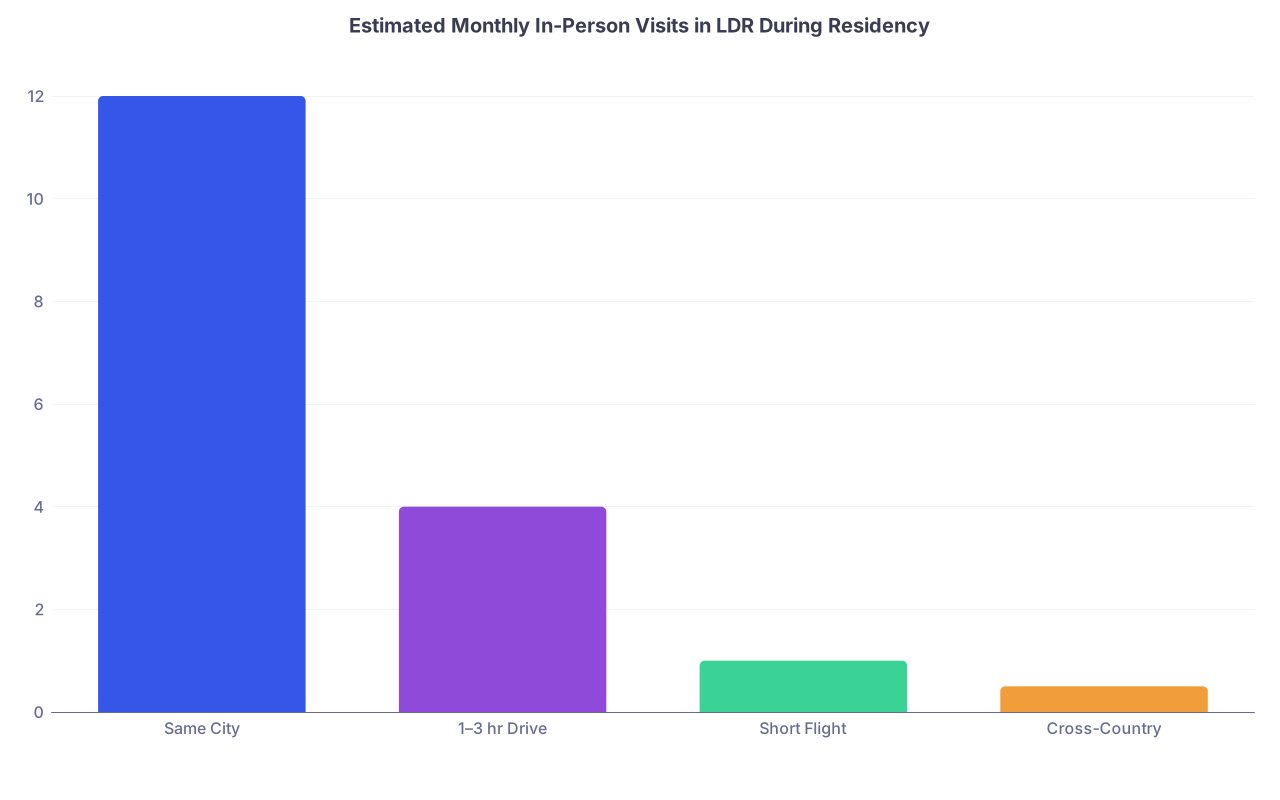
| Category | Value |
|---|---|
| Same City | 12 |
| 1–3 hr Drive | 4 |
| Short Flight | 1 |
| Cross-Country | 0.5 |
Roughly:
- Same city: You can see each other most days, even if briefly.
- 1–3 hour drive: Many couples manage 2–4 weekends per month, depending on call.
- Short flight (1–3 hours): Maybe 1 visit per month if money and schedules allow.
- Cross‑country: Every 1–3 months. Sometimes less.
Layer residency on top:
- 70–80 hour weeks on some rotations.
- Random nights, weekends, and holidays.
- Rotations where you simply won’t travel for 4–6 weeks straight (ICU, night float, heavy wards).
Couples who make LDR work in residency almost always:
- Schedule standing calls (even 10–15 minutes)
- Put visits on the calendar months ahead
- Have realistic expectations (“You might not hear from me much this week, I’m on nights”)
- Don’t weaponize exhaustion (“If you cared, you’d call more”)
LDR is doable. I’ve seen residents thrive with it. But it is not neutral. Your rank list should reflect your actual appetite for this.
8. What About Couples Match?
If you’re couples matching, you already have a more formal structure. But I’ve seen people misuse it.
Couples match works best when:
- You both agree on how much you’re willing to sacrifice in program quality for proximity.
- You understand that “same city” is not always the outcome; “same region” may be the realistic goal depending on competitiveness.
The typical mistake:
- One partner very competitive (e.g., strong Step, AOA, top specialty), one much weaker
- They rigidly couples match only same‑city options at competitive places
- Both slide down their lists, end up far lower than necessary—or unmatched
Be strategic:
- Build tiers in your couples list:
- Tier 1: Same hospital / same city
- Tier 2: Same city / different hospitals
- Tier 3: Same region (drivable)
- Tier 4: Strong independent matches where you’re at least on the same coast
And again, you both have to decide: at what point does “being matched in our best individual programs but far apart” beat “being together in weaker programs”?
That’s a values judgment, but you have to make it before certification.
9. How to Actually Sit Down and Build the Rank List
Here’s a practical workflow for one evening (or two) that I’ve seen work well.

| Step | Description |
|---|---|
| Step 1 | List All Programs |
| Step 2 | Remove Unsafe or Malignant |
| Step 3 | Score Career Fit 1-10 |
| Step 4 | Score Relationship Fit 1-10 |
| Step 5 | Rank by Career Fit |
| Step 6 | Weighted Ranking |
| Step 7 | Adjust for Gut Feel |
| Step 8 | Finalize and Certify |
| Step 9 | Serious Relationship? |
Do this:
List every program you interviewed at.
Cross out any you absolutely would not attend, no matter what (malignant, unsafe, awful vibe).
For each remaining program, give:
- Career Score (1–10): training quality, mentorship, fellowship chances, city fit for your field.
- Relationship Score (1–10): proximity to partner, reality of visits, partner’s job options.
If you’re in a serious, long‑term relationship, create a combined score like:
- Combined = 0.6 × Career + 0.4 × Relationship
Or 0.5 / 0.5 if you’re truly equal‑weighting.
- Combined = 0.6 × Career + 0.4 × Relationship
Sort by combined score.
Then sanity‑check:
- Are any top options obviously dangerous (burnout factories)? Move them down.
- Are you over‑penalizing one‑off distance that you could tolerate for 3 years? Adjust if needed.
- Does your #1–3 actually reflect how you’d feel on Match Day opening each option?
If your heart sinks at the idea of matching at your current #1 because of what it means for your relationship, change the order. Your gut knows what your spreadsheet is trying to avoid.
10. When You and Your Partner Disagree About Priorities
It happens. A lot.
You want: big coastal academic center, great name, fellowship pipeline.
They want: stability, family nearby, your physical presence.
You can approach this in two ways:
Transactional (bad):
“I’ll give up prestige if you move here later.”
“You owe me if I choose the smaller program.”
This builds a quiet ledger of resentment.
Collaborative (better):
“Let’s decide together what success looks like for both of us in 5–10 years. Then choose the path that gets us closest.”
Sometimes that still ends with you choosing the fancy program and doing LDR. Sometimes it ends with you in a medium‑tier but perfectly solid program where you build an actual life together.
Either is defensible. What is not defensible is pretending the decision “just happened” to you because of the algorithm.
11. Two Hard Truths You Need to Hear Before You Certify
I’ll end with the part people usually only learn the hard way.
- A slightly less fancy program where you aren’t chronically lonely is often better for your long‑term career than a top program where you’re depressed and isolated.
Residency is a grind. Support matters. People with real relationships, close friends, and connection burn out less and last longer.
- If your relationship cannot withstand you making a rational rank list that balances both of your futures, it probably wasn’t going to survive the stress of residency anyway.
Sometimes the process exposes that misalignment. That hurts. But it’s better to see it clearly now than in PGY‑2 with a divorce lawyer or a messy breakup between night shifts.
Strip it down to the essentials
- Be brutally honest about your relationship’s seriousness and your true appetite for long‑distance. Then rank accordingly; don’t lie to yourself.
- Eliminate unsafe or malignant programs first, then let geography and relationship weight heavily among the solid options.
- Decide, together if possible, what “success” looks like for both of you in 5–10 years—and build a rank list that gives your career and your relationship a real chance, not just one or the other.