
The usual residency advice ignores one brutal fact: if you are the primary caregiver at home, you cannot choose a program the way your classmates do—and if you try, you’ll pay for it with your health, your relationships, or both.
You’re not just choosing a residency. You’re choosing who raises your kids at 3 a.m., who takes your aging parent to the ER, and whether you ever see daylight with your family for the next 3–7 years.
Let’s walk through how to choose a residency when you are the default parent, the main caregiver for a partner with chronic illness, or the only local adult responsible for an elderly parent. Very different game. Different rules.
Step 1: Get Extremely Clear on Your Non‑Negotiables
You need to know what actually matters for your life, not just your CV.
Do this before you open ERAS or talk to your advisor. Otherwise you’ll get talked into “prestige” and “great training” and forget you’re also trying to keep a five-year-old alive and a parent out of the ICU.
Make a list with three columns:
- Absolutely non‑negotiable
- Strong preference
- Nice to have
Examples of realistic non‑negotiables for primary caregivers:
- You must live within 20–30 minutes of home because you’re the one on school pickup or parent emergencies.
- You need some control over vacation timing (for school breaks, surgeries, or recurring medical visits).
- You cannot rotate at distant sites for months at a time because you handle day-to-day caregiving.
- You must have maternity/paternity/parental leave you can actually take without retaliation.
- You need a program that doesn’t normalize “voluntary” unpaid extra hours.
Things that are often not truly non‑negotiable (even if advisors push them):
- “Top 10” name brand
- Hottest research program in the country
- All the fellowships in-house
- The exact ideal city, if that city offers zero realistic support for your caregiving load
Write your list, then run it past one person who actually sees your life day to day (partner, sibling, friend). Ask bluntly: “Am I lying to myself about what I can handle?” Let them call you out.
Step 2: Narrow by Location Using a Reality Filter, Not a Fantasy Map
Location matters more when you’re the primary caregiver than for almost anyone else. But not because of restaurants and weather.
You care about:
- Who will help you when everything goes wrong at once
- Where your dependents can realistically live and get care
- How much time you lose commuting when you already have nothing left to give
Here’s how to think about it.
2.1 Start with your support radius
Draw three circles (mentally or literally):
Circle A: Places where you already have real, boots-on-the-ground help
(grandparents who can do daycare pickup, sibling who can sleep over if your kid is sick, close friend who can sit with your parent in the ED).Circle B: Places where you could build support in year 1
(partner’s family within a few hours, cheap enough cost of living to hire part-time help, strong school/daycare system, decent home health options for elders).Circle C: Places with zero realistic support, no matter how hard you grind.
As the primary caregiver, you should heavily favor programs in A and B. Circle C is almost always a mistake, no matter how shiny the name.
2.2 Consider commute like it’s another rotation
If you’ll be in the hospital 60–80 hours/week, that extra 30–40 minutes each way is not “just a drive.” It’s stolen time from sleep, kids, or your parent’s meds.
Aim for:
- Commute ≤ 30 minutes from home to hospital
- No required long-distance rotations where you’d be living away from your dependents for weeks (unless you have backup caregiver you absolutely trust)
If a program is famous but scatters you across 5 distant hospitals with terrible transit? Huge red flag for a primary caregiver.
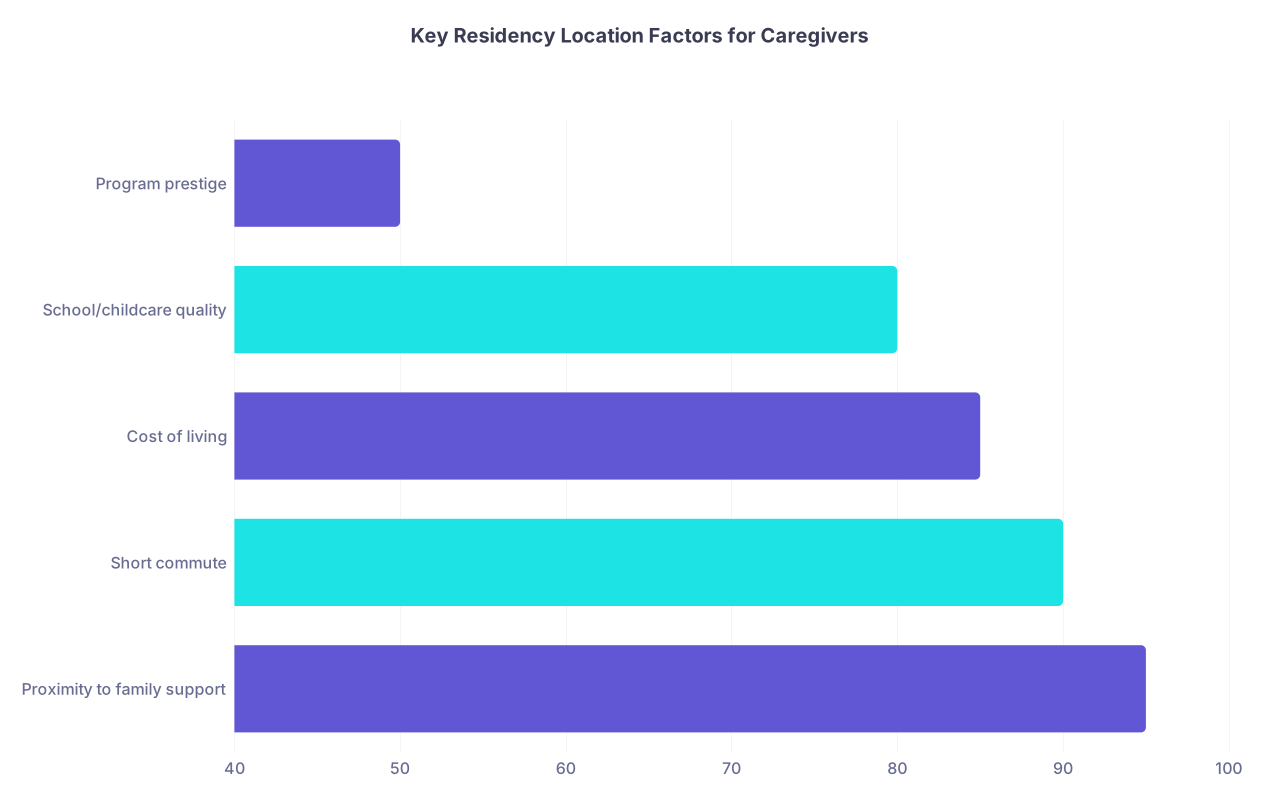
| Category | Value |
|---|---|
| Proximity to family support | 95 |
| Short commute | 90 |
| Cost of living | 85 |
| School/childcare quality | 80 |
| Program prestige | 50 |
Step 3: Decode Programs for Caregiver-Friendliness (Before You Apply)
You’re not looking for the mythical “chill” residency. You’re looking for programs that operate like adults live real lives.
On paper, they all say the same things: “supportive culture,” “resident wellness,” “work-life balance.” Useless. You have to read between the lines.
Here’s how to pre‑screen programs before you even send an application.
3.1 Read the schedule like a detective
Most programs post sample schedules. Do not skim. Study them.
Watch for:
- How many months of night float and how they’re grouped
- How often 24‑hour call (or longer) actually appears
- How many rotations are at other sites, and how far they are
- Outpatient vs inpatient time (outpatient generally = more predictable)
You’re looking for programs with:
- Reasonable grouping of nights (e.g., 1–2 weeks at a time, not constant flipping)
- Limited away rotations or guarantee of close sites
- Some ambulatory blocks where childcare is actually predictable
3.2 Hunt for actual policies, not wellness slogans
Go to the program website and employee HR pages. Search for:
- “Parental leave”
- “Family leave” / “FMLA” / “short-term disability”
- “Lactation policy”
- “Part-time residency” or “reduced schedule”
- “Religious accommodations” (often similar machinery gets used for family needs)
If all you see is “we’re a family here” but no actual written policies for leaves or accommodations, proceed with caution.

Step 4: Use the Application to Signal (Smartly) Without Tanking Yourself
You do not need to broadcast every detail of your caregiving situation on your personal statement. But hiding the fact that you have serious outside responsibilities can backfire when you later need schedule flexibility.
You have to thread the needle.
What to include in your personal statement (if at all)
Acceptable, low-risk ways to signal priorities:
- “Maintaining a sustainable career while being present for my family is very important to me, so I’m looking for a residency with transparent scheduling and a culture that values residents as whole people.”
- “As someone who has helped coordinate complex care for a family member, I’ve seen how system-level obstacles affect both patients and caregivers.”
Notice what this does: it flags that you care about family and caregiving, without listing your childcare schedule or your parent’s diagnosis.
What to save for later
Details like:
- “I am the only person who can take my mom to dialysis”
- “My partner works nights; I handle 100% of daytime kid responsibilities”
Those are interview and post‑interview conversation topics—not ERAS personal statement material.
Step 5: Ask the Right Questions on Interview Day (Without Red Flags)
The interview is where you separate programs that say they care from the ones that actually function for human beings.
You’ll ask different questions to three groups:
- Residents without kids
- Residents with kids or caregiver roles
- Program leadership
5.1 What to ask residents (especially those with families)
Find them. If there are none, that’s information.
Questions that work:
- “How predictable are your schedules? Can you usually plan child care or family appointments in advance?”
- “When residents have kids or need to take family leave, how does the program respond in real life?”
- “Have people taken maternity/paternity leave during residency here? Did they feel supported?”
- “If your kid/parent gets sick at 7 a.m. on a clinic day, what actually happens?”
Listen for the tone more than the words. If they pause, wince, or say, “Well… you can technically do X,” that’s your answer.
5.2 What to ask program leadership
Be professional but direct. You can frame it as “future planning” even if you’re already deep in caregiving.
Good questions:
- “How have you supported residents who needed parental or family leave in recent years?”
- “Can you tell me about schedule flexibility if unexpected family emergencies come up?”
- “Have any residents trained here while managing significant caregiving responsibilities, and how did that go?”
Bad questions (too specific, too early):
- “I have a child with disability/parent with dementia—can I get every Friday off?”
- “Can I guarantee no ICU blocks in July because of my daycare situation?”
Those belong in a targeted conversation after you know they want you or on a second look, not in the first 20 minutes of an interview.

| Step | Description |
|---|---|
| Step 1 | Identify caregiving needs |
| Step 2 | Screen locations by support |
| Step 3 | Review program schedules |
| Step 4 | Check policies online |
| Step 5 | Apply selectively |
| Step 6 | Interview and ask targeted questions |
| Step 7 | Rank based on fit plus support |
Step 6: Build a Realistic Ranking Strategy
When you get to ranking, your classmates will talk about “prestige,” “research weight,” “fellowship opportunities.”
You need a different weighting system. Something like this:
| Factor | Priority Level |
|---|---|
| Local support / help available | Critical |
| Call structure & schedule | Critical |
| Program culture on leave | Critical |
| Cost of living | High |
| Prestige / name recognition | Moderate |
| Research / fellowship options | Moderate |
If your top “prestige” choice leaves you with:
- No local help
- 45-minute commute
- Q4 in-house call on multiple services
- Regular “voluntary” staying late pressure
Then for a primary caregiver, that’s not your top choice. That’s a potential disaster.
Ask yourself one hard question for each program:
If my dependent has a major crisis during PGY‑2 (ICU month, boards year, whatever), will this program work with me or against me?
If the honest answer is “against me,” it does not belong near the top of your list.
Step 7: Anticipate the First Year—And See If the Program Helps or Hurts
Some caregiving situations are predictable (ongoing child care, scheduled treatments). Some aren’t (sudden deterioration, behavioral crises, new diagnoses).
You can’t plan everything. But you can see which programs make your first year survivable instead of impossible.
Green flags:
- They talk openly about schedule swaps and cross-coverage being manageable, not punished
- Multiple residents have taken parental leave without being labeled “problem residents”
- Chiefs or PD give concrete examples: “Last year, a resident’s dad had surgery; we rearranged two rotations and used elective time to keep them on track”
- They have backup call systems that actually function
Red flags:
- “We always find a way” with zero specifics
- “We rarely use parental or family leave” (translation: no one feels safe taking it)
- Residents joke nervously: “Well, we survive” or “You just don’t get sick here”
You’re not looking for perfection. You’re looking for evidence of flexible competence.
Step 8: Special Scenarios and How to Think About Them
Your situation might not be the generic “I have a kid” story. Here are a few common hard ones I’ve seen.
8.1 You’re a single parent
You need:
- Rock-solid childcare plan: primary + backup + emergency
- Super short commute or reliable 24/7 transportation
- Programs with clear written policies and a track record of residents with kids
Lean harder into local support. A slightly less competitive program near your mom/sibling/close friend is usually a much better choice than a big-name program where you’re completely alone.
8.2 You care for an adult with serious medical needs
Think:
- Distance from major hospitals/clinics they’ll need
- Whether your work schedule syncs even a little with their appointment times
- Programs that have experience handling residents with chronic health issues in their families
You also need to think about worst-case scenarios: prolonged hospitalization, rapid decline. Which program geographic setup lets you be present without imploding?
8.3 You and your partner are both in medicine
Classic two-body problem, plus caregiving.
Coordinate:
- Locations that allow both of you reasonable commutes
- Program leaderships that have already handled couples with kids
- Staggered call schedules if at all possible (you cannot both be on q4 24-hour call with a toddler)
You will probably have to sacrifice something—prestige, dream city, ideal specialty location—to preserve your family. That’s not failure. That’s prioritization.
Step 9: Use the “Honest Week” Test
Here’s a simple mental exercise that cuts through a lot of noise.
Pick your top 3–5 programs. For each, imagine:
- You’re on an ICU or wards month, at peak intensity
- Your dependent (kid, partner, parent) has a bad week: new diagnosis, ED visit, school crisis, falls at home, whatever is realistic for your situation
- You’re also sick. Not dying, but miserable.
Now ask yourself:
- At this program, could I call out without being destroyed politically?
- Is there anyone local who could step in for 2–3 days?
- Would program leadership likely be problem-solvers or guilt-trippers?
If for a given program your honest gut is:
- “No way, I’d have to just push through and hope my kid/parent is okay,”
drop that program down your list. Maybe way down.
You’re not optimizing for the best week. You’re optimizing for the worst week you can realistically expect.
Step 10: Protect Your Future Self, Not Your Ego
This is where people mess up. They chase the “right” name, the program that impresses attendings, the city their peers brag about. They ignore the fact that their life outside the hospital is already running at 120%.
Your future self—PGY‑2 you, post-call, on three hours of sleep, with a vomiting child and a parent calling about new confusion—does not care about your program’s U.S. News rank.
They care about:
- Can I get a day off without being punished?
- Can I be home in 20 minutes if there’s an emergency?
- Is there anyone nearby who can grab my kid from school if I’m stuck?
- Am I slowly breaking, or can I actually sustain this?
So when you’re about to rank that super-elite program first, ask:
Am I choosing this for my career, or for my ego? And how much am I charging my family for that choice?
Sometimes the answer is still: “Yes, I’ll pay that price.” Fine. Own it. But be conscious, not delusional.
What you should do today
Today, not next week: open a blank page and write down your top five caregiving realities for the next three years—concrete things like “I do morning school drop-off” or “I’m the one who handles my dad’s medical appointments.”
Then pull up your current list of programs, and for each one, quickly label it green / yellow / red based on those five realities.
If too many of your “dream” programs are bright red, don’t sugarcoat it. Start revising that list now—before interviews, before rank lists—so you’re actually matching into a life you can live.