
You’re a late MS3 or early MS4. You want kids. Not “someday, abstractly.” Actually. In the next 1–4 years. And now you’re staring at residency program websites, trying to decode elective schedules and call structures and “family friendly” buzzwords, wondering:
If I match here and get pregnant during residency, will I be okay—or screwed?
This is exactly where program policies stop being fine print and start being a survival plan. Let’s walk through how to use pregnancy, parental leave, and culture policies as a primary filter when you build your rank list—without tanking your career or pretending your life outside medicine does not exist.
Step 1: Get Real About Your Timeline Before You Rank
Forget what you “should” do. Get specific.
Ask yourself a few hard questions:
- Earliest you’d realistically be okay getting pregnant?
- Latest you’d feel okay delaying pregnancy for this specialty?
- Any medical issues (PCOS, endometriosis, prior losses, partner’s fertility issues) that might make timing less predictable?
- Are you open to:
- Trying in med school and delivering intern year?
- Trying PGY-1 / early PGY-2?
- Waiting until later training or fellowship?
Write down three things:
- Your “ideal” pregnancy window (e.g., “Sometime PGY-2 or PGY-3.”)
- Your “absolutely not” window (e.g., “First 6 months of intern year.”)
- Your hard line (e.g., “I’m not willing to postpone pregnancy beyond PGY-4.”)
Now, overlay that on typical program lengths:
| Specialty Type | Typical Length | Common Pregnancy Window Residents Choose |
|---|---|---|
| Primary Care (IM, FM) | 3 years | PGY-2 to early PGY-3 |
| Pediatrics | 3 years | PGY-2 to early PGY-3 |
| OB/GYN | 4 years | Late PGY-2 through PGY-4 |
| Surgical (Gen Surg) | 5+ years | PGY-2 to PGY-5 (varies widely) |
| Road Specialties | 3–4 years | Anywhere after PGY-1 |
You’re not trying to be perfect. You’re trying to see:
“Is it even remotely compatible for me to train here and not fully pause my life for 5+ years?”
Step 2: Understand What Must Be There Legally vs What Actually Matters
Programs love to say “we follow institutional policies” as if that explains anything. It does not. You need to know the baseline, then see who actually goes beyond it.
The Non-Negotiables (or Should Be)
There are a few layers:
- Federal/State laws (FMLA, pregnancy discrimination laws, state parental leave laws)
- ACGME requirements
- ABMS board requirements for your specialty
- Hospital/University HR policy
- Program-specific norms (this is where your life actually changes)
For example:
ACGME says residents must have adequate time away, duty hour protections, and that programs cannot punish pregnancy. Great. But your board might say you can only be away from training X weeks per year without extending residency. And the hospital might just mirror FMLA (unpaid) with minimal paid leave unless the system is more progressive.
So, when programs throw “We follow ACGME and institutional policies” at you, translate that as:
“Bare minimum compliance. No guarantees of actual support.”
You’re looking for who has:
- Clear, written paid parental leave (not just “you can use sick/vacation”)
- A track record of residents having babies and not being punished for it
- A plan for coverage that is not: “Your co-residents will just absorb everything and hate you forever”
Step 3: Decode Policies on Paper vs Reality
Here’s how to dissect policies like an adult who understands that marketing exists.
A. Start With What’s Written
Things you want to see in writing (HR website, GME handbook, or program manual):
- Number of weeks of paid parental leave (not lumped into vacation)
- Whether non-birthing parents get paid leave (this tells you a lot about culture)
- Whether you’re forced to use vacation to cover parental leave
- How board eligibility is protected (e.g., “Up to 6 weeks per year + 2 additional weeks once in training without extension,” etc.)
If you cannot find this online, make a note: “Ask directly.”
B. Then Ask Residents What Actually Happens
You want specific, concrete questions. Not “Is the program family friendly?” That’s useless.
Ask current residents:
- “In the last 3–5 years, how many residents had babies? What PGY years were they?”
- “How much time did they actually take off? Was it fully paid?”
- “Did anyone have to extend training because of leave?”
- “What did coverage look like? Were people resentful or was there a system?”
- “Did anyone feel subtly punished—bad evals, pressure to come back early, bad rotations after returning?”
The answers will tell you instantly whether the written policies are real or just PR.
Step 4: Know the Board Requirements for Your Specialty
This part gets ignored by students until they’re 7.5 months pregnant and their PD is saying, “So about that extra month you’re taking…”
Look up your board’s leave policy. Not summarized by Reddit. Directly from the board website.
Typical pattern: boards allow a certain number of weeks away from training per year and/or in total before extension is required. That “away” bucket usually includes:
- Vacation
- Sick time
- Parental leave
- Sometimes research or non-clinical time (depends on the board)
For example (numbers change, so this is conceptual, not legal advice):
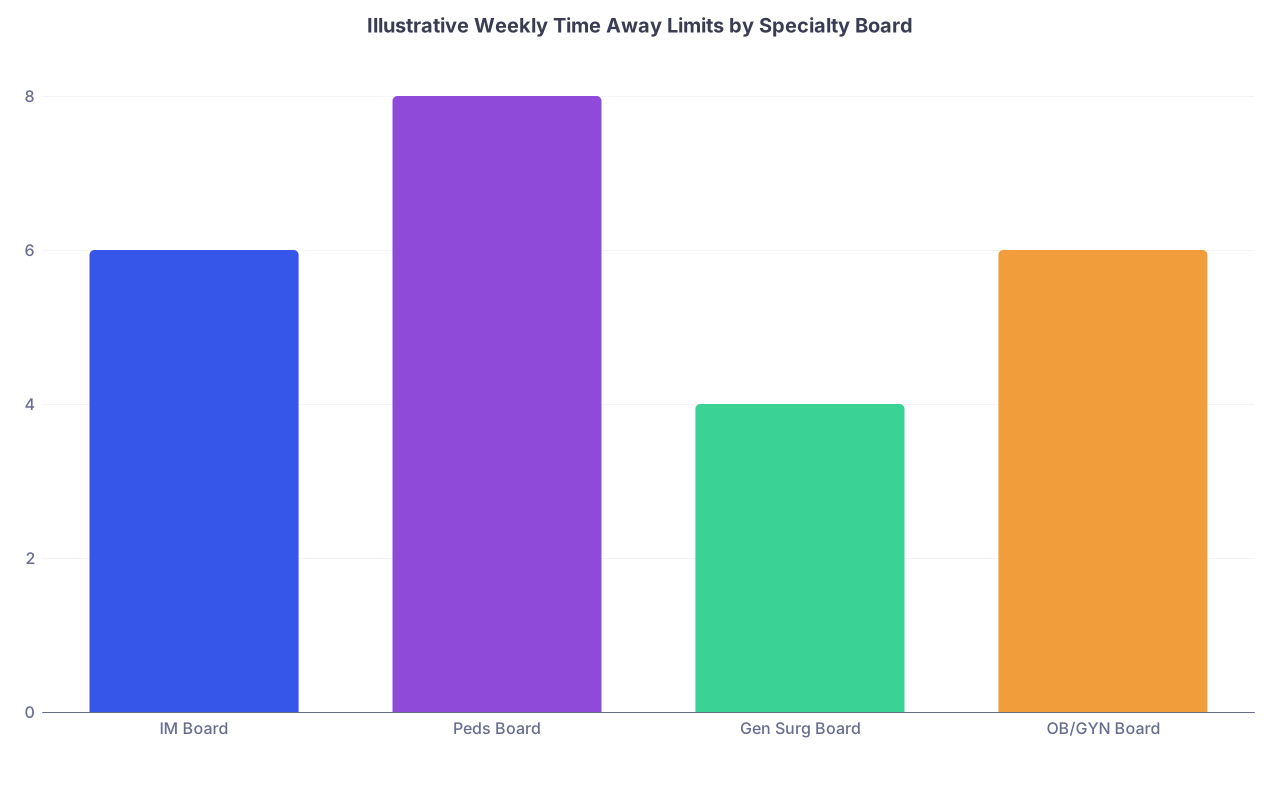
| Category | Value |
|---|---|
| IM Board | 6 |
| Peds Board | 8 |
| Gen Surg Board | 4 |
| OB/GYN Board | 6 |
If your board allows 6–8 weeks per year total, and your hospital allows 12 weeks parental leave, guess what? Someone has to reconcile that. That “someone” is you, with your program director, possibly being told:
“You can absolutely take 12 weeks. But you’ll extend residency by X months.”
Which might be fine. Or completely unacceptable. You decide that now, not at 36 weeks pregnant.
When you’re interviewing or emailing coordinators, ask:
- “How does your program handle board-required training weeks when residents take parental leave?”
- “Do people usually graduate on time, or do they commonly extend?”
If they can answer clearly and calmly, that’s a good sign. If they hand-wave, be wary.
Step 5: Align Pregnancy Timing With Program Structure
This is where you get practical.
You do not control when you conceive. But you can aim for certain windows, and you can choose programs where multiple windows are survivable.
Look at each program’s structure:
- When are the heaviest rotations?
- For IM: often ICU, night float, some wards blocks.
- For Surg: trauma, transplant, high-volume services.
- For OB/GYN: L&D, nights, Gyn onc.
- Is there protected elective time in PGY-2/3?
- How flexible is scheduling? Do they truly rearrange around pregnancies, or make you “prefer not” and then ignore it?
Programs that handle pregnancy well usually:
- Have multiple elective blocks that can be moved around
- Allow scheduling of lighter rotations in late pregnancy
- Shift you away from heavy call late in pregnancy
- Have residents who can say, “Yeah, they did that for me and it wasn’t a fight.”
You want to be able to imagine:
“I get pregnant at the end of intern year. Delivery around the middle of PGY-2. Could this program:
- Shift my ICU/trauma away from third trimester?
- Give me some clinic/elective or lighter inpatient right before leave?
- Not kill my co-residents with coverage?”
If the answer feels like “Not really,” that program goes lower on your rank list. Yes, even if it has a big name.
Step 6: Questions to Ask—Without Sounding Like You’re Announcing a Pregnancy
You do not have to tell anyone you’re planning pregnancy. You should not during interviews, frankly. You can ask everything you need by framing it generically.
Use these during interview dinners, resident lunches, or post-interview emails:
To residents:
- “How has the program handled parental leave in the last few years?”
- “Have you seen anyone have a tough time with pregnancy or parental leave here?”
- “If someone needed schedule adjustments late in pregnancy, was that accommodated?”
- “Do people with kids feel like second-tier residents?”
To faculty/program leadership (carefully, more general):
- “How does your program approach major life events like parental leave or health issues? Is there a standard framework?”
- “How do you balance coverage needs with supporting residents who need extended time off?”
Then listen to how fast they answer and how specific they are.
Vague = not good. Defensive = really not good.
Step 7: Watch for Red and Green Flags in Culture
Policies are the skeleton. Culture is the muscle. Culture wins.
Red Flags
If you hear or see any of this, believe it:
- “We’ve had one resident have a baby in the last 10 years.” In a big program? That’s either bad luck or culture.
- Jokes about “baby fellowships,” “timing pregnancies after chief year,” or “don’t get pregnant on this service.”
- Residents quietly warning you: “You probably don’t want kids during residency here.”
- Stories of:
- Residents pumping in stairwells or cars
- No private lactation space near clinical areas
- Residents being told to make up call or extra nights for taking leave
- Faculty saying things like, “Well, training has to come first.”
Yes, training matters. But people who lead with that line usually mean: “We come first. Your life is negotiable.”
Green Flags
Programs that actually support pregnancy usually show it without bragging.
Signs:
- Multiple residents (both birthing and non-birthing parents) had children in the last few years and are… fine. Not bitter. Not warning you away.
- Residents casually mention daycare, pump rooms, or shifting schedules like it’s normal.
- Someone says, “We have 8 weeks of paid parental leave plus vacation, and most people graduate on time.”
- The PD can name exactly how many residents had children and what the program did to support them.
You are not looking for perfection. You’re looking for: “We’ve handled this multiple times, and no one had to beg.”
Step 8: Consider Practical Logistics You’ll Hate Yourself for Ignoring
Even the most generous parental leave policy will not fix terrible logistics.
A. Location & Support System
Do you have:
- Family within driving distance who can help?
- A partner with a flexible job or not?
- Affordable childcare options near the hospital?
A “perfect” academic program in a city where daycare costs more than your PGY-2 salary is not perfect if your budget is already fragile.
B. Schedule Type
Night float vs 24-hour call vs home call matters a lot once you have a newborn.
- Heavy 24-hour in-house call + minimal schedule flexibility = brutal with infants.
- A program with more shift-work style coverage (ED, anesthesia, some IM models) can be easier to patch around daycare and sleep.
C. Facilities
Ask residents quietly:
- “Are there actual lactation rooms near where you work?”
- “Do people get protected time to pump without being shamed?”
I’ve seen programs where the “lactation room” is a locked supply closet that no one has the key to after 4 pm. That’s not a detail you want to discover postpartum.
Step 9: Balancing Competitiveness, Prestige, and Your Actual Life
Here’s the harsh part. Some of the highest-prestige programs are also the worst for pregnancy. Because they’re obsessed with productivity, research, and reputation—and residents are fuel.
You have to decide what you’re willing to trade.
Let me be blunt:
- Matching at the “top name” but spending 4–6 years terrified to get pregnant, or crawling through postpartum with zero support, is not “worth it” for most humans.
- A solid, mid-tier program that will bend over backward to get you through pregnancy, postpartum, and board eligibility without wrecking your body or marriage? That’s worth a lot.
When you’re staring at your rank list, you should be asking:
“If I learned I was 8 weeks pregnant the day after I match here, would I feel relief or dread?”
If the honest answer is dread, that program does not deserve your top slot. No matter how shiny its website is.
Step 10: How to Actually Use All This When Ranking Programs
By the time you’re ranking, here’s what you should have for each serious program:
- Known parental leave details
- Real stories from residents about pregnancy/parenthood
- Sense of schedule flexibility and culture
- Rough alignment between:
- Your likely pregnancy window
- Their rotation structure
- Their board + institutional leave rules
Quick way to summarize for yourself:
| Program | Paid Leave | Recent Resident Pregnancies | Culture Vibe | Board Extension Common? |
|---|---|---|---|---|
| A | 8 weeks | 3 in last 3 yrs | Supportive | Rare |
| B | 0–2 weeks | 1 in last 7 yrs | Mixed | Sometimes |
| C | 6 weeks | Several yearly | Very good | Only for very long leave |
You do not need perfection. You do need to avoid disasters.
If two programs feel similar academically, but one clearly handles parental leave well and the other dodges every question—rank the supportive one higher. That’s not weakness. That’s long-term thinking.
Two Example Scenarios (To Make This Concrete)
Scenario 1: You Want Kids Early—Like PGY-1 or PGY-2
You:
- Are late 20s/early 30s
- Maybe already trying to conceive
- Not willing to postpone pregnancy much longer
You should prioritize:
- Programs with explicit, generous paid parental leave
- Multiple residents with recent babies
- Lots of schedule flexibility and electives
- Less malignant call structures (or at least a PD who clearly rearranges call around pregnancy/postpartum)
You should de-prioritize:
- Rigid legacy programs where “we’ve always done it this way”
- Programs that openly or subtly shame residents for leave
- Extremely small programs with limited coverage options (1–2 residents per class) unless they have a rock-solid track record of supporting pregnancy
Scenario 2: You Might Wait Until Later in Training—but You Don’t Want the Door Closed
You:
- Are late 20s/early 30s but okay waiting until PGY-3–4
- Still want kids during or just after residency
You should:
- Still ask all the same questions
- Focus less on immediate leave logistics, more on overall culture and board requirements
- Make sure your future fellowship (if planned) is not notorious for destroying residents who have kids
Programs where older residents can say: “Yeah, people have kids here, and it’s fine,” should get a bump up your list.
One More Layer: How You’ll Feel About Yourself
There’s the policy. The culture. The logistics. Here’s the last layer people ignore:
How will you treat yourself if you pick a place that makes pregnancy nearly impossible?
I’ve seen residents in their mid-30s sobbing in on-call rooms because they “chose wrong” and now feel trapped between infertility work-ups and malignant fellowship expectations. Programs will not carry that burden for you. They’ll send a card if you have a miscarriage and then put you back on nights.
Your job now, as you rank programs, is to protect your future self from that corner.
Quick Summary: What Actually Matters
- Concrete, not vibes. Get actual numbers on paid leave, real resident stories, and board leave rules. Do not rely on “family friendly” slogans.
- Culture over prestige. A mid-tier program that routinely supports pregnant residents beats a big-name program that barely tolerates them.
- Match your timing to their structure. Think about when you might get pregnant and whether this program’s rotations, call, and board constraints make that survivable—or miserable.
If you’re serious about pregnancy in residency, your rank list is not just a career decision. It’s a body-and-life decision. Treat it that way.