
You have the ERAS token in your inbox and a CV that does not fit neatly in the usual boxes. There’s a gap. Maybe two years, maybe ten. Maybe you switched careers, took time for family, had health issues, immigration delays, military service, or you just burned out and stepped away.
Now you’re coming back. And you’re not just asking, “Can I match?” You’re asking, “Where can I actually survive—and do well—after time away?”
This is not a generic “how to pick a residency” situation. You don’t need another list of “look for strong didactics and culture.” You need to know:
- Who is actually willing to invest in someone who’s rusty?
- Which programs say “we support non‑traditional paths” and which ones mean it?
- How to avoid the places that will silently punish you for your gap while smiling in the interview.
Let’s build a practical filter so you can sort programs into two piles: places that will set you up to succeed, and places that will chew you up.
Step 1: Get Honest About Your “Time Away” Profile
Before you evaluate programs, you need to know exactly what you’re asking them to accept. Not in a shame way. In a risk‑management way.
There are four big variables that change how programs look at your gap:
- How long you’ve been away from clinical medicine
- Whether you graduated already (and when)
- Whether you’ve done any clinical or academic work during the gap
- Whether there’s anything “radioactive” in your file (failures, dismissals, licensing issues)
Let’s sketch what you’re up against.
| Profile Type | Example | Typical Program Reaction |
|---|---|---|
| Short gap, recent grad | 1–2 years off, recent MD/DO | Many programs comfortable |
| Long gap, recent activity | 5+ years, but recent USCE | Selective but possible |
| Old grad, no clinical since | 7–10+ years out, no recent clinical | Only a few programs consider |
| Academic/non-clinical gap | PhD, research, admin roles | Academic programs more open |
If you’re more than 3–5 years out from meaningful clinical work, you are not looking for “any good program.” You are looking for:
- Programs with a track record of taking older grads / re‑entrants
- Programs that have structured remediation and extra support
- Programs that won’t pretend you’re exactly like a brand‑new M4
If you’ve got major red flags (repeated failures, dismissal, license issue), you need a very forgiving, hands‑on program. That’s a narrower set. Better to accept that now than send 80 blind apps and hope.
Write this down in a one‑liner for yourself:
“I am a [year] graduate who has been away from [clinical / US clinical] work for [X] years, with [brief note: exams passed / failures / extra training]. I need a program that can [2–3 support needs].”
Those 2–3 needs (e.g., “strong supervision early,” “US system re‑orientation,” “procedural re‑training”) will drive what “supportive” actually means for you.
Step 2: Decide What “Supportive” Means Functionally, Not Vibe‑Wise
Forget the glossy “we are a family” brochure language. A supportive program for someone returning after time away has very specific features.
Here’s what that usually looks like in the real world:
Real supervision early on
Not just “we have attendings available.” You want:- Seniors who actually come see the patient with you the first week or two.
- Attendings who expect to be called and don’t ridicule or punish for questions.
- Night float structures that don’t leave brand‑new interns exposed.
Structured on‑boarding, not a one‑day orientation
Look for:- Boot camps, ramp‑up rotations, or “orientation blocks” where the workload is lighter.
- Simulation sessions for codes, procedures, notes, orders.
- Clear systems training: EMR, order sets, communication workflows.
Remediation that isn’t career‑ending
A supportive place will have:- A formal remediation process (you’ll hear the words “individualized learning plan”).
- Examples of residents who struggled and then successfully graduated (you can ask about this).
- A PD who can explain what happens when someone is behind. If they seem vague? Red flag.
Reasonable workload for the learning curve
If you’ve been away ten years, you do not want a pure service machine with 90th-percentile patient loads. You want:- Slightly smaller volume or better staffing on intern services.
- Night float / call systems that don’t demand you function at full speed in week 1.
- Access to ancillary support (pharmacy, RT, case management).
Support is not just “kind people.” You can have a very kind program where interns drown because the workload is insane. That still breaks you.
Keep this checklist in your head: supervision, structured onboarding, sane workload, remediation. Those four are non‑negotiable if your clinical muscle memory is rusty.
Step 3: Use Public Data to Filter Out Bad Fits Before Applying
You don’t have time or money to shotgun applications blindly. Use what’s already public to slice your list.
A. Check program websites for hints about non‑traditional paths
Go to the “Current Residents” page. Patterns matter.
Red flags for you:
- Every intern is an MD/DO who graduated last year or the year before.
- No one older than 30‑ish.
- No IMGs or only one token IMG in PGY‑3.
Positive signs:
- Residents who list previous careers (nurse, paramedic, engineer, teacher, etc.).
- Residents with obvious gaps between undergrad and med school or med school and residency.
- IMG presence, especially if they’re not all from a single pipeline school.
If a program says they “value diversity of experiences” but their residents all look exactly the same on paper? That tells you everything.
B. Find how far out from graduation they’re willing to go
Some programs state this outright: “We prefer graduates within 3 years.” Translation: they will probably auto‑screen you out.
Others will be vaguer. Look at the graduation years of current PGY‑1s and PGY‑2s. If all PGY‑1s are 0–2 years from graduation, PGY‑2s are 1–3 years, etc., they likely screen harder.
Create three buckets:
- Green: They clearly have people 4–6+ years out or second‑career folks.
- Yellow: Unclear, maybe one or two older grads.
- Red: Everyone is straight‑through, no obvious exceptions.
Apply heavy to green, selective to yellow, and only to red if you have some inside connection or compelling hook (home program, strong advocate, etc.).
C. Use chart data to reality‑check competitiveness
Programs drowning in applications can be picky about “non‑standard” profiles. You want places that need a broader pool.
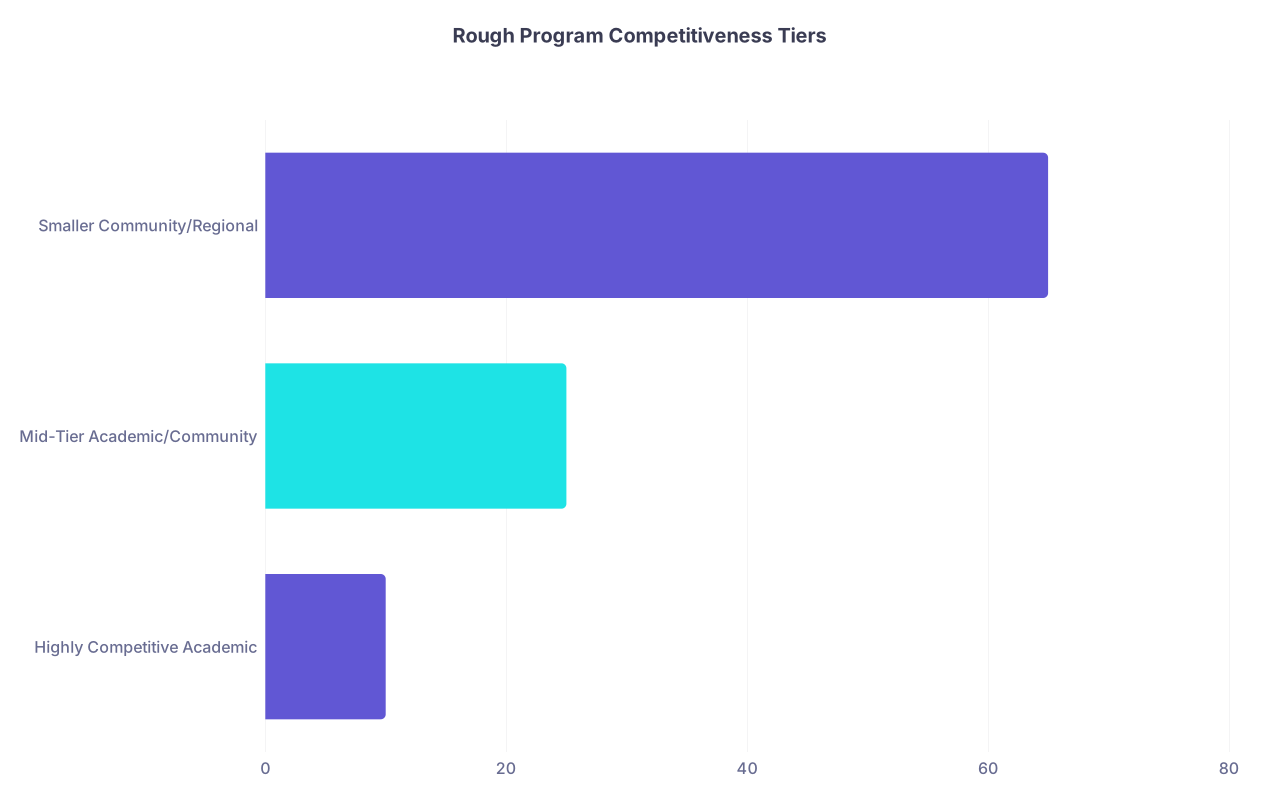
| Category | Value |
|---|---|
| Highly Competitive Academic | 10 |
| Mid-Tier Academic/Community | 25 |
| Smaller Community/Regional | 65 |
That 10–25–65 split is rough, but the point stands: the vast majority of positions are not ivory‑tower. You may be better off in a smaller community program that routinely takes older grads than trying to squeeze into a shiny big‑name place that has a clean, young applicant pipeline every year.
Step 4: Decode “Support” During Interviews (And Before)
Interviews are where programs will swear they “support residents.” Your job is to force them to show their work.
Ask directed, uncomfortable questions (politely)
You’re not interviewing as a standard M4. You have to ask about your risks directly. Use questions like:
- “How have you supported residents who came from non‑traditional or returning paths?”
- “Can you walk me through what happens if an intern is struggling clinically in the first few months?”
- “Have you had residents who were several years out from graduation when they started here? How did that go?”
- “How much supervision does a new intern get on nights in the first month?”
- “Is there any flexibility for extra orientation or shadowing time if someone’s been out of clinical practice for a while?”
Watch for how concrete their answers are.
Good answers sound like:
- “Yes, we had a PGY‑1 who had been a basic science researcher for 8 years before coming back. We started her on a lighter rotation, paired her with a strong senior, and she met with our APD monthly for the first six months. She’s now a chief resident.”
- “When someone struggles, we do XYZ: we make a written plan, add observation on rounds, adjust rotations, and meet regularly. We’ve had several residents do very well after this.”
Bad answers:
- “Oh, we’re very supportive here.” (Period.)
- “Everyone struggles at first, but you’ll be fine.”
- “We don’t really have remediation; we just expect people to keep up.”
- “We haven’t really had anyone who’s been away that long, but I’m sure it would be fine.”
If they cannot name a single resident who needed extra help and did well afterward, either they’re new or people who struggle disappear.
Talk to current residents without leadership in the room
This is where the truth comes out. Ask:
- “Have you seen anyone come in after time away or from a different system? How were they treated?”
- “Is it safe here to say ‘I don’t know’ or ‘I’m rusty’?”
- “Do seniors actually help on busy days, or are interns on their own?”
- “What happens when someone is behind? Do people get labeled as ‘weak’ and written off?”
Listen for eye contact shifts, awkward silences, and code words like “sink or swim,” “high expectations,” “you learn fast here,” “trial by fire.” These do not mix well with coming back from a gap.
Step 5: Specific Features That Help Returning Trainees
Let’s get more granular. There are program characteristics that are particularly friendly to people returning after time away.
A. Programs that routinely take IMGs / FMGs
You do not have to be an IMG to benefit here. Programs used to onboarding IMGs are:
- Used to orienting people to a new system
- More patient about different documentation/cultural expectations
- Less fazed by a non‑standard CV
If half their interns are IMGs with graduation dates 4–6 years prior, they’ve already built the systems you need. That’s good.
B. A real, named mentoring structure
Look for:
- Assigned faculty mentors with scheduled meetings, not “optional office hours”
- Chief residents involved in onboarding and peer support
- APDs who actually know the interns’ names and situations
Mentoring can’t be “there if you seek it out.” You might be too overwhelmed early to advocate for yourself. Built‑in structures matter.
C. Emphasis on feedback and coaching, not just evaluation
On websites or in interviews, listen for words like:
- “Coaching model”
- “Formative feedback”
- “Quarterly or monthly check‑ins”
Less helpful language:
- “We have strict cutoffs.”
- “We expect residents to hit the ground running.”
- “We don’t micromanage.”
You do not want to be “self‑directed” in the first 3 months back. You want structured feedback loops.
Step 6: Align Program Type With Your Specific Gap
The reason you were away matters. Use it to match to the right environment.
Scenario 1: Time away for research / PhD / academic work
You’re rusty clinically, but your brain is fine and you can handle complexity and reading.
Best fits:
- Academic programs that value your research and will give you time to ramp clinically.
- Places with a strong culture of teaching and morning reports, not just service.
Questions to ask:
- “How do you support residents who have strong research backgrounds but have been away from direct patient care?”
- “Can I start on rotations that are more supervised (ward teams, not solo night float) in month one?”
Scenario 2: Time away for family, caregiving, or personal illness
Your life experience is a strength. Your energy and bandwidth may not be infinite.
Best fits:
- Programs with sane duty hours and not‑insane call structures.
- PDs who don’t flinch when you talk about family responsibilities.
- Programs that allow part‑time or leave without being punitive (even if you hope never to use it).
Questions:
- “Have you had residents who are parents, caregivers, or who needed medical leave? How did the program support them?”
- “Is there flexibility for scheduling appointments when needed?”
Watch reactions closely. If you sense subtle judgment, believe it.
Scenario 3: Long break from clinical medicine, possibly another career
You might be good with systems, leadership, or analytics, but you’ll need reps for basic tasks.
Best fits:
- Community programs with heavy but supervised clinical loads (lots of patient contact, manageable acuity early on).
- Programs with structured orientation blocks and strong senior culture.
Avoid:
- Ultra‑competitive university programs where everyone around you has been doing sub‑I’s on step‑down units all year and expects you to function like them on day 1.
Step 7: Don’t Ignore the Geographic / Social Support Piece
Coming back after a gap is mentally brutal. Your learning curve will be steeper than your co‑interns. You’ll feel behind even if you’re doing fine. That’s just how brains work.
Where you live will matter more than you think.
Ask yourself:
- Do I have or can I build a support system near this program (friends, family, community, faith, hobbies)?
- Is this location going to add stress (expensive city, unsafe area, long commute)?
- Will I be able to do simple restorative things—walk, see green space, attend events—on rare days off?
A “top‑tier” program in a city you hate, isolated from everyone, may be much harder than a mid‑tier program in a place where you have people and peace.
Step 8: Red Flags That Should Make You Walk Away
If you see these, do not talk yourself into the program because they were “nice” or “it’s prestigious”:
- Leadership downplays your time away: “Oh, that won’t be an issue at all, we treat everyone the same.”
- Residents describe a “tough love” culture, lots of yelling, or public shaming on rounds.
- No one can articulate how they handle struggling residents. “It just works out” is not a plan.
- Interns are regularly doing 16–20 patient lists alone with minimal senior help.
- You bring up your gap and the response is visibly uncomfortable, dismissive, or they immediately change the subject.
You need a program that has thought about and dealt with non‑linear paths before. You are not a beta test they get to experiment on.
Step 9: Build a Balanced Application Strategy
You still have to play the numbers game. Being realistic doesn’t mean giving up.
Basic approach:
- Heavy applications to green‑flag programs that clearly accept older grads / returning trainees.
- Moderate applications to yellow‑flag programs where your other strengths (scores, research, letters) are strong.
- Sparing applications to red‑flag programs only if you have direct connections or some inside knowledge they’ll actually consider you.
And then, tailor your ERAS materials:
- Personal statement: Directly and calmly explain your time away, what you did, and how it makes you a better resident now. One concise, honest paragraph. No rambling self‑defense.
- Letters: Get at least one from a recent clinical supervisor who can explicitly say, “X came back after time away and rapidly readjusted; they ask for help appropriately, learn fast, and are safe.”
- CV: Put your gap activities in the experiences section. Don’t leave blank years for programs to imagine the worst.
You’re not “hiding” the gap. You’re controlling the story.
Step 10: Have a Plan for the First 3–6 Months Wherever You Go
Even in a supportive program, you need your own strategy for the restart.
Think in phases:
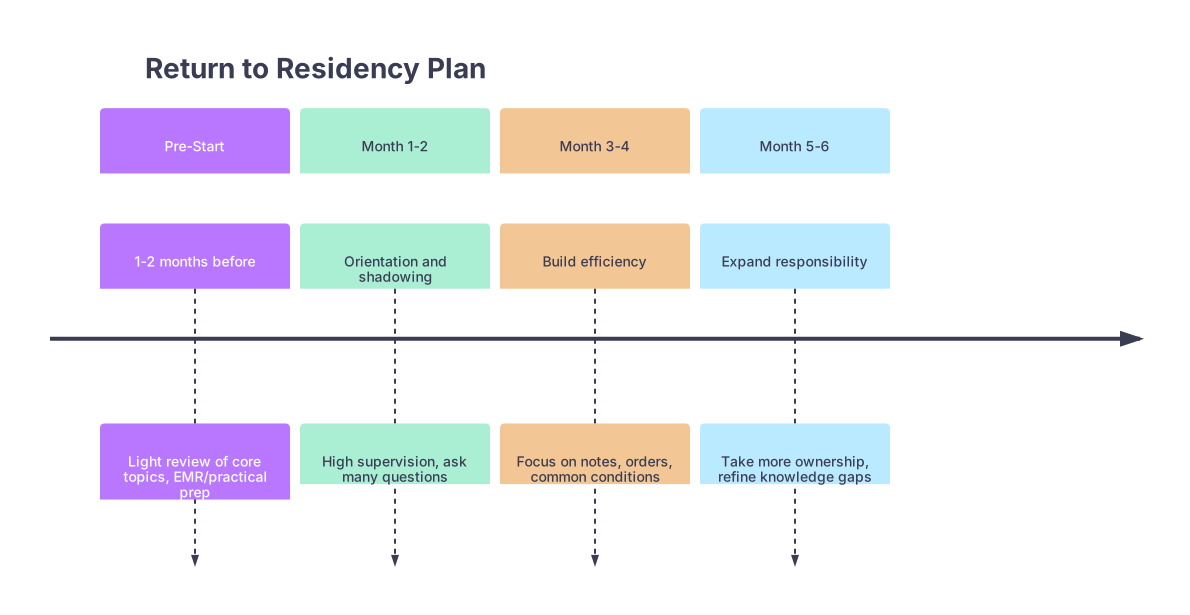
| Period | Event |
|---|---|
| Pre-Start - 1-2 months before | Light review of core topics, EMR/practical prep |
| Month 1-2 - Orientation and shadowing | High supervision, ask many questions |
| Month 3-4 - Build efficiency | Focus on notes, orders, common conditions |
| Month 5-6 - Expand responsibility | Take more ownership, refine knowledge gaps |
Before you start:
- Review high‑yield basics for your specialty (IM: chest pain, sepsis, common meds; FM: diabetes, hypertension, well visits; etc.). Not to “cram Step 1.” Just to be less lost.
- If possible, get some observership or shadowing to wake up your clinical brain.
First months:
- Over‑communicate with seniors. “I’ve been out of clinical work for X years, I may be slow at first; I’d rather be safe and ask too many questions.”
- Ask to start on rotations with strong team structures (wards, not solo night shifts).
And if you realize early that you’re struggling more than you expected, say so. In a truly supportive program, that should trigger help, not punishment.
Final Takeaways
- Supportive for you means concrete things: close supervision, structured onboarding, sane workload, and real remediation—not just nice people.
- Use public signals (resident bios, graduation years, IMG presence) and targeted interview questions to filter for programs that have actually handled returning or non‑traditional trainees before.
- Be upfront and strategic about your gap in your application and in conversations; you’re not begging for a chance, you’re looking for a training environment built to help people like you succeed, not sink or swim.