
The biggest mistake second‑career physicians make is assuming programs will “see the value” of their prior experience on their own. They will not. You have to choose programs that are wired to appreciate it—and then hit them over the head with why it matters.
You’re not a 24‑year‑old straight‑through applicant. You’re someone who ran teams, closed deals, managed classrooms, led squads, built products, raised kids, or practiced another healthcare discipline before med school. That can be a huge asset. Or it can get ignored. Which way it goes depends heavily on the residency programs you target.
This is how you choose residency programs that actually value your prior career—and how you avoid wasting interviews at places that only want cookie‑cutter CVs.
1. Start With Brutal Clarity: What Do You Bring and What Do You Need?
Before you look at a single program website, you need to be clear on two things:
- What your prior experience really gives a program
- What you must get from a program for this to be sustainable
Skip this, and you’ll chase prestige instead of fit.
A. Translate your prior career into residency currency
Programs care about outcomes: patient care, team function, scholarship, and not being a hassle. Your old career matters only as it moves those needles. Here’s how to translate:
- Former nurse/PA/RT/paramedic →
You bring real clinical workflow understanding, comfort talking to patients and nurses, and you won’t freak out the first night on call. - Former teacher/lecturer/professor →
You can teach med students, lead morning report, design curricula, and communicate clearly with patients and families. - Former military/officer →
You understand chain of command, high‑stress decision‑making, and leading teams in chaos. - Former business/tech/consulting/manager →
You get systems, QI, EMR optimization, analytics, project management, and can drive initiatives. - Former social work/psych/chaplain/community →
You understand psychosocial complexity, boundaries, de‑escalation, and resource navigation.
Write down 3–5 specific, concrete contributions you can make in residency that a typical MS4 cannot. If you can’t say them out loud in one breath, you can’t sell them.
Example:
“I’ve managed a 12‑person team across shifts, handled high‑conflict situations daily, and led three process‑improvement projects that cut response times by 20%. I can help your program with resident wellness, communication, and QI.”
That’s the level of specificity you’re aiming for.
B. Be honest about what you need
You’re not 22. You probably have:
- A partner, kids, or dependents
- A mortgage, loans from two careers, or both
- Less patience for pointless hazing and toxic culture
So be explicit. What do you need?
- Geographic boundaries (custody, spouse job, aging parents)
- Reasonable call structure vs “we all suffered, you will too”
- A program that respects your time (schedules posted early, predictable didactics)
- A culture where age and prior experience aren’t mocked
Write this down. This becomes your filter.
2. Where Programs Quietly Tell You If They Value Non‑Traditional Residents
Programs rarely say: “We do not value prior experience and we just want cheap labor.” They tell you indirectly. You just have to know where to look.
Check their residents, not their mission statement
The single best indicator: who they’ve already taken.
- Do they have older residents?
- Any prior careers listed in bios? (RN, EMT, engineer, teacher, military, MBA, etc.)
- Any IMGs or DOs with interesting backgrounds?
- Or is it all: “MD, 4th‑year research, AOA, went to the same three med schools”?

If they’re proud enough to mention people’s prior worlds, that’s a good sign. If everyone looks 27 and interchangeable, they may tolerate you, but they probably don’t seek applicants like you.
Look for these keywords and clues
On program websites and marketing material, pay attention to language. Green flags:
- “We value nontraditional paths”
- “Residents with prior careers in…”
- “Our residents include former nurses, military officers, teachers…”
- “Diverse paths to medicine”
- “Career change” or “second career” mentioned explicitly
Red flags:
- Zero mention of diversity of paths, only diversity of “experiences and interests”
- Every profile highlights test scores and publications, never lived experience
- Heavy emphasis on “we are a young, energetic group” (translation: we skew very young and may not know what to do with you)
Where to research systematically
Do not guess. Build a spreadsheet and treat this like work.
| Signal Type | Strong Green Flag |
|---|---|
| Resident bios | Multiple older residents, prior careers listed |
| Website text | Explicit mention of nontraditional or second-career residents |
| Leadership | APD or PD with a nontraditional path or prior career |
| Alumni | Graduates who pivoted into admin, education, QI, leadership roles |
| Interview structure | Dedicated questions about prior career and leadership |
Spend an hour per serious program scanning:
- Program website → “Our Residents,” “About Us,” program director message
- Resident Instagram/Twitter (if they have one)
- Doximity reviews (grain of salt, but patterns matter)
- FREIDA filters for things like community vs academic, size, leadership focus
If you see no signs they’ve ever taken someone like you, assume you’re uphill.
3. Use Data and Timelines: Don’t Romanticize the Match
You’re a second‑career applicant. You cannot “see what happens.” You need a plan with numbers.
Be realistic about your competitiveness
Your prior career does not erase board scores, grades, or gaps. Programs are not charities. They are risk managers. You have to operate in both worlds: numbers and story.
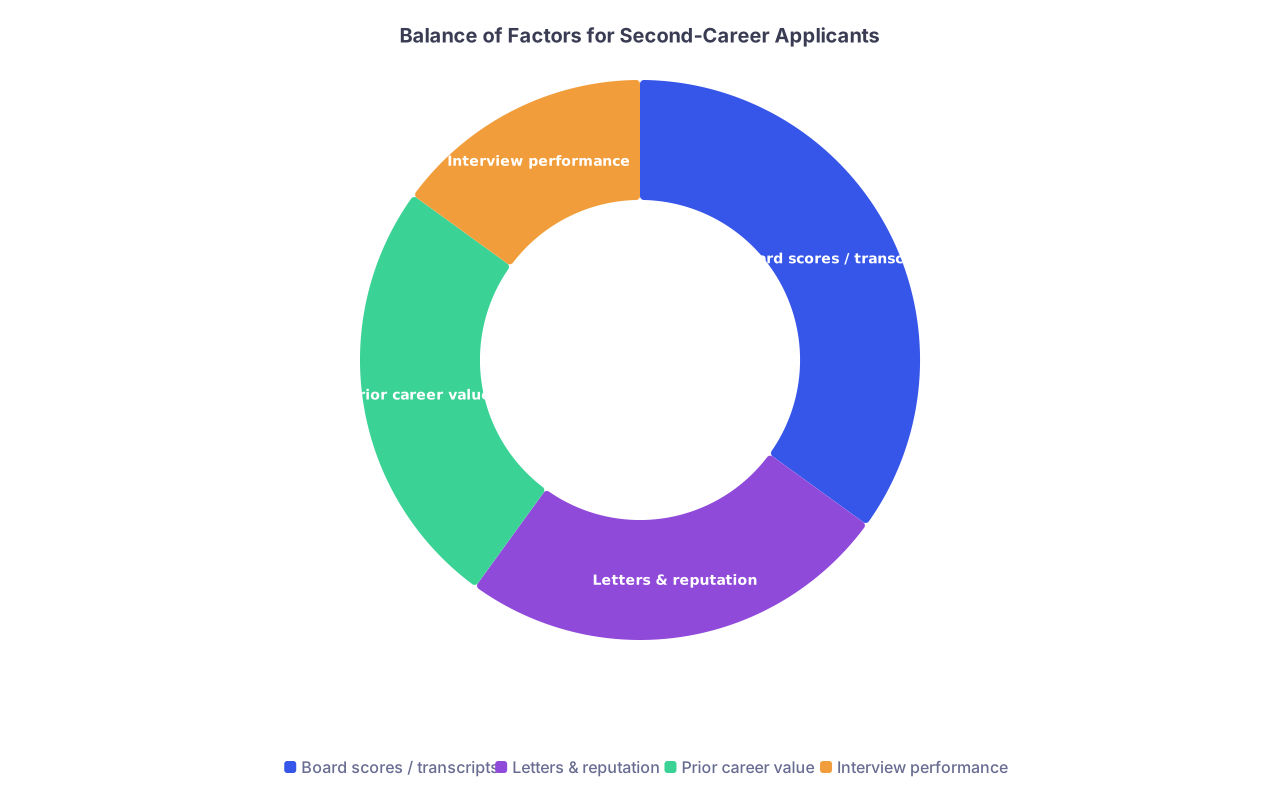
| Category | Value |
|---|---|
| Board scores / transcripts | 35 |
| Letters & reputation | 25 |
| Prior career value | 25 |
| Interview performance | 15 |
If your scores are average or a bit below, your prior career can absolutely help push you over the line. If your scores are catastrophic for your chosen specialty (e.g., failed Step 1/2 in a hyper‑competitive field), prior experience will not rescue that. Adjust specialty choice or expectations.
Map your application year like a project
You’ve probably run projects before. Treat the Match the same way.
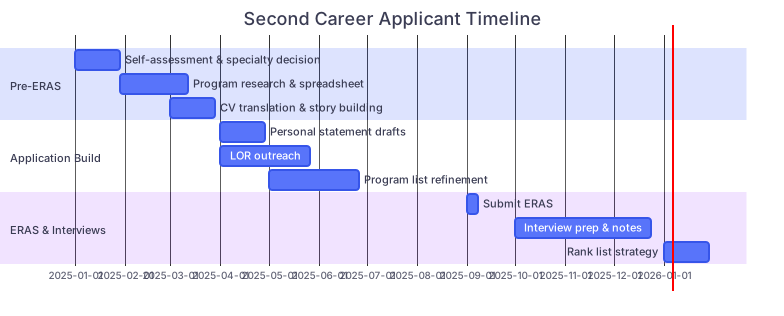
| Task | Details |
|---|---|
| Pre-ERAS: Self-assessment & specialty decision | a1, 2025-01, 4w |
| Pre-ERAS: Program research & spreadsheet | a2, after a1, 6w |
| Pre-ERAS: CV translation & story building | a3, 2025-03, 4w |
| Application Build: Personal statement drafts | b1, 2025-04, 4w |
| Application Build: LOR outreach | b2, 2025-04, 8w |
| Application Build: Program list refinement | b3, 2025-05, 8w |
| ERAS & Interviews: Submit ERAS | c1, 2025-09, 1w |
| ERAS & Interviews: Interview prep & notes | c2, 2025-10, 12w |
| ERAS & Interviews: Rank list strategy | c3, 2026-01, 4w |
The earlier you start researching programs, the more selectively you can choose ones that will actually use your skills instead of ignoring them.
4. Practical Filters: How to Build a Target List That Makes Sense for You
Let’s get specific. Here’s how I’d tell a 38‑year‑old former ICU nurse applying to IM to build a program list.
Step 1: Set your non‑negotiables
These usually include:
- Region(s) you can actually move to
- Program size (tiny places often don’t know what to do with outliers; huge programs may not notice you)
- Safety vs competitiveness (you need a good spread)
- Lifestyle realities (night float vs q4 24‑hour call, etc.)
Step 2: Screen programs with a “second‑career lens”
Go through your initial list and tag each program:
- Strongly values prior experience
- Neutral
- Probably indifferent or negative
How to assign the tags:
- Strongly values: At least 2–3 residents with prior careers; explicit mention online; PD/leadership have a history of training nontraditionals.
- Neutral: No obvious evidence either way, but not hyper‑prestige or rigid.
- Negative: All straight‑through high‑achievers, language about “elite,” “top percentiles,” nothing about diverse paths.
Aim for a list where at least 30–40% of programs are in the “strongly values” bucket.
Step 3: Prioritize certain program types
Some program structures naturally do better with second‑career folks:
- Community or community‑academic hybrids with strong teaching focus
- Programs with formal leadership, QI, or education tracks
- VA‑heavy programs (often more receptive to nontraditional, especially vets)
- Programs that clearly leverage residents in teaching med students

You’re looking for places that see residents as people who can contribute, not just “bodies to cover the pager.”
5. How to Signal Your Value Early—Before They Even Meet You
Finding the right programs is half the game. The other half is making it very obvious why your prior world makes you a better resident.
Your ERAS experiences: stop being vague
Too many second‑career folks write their old jobs like this:
“Project Manager, Company X. Managed multiple projects and collaborated with stakeholders.”
That tells a PD nothing.
Translate into residency language and outcomes:
“Led 8‑person project team across 3 departments to redesign workflow, decreasing turnaround time 22%. Coordinated conflict resolution between senior stakeholders with competing priorities.”
Now a PD sees: leadership, systems thinking, conflict management. That’s useful.
Personal statement: pick a lane
Don’t write a memoir. You need a through‑line:
- Why you left your prior career
- What skills from that career make you an asset to this specialty
- Why now, and why you’re not a flight risk
Sample skeleton:
- One concrete story from your prior life that clearly connects to medicine (or this specialty).
- The moment you realized you needed to pivot.
- 2–3 specific skills you developed before med school that you’ve already used in clinical rotations.
- What kind of resident you will be because of that path.
If your prior career is completely unrelated (say, corporate law), you lean heavily on communication, advocacy, systems, and stamina. Don’t pretend you were “basically doing medicine” when you weren’t. PDs can smell that.
6. During Interviews: How to Test Whether They Actually Value You
You are not just being interviewed. You are interviewing them. As a second‑career applicant, you have more to lose by ending up in the wrong place.
Questions you should explicitly ask
Do not be shy about targeting your questions.
Ask faculty or PD:
- “Have you had other residents who came to medicine as a second career? How has that worked out here?”
- “How do you leverage residents’ prior professional experience in leadership or QI?”
- “If a resident is interested in teaching/operations/admin because of a prior background, what opportunities do they realistically get here?”
Ask residents (privately, away from PDs):
- “Are there any residents who had other careers before med school? How are they treated?”
- “How does the program handle people who have kids or significant family obligations?”
- “Can you be honest—how much pushback is there if someone doesn’t fit the standard straight‑through mold?”
You are listening for tone as much as content. If people hesitate, laugh awkwardly, or say “we had one older resident but…” and trail off—that’s a data point.
Watch how they respond to your story
You’ll talk about your prior career. Pay attention to the reaction.
Green flags:
- Genuine curiosity: “Tell me more about how that plays into your approach to patients.”
- Follow‑up questions about your leadership, QI, teaching, or systems experience.
- “We could really use that here in X initiative.”
Red flags:
- Jokes about your age or “finally coming to the dark side.”
- Rapid topic change away from your previous career.
- Focus only on whether you’ll “keep up” physically, not what you bring.
If they keep trying to shove you into a generic MS4 box, they’re telling you they don’t know how to use what you offer.
7. Rank List Strategy: Choosing Fit Over Ego
This is where second‑career applicants often sabotage themselves. They chase the shiniest name rather than the place that will actually leverage their strengths and not burn their life down.
Here’s how I’d think about ranking if you have multiple options:
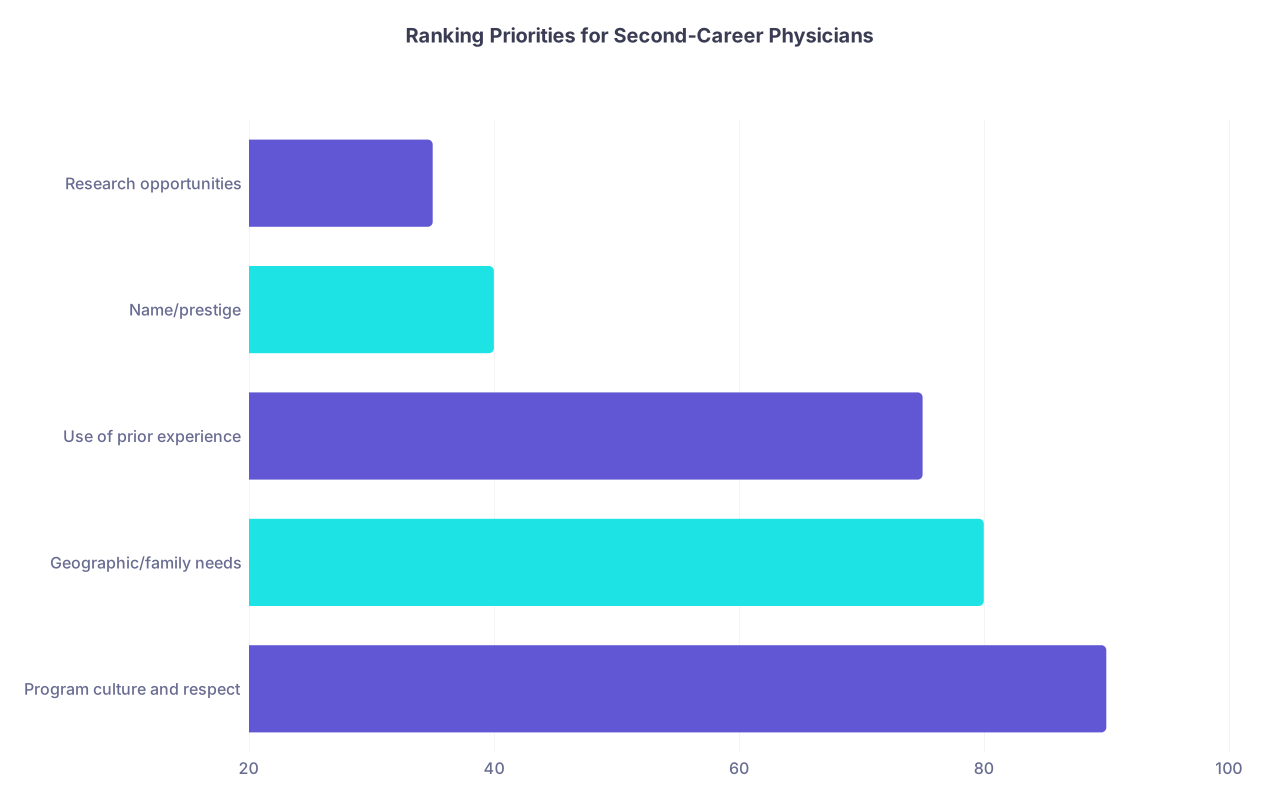
| Category | Value |
|---|---|
| Program culture and respect | 90 |
| Geographic/family needs | 80 |
| Use of prior experience | 75 |
| Name/prestige | 40 |
| Research opportunities | 35 |
If you’re 35–45 with a family, I’d put it bluntly:
- A program that truly respects you, fits your life, and uses your skills is worth more than a minor bump in prestige.
- A toxic “name brand” that treats you like a problem will chew you up, and you’ll be miserable for 3–7 years.
When comparing two offers, ask:
- Where did I feel most like a colleague instead of a supplicant?
- Where did people explicitly reference my prior skills as something they were excited to have?
- Where will my family (or future self) actually survive this training?
Pick the place where you felt least like you had to apologize for your age or your path.
8. Common Pitfalls Second‑Career Applicants Fall Into
Let me be direct about what I’ve seen go sideways.
- Over‑romanticizing your prior career. Programs don’t want to hear a long saga about how incredible your past life was. It starts to sound like you’re not done with it.
- Being defensive about age. When asked about timeline, answer cleanly and confidently. “I spent 10 years as a teacher, then made the decision to switch to medicine. It was deliberate, and I’m all‑in on this path.” Done.
- Assuming your prior experience overrides mediocre clinical evals. It doesn’t. You still need strong letters and solid clerkship comments.
- Under‑applying “safety” programs you’re actually a great fit for because they’re not fancy. Second‑career people sometimes overestimate how far their old world will carry them in hyper‑competitive specialties or institutions.

FAQs
1. I’m 40+ and switching careers. Are there age‑biased programs I should avoid?
Yes. They just will not label themselves that way. If you see only very young residents, a culture of bragging about “being in the hospital 100 hours a week,” and no mention of nontraditional paths, assume implicit age bias. Focus on programs with at least a few older residents or prior‑career folks—those PDs have already proven they’re willing to take that “risk.”
2. How much should I highlight my prior career vs my medical training?
In your written materials, 70% medicine, 30% prior career. In interviews, you flex that up or down depending on their interest. Your prior world is a lens, not the whole picture. Always anchor back to: “Here’s how that makes me a better resident in your program.”
3. Will my prior salary or career level make PDs worry I’ll be unhappy with resident life?
Some will worry quietly. That’s why you have to address it head‑on. A simple, confident line works: “I took a significant pay cut and lifestyle shift to go to med school. I did that with my eyes open. I’m not here for the money—I’m here because I want to do this work.” Then stop explaining. Over‑justifying triggers more doubt.
4. What if my prior career was a failure or very messy?
You do not need to glorify it. You do need to show growth and coherence. Frame it as: “I learned X, Y, Z, realized it wasn’t sustainable/fulfilling/aligned, and chose medicine knowing the tradeoffs.” If there were big gaps, address them briefly and move on. PDs care less about failure and more about whether you own your story without sounding evasive.
5. Should I target leadership‑heavy programs as a second‑career applicant?
Yes, but selectively. Programs with chiefs who actually do projects, formal leadership tracks, or strong QI infrastructures often love second‑career applicants who can drive initiatives. Just make sure the leadership culture is healthy—not performative. Talk to current residents privately and ask who actually runs the show and whether residents’ ideas go anywhere.
Key points to walk away with:
- Don’t assume programs will automatically see the value of your prior life—choose ones that have a track record of valuing nontraditional paths.
- Translate your past into residency language: leadership, systems, teaching, communication, crisis management—then push that story clearly in ERAS and interviews.
- Rank for culture, respect, and real‑world fit over ego; you’re building a life, not just a CV.