
The worst mistake residents with chronic illness or disability make is assuming “supportive” equals “we said we’d accommodate you.” That’s not support. That’s the legal minimum. You’re looking for programs that actively reduce your risk of crashing, failing, or burning out in year one.
If you’re entering the Match with a chronic illness, mental health condition, neurodivergence, or physical disability, you are playing on hard mode. Not impossible mode. But hard mode. You cannot afford magical thinking about residency culture.
Here’s how you actually evaluate programs for support vs risk.
Step 1: Get Honest About Your Real Needs (Not the Polite Version)
Before you can judge a program, you need to know what you actually require to function safely. Not what sounds reasonable. What is real.
Think in three buckets:
- Non‑negotiables (you literally cannot do the job without these)
- Strong preferences (make your life way better, but you could survive without)
- Red‑flag triggers (things that reliably make you flare, decompensate, or crash)
Be concrete. “I get tired easily” is useless. “If I’m standing more than 4–5 hours without breaks, I flare for 3 days” is actionable.
Here are examples of what to define:
- Maximum safe work hours per week
- Night float vs 24‑hr call tolerance
- How many consecutive nights you can realistically work
- Physical restrictions (no heavy lifting, mobility aid, need to sit periodically)
- Sensory needs (noise, lights, chaotic ED environments)
- Medication schedules, infusion days, therapy appointments
- Predictable flare triggers (sleep deprivation, missed meals, cold exposure, infectious exposures)
Write this down. Literally. A one‑page “functional needs” sheet for yourself. That becomes your lens for evaluating programs.
Now connect it to residency realities. For example:
- If you have POTS and can’t tolerate prolonged standing or dehydration → surgery prelim year with 24‑hr trauma calls is a high‑risk move.
- If you have Crohn’s and do badly with unpredictable overnight disruptions → heavy night float or q4 28‑hr call IM programs are riskier.
- If you’re autistic and require quieter, structured environments → chaotic, high‑volume EDs with constant multitasking may be an issue unless there’s a very understanding leadership.
You’re not being “weak” or “needy.” You’re doing basic risk management.
Step 2: Understand Which Specialties and Structures Are Naturally Higher Risk
Some program models are just more brutal than others, even if everyone is “nice.”
Here’s a rough sense of risk by structure, not by how “competitive” the specialty is:
| Structure / Feature | Relative Risk Level |
|---|---|
| Frequent 24–28 hr in‑house call | High |
| Heavy night float blocks | Moderate–High |
| Shift-based with protected days off | Lower |
| Outpatient-heavy programs | Lower |
| ICUs with long continuous shifts | High |
Now add typical specialty demands:
Higher baseline risk for many chronic conditions:
- General surgery, ortho, neurosurgery: long OR days, heavy call, high physical demands.
- OB/GYN: nights, unpredictability, OR + L&D standing, emergencies at odd hours.
- EM: shift work, circadian chaos, intense sensory load.
Often more modifiable / flexible:
- Internal medicine: still hard, but more programs experimenting with night float vs 28‑hr call; outpatient tracks exist.
- Pediatrics: similar to IM, with some friendlier cultures, though no guarantee.
- Psychiatry, pathology, radiology: typically more controlled schedule, fewer brutal nights, more cognitive than physical.
The question isn’t “Can a disabled person do surgery?” Some do. The question is “What price are you going to pay, and is any individual program willing to absorb some of that cost with you?”
Step 3: Read Between the Lines of Program Websites and Schedules
Most programs won’t say “We burn people out and hope for the best.” You have to interrogate the data they do show.
Look at:
Call schedules:
- Are they still doing traditional q4 28‑hr call?
- How many months of ICU, ED, and night float?
- Do they brag about “work hard, play hard” or “We’re like a surgical boot camp”?
Rotation structure:
- Is there a clear outpatient continuity clinic with predictable days?
- Do they say anything about flexible scheduling, part‑time options, research years, or leave policies?
Wellness pages (yes, most are fluff, but still useful):
- Do they show generic yoga stock photos and pizza nights? Or detailed, specific policies: free confidential counseling, dedicated wellness half‑days, reduced schedules for new parents, coverage structure for illness?
Here’s how I mentally score websites:
- Vague “We support wellness” with no examples → neutral at best, sometimes a warning.
- Specific, structural things listed (e.g., “no 24‑hr calls after PGY-1”; “built‑in jeopardy coverage for illness”) → greenish flag.
- Pride in how “tough” the program is, heavy emphasis on being “resilient,” “gritty,” or “only the strong survive” → that’s not subtle. That’s a red flag.
Step 4: How to Use Interviews and Social Events to Probe Culture Without Over‑disclosing
You don’t need to lead with your diagnosis to figure out if a program is risky. You do need to ask the right questions.
Do this in three layers:
Layer 1: Generic culture questions for everyone
These are safe regardless of disclosure:
- “How does your program handle it when a resident is having a rough year? For example, serious family issue or health problem?”
- “Can you give an example of a time a resident needed schedule flexibility and how that was managed?”
- “How often do residents call out sick, and what’s the coverage system like?”
Listen for specifics. Someone saying “We’re super supportive” is meaningless. Someone saying, “Last year one of our PGY-2s needed to cut back for chemotherapy; we rearranged rotations, spread call across the class, and they’re now a chief” — that’s gold.
Layer 2: “Hypothetical” health‑related questions
Use “what if” questions that mirror your needs:
- “If a resident had a chronic condition that occasionally flared and needed a last-minute sick day once every couple of months, how would that typically be handled?”
- “How does the program balance ADA accommodations with service needs — who actually helps residents work through that?”
Ask attendings, PDs, and especially current residents. Staff and residents are less filtered.
Layer 3: Targeted questions for residents only
At socials or post‑interview Q&As, you can bluntly ask:
- “Have any residents had major health issues or needed leave? How was that received by the rest of the program?”
- “Do you actually feel safe calling in sick?”
- “What happens when someone is obviously struggling and not just ‘fine’ after three 28‑hr calls in a row?”
If the room goes a little quiet or people glance at each other or laugh nervously, that tells you a lot.
Step 5: Recognize Concrete Green Flags vs Red Flags
Stop relying on vibes alone. You want observable behaviors and structures.
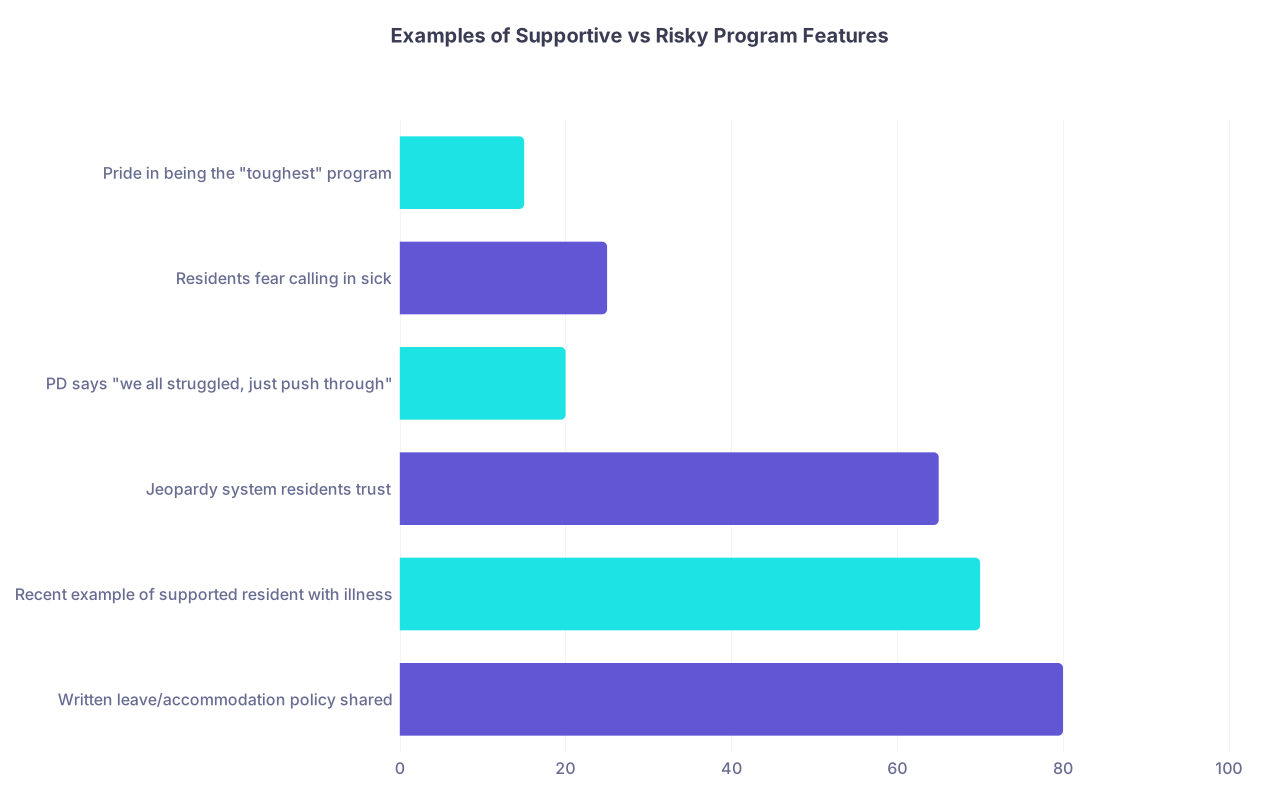
| Category | Value |
|---|---|
| Written leave/accommodation policy shared | 80 |
| Recent example of supported resident with illness | 70 |
| Jeopardy system residents trust | 65 |
| PD says "we all struggled, just push through" | 20 |
| Residents fear calling in sick | 25 |
| Pride in being the "toughest" program | 15 |
Numbers here are illustrative “support score” out of 100 — point is the relative direction, not the actual value.
Strong green flags
These are real signals a program might be safe for you:
Residents can name examples of:
- Someone taking FMLA/extended medical leave and successfully returning.
- A co‑resident with a visible or known disability who’s still thriving there.
There’s a jeopardy or backup system residents openly say they trust.
PD/APD talk about struggling residents with empathy instead of contempt.
They discuss wellness in terms of schedule changes, call structure, mental health access — not just free donuts and resilience talks.
Quiet but telling: a resident mentions going to weekly therapy, PT, or ongoing medical appointments without whispering or apologizing.
Strong red flags
If you have significant health needs, these should seriously downgrade a program on your list:
- Leadership comments like:
- “Everyone is tired — that’s residency.”
- “We don’t have weak residents here.”
- “We expect people to put their personal lives on hold for three years.”
- Residents brag about never calling in sick, then quietly tell you “no one likes it when people miss call.”
- Stories of a resident with health problems who “just wasn’t a good fit” or “couldn’t hack it” — with no reflection on what the program did (or didn’t do) to support them.
- Programs that make urgent coverage sound like a moral failing: “We all pulled extra call when X had issues.”
If you already know your condition will require accommodations, these red flags should push that program way down or off your rank list.
Step 6: Deciding Whether, When, and How to Disclose
This is where people get paralyzed. Let me cut through it.
You have three partially competing goals:
- Protect yourself legally and structurally (ADA protections, accommodations).
- Protect yourself socially (avoid bias in selection and treatment).
- Make sure the program understands your real functional limits, not some vague “I’ll be fine.”
There is no perfect answer, but here’s a practical framework.
Before rank list time, ask yourself:
- Do you need substantial, structural modifications to the usual schedule to be safe? (e.g., no nights, part‑time, fewer ICU months)
- Or can you function in a standard rotation structure with a few modest accommodations? (more breaks, ergonomic changes, scheduled medical appointments, maybe slightly modified call)
If you’re in the first group, it is risky to withhold all specifics until after you match. You could end up bound to a program that literally cannot meet your needs without gutting their schedule.
If you’re in the second group, you can often wait until after you’ve matched to work formally with GME/HR on accommodations — though you still want to rank places that showed those green flags.
Safer disclosure strategies
Use functional language first, diagnosis second (or not at all initially).
Instead of:
“I have lupus and some disability needs.”
Try:
“I have a chronic medical condition that is stable but does require some predictable accommodations — such as protected time for medical appointments once or twice a month, and ensuring I’m not scheduled for back‑to‑back 28‑hour calls. I’ve been able to manage full‑time clinical rotations with these supports.”
This tells them:
- You’re serious.
- You’ve thought it through.
- You’re not expecting special treatment, but you aren’t going to martyr yourself.
You can ask a PD or APD (preferably after they’ve shown they like you, e.g., late in the season or after an interview):
- “I want to ask a more sensitive question. I have a stable chronic health condition that sometimes affects my stamina. I function well with [specific supports]. How feasible is it in your program to arrange something like that without overburdening co‑residents?”
If they get defensive, vague, or annoyed — good. You just saved yourself three years of misery.
Step 7: Use Past Outcomes, Not Promises, as Your Compass
Programs will promise the moon during interview season. You care about receipts.
Ask:
- “Have any residents here ever gone part‑time or extended training for health or family reasons?”
- “Do you have former residents who had a disability or chronic condition and successfully graduated? Do any of them stay in touch?”
And then watch:
- Do they light up and say, “Yes, actually, one of our chiefs last year had X, here’s what we did”?
- Or do they pause and say, “We’d definitely support that if it came up,” but can’t name a single real example?
Track record matters more than intentions.
Step 8: Build a Realistic Risk Map Across Your Rank List
By January, your brain will want to rank based on prestige, location, and vibes. You’re going to add one more axis: health risk.
Draw a simple grid for yourself:
Columns:
- Program name
- Call structure
- Leadership attitude (from your notes)
- Resident stories about sick/struggling colleagues
- Evidence of prior accommodations
- Gut safety rating (1–10)
Fill it in from your actual data. A program with a big name but a “we just grind through it” culture should drop. A slightly less prestigious program where a PD said, “We had a PGY‑3 who needed surgery and 3 months off, and we rearranged the schedule to support them” should rise.
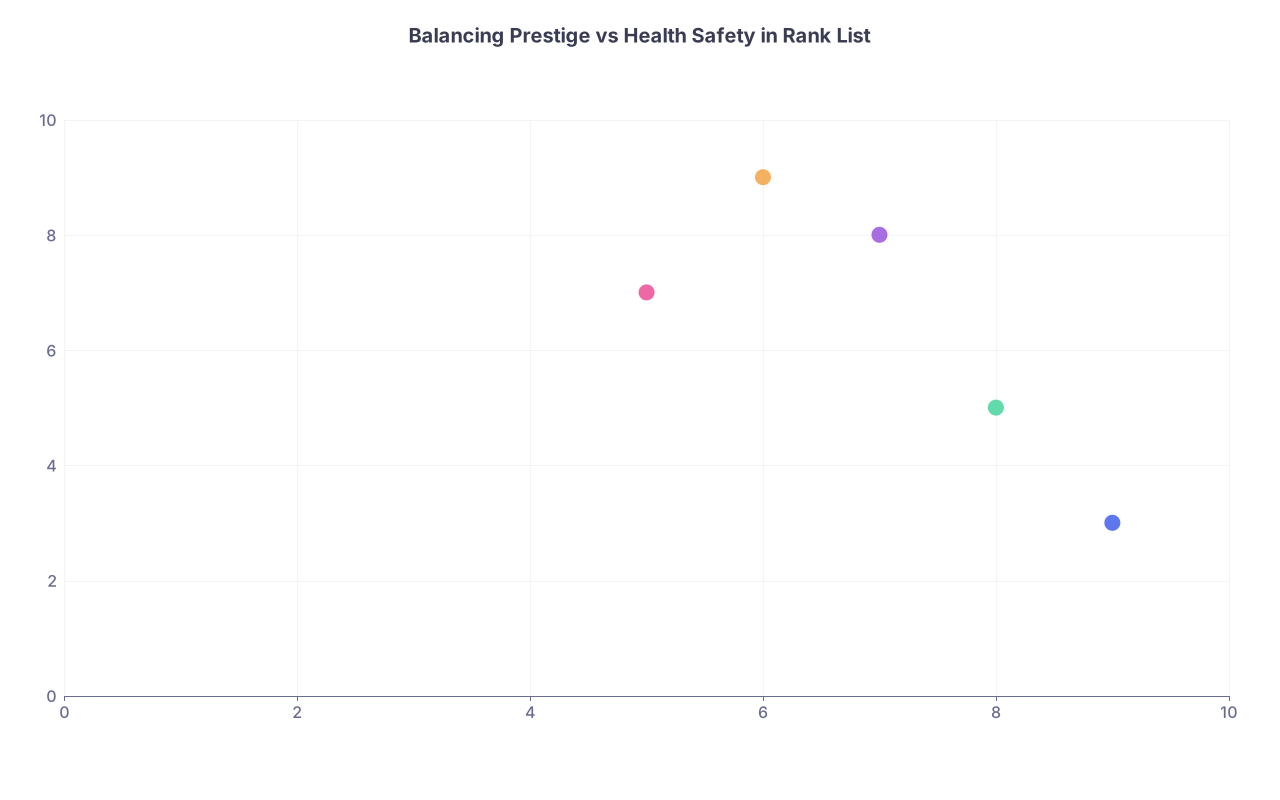
| Category | Value |
|---|---|
| Program A | 9,3 |
| Program B | 7,8 |
| Program C | 8,5 |
| Program D | 6,9 |
| Program E | 5,7 |
Imagine x-axis = prestige (1–10), y-axis = health safety (1–10). If you have chronic illness or disability, your rank list should favor the upper‑right and upper‑middle, not the furthest right.
Step 9: Know Your Formal Rights — and Their Limits
Residency programs are employers. That means:
- You’re usually covered by the ADA (or equivalent laws outside the US).
- You’re entitled to reasonable accommodations that do not cause “undue hardship” or fundamentally alter the job.
Reasonable does not mean “whatever you ask for.” This is where people get blindsided.
Examples usually considered more feasible:
- Ergonomic adjustments, chairs or stools in clinic, adaptive equipment.
- Adjusted start times by small amounts, if consistent with team needs.
- Scheduled time for medical/therapy appointments.
- Modified call frequency if someone else can take equivalent work.
Examples that are often very hard to get in a traditional residency:
- No nights ever in a specialty where everyone does nights.
- No ICU at all in categorical IM or similar core specialties.
- Massive, ongoing reduction in total hours with no extension of training.
Sometimes the answer is: you can do it, but your training will be extended by 6–12+ months so you still meet board requirements. That is not a failure. That is a pathway.
After you match, your formal accommodation process is usually through:
- GME office / HR
- Institutional disability services
- Program leadership (looped in at some stage)
A supportive program will help you navigate this and won’t make you feel like a burden for asking.
Step 10: Plan for Worst‑Case Scenarios Upfront
Supportive programs are not defined by how they treat you on good days. They’re defined by what happens when everything goes sideways.
You should have answers — before you rank — to at least these:
If you need 2–3 months of medical leave:
- Who approves it?
- How often has it been done?
- Do prior residents actually graduate on time or with only minor delay?
If your condition worsens and you need a lighter load temporarily:
- Is there a mechanism for that (e.g., switching to clinic, research, admin blocks)?
- Or is everything so rigid that it’s “do full call or take a leave”?
If, worst case, you truly can’t continue in that specialty:
- Is there any history of residents transferring to other programs or specialties from this institution?
- Or does everyone who can’t hack it just disappear quietly?
This isn’t doom‑planning; it’s acknowledging your reality. Programs that can’t answer these questions without looking annoyed or confused are, by definition, higher risk.
A Quick Visual: Supportive vs Risky Program Snapshot
| Feature | Supportive Program Example | Risky Program Example |
|---|---|---|
| Call culture | Residents feel safe calling in sick | Residents brag about never missing a shift |
| Leadership language | “We adjust when people struggle” | “We only want the strongest residents” |
| Past accommodations | Can name real examples with good outcomes | Only hypothetical support, no concrete stories |
| Wellness | Structural changes (schedule, coverage, services) | Pizza nights, “resilience” talks only |
| Reaction to illness stories | Empathy and problem‑solving | Blame, “not a good fit” |
Two Final Things You Probably Need to Hear
First: You are not “lucky” to suffer in silence just because you matched. You are allowed to prioritize not ending up in the ICU as a patient during your own residency.
Second: A slightly “less shiny” program that actively supports your health will launch a better career than a brand‑name program that breaks your body or mind in year one.
If you remember nothing else:
- Evaluate programs based on how they’ve treated struggling residents before, not on what they promise you now.
- Use your actual functional needs as the filter — not prestige, not ego, not fear of being “high maintenance.”
(See also: If You Need a Visa for more details.)