
Most applicants are flying blind on one of the most important metrics in residency applications: how many interviews you actually need for a safe Match in your specialty and your program tier. The traditional “just get 10–12 interviews” advice is lazy and wrong for a large chunk of applicants.
The data paints a more nuanced picture. Interview-to-rank ratios differ sharply by:
- Program type (university vs community vs hybrid)
- Specialty competitiveness
- Applicant competitiveness
If you treat all interviews as equal, you are misreading your risk profile.
Let me walk through what the numbers actually show, then translate that into actionable cutoffs by program type.
The Core Concept: Interview-to-Rank Ratio
The interview-to-rank ratio is brutally simple:
Interview-to-rank ratio = number of interviews attended / number of programs ranked
So, if you attend 14 interviews and rank 13 programs, your ratio is ~1.08. That is typical. Most people rank almost every program they interview at; the drop-off is small.
Where this ratio becomes useful is when we connect it to Match probability data.
The NRMP’s Charting Outcomes and “Results and Data: Main Residency Match” reports consistently show:
- A strong positive relationship between number of contiguous ranks and probability of matching.
- Steep gains up to ~10–15 ranks in many specialties.
- Diminishing returns beyond ~15–20 ranks.
For categorical positions in big specialties (IM, FM, Peds), most applicants rank all programs they interview at, unless there is a major red flag. So the number of interviews ≈ number of ranks.
For competitive specialties or location-restricted applicants, the interview-to-rank ratio can deviate. Some applicants throw away programs they dislike; others rank everything that moves.
From a risk standpoint, what matters is not “interviews” in the abstract, but how many realistic ranks you have on your list, given the type of programs they are.
What the NRMP Data Actually Shows (Across Specialties)
The NRMP does not publish interview counts directly for every applicant, but it gives:
- Match probability by number of contiguous ranks.
- Distributions of rank list lengths by specialty and by matched vs unmatched applicants.
If we approximate that each interview typically leads to 0.9–1.0 ranks, interview count and rank count are nearly interchangeable. For conventional applicants (not SOAPing, not dual applying), this assumption holds well.
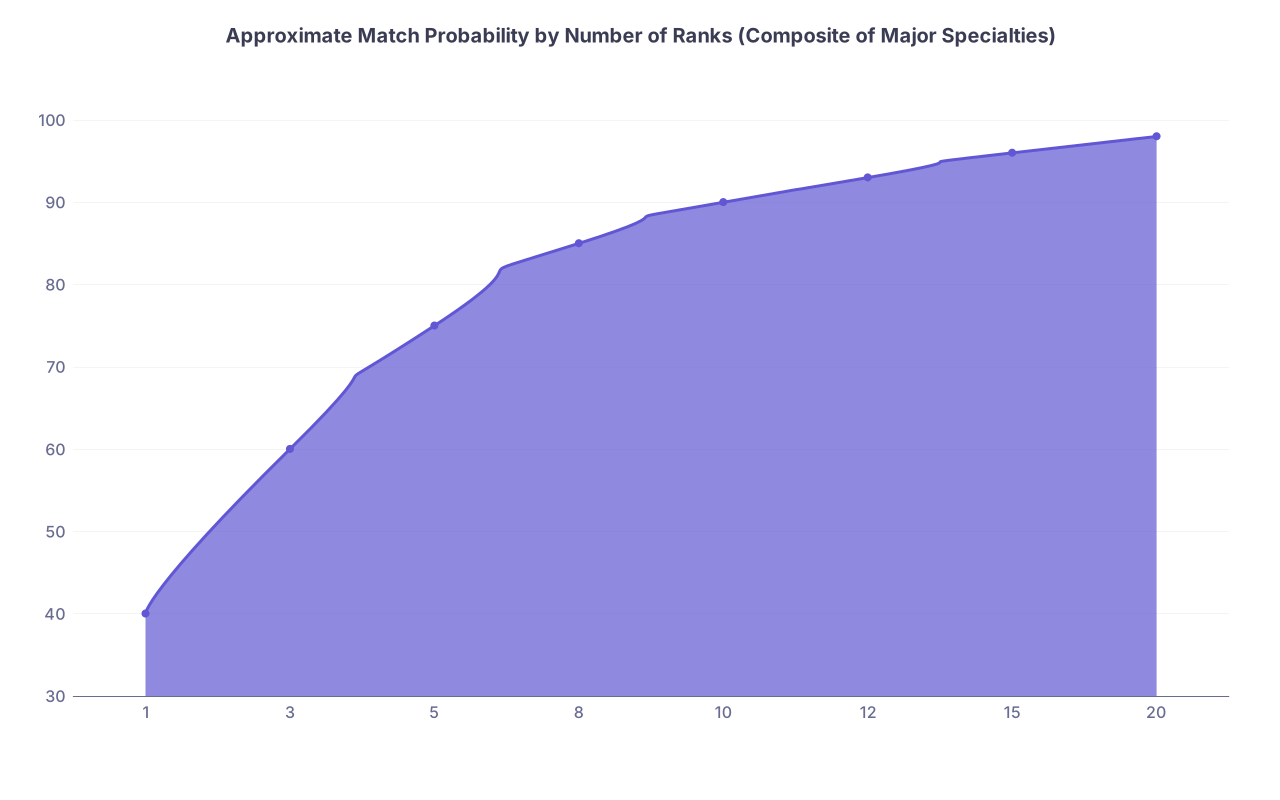
A simplified composite view from recent NRMP data for U.S. MD seniors applying to categorical positions looks like this:
| Category | Value |
|---|---|
| 1 | 40 |
| 3 | 60 |
| 5 | 75 |
| 8 | 85 |
| 10 | 90 |
| 12 | 93 |
| 15 | 96 |
| 20 | 98 |
Interpretation:
- The jump from 1 to 5 ranks is huge: 40% → ~75% match probability (order-of-magnitude estimate).
- The most important milestones are hitting roughly 8–10 and then 12–15 ranks.
- Past 15–20, you see diminishing returns for most non-dermatology, non-plastic surgery, non-ortho scenarios.
Now layer in program type. Because a list of 10 interviews that is 90% low-volume community programs in non-urban areas does not carry the same odds as 10 interviews made up entirely of hyper-selective academic flagships.
Program Types Behave Differently
Let me split programs roughly into three categories, because the interview-to-rank dynamics differ:
- Academic / University-based programs
- Hybrid or “university-affiliated community” programs
- Pure community programs (often non-university, smaller faculty, local/regional focus)
Each category has different:
- Applicant pools
- Fill rates
- Rank list lengths
- Propensity to rank interviewees
This changes how many interviews in each bucket translate into realistic rank positions.
1. Academic / University Programs
Academic programs, especially in desirable metros or top-name institutions, are heavy on:
- High Step 2 scores among interviewees
- Significant research among applicants
- Home institution bias (home students and visiting rotators get a bump)
They also tend to:
- Over-invite relative to their positions, because they can.
- Rank selectively. Some candidates leave the day effectively functionally “rejected,” though they do not know it yet.
In practical terms, a single academic interview in a highly competitive specialty behaves like a low-probability lottery ticket. You cannot count it the same as a community interview from a program that struggles to fill.
2. Hybrid / University-Affiliated Community Programs
These are mid-tier in most respects:
- Moderate research exposure
- Decent name recognition in-region
- Often have a mix of academic and community flavor
These programs typically have:
- Reasonable fill rates
- Less extreme competition than top academic centers
- A fairly stable behavior: if they interview you, there is a decent chance you are rankable
One hybrid interview generally carries more realistic match weight than an aspirational academic interview but less than a low-demand community program in an unpopular location.
3. Pure Community Programs
Community programs are not all the same, but across NRMP data you see a pattern:
- Some community programs in saturated cities are very competitive.
- Many community programs, especially in smaller cities or non-coastal states, routinely face unfilled positions and depend on SOAP.
- They sometimes interview fewer people per position and rank more generously.
For a risk-averse applicant, these are the programs that turn a marginal interview portfolio into a safe one.
A Data-Driven Comparison: How Interviews Convert to Match Odds
Let me put rough numbers to this based on a composite of NRMP patterns and actual rank list behavior I have seen across multiple cycles.
These are not official NRMP numbers; they are realistic approximations that capture the shape of your risk curve, assuming:
- U.S. MD or DO senior
- Applying in a moderately competitive core specialty (IM, Peds, EM, Anesthesia, FM, OB/Gyn)
- No catastrophic red flags
| Interview Mix (10 total) | Est. Match Probability |
|---|---|
| 8–10 academic, top-heavy, big cities | 60–70% |
| 5 academic / 5 hybrid | 75–85% |
| 3 academic / 4 hybrid / 3 community | 85–90% |
| 2 academic / 3 hybrid / 5 community | 90–95% |
| 0 academic / 3 hybrid / 7 community (spread out) | 95%+ |
Same number of interviews. Completely different risk.
This is why “you are fine with 10–12 interviews” is sloppy advice unless you specify: 10–12 what.
Interview-to-Rank Ratios by Program Type
Now let us talk ratios explicitly. For most applicants, the number of interviews ≈ number of ranks. However, by program type, the effective value of each interview (in terms of realistic rank list power) differs.
Think about a notional “effective rank weight”:
- Academic interview at a very competitive program: weight ~0.7–0.9 (more interviewees per spot, more internal candidates)
- Hybrid mid-tier program: weight ~1.0
- Lower-demand community program: weight ~1.1–1.3 (they are less likely to skip ranking you altogether)
If we scale 1.0 as “average” rank weight, then a portfolio of 10 interviews might produce the equivalent of 8–9 “average” ranks (if top-heavy academic) or 11–12 “average” ranks (if mostly hard-to-fill community spots).
In other words, the strict interview-to-rank ratio (numerically) is near 1.0, but the effective ratio for match odds is not.
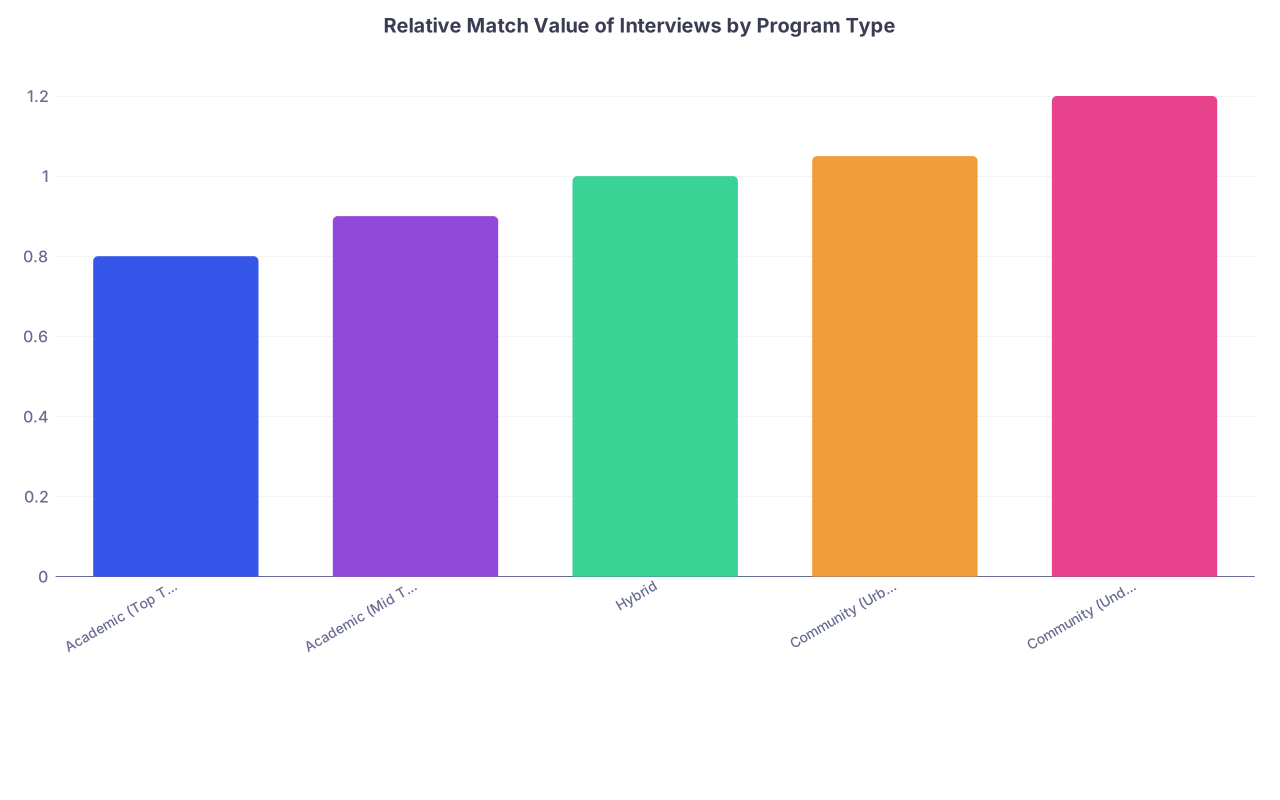
Here is a cleaner way to visualize this for a mid-range core specialty:
| Category | Value |
|---|---|
| Academic (Top Tier) | 0.8 |
| Academic (Mid Tier) | 0.9 |
| Hybrid | 1 |
| Community (Urban) | 1.05 |
| Community (Underserved) | 1.2 |
Interpretation:
- One interview at an underserved community program carries ~1.2x the “rank list safety” of a mid-tier hybrid.
- One interview at a flagship academic program carries maybe 0.8x the “rank list safety” of a mid-tier hybrid, purely because of volume and selectivity.
So your interview-to-rank ratio by program type is not just a count. It is a weighted portfolio. Applicants who ignore this end up surprised on Match Day.
Academic-Heavy vs Community-Heavy Strategies
Let me break down two common scenarios and what the stats suggest about interview-to-rank ratios.
Scenario A: Academic-Heavy Applicant
Profile:
- Wants big-name academic IM, EM, Anesthesia, Peds, etc.
- Above-average scores, solid research, but not at the very top.
- Interview list: 12 total – 8 academic, 3 hybrid, 1 community.
On paper: “12 interviews, I should be fine.”
Statistically, this looks more like:
- 8 academic = 8 × 0.8 ≈ 6.4 effective
- 3 hybrid = 3 × 1.0 = 3.0
- 1 community = 1 × 1.1 ≈ 1.1
Total effective interviews ≈ 10.5 “average” ranks.
Good, but not bulletproof. Especially if:
- Several academic programs are ultra-competitive and interview >15 candidates per position.
- You are regionally constrained and would not actually go to a few of these places.
For this applicant, the data suggests:
- Aim for 14–16 total interviews or
- Add 2–3 more community/hybrid programs to increase effective rank weight
Once they hit the equivalent of ~13–15 “average” ranks, their probability of matching jumps into the >95% range in core specialties.
Scenario B: Community-Heavy Applicant
Profile:
- Wants to match in FM, IM, or Peds. Location flexible.
- Average or slightly below-average board scores, minimal research.
- Interview list: 9 total – 2 academic, 3 hybrid, 4 community (including underserved/rural).
Effective interviews:
- 2 academic mid-tier = 2 × 0.9 = 1.8
- 3 hybrid = 3 × 1.0 = 3.0
- 4 community (mixed) ≈ 4 × 1.15 = 4.6
Total ≈ 9.4 “average” ranks.
Surprisingly, the risk profile is similar to the academic-heavy applicant with 12–13 interviews. This applicant, despite having fewer interviews numerically, may actually have as safe or safer Match odds in a core specialty because the programs are more likely to rank and need them.
I have seen exactly this play out: an applicant with 8–9 interviews, almost all at community-heavy programs, matching comfortably while someone with 12–14 big-name academic interviews anxiously watches the Monday-of-Match-Week email.
Specialty Matters: You Cannot Ignore Competitiveness
Program type is not the whole story. Specialty competitiveness changes the baseline slope of your probability curve.
Roughly:
- Very competitive specialties (Derm, Ortho, Plastics, ENT, Neurosurgery):
- Many successful applicants show 13–20+ interviews.
- Community vs academic still matters, but the floor number is just higher.
- Moderately competitive (EM, Anesthesia, OB/Gyn, Gen Surg at desirable places):
- Reasonable safety often starts around 12–14 interviews with some community/hybrid content.
- Core / broader specialties (IM, FM, Peds, Psych, Pathology):
- Many applicants match with 8–10 interviews if program mix is favorable.
For the context of “How to choose the right residency program,” the takeaway is simple: if you are targeting primarily academic programs in a competitive specialty, your needed interview-to-rank ratio is substantially higher than the generic advice indicates.
You are not safe with 10 interviews if 8 of them are aspirational.
Translating Stats Into Concrete Targets by Program Type
Let me boil this into actual targets for U.S. MD/DO seniors in core specialties (IM, FM, Peds, Psych, EM, Anesthesia, OB/Gyn, Gen Surg) who do not have major red flags.
Safer Match Ranges by Program Mix
Assuming you are willing to rank all programs you would realistically attend:
| Program Mix (Approximate) | Safer Interview Target | Comment |
|---|---|---|
| ≥70% academic, high-demand cities | 14–16+ | Aggressive portfolio, higher risk |
| 50% academic / 30% hybrid / 20% community | 12–14 | Balanced but still selective |
| 30% academic / 40% hybrid / 30% community | 10–12 | Solid portfolio |
| ≤20% academic / 40% hybrid / 40% community | 8–10 | Usually safe in core specialties |
If you are below these ranges and your mix is top-heavy academic, the data is clear: your odds of going unmatched are higher than you think.
Conversely, if you have 8 interviews and 5–6 of them are at low-demand community programs that historically fill late or SOAP, your risk profile may actually be acceptable—assuming you truly are willing to attend them.
How to Use This When Building and Adjusting Your Rank List
Theory is nice. Let us convert it into moves.
Step 1: Classify Your Programs
Go down your interview list and label each as:
- Academic (flagship / top-tier)
- Academic (mid-tier, less competitive)
- Hybrid
- Community (high-demand location)
- Community (underserved, rural, or historically underfilled)
You can often infer this from:
- Whether they routinely SOAP in prior years (ask residents bluntly).
- Their reported fill rate in NRMP Program Director Survey.
- Their city and reputation (yes, reputation correlates with demand).
Step 2: Count Your “Effective” Interviews
Assign rough weights, for internal use only:
- Academic flagship: 0.8
- Academic mid-tier: 0.9
- Hybrid: 1.0
- Community, urban: 1.05
- Community, underserved/underfilled: 1.2
Multiply and sum. That is your “effective interview count.”
Now compare:
- If effective interviews ≥ 12–13 in core specialties → your list is generally robust.
- If effective interviews 8–11 → moderate risk, depends on your personal red flags and preferences.
- If effective interviews < 8 → high risk; consider SOAP risk and whether you are under-ranking places you should keep.
Step 3: Decide How Aggressive Your Rank Strategy Can Be
I have watched applicants sabotage themselves by:
- Cutting 2–3 “safety” community programs from the bottom of their list because they “cannot see themselves there.”
- Keeping only hyper-competitive academic programs on the list, ending up with 7–8 total ranks.
Statistically, that is just gambling. The data shows the probability drop is not linear. Once your rank list shrinks below ~8–10, your curves fall fast.
If you want to roll the dice, fine. But do it with your eyes open:
- If your effective interview count is below ~10 in core specialties, deleting any program from your rank list materially increases your risk of going unmatched.
- Each “safety” community program you add or retain at the bottom of your list can add 3–5 percentage points of Match probability, sometimes more.
A Quick Visual: Rank Length vs Match Odds
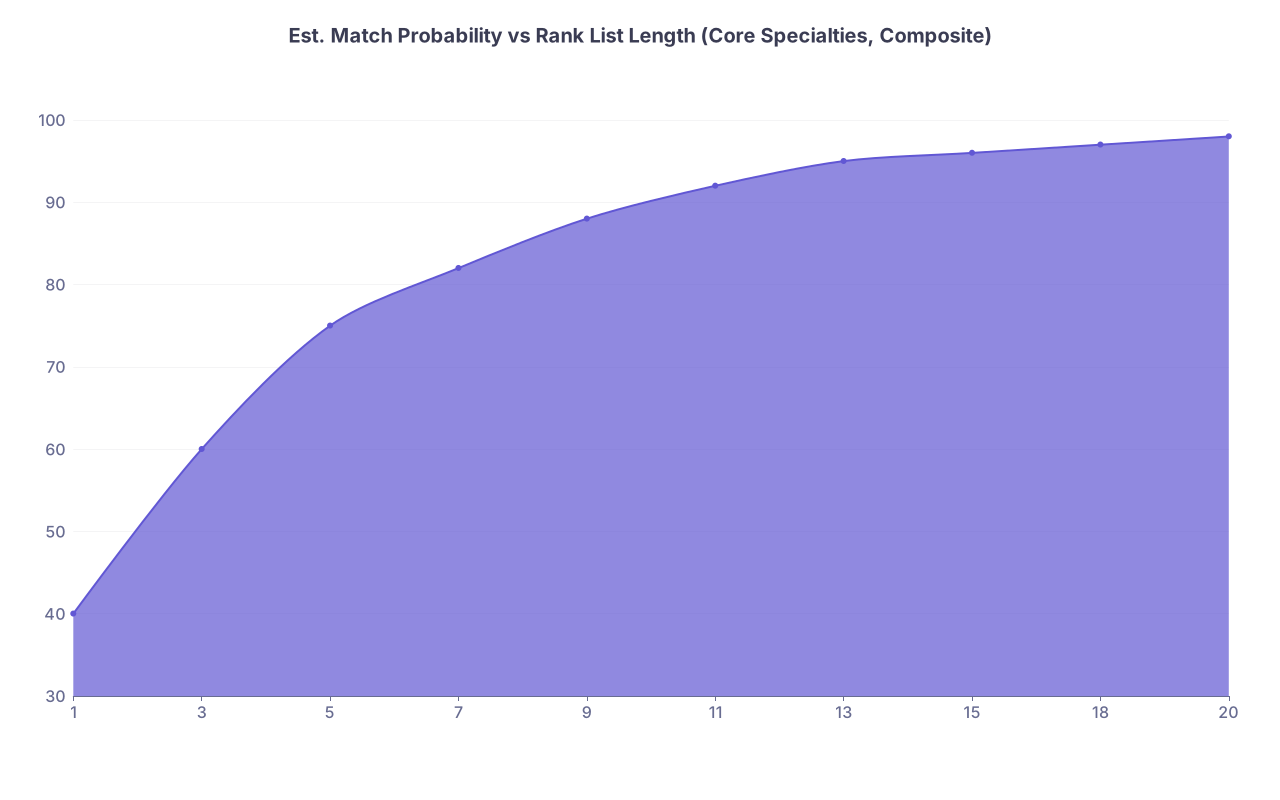
Let’s close the loop with the key driver: number of programs ranked. Again, these are approximate composite values, not specialty-specific.
| Category | Value |
|---|---|
| 1 | 40 |
| 3 | 60 |
| 5 | 75 |
| 7 | 82 |
| 9 | 88 |
| 11 | 92 |
| 13 | 95 |
| 15 | 96 |
| 18 | 97 |
| 20 | 98 |
Notice the breakpoints:
- Going from 3 → 7 ranks: huge change (60% → ~82%).
- Going from 7 → 13 ranks: still substantial (82% → ~95%).
- Going from 13 → 20 ranks: smaller incremental gains (95% → ~98%).
Your program type mix largely determines how difficult it is to get your list into that 10–15 zone.
What the Stats Actually Suggest
Let me be blunt.
A raw count of “10–12 interviews” is not a universal safety threshold.
It is only meaningful when you specify what type of programs those interviews are, and in which specialty.Academic-heavy interview lists require more interviews to reach the same Match probability.
Flagship university programs over-invite and are more selective in ranking; each interview is “worth less” in terms of match odds than an interview at a lower-demand community program.The smartest applicants treat interviews like a portfolio and weight them by program type.
They aim for an effective rank count in the 12–15 range for core specialties, using a mix of academic, hybrid, and community programs, rather than gambling on a thin list of prestige shots.
If you internalize those three points, you are already ahead of most of your competition.