
The way most applicants “feel out” residency programs is inefficient and biased. The NRMP Program Director Survey gives you harder numbers—and those numbers should be driving how you prioritize program features.
You are not guessing what matters. Program directors literally ranked it for you.
1. What the NRMP Program Director Survey Actually Tells You
Every few years, the NRMP asks program directors a simple but brutal set of questions:
- Which factors do you use to decide who gets an interview?
- Which factors do you use to decide who ranks highly?
- For each factor:
- What percentage of applicants have this factor?
- How important is it (on a 1–5 scale)?
The data varies by specialty, but the patterns are remarkably stable. The survey is not perfect, but as a directional tool for choosing and comparing residency programs, it is better than vibes, social media, or what your friend’s cousin’s co-intern said.
Here is the key mental shift:
You should not only ask, “What matters for me to get in?”
You should also ask, “What does this data tell me about how programs think—and which program features are truly critical to my long‑term goals?”
Because the survey is a window into:
- How academic vs community programs screen
- How competitive different specialties are
- How much weight programs give to things like research, prestige, geographic connections, and perceived ‘fit’
That directly feeds into:
- Which programs to apply to
- How to prioritize features (location, prestige, fellowship pipeline, work-life balance)
- Where to stretch and where to be safe
2. Core Survey Metrics You Should Map to Your Priorities
The survey is long. You do not need all of it. You need a focused subset that actually shifts your decision‑making.
The main quantitative levers:
- Percentage of programs using each factor for interview offers
- Mean importance rating for each factor
- Step/COMLEX score distributions (screening thresholds)
- Research importance (especially for academic specialties)
- Class ranking/AOA and school reputation effects
- Program size and fill rate (from other NRMP data, but interpret alongside survey results)
Let us anchor this in a concrete example. Assume a representative (simplified) slice of PD survey data for interview decisions:
| Factor | % Programs Using | Mean Importance (1–5) |
|---|---|---|
| USMLE Step 2 CK / COMLEX Level 2 | 85% | 4.3 |
| Grades in core clerkships | 78% | 4.1 |
| Perceived commitment to specialty | 70% | 4.0 |
| Letters of recommendation | 82% | 4.2 |
| Research in specialty | 55% | 3.4 |
You do not need the exact current-year numbers to see the hierarchy. The data consistently says the same thing across cycles:
- Scores and clinical grades are gatekeeping variables.
- Specialty commitment and letters are signal amplification variables.
- Research is variable weight—critical for some paths, optional for others.
Now you turn that into program‑selection criteria.
3. Linking Survey Data to Program “Types”
Programs are not monolithic. PD survey responses vary by:
- Specialty
- Program setting (university, university‑affiliated, community)
- Size and fill pressure
Broad patterns show up again and again:
Academic/university programs
- Higher reliance on research, school reputation, and AOA/honors
- Stronger preference for high Step 2 CK / Level 2 scores above specialty medians
- More attention to scholarly productivity (publications, presentations)
Community programs
- Higher relative weight on clinical performance and letters from known clinicians
- Less rigid about research, sometimes more flexible on test score thresholds
- More focus on “fit,” communication skills, and likelihood to stay and work locally
Highly competitive specialties (Derm, Ortho, Plastics, ENT, Rad Onc, etc.)
- Survey data shows near‑universal use of standardized test scores
- Research and specialty‑specific experiences often near the top of the importance list
- “Commitment to specialty” and “away rotations” heavily weighted
Moderately competitive / primary care specialties (IM, FM, Peds)
- Broader variation in what programs emphasize
- Often more room to trade research for strong clinical performance and fit
- Location and applicant’s geographic ties more openly considered
The survey basically tells you: different program types optimize for different applicant profiles.
You should respond by matching your data (scores, grades, research, geography, life constraints) to the program data (PD priorities, structure, outcomes).
4. Translating PD Priorities into Program Feature Priorities
Here is where most applicants fail. They read the PD survey as “how to get interviews,” then return to ranking programs by location, reputation, and hearsay.
The smarter play is to reverse‑engineer which program characteristics matter most for your long‑term plan, using PD priorities as a guide.
4.1. If test scores are heavily weighted in your specialty
Survey pattern: Step 2 CK / Level 2 used by 80–95% of programs with high importance.
Implications:
- High scorers can justifiably prioritize:
- Academic centers
- Strong fellowship pipelines
- Research‑heavy environments
- Lower scorers must be more tactical:
- Target more community and hybrid programs
- Prioritize program cultures known to value clinical growth over pedigree
- Consider mid‑tier academic programs in less popular locations
But here’s the key: do not waste energy obsessing about minor lifestyle differences when your match probability is strongly driven by whether a program’s culture is score‑obsessed or more holistic.
For each specialty, you can roughly map competitiveness versus average Step 2 CK:
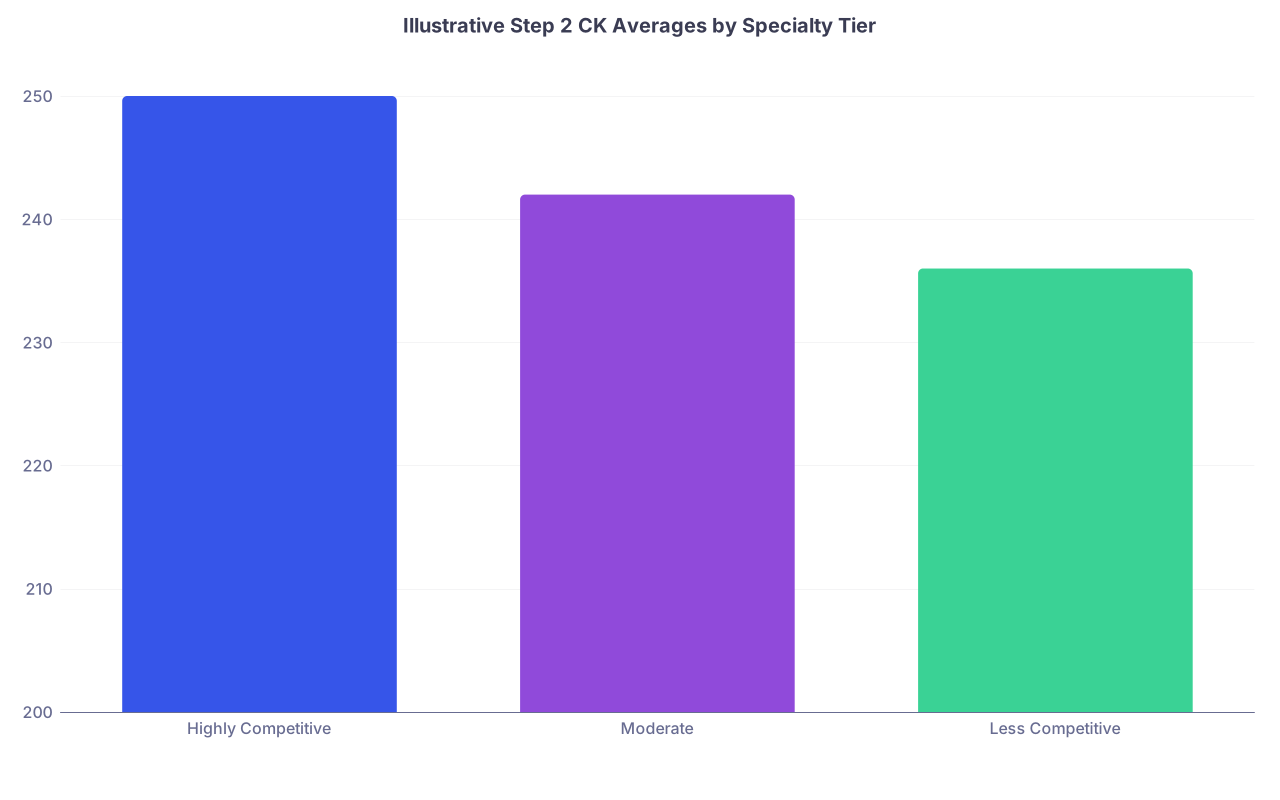
| Category | Value |
|---|---|
| Highly Competitive | 250 |
| Moderate | 242 |
| Less Competitive | 236 |
Use this to ask:
“Do I belong in the top, middle, or lower tier of this distribution?”
Then tilt your applications to programs whose behavior (from PD survey and reputation) matches where you realistically sit.
4.2. If research is heavily weighted in your target path
Some PD survey specialty sections show:
- ≥70% academic programs rating research experience as moderately or very important
- Higher rank given to applicants with publications, especially in the specialty
That should immediately affect how you prioritize program features.
If you are targeting an academic fellowship (Cards, GI, Heme/Onc, ICU, etc.) or a research‑centric specialty:
You should elevate:
- Programs with:
- Visible research infrastructure
- NIH funding
- Active clinical trials
- Structured research tracks
- Programs where PD survey patterns align with what you want:
- High importance on research in their specialty
- Clear pipeline into research fellowships
You should down‑weight:
- Programs that consistently produce mostly community‑bound graduates
- Programs with limited scholarly output (you can literally count publications on PubMed tied to the department if you want to be aggressive)
4.3. If specialty commitment is high on PD lists
Survey after survey, “demonstrated commitment to specialty” ranks near the top.
This is not just about getting interviews. It tells you something about how programs think and what they value day‑to‑day.
If commitment is top‑weighted, you should prioritize programs where:
- You actually want to do that specialty long term
- You have evidence you fit their profile:
- Away rotation there
- LOR from their faculty
- Aligned clinical interests
Do not rank a program highly just because of location or name if your application clearly does not match what PDs in that culture say they prioritize. You will feel that mismatch on day one.
5. Converting Survey Data into a Personal Program Scoring Model
If you really want to think like a data analyst, you stop arm‑wrestling vague pros and cons and build a weighted scoring system.
Step 1 – Pull out the PD survey factors that matter most in your specialty.
Step 2 – Decide which of those should drive your residency feature priorities.
Step 3 – Assign weights.
Example: Let’s assume you are an internal medicine applicant targeting cardiology fellowship. Based on PD survey patterns, the factors you care most about for program selection might be:
- Fellowship match strength
- Research opportunities and expectations
- Clinical volume and complexity
- Program reputation (for fellowship placement)
- Geographic constraints
Now align this with known PD priorities:
- PDs value research and academic productivity -> you must prioritize programs where that is possible.
- PDs care about clerkship performance and letters -> you benefit from programs with strong mentorship and close attending interaction.
You could create a simple 1–5 scoring matrix for each program:
| Feature | Weight (1–5) | Program A | Program B | Program C |
|---|---|---|---|---|
| Cardiology fellowship pipeline | 5 | 5 | 3 | 2 |
| Research infrastructure | 4 | 4 | 2 | 1 |
| Clinical volume/complexity | 4 | 4 | 3 | 3 |
| Reputation among IM PDs | 3 | 4 | 3 | 2 |
| Geographic fit | 2 | 2 | 5 | 4 |
Then compute a weighted score. It is crude, but it forces discipline:
- Program A: (5×5) + (4×4) + (4×4) + (3×4) + (2×2) = 25 + 16 + 16 + 12 + 4 = 73
- Program B: (5×3) + (4×2) + (4×3) + (3×3) + (2×5) = 15 + 8 + 12 + 9 + 10 = 54
- Program C: (5×2) + (4×1) + (4×3) + (3×2) + (2×4) = 10 + 4 + 12 + 6 + 8 = 40
This mirrors what the PD survey is doing on their side. You align your ranking process with the way decision‑makers actually think: structured, weighted, not purely emotional.
6. Using PD Survey Data to Adjust Your Application Strategy
There is another layer here: not just picking programs, but deciding how aggressively to apply and how to segment your list.
The PD survey and NRMP match data together show a simple reality:
- Over‑reaching (too many programs whose PD priorities do not match your metrics) → higher risk of not matching.
- Over‑conservative (only programs where you’re overqualified relative to PD priorities) → you sacrifice fit, opportunity, and maybe long‑term goals.
If you map programs by how hard they lean on specific factors that are either your strength or weakness, you can categorize:
- Green: PDs emphasize factors that are your strengths (scores, research, clinical performance, geography).
- Yellow: Mixed alignment.
- Red: PDs emphasize your weaknesses.
Then build an application portfolio with something like:
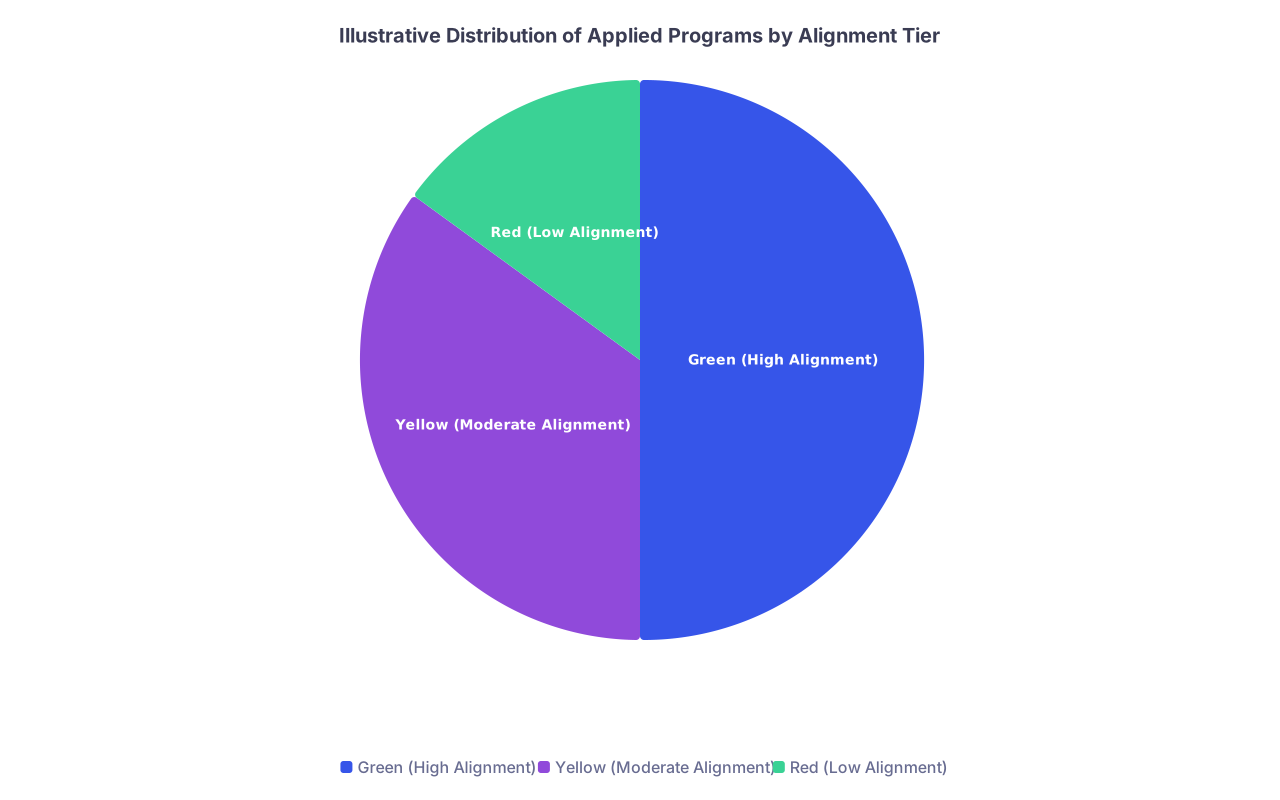
| Category | Value |
|---|---|
| Green (High Alignment) | 50 |
| Yellow (Moderate Alignment) | 35 |
| Red (Low Alignment) | 15 |
If your “Red” slice is much larger than ~15–20%, you are gambling more than the data justifies.
7. How Different Applicant Profiles Should Use the Survey
Let me walk through a few concrete archetypes and how I have seen them misinterpret or correctly leverage PD survey data.
7.1. Strong scores, moderate research, flexible location
Profile:
- Step 2 CK significantly above specialty mean
- Decent but not stellar research
- No strict geographic limitation
What the PD survey says for you:
- Programs that heavily weight scores will love you.
- Academic programs that also care about research may still rank you high if your scores ease concerns about board pass rates.
- Community programs may consider you an “overqualified flight risk.”
Your move:
- Prioritize higher‑tier academic and hybrid programs; these programs often self‑report high reliance on test scores and academic metrics.
- Do not oversubscribe to small community programs that mostly train local, stay‑in‑area physicians unless you genuinely want that path.
7.2. Average scores, strong research, wants academic career
Profile:
- Scores close to or slightly above the mean for the specialty
- Multiple publications, posters, projects
- Clearly articulated academic goals
PD survey trends:
- For research‑heavy specialties/programs, academic productivity can offset mid‑range scores.
- PDs in these programs explicitly rate research and scholarly potential high in importance.
Your move:
- Target university programs where the PD survey shows research importance is high.
- De‑prioritize programs whose own outputs show minimal academic productivity.
- When ranking, bump up programs with protected research time and mentorship, even if lifestyle is slightly worse.
7.3. Below‑average scores, strong clinical performance, geographic ties
Profile:
- Scores a bit below specialty median
- Honors in core clerkships, strong clinical LORs
- Strong ties to a specific region or state
PD survey trends:
- Many programs, especially in primary care and some IM/FM programs, weight geographic ties and clinical performance highly.
- Some community programs are much less rigid on scores if other boxes are checked.
Your move:
- Use the survey to identify specialties/program types where clinical performance and commitment outrank pure numbers.
- Prioritize programs in your target region where PDs historically favor local graduates and regional candidates.
- De‑emphasize prestige as a priority and lean into alignment with PD preferences (fit, likelihood to stay, work ethic).
8. Red Flags When You Ignore the Data
I have watched these patterns play out:
- Applicant targets “top name” programs in a specialty where PDs heavily weight research and AOA. Applicant has neither. Application list is 80% misaligned. Outcome: under‑interviewed, ends up scrambling or SOAPing.
- Applicant with very strong Step 2 CK applies mostly to lifestyle‑hyped but academically weaker programs because “the residents seemed chill.” Later, during fellowship applications, applicant realizes their program’s PD network is weak in desired subspecialty.
Both mistakes share a common issue: they did not translate survey‑level PD priorities into program‑level decisions.
Any program where PDs care about:
- Board pass rates
- Fellowship placement metrics
- Research productivity
…will, in practice, prioritize applicants and residents who help those numbers. You should pick programs where your strengths match that incentive structure.
9. A Practical 5‑Step Workflow for Using the PD Survey
If you want a clean process, do this:
Identify your specialty’s PD survey section.
Pull out the top 5–7 factors by “% of programs using” and “mean importance” for interview and ranking decisions.Map those factors to your personal strengths and weaknesses.
Be blunt. If research is rated 4.5/5 and you have nothing, that is a mismatch. If Step 2 CK is a 4.6/5 factor and you are at or below average, adjust expectations.Classify programs by type.
Use public data and reputational info to roughly categorize: academic, hybrid, community; heavy‑research vs clinically focused; regional vs national draw.Define your weighted priorities.
Based on PD data and your goals, pick 5–7 program features that matter most (fellowship pipeline, research, geography, workload, clinical complexity). Assign weights.Score and rank programs.
For each program: rate them on each feature (1–5) and compute a weighted score. This does not replace gut feeling but forces you to see where your emotions are fighting the data.
You are not removing subjectivity. You are constraining it with structured information from the people who control the positions.
Key Takeaways
- The NRMP Program Director Survey is not just about “getting interviews”; it is a roadmap to how different program types think and what they reward.
- You should align your program priorities—research, prestige, geography, lifestyle—with the factors PDs in your specialty actually rate as important.
- A simple, weighted scoring system grounded in survey data will outperform intuition alone when deciding where to apply and how to rank residency programs.