
The way most applicants compare residency programs is statistically weak. They overvalue vibes and underweight the only three metrics that consistently predict training quality: board pass rates, case logs, and fellowship outcomes.
If you want to choose the right residency, you need to think like a data analyst, not a tourist on interview day.
This is the hard truth: the difference between a program where 100% of residents pass boards and one where 80% pass is not “just a small gap.” Over a 4-year span, that is the difference between essentially guaranteed certification and a real risk of scrambling into remediation, delayed practice, or re-taking exams with all the stress and cost that implies.
Let’s break this down systematically.
The Three Signals That Actually Predict Training Quality
You are drowning in noise: glossy websites, simulation centers, resident wellness blurbs, free lunch photos on Instagram. The data shows that three signals carry disproportionate weight for objective training quality:
- Board pass rates (ABIM, ABS, ABEM, ABFM, etc.)
- Case logs / procedural volume and diversity
- Fellowship match rates and destinations
Everything else is secondary. Culture, location, and call structure matter for your life, but they do not compensate for weak training fundamentals.
To make this concrete, I will assume a specialty (say Internal Medicine or General Surgery), but the logic generalizes to almost all residency programs.
Board Pass Rates: Your First Hard Filter
If a residency cannot consistently get its graduates over the board-certification finish line, that is a serious red flag. Not a minor quirk.
How to interpret board pass rates numerically
Suppose you have three Internal Medicine programs over a recent 3-year window:
| Program | 3-Year Pass Rate | Graduates per Year | Estimated Failures per 3 Years |
|---|---|---|---|
| Program A | 99% | 20 | ~1 |
| Program B | 92% | 25 | ~6 |
| Program C | 82% | 30 | ~16 |
Program C will often try to sell you on “complex pathology” and “we train independent thinkers.” The data tells a simpler story: out of ~90 grads over 3 years, maybe 15–20 failed boards. That is a lot of personal and professional damage.
Let me quantify the risk to you.
Assume the stated pass rate approximates your individual probability of passing (this is a simplification, but directionally correct):
- At 99%: 1% chance you fail on first attempt
- At 92%: 8% chance you fail
- At 82%: 18% chance you fail
The relative risk of failing at an 82% program vs a 99% program is about 18x. That is not noise. That is a different universe of risk.
Where to find the data
Most boards publish program-specific pass rates:
- ABIM: Internal medicine and subspecialty program pass rates
- ABS: General and subspecialty surgery outcomes
- ABEM: Emergency medicine
- ABFM: Family medicine
- Anesthesiology, Pediatrics, OB/GYN, etc. have similar public reporting
The pattern is clear when you look:
- Top-quartile programs: usually ≥95–98% multi-year pass rates
- Middle group: 90–94%
- Bottom group: often in the 70–85% range with significant year-to-year volatility
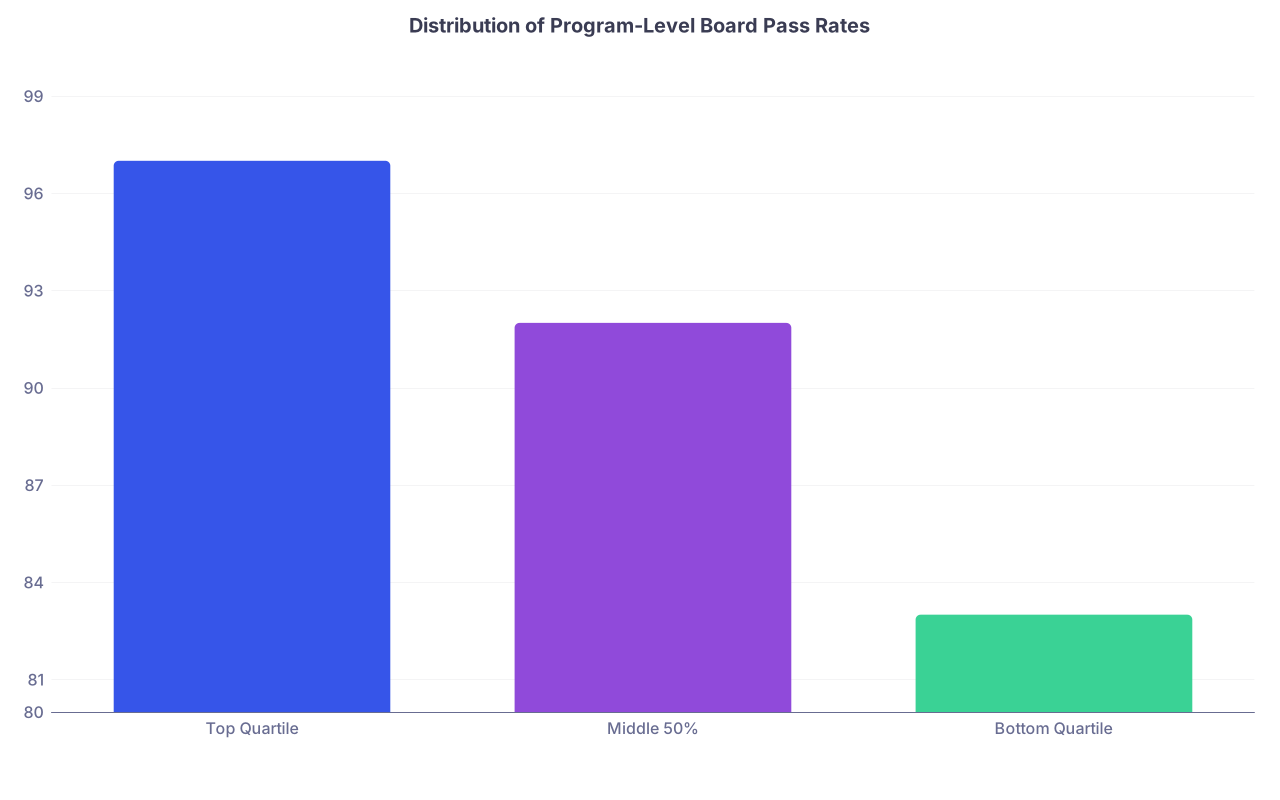
| Category | Value |
|---|---|
| Top Quartile | 97 |
| Middle 50% | 92 |
| Bottom Quartile | 83 |
You are not choosing between 93% and 94%. You are often choosing between structurally high-pass programs and structurally risky ones.
How to use board data in your rank list
Here is my blunt rule:
- Any program with a consistent multi-year pass rate below ~90% deserves intense scrutiny. It may still be worth it for geography or other factors, but you should know you are paying with higher risk.
- Programs in the 90–94% band: middle of the pack. Combine this with case logs and fellowship data before judging.
- ≥95–98%: this is baseline competence. Then the tie-breakers become case volume and career outcomes.
If a program director tries to hand-wave a poor record (“our residents are not test-takers,” “we see really sick patients”), you are getting an excuse, not an explanation.
Case Logs and Procedural Volume: What You Actually Do Every Day
Certification is the output; case logs are the inputs. They tell you what kind of clinical reality you will live in for 3–7 years.
The data question is simple: Will you reach graduation with enough volume and diversity to be safe and confident without supervision?
Interpreting case logs the right way
Most specialties track required minimums:
- Surgery: defined minimums for index operations (e.g., hernia, cholecystectomy, colectomy, etc.)
- OB/GYN: deliveries, C-sections, hysterectomies
- EM: intubations, central lines, sedations, pediatric cases
- Anesthesia: neuraxial, regional, peds, cardiac, etc.
Here’s the problem: the ACGME minimums are just that—minimums. Not targets for a strong program.
Take a typical surgical scenario:
| Case Type | ACGME Minimum | Program X Median | Program Y Median |
|---|---|---|---|
| Total Major Cases | 850 | 1050 | 1450 |
| Laparoscopic Chole | 85 | 120 | 200 |
| Inguinal Hernia | 50 | 70 | 110 |
| Colectomy | 20 | 30 | 55 |
The residents from Program Y will simply have seen and done much more. On day one as an attending, that translates into:
- Faster pattern recognition
- Better complication management
- Less hesitancy in the OR or clinic
Numbers like 120 vs 200 laparoscopic cholecystectomies matter. The literature on skill acquisition is clear: repetition drives performance, especially in procedural fields.
Variability across residents matters more than averages
Programs love to quote “our average resident graduates with 1,200 cases.” That hides the real story: distribution.
If one chief logs 1,600 cases and another logs 850, you have a problem. The weaker resident is still technically “meeting requirements,” but their real-world readiness is different.
Look for clues that the distribution is tight, not just the mean:
- Ask: “How often do residents struggle to meet case minimums?”
- Ask: “Are cases ever reassigned from seniors to juniors when they are short?”
- Ask: “Do you track case volume by resident in real time and intervene?”
Programs that actually monitor and adjust usually have more uniform outcomes.
How to compare case volume when you cannot see the raw logs
You will not always get transparent spreadsheets. So you have to infer:
Ask graduating seniors concrete questions:
- “How many intubations do you have logged right now?”
- “How many C-sections/deliveries did you perform as primary?”
- “Do people scramble for cases or are there more than enough?”
Cross-check with environment:
- Is this the primary hospital for trauma/OB/surgery in its region?
- Are there competing fellowships that take away cases?
- Are there multiple residency programs fighting over the same pool of procedures?
Watch for red flags:
- Seniors saying “we hit minimums easily, but just barely”
- Heavy reliance on simulation to backfill deficits
- Residents talking about “signing up” or “lotteries” for basic cases
Anything that sounds like rationing routine bread-and-butter cases is a structural weakness.
Fellowship Match Outcomes: The Market’s Judgment of the Training
Board pass rates measure whether the program gets you to baseline. Case logs measure what you actually did. Fellowship outcomes measure how the rest of the field values your training.
If you want a competitive fellowship (GI, cardiology, heme/onc, surgical subspecialties, EM critical care, etc.), you ignore these numbers at your own risk.
What the fellowship data should tell you
You want three things:
- Match rate among residents who actually applied
- Competitiveness of those fellowships (e.g., GI vs endocrinology)
- Destination programs (home institution vs external, regional vs national”
Here is a stylized example from Internal Medicine:
| Program | GI/ Cards/ Heme-Onc Match Rate | Other Subspecialty Match Rate | Applied to Fellowship and Matched |
|---|---|---|---|
| Program A | 80% | 95% | 96% |
| Program B | 55% | 85% | 88% |
| Program C | 30% | 70% | 75% |
The spread is real. At Program C, 7–8 out of 10 residents who want a top-tier subspecialty may not get it on first try. That shows up in your life in 3–4 years as a closed door.
Let’s visualize the “applied vs matched” effect.
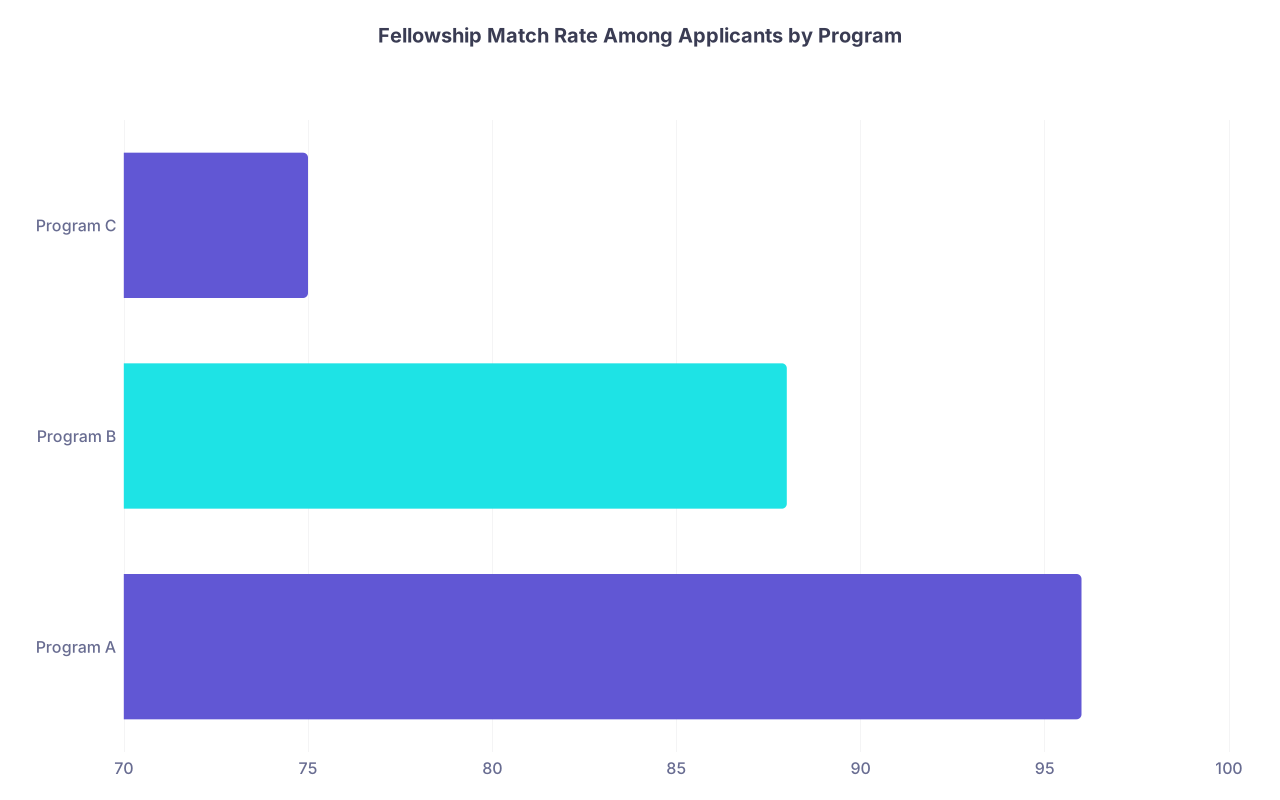
| Category | Value |
|---|---|
| Program A | 96 |
| Program B | 88 |
| Program C | 75 |
Program websites sometimes blur the denominator: “Over 90% of our residents pursue and successfully match into fellowship.” That line hides three critical questions:
- 90% of all residents or 90% of those who applied?
- What proportion went into highly competitive vs less competitive fields?
- How many matched at strong external programs vs only at home?
Reading between the lines on “home program” bias
If a program has a strong home fellowship and most residents match there, that can be good or bad.
- Good: Shows that the department trusts its own training and pipeline.
- Bad: If almost no one matches externally at similar-level programs, that sometimes signals weak national reputation.
You want a mix: some people staying, some going to strong outside institutions.
Ask specific questions:
- “In the last 5 years, where did GI applicants match?” (Make them list names.)
- “How many residents who applied GI or cards did not match and had to reapply?”
If they cannot or will not answer, that tells you a lot.
Putting It Together: A Comparative Framework
You are trying to choose between, say, three programs on your rank list. Let’s create a simplified but realistic comparison.
| Metric | Program Alpha | Program Beta | Program Gamma |
|---|---|---|---|
| 3-Year Board Pass Rate | 98% | 92% | 84% |
| Total Case Volume (Surgery) | 1400 median | 1150 median | 900 median |
| Residents Below ACGME Minimum | Rare | Occasional | Periodic |
| Fellowship Match (top fields) | 85% | 60% | 35% |
| External Fellowship Matches | Frequent | Some | Rare |
In words:
- Filter by board pass rates. Anything <90% requires a strong compensating reason.
- Among survivors, compare case volume and diversity. Favor programs clearly above ACGME minimums.
- If you care about fellowship, heavily weight match outcomes. Not just raw percentages, but destinations and fields.
- Use “soft” factors (location, culture, schedule) as tie-breakers, not primary drivers.
You are not trying to optimize a vacation. You are optimizing the next 30–40 years of your career.
How To Ask Smart Questions on Interview Day
You will not always get neat PDFs of board pass curves and fully transparent case logs. You will have to interrogate the system, politely but precisely.
Here are tighter questions that force useful data:
For board pass rates
- “What has your first-time board pass rate been over the last 5 years?”
- “How many residents have needed remediation or extra support for boards in that time?”
- “What specific board preparation structure do you have—didactics, protected time, in-training exam review?”
Programs that perform well usually know their numbers and talk concretely. Vague answers correlate strongly with mediocre statistics.
For case logs
- “Does any resident ever struggle to meet ACGME minimums? How often?”
- “Are there types of cases that are historically thinner here—trauma, peds, high-risk OB, advanced laparoscopy?”
- “Do you track case volume by resident in real time and intervene if someone is low?”
Listen for phrases like “we monitor continuously” vs “people usually end up fine.” The former is system-based, the latter is vibes-based.
For fellowship outcomes
- “For residents who applied to [target fellowship] in the last 5 years, what proportion matched?”
- “Can you give a few examples of where they matched, both here and externally?”
- “How strong is departmental support for research or mentorship for those subspecialties?”
When a chief or PD can rattle off programs—“Last year GI to Mayo and BIDMC, cards to our home program and UT Southwestern”—that usually reflects a healthy pipeline.
Balancing Data with Your Life Reality
You are not a robot. Money, geography, family, and personal happiness matter. There are legitimate scenarios where you may choose a weaker data profile for strong non-academic reasons.
Here is how to do that rationally:
Quantify the trade-off.
“If I choose Program C over Program A, my risk of failing boards roughly triples, I will likely have 25–30% fewer cases, and my odds of a competitive fellowship drop from ~80% to ~35%.”Ask if your goals align.
- If you want pure community practice and no fellowship, maybe strong case volume + decent pass rate is enough, and you care more about local connections.
- If you are fellowship-focused, sacrificing strong match data for weather is a poor bargain.
Accept that happiness still matters.
A program where you are miserable can drag down your board scores and your performance too. But “happy + undertrained” is not a win either.
The mature approach is not “ignore data, trust gut” nor “ignore gut, trust data.” It is recognizing where the numbers are non-negotiable (board certification, minimal procedural competence) and where you have room to trade (pedigree vs location, top-10 fellowship vs solid regional).
A Quick, Rough Scoring System You Can Use Tonight
If you like numbers, assign a 1–5 score to each dimension for every program you are considering:
- Board pass rate (5 = ≥97%, 4 = 93–96%, 3 = 90–92%, 2 = 85–89%, 1 = <85%)
- Case volume and diversity (5 = far above minimum, 3 = around minimum, 1 = below/struggle)
- Fellowship outcomes (for fellowship-oriented applicants; otherwise weight less)
- Personal factors (location, culture, schedule)
Then weight them:
- If fellowship-focused: Board (30%), Case Volume (25%), Fellowship (30%), Personal (15%)
- If non-fellowship practice-focused: Board (35%), Case Volume (35%), Fellowship (10%), Personal (20%)
You do not need this to be perfect. But the act of scoring forces you to confront reality. I have seen more than one applicant discover that the program they “liked most” was actually their weakest on every hard metric.
The Bottom Line
The market for residency spots is emotional on the surface and brutally quantitative underneath. Program directors are judged on board pass rates, case log compliance, and fellowship placement. Those same metrics will shape your career options long after interview day is a fuzzy memory.
If you discipline yourself to ask three core questions—
- How reliably do graduates pass boards?
- How many and what kinds of cases will I actually see?
- What do fellowship outcomes say about how the field values this training?
—you will already be ahead of most of your peers who are still optimizing free food and scenery.
You are not picking a 3-year experience. You are picking the foundation of a 30-year career. Use the numbers like the blunt instruments they are. Then layer your personal preferences on top, consciously, instead of letting them quietly override everything.
With that mindset and these metrics, you will build a rank list that actually serves your future self. The next step is just as important: learning how to communicate your goals and fit to those programs so they see you as a high-yield investment. But that is a story for another day.