
The way most residents talk about fellowship match rates is statistically sloppy—and that sloppiness will wreck your decision‑making if you copy it.
Programs love to throw out a shiny “90% fellowship match” line on interview day. Residents repeat it. Applicants nod. Nobody asks, “90% of who? Into what? Over how many years? With what denominator?” That is how bad choices get made.
You want to choose a residency that maximizes your odds of the fellowship you care about, not one that just markets well. That means reading beyond the headline percentages and forcing the numbers to tell the truth.
Let me walk through how to do that like a grown‑up analyst, not a brochure reader.
1. The Basic Fellowship Match Percentages Are Almost Always Misleading
Here is the core problem: “X% fellowship match” is usually a composite number that hides more than it reveals.
I have seen versions like:
- “95% of residents who applied matched into fellowship.”
- “80% of graduates go into fellowship.”
- “We place fellows at top programs every year.”
None of those sentences are inherently false. They are just incomplete. The data questions you should be asking immediately:
- What exactly is the denominator?
- Over how many years?
- Into which specialties?
- At what kind of programs?
Consider three different programs, all claiming “90% fellowship match.”
| Program | Claim | Reality summary |
|---|---|---|
| A | 90% match | Mostly cards/GI, heavy research, strong pipeline |
| B | 90% match | Mix of nephro/endo/ID, few competitive matches |
| C | 90% match | Only 10 residents applied; 9 matched in any program |
All three can truthfully say “90%.” Only one might be a good launchpad for cardiology or GI. The number is the same. The reality is not.
You have to stop consuming “match rate” like a single scalar. It is not. It is at least a 4‑dimensional problem: specialty, program tier, location competitiveness, and applicant self‑selection.
2. The Denominator Game: Who Actually Applied?
The nastiest statistical trick in this space is denominator manipulation. Programs quietly change who “counts” in their match rate.
Common patterns I have seen:
- Excluding residents who decided on fellowship late and applied weakly.
- Excluding people who only applied locally (“they were couples matching, so we did not count them”).
- Excluding residents who did research years or took time off.
- Only reporting on “categorical residents committed to fellowships” instead of the whole class.
Let me spell it out with numbers.
Program advertises: “92% of our residents who applied matched into fellowship last year.”
Reality under the hood:
- Total PGY‑3s: 30
- Residents who originally said they wanted fellowship: 24
- Residents who ultimately applied in NRMP/other match: 18
- Residents who matched anywhere: 16
Now compute three different “match rates” from the same data:
- 16 / 18 = 89% (of those who applied)
- 16 / 24 = 67% (of those who initially aimed for fellowship)
- 16 / 30 = 53% (of the whole graduating class)
A program rep will almost always quote you the 89–92% number. As an applicant, you should be thinking in the 50–70% range, because that is closer to the probability you are playing with ex ante if you arrive there wanting fellowship.
When you are on the interview:
- Ask: “How many PGY‑3s applied for fellowship last cycle, and how many matched?”
- Ask: “How many PGY‑1s start out saying they want a fellowship, and by PGY‑3 how many still pursue it?”
- Then do the math yourself. On paper. In front of them if you must.
You are not being difficult. You are being precise.
3. Specialty‑Specific Match Rates Matter Far More Than Global Ones
The data reality: “fellowship match rate” is almost meaningless if it is not stratified by specialty. Matching into endocrinology vs interventional cardiology are not even the same sport.
Most internal medicine programs have a decently high overall fellowship match rate because:
- Nephrology and geriatrics positions remain relatively undersubscribed.
- Many community programs match into local endocrine, rheum, or ID programs that are not hyper‑competitive.
- Residents self‑select—weak applicants often avoid cardiology/GI, boosting the apparent rate for those that do apply.
You should be asking targeted, specialty‑level questions. For example, suppose you care about cardiology, GI, or heme/onc. Then you want data like this, not noise about “80–90% overall fellowship match.”
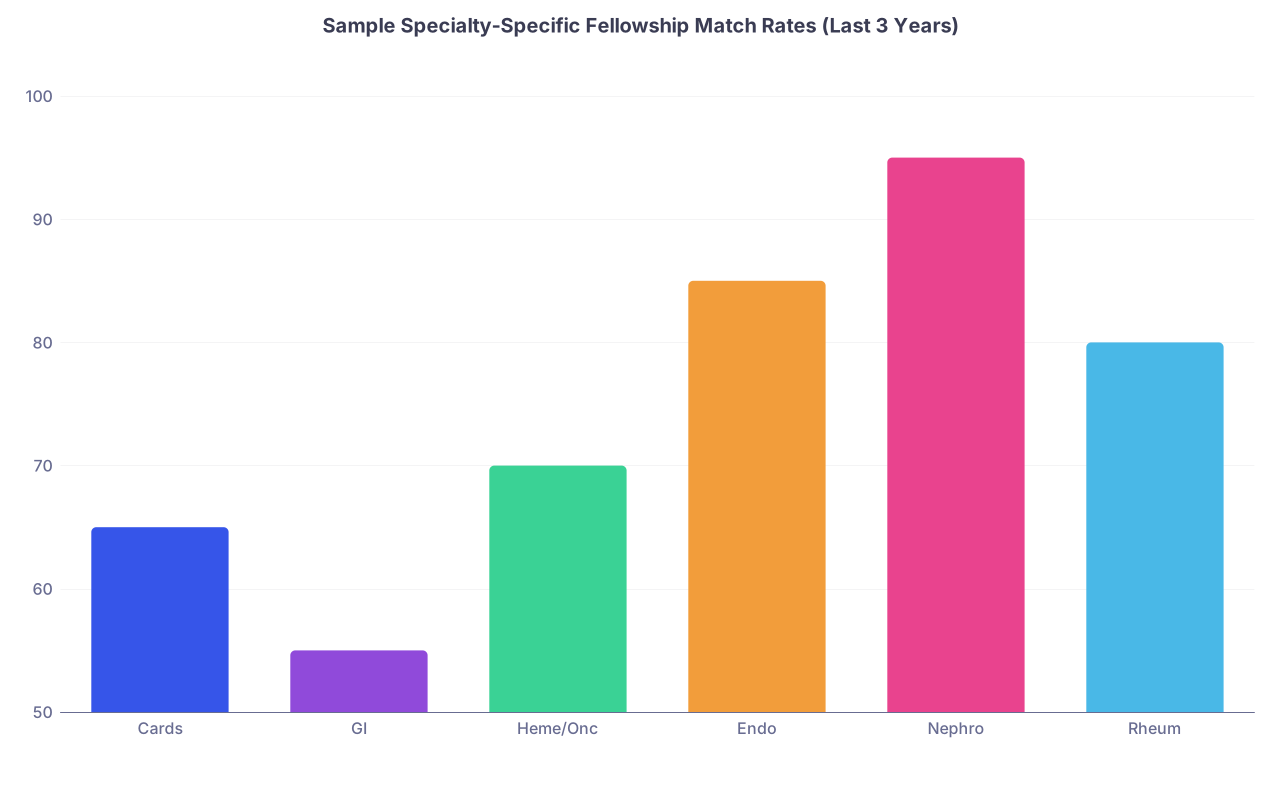
| Category | Value |
|---|---|
| Cards | 65 |
| GI | 55 |
| Heme/Onc | 70 |
| Endo | 85 |
| Nephro | 95 |
| Rheum | 80 |
Those are hypothetical but directionally accurate for many mid‑to‑strong academic programs:
- High match into nephro/endo/rheum.
- Noticeably lower, more volatile match into cards/GI.
When you are vetting a program:
- “Over the last 3–5 years, how many residents applied to cardiology, and how many matched?”
- “Were any of those unmatched strong applicants, or were they under‑prepared / late to decide?”
- “Where did they match? Home program vs external? Community vs university?”
If they will not break it down by specialty, interpret their top‑line number as marketing, not data.
4. Where People Match: Program Tier and Geography
Matching “into fellowship” is not binary success. The distribution matters.
Two dramatically different outcomes can both be described as “100% fellowship match.”
Program X (big‑name academic center):
- 6 applied to cardiology: 6 matched.
- Programs: 3 at home institution, 2 at other top‑20 academic centers, 1 at solid regional university.
Program Y (community program):
- 4 applied to cardiology: 4 matched.
- Programs: 3 at small community cardiology fellowships, 1 at mid‑tier university.
Both can say “100% cards match.” If you care about ultimate job prospects in a large academic system or procedural subspecialty, those are not equivalent.
Look for three distribution patterns:
Home vs away: Strong programs place a good number at their own fellowships and send others out to comparable or better places. If almost everyone stays home because nobody else takes them, that tells you something.
Academic vs community: If your goal is an academic career or a heavily procedural field, matching into university fellowships matters. If a program’s matches are predominantly community, adjust expectations accordingly.
Geographic reach: Programs that regularly send fellows to different regions (coasts, Midwest, South) have broader networks and reputational strength. Programs that only place locally are more limited.
You can organize what you learn in a simple grid when comparing programs.
| Metric | Program A | Program B | Program C |
|---|---|---|---|
| Cards applicants last 3 yrs | 12 | 8 | 5 |
| Cards match rate | 11/12 (92%) | 5/8 (63%) | 4/5 (80%) |
| Cards matches at top 30 programs | 7 | 1 | 0 |
| % matches internal vs external | 40 / 60 | 80 / 20 | 100 / 0 |
And you overlay that with your own profile:
- US grad vs IMG.
- Step scores / in‑training scores.
- Research background.
- Willingness to grind for 3 years on papers and QI projects.
A program that sends 3–4 people per year into your desired subspecialty, including some external placements, is a proven pipeline. One that has a single match every few years, even “to a great place,” is not a pipeline. It is a sporadic success.
10. A Quick Reality Check on Your Own Odds
I will be blunt here. The best fellowship match rate in the world will not rescue you from being a weak applicant. But the wrong residency environment can absolutely cap your ceiling.
Think in rough probability bands, not fantasies. For a given program and specialty, based on its multi‑year data, you can mentally group your odds if you perform at different levels:
- Top 10–20% of your residency class.
- Middle 50–60%.
- Bottom third.
The data pattern I have watched repeatedly:
- Top residents at solid academic programs almost always match into something good, often their first choice subspecialty.
- Middle‑of‑the‑pack residents at elite programs sometimes underperform middle‑of‑the‑pack residents at mid‑tier programs because they are competing against monsters and have less faculty attention.
- At community programs with weak academic ties, even top residents may struggle for cards/GI/onc unless they aggressively build external research and connections.
So as you evaluate fellowship match data, ask yourself realistically:
“If I end up being average at this program, what has happened historically to average people here who wanted my subspecialty?”
If nobody can answer that question, or the answer is “they usually do not match where they want,” that is a data signal.
11. What To Actually Ask On Interview Day
Most applicants waste their limited time asking vague questions. You can do much better with targeted, quantitative ones.
To program leadership or chiefs:
- “Over the last 5 years, how many residents per year, on average, have applied to [your desired subspecialty]?”
- “Of those, roughly how many matched, and where do they usually go?”
- “How many of your fellowship matches are here versus at other academic centers?”
- “Do you have that data summarized anywhere I can review later?”
To current residents:
- “If someone here is serious about [cards/GI/onc/etc.], what does their path usually look like—how early do they start research, who writes their letters?”
- “Have strong residents ever failed to match in that field, and why?”
- “Do you feel the program advocates hard for its applicants in fellowship, or are you on your own?”
You are trying to triangulate not just the numbers, but how the culture and mentorship interact with those numbers.
12. Bottom Line: How To Read Beyond the Headline Percentages
If you remember nothing else, remember this: fellowship match rates are not a single number; they are a messy, multi‑variable distribution that programs flatten for marketing.
The data‑driven way to use them:
- Always unpack the denominator and time window.
- Focus on specialty‑specific rates and destination quality, not global match percentages.
- Adjust for program size, internal pipelines, and self‑selection.
Do this, and you stop being at the mercy of glossy brochures and charismatic PDs. You start acting like what you are training to be: a professional who can read complex data, filter noise, and make a decision under uncertainty.
That is the real skill you are practicing here—not just picking a residency, but learning how to interrogate the numbers that will keep getting thrown at you for the rest of your career.