
The average applicant spends more time memorizing program names than analyzing their career outcome data. That is backward.
If you treat residency selection as a 3–7 year, six-figure decision (which it is), you need to think like a data analyst, not a tourist reading glossy brochures. The question is not “Will I match?” The question is: “What does the objective evidence say about my long‑term job prospects from this program versus that one?”
This is a career ROI problem. And there is actual data you can use.
1. The Core Outcome: What “Job Placement” Really Means
You cannot optimize what you do not define. Programs love vague phrases:
- “Our graduates are highly sought after.”
- “Excellent fellowship matches.”
- “Strong placement in academic and community positions.”
None of this is measurable.
For residency selection, “job placement outcomes” break down into several quantifiable pieces:
- Time to first job or fellowship (months from graduation).
- Match into desired fellowship (for fellowship-heavy specialties).
- Geographic alignment with trainee preferences (same region vs forced relocation).
- Type of practice obtained (academic, large group, hospital-employed, private).
- Compensation band relative to specialty norms.
- Leadership and academic roles over time (chief, program director, department leadership, etc.).
If a program cannot give you historical numbers on at least 3–4 of these, it is making you buy blind.
To make this concrete, think in categories. For your own decision, the data you care about usually clusters into:
- Short-term: fellowship match, first job type, time to contract signature.
- Medium-term (3–7 years out): job stability, promotions, advanced certifications, early leadership.
- Long-term (8+ years out): income trajectory, partnership, academic rank, subspecialty reputation.
Residency programs rarely have perfect long-term tracking, but many have enough 3–7 year data to signal trends. You just have to force the issue and ask for it in a structured way.
2. The Hidden Metrics You Should Be Asking Programs For
Think in metrics, not adjectives. During interview season, you should act like you are conducting a small outcomes study on each program.
Here are the core metrics that actually separate strong career-launching programs from mediocre ones.
A. Fellowship Match Rates and Targets
For fellowship-oriented fields (IM, Pediatrics, EM subspecialties, Anesthesia, etc.), the data that matters is not “we match well,” but:
- Denominator: How many residents applied for fellowship in the last 3–5 years?
- Numerator: How many matched?
- Quality: Where did they match? Top-tier / regional / any spot?
- Fit: Did they match in their top 3 choices (if the program tracks it)?
| Program | % Residents Applying | Overall Match Rate | Match to Top 3 Choice | Match at Top-20 Programs |
|---|---|---|---|---|
| Program A | 70% | 92% | 78% | 35% |
| Program B | 55% | 80% | 60% | 15% |
| Program C | 65% | 88% | 72% | 25% |
The data shows a very real spread between 80% and 92% overall match, and a more dramatic spread in matching to top-20 fellowships. That gap translates into dozens of careers every decade.
B. First Job Timing and Offers
You want to know how quickly people secure stable employment or fellowships. Specifically:
- Median time from PGY-3/4 to signed contract (in months).
- % of residents with ≥2 offers vs exactly 1 vs scrambling last minute.
- % who stay at the same institution (extension) vs have to move.
Programs with strong reputations and tight networks often have residents signing contracts 9–12 months before graduation. In weaker environments, I have seen residents still interviewing in May.
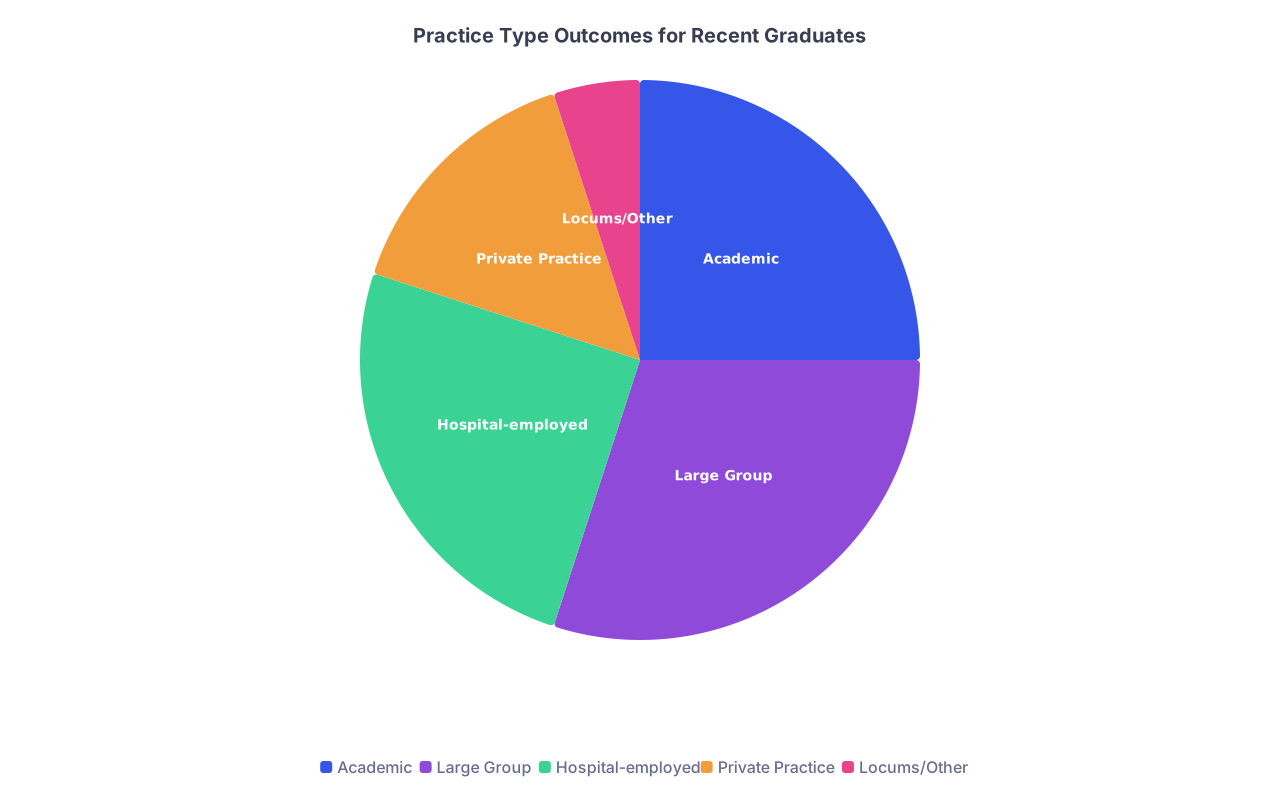
C. Location and Practice Type Outcomes
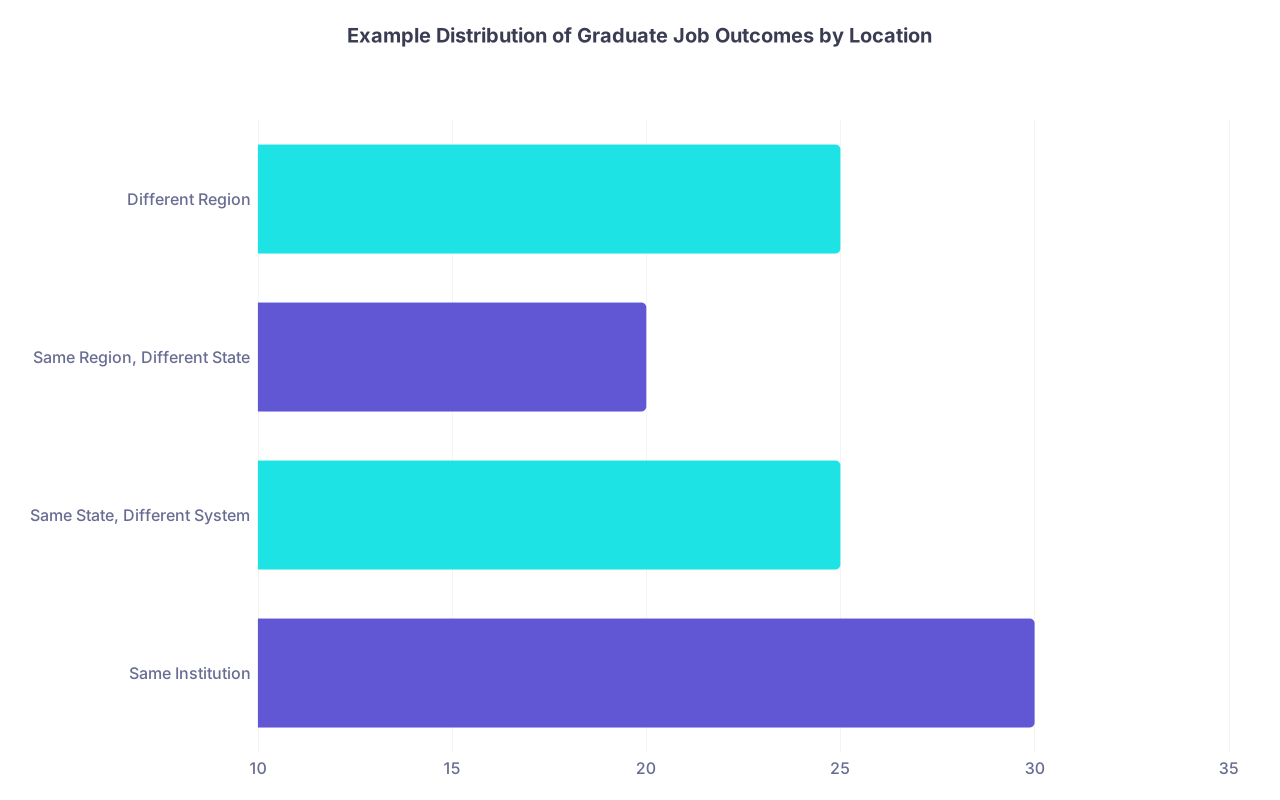
Most residents care about geography and practice style more than they admit on paper. Measure it.
The program should be able to show, over the last 3–5 graduating classes:
- % remaining in the same state/region.
- % going academic vs community vs private practice.
- % taking hospital-employed vs group vs locums/temporary roles.
| Category | Value |
|---|---|
| Academic | 25 |
| Large Group | 30 |
| Hospital-employed | 25 |
| Private Practice | 15 |
| Locums/Other | 5 |
If you want private practice surgery in the Midwest, a program where 70% go academic on the coasts is a poor statistical match for your goals.
D. Board Pass Rates and Exam Performance
Job placement is strongly correlated with competence signals. The simplest proxy: board performance.
Ask for:
- 5-year first-time board pass rate (not just “eventual” pass).
- Mean board scores vs national mean by specialty.
- Any trend (upward/flat/downward) in the last 5–7 years.
A program with a consistent >95% first-time pass rate and scores above the national mean gives you a different risk profile than one hovering around 85–90%.
3. How to Collect and Interpret Outcome Data as an Applicant
Most applicants behave like the data will magically appear. It will not. You have to extract it.
Step 1: Build a Personal Outcomes Spreadsheet
Yes, an actual sheet. For each program on your list, create columns like:
- % graduates in fellowship vs direct to practice
- Fellowship match rate among applicants
- % who stay in-region
- % in academic roles at 3–5 years
- Board first-time pass rate
- Median time to first job/fellowship offer
- Subjective network strength (you can rate 1–5 after interviews)
This gives you a consistent structure to compare programs instead of random anecdotal notes.
Step 2: Ask Specific Questions, Not Vague Ones
Most residents and faculty will answer specific, numerically framed questions far better than open-ended nonsense like “How are your graduates doing?”
Ask things like:
- “Of your last 3 graduating IM classes, about what percentage applied to fellowship, and how many matched?”
- “Roughly how many of your EM residents stay in-state for their first jobs?”
- “What is your 5-year first-time board pass rate?”
- “Do you track how quickly graduating residents are signing their first contracts?”
You do not need perfect precision. “About 80–85% of our residents who apply to GI match” is already powerful signal.
Step 3: Normalize the Data Across Programs
Programs differ in what they track, so your dataset will be messy. That is normal. Use relative indicators:
If Program X: “We have near 100% fellowship match for those who apply”
and Program Y: “Most people do fine, I think last year two did not match,”
you already see a difference in culture and data literacy.If one program gives you a printed or PDF outcomes report and another gives you shrugs, you are looking at very different levels of institutional seriousness.
Even approximate ranges matter. If 3 of your top programs say “Our IM boards pass rate is 97–100% each year” and one says “around 90%,” that delta is meaningful.
4. What Large-Scale Data Already Tells You (NRMP, Specialty Reports, etc.)
You are not starting from zero. There are already macro-level datasets that frame what is realistic.
National Trends on Fellowship and Employment
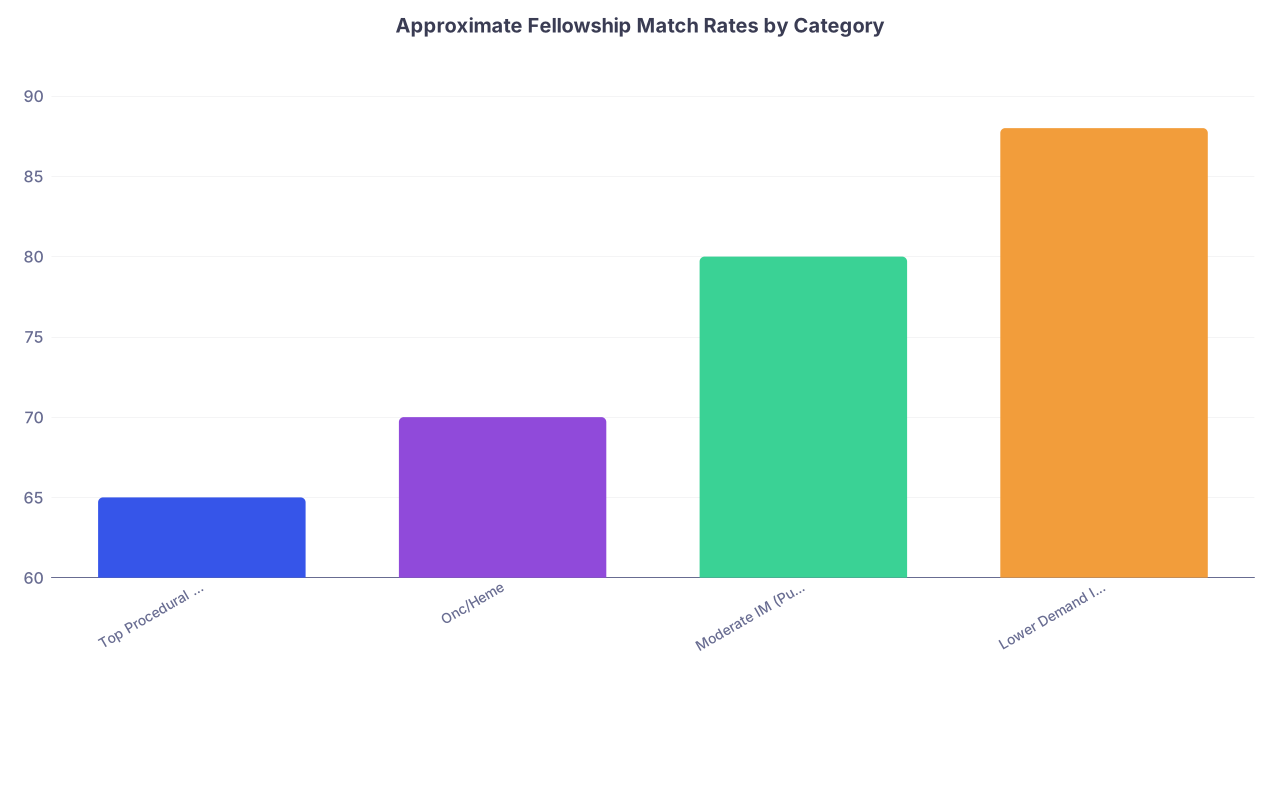
Using recent NRMP and specialty data (patterns have been stable):
- Competitive subspecialties (Cards, GI, Heme/Onc) often have match rates in the 60–75% range among applicants.
- Less competitive fellowships (Endocrine, Rheum, Nephro) can see 80–90% match.
- Many procedural and surgical subspecialties have very high employment rates but meaningful variation in geography and case mix.
| Category | Value |
|---|---|
| Top Procedural IM (GI/Cards) | 65 |
| Onc/Heme | 70 |
| Moderate IM (Pulm/CC) | 80 |
| Lower Demand IM (Rheum/Endo) | 88 |
That baseline matters. If national GI match rate is ~65–70%, and a program claims “nearly everyone who wants GI here matches,” either:
- They are selectively encouraging only the strongest residents to apply, or
- They have unusual strength and connections in that subspecialty.
Both scenarios change how you interpret their outcomes data.
Board Pass Data
Most boards publish national pass rates. A typical pattern for many core specialties:
- National first-time pass rate: 88–95%.
- Top academic programs: often at or above 95–98%.
- Struggling programs: can drop to the low-to-mid 80s.
This is where you calibrate: “We are usually at or slightly above the national average” means one thing if the national average is 90%. It means something very different if the national average is 98%.
ACGME and GME Reports
Some institutions publish graduate tracking metrics as part of their GME or institutional reporting:
- % of residents entering academic positions.
- Number of graduates in leadership roles (program directors, chairs).
- Distribution of graduates by state or region.
These institutional-level reports are underused by applicants. They are boring PDFs, but they tell you whether this place has a history of producing chiefs, fellowship directors, and chairs—or just anonymous community workhorses.
5. Comparing Programs: A Data-Driven Framework
At some point you have to rank programs. Here is a rational way to do it using outcomes data.
Build a Simple Scoring Model
You do not need a PhD. You need a weighted score aligned with your goals.
Example: You are an IM applicant absolutely set on GI fellowship, prefer Midwest, and want academic practice.
You could weight:
- GI + Cards fellowship match success: 40%
- Overall fellowship match rate: 20%
- % remaining in Midwest: 20%
- % in academic positions 3–5 years after fellowship: 20%
Now create a 1–5 score for each program on each metric based on the data and your impressions.
| Metric | Weight | Program A | Program B | Program C |
|---|---|---|---|---|
| GI/Cards Match Strength (1–5) | 0.40 | 5 | 3 | 4 |
| Overall Fellowship Match (1–5) | 0.20 | 4 | 4 | 3 |
| Percent Staying in Midwest (1–5) | 0.20 | 3 | 5 | 2 |
| Academic Placement (1–5) | 0.20 | 4 | 3 | 3 |
Compute weighted scores:
- Program A = 50.40 + 40.20 + 30.20 + 40.20 = 2.0 + 0.8 + 0.6 + 0.8 = 4.2
- Program B = 30.40 + 40.20 + 50.20 + 30.20 = 1.2 + 0.8 + 1.0 + 0.6 = 3.6
- Program C = 40.40 + 30.20 + 20.20 + 30.20 = 1.6 + 0.6 + 0.4 + 0.6 = 3.2
This is not perfect science. It is structured thinking. That alone will separate you from applicants who “just vibe” their rank list.
Look for Outliers and Red Flags
Patterns that often predict trouble:
- Repeated stories of residents scrambling late for jobs.
- Vague answers about where graduates go: “All over the place.”
- No one can recite approximate board pass rates.
- No alumni presence in the subspecialty or practice type you want.
On the positive side, high-signal patterns:
- Residents routinely getting “too many” job or fellowship offers.
- Alumni clearly visible as chiefs, attendings, and fellowship directors at reputable centers.
- Clear pipelines: “We send 1–2 people almost every year to our own advanced fellowship” or “Our graduates are at X, Y, Z top systems.”
| Category | Value |
|---|---|
| Same Institution | 30 |
| Same State, Different System | 25 |
| Same Region, Different State | 20 |
| Different Region | 25 |
If you want to stay local, a program where only 10–15% stay in-state might not align with reality no matter how warm the residents feel.
6. The Long Game: Leadership, Income, and Reputation Trajectories
Most applicants understandably obsess about first jobs and fellowships. But if you are serious about long-term outcomes, you should at least glance at 5–10 year data, even if it is noisier.
Leadership and Academic Trajectory
Ask program leadership or senior faculty:
- “Do you track how many graduates eventually become faculty, program directors, or division chiefs?”
- “Can you name some alumni in leadership roles now?”
If a mid-sized program can rattle off multiple graduates who are now chairs, fellowship directors, or national society leaders, that tells you something about the culture and training environment.
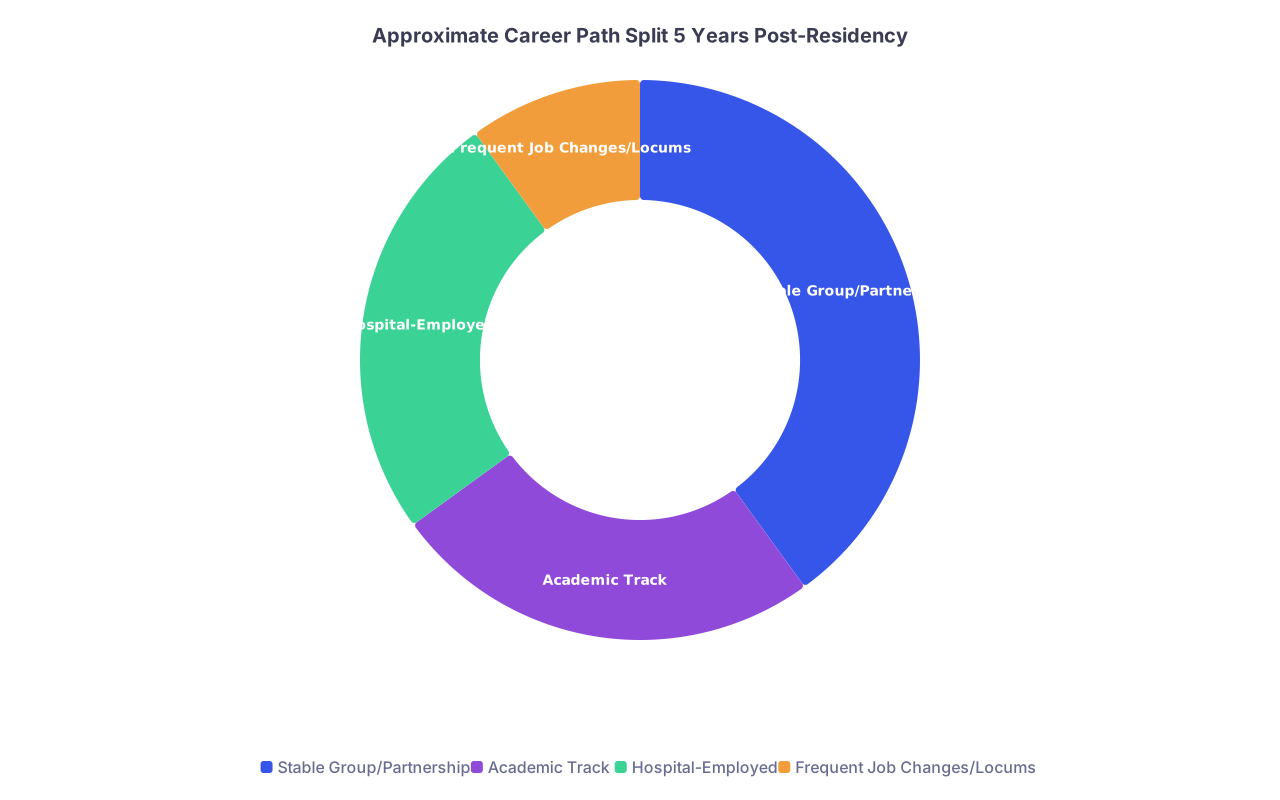
Income and Practice Stability
You will rarely get hard income data by program, but you can infer indirectly:
- Programs that feed into strong private groups or high-demand regions typically see graduates with multiple lucrative offers.
- High proportion of graduates in stable group practice or partnerships suggests better long-term income trajectory than large numbers drifting between locums or short-term contracts.
| Category | Value |
|---|---|
| Stable Group/Partnership | 40 |
| Academic Track | 25 |
| Hospital-Employed | 25 |
| Frequent Job Changes/Locums | 10 |
You cannot control national reimbursement trends. But you can choose training environments that consistently place graduates into the more stable, higher-leverage categories.
Reputation Lag and Trend
One subtle but critical point: reputation is lagging data.
A program that was elite 15 years ago but has declining board scores, fewer fellowships, and leadership churn may still trade on past prestige. Conversely, an “up-and-coming” program might show rapidly improving outcomes even if older attendings still dismiss it.
This is why you should ask about trends:
- “How have your board scores changed over the last 5 years?”
- “Has the number of your residents going into competitive fellowships increased or decreased lately?”
You are not choosing the 2010 version of the program. You are choosing the 2030 version of your career.
7. Practical Script: What to Ask and Who to Ask
Make this concrete. Here is how data-focused questions sound in real conversations.
With current residents:
- “Of your last few graduating classes, what percentage went straight to practice versus fellowship?”
- “How many people struggled to find jobs or fellowships they liked?”
- “Do most people end up where they want geographically? Or do many have to compromise?”
With program directors / chiefs:
- “What is your 5-year first-time board pass rate? How does that compare with the national average?”
- “Do you track where your graduates are 3–5 years out, and would you be able to summarize that distribution for me?”
- “For residents who apply, what proportion typically match in their top 3 fellowship choices?”
With alumni (if you can reach them):
- “Did doors open for you because of this program’s name or network?”
- “Among your co-residents, who has ended up in the best positions, and did that feel random or structural?”
- “If you had to quantify it, how many of you are in roles you really wanted versus ‘just something that worked’?”
You are not interrogating them. You are extracting the data points that will define the next decade of your life.
FAQ (Exactly 5 Questions)
1. What if programs refuse to give specific job placement data?
That is itself data. A serious program that is proud of its outcomes usually has at least rough numbers ready: board pass rates, fellowship match success, alumni distribution. If you repeatedly get vague answers like “Our residents do great” without any quantification, treat that as a negative signal in your ranking. You do not need perfect spreadsheets, but you should expect approximate metrics.
2. How much weight should I give job placement data versus “fit” and quality of life?
You are optimizing for a multi-year experience and a decades-long career. I would not let outcomes data be less than 30–40% of your decision weight. You can and should consider culture, location, and call schedules. But if two places feel similar socially and one has clearly stronger board performance, fellowship match, and alumni trajectories, the rational choice is obvious.
3. Are big-name academic programs always better for long-term careers?
Not always. Large academic centers tend to have stronger fellowship pipelines and academic opportunities, which benefit certain career paths. But there are community-heavy or hybrid programs that outperform on specific metrics (private practice placement, certain geographic markets, particular subspecialties). You want program–goal fit, not prestige for its own sake. Use data, not brand assumptions.
4. How do I compare programs in different tiers (community vs academic, new vs established)?
Use normalized metrics. For example, compare each program’s board pass rate to the national average in its specialty; compare its fellowship match rate to national fellowship match data; compare how often its graduates obtain their desired practice type. A smaller or newer program that consistently beats its “expected” level on these measures can be a better bet than a larger, complacent academic center with stagnant outcomes.
5. What if my career goals are uncertain—does job placement data still matter?
Yes, and arguably more. If you are unsure between academic vs community, or fellowship vs generalist, you want a program with diversified, strong outcomes across multiple paths. Look for breadth in alumni careers: some in fellowship, some in strong community jobs, some in academics. That kind of distribution suggests you will have options once your goals sharpen, rather than being funneled down a narrow track.
In the end, three things matter most:
- Quantified outcomes beat glossy impressions. Ask for actual numbers on board pass rates, fellowship match, and first job distribution.
- Align program strengths with your specific long-term goals—subspecialty, geography, and practice type—using a simple weighted framework.
- Treat weak, vague, or absent data as a real signal. A program that cannot describe its own career outcomes is not the one you want steering yours.