
Most applicants pick residency locations using vibes, prestige, or weather—and ignore the single biggest financial variable: cost-of-living adjusted salary. That mistake can quietly cost you $40,000–$80,000 of real spending power over a 3–4 year residency.
Let me show you the math.
Residency salaries are deceptively simple on paper: “$64,000 PGY-1,” “$71,000 PGY-3,” and so on. Programs throw around numbers, throw in a transit pass or free meal card, and everyone nods. But once you adjust for rent, taxes, and basic expenses, two offers that look similar can differ by 30–50% in what actually lands in your checking account as usable money.
This is not about penny-pinching. It is about avoiding graduating with an extra $30,000–$60,000 in credit card and high-interest debt purely because you picked the wrong city with the right logo.
The Core Concept: Nominal vs Real Residency Pay
You are not comparing salaries. You are comparing purchasing power.
Nominal salary is the number on your contract: $65,000, $70,000, etc.
Real (or cost-of-living adjusted) salary is that number divided by how expensive it is to live where you train.
The basic formula:
Cost-of-living adjusted salary = Nominal salary ÷ Local Cost-of-Living Index × 100
Where “100” is the reference (often the national average). So:
- A city with cost-of-living index 130 is 30% more expensive than the reference.
- A city with index 90 is 10% cheaper.
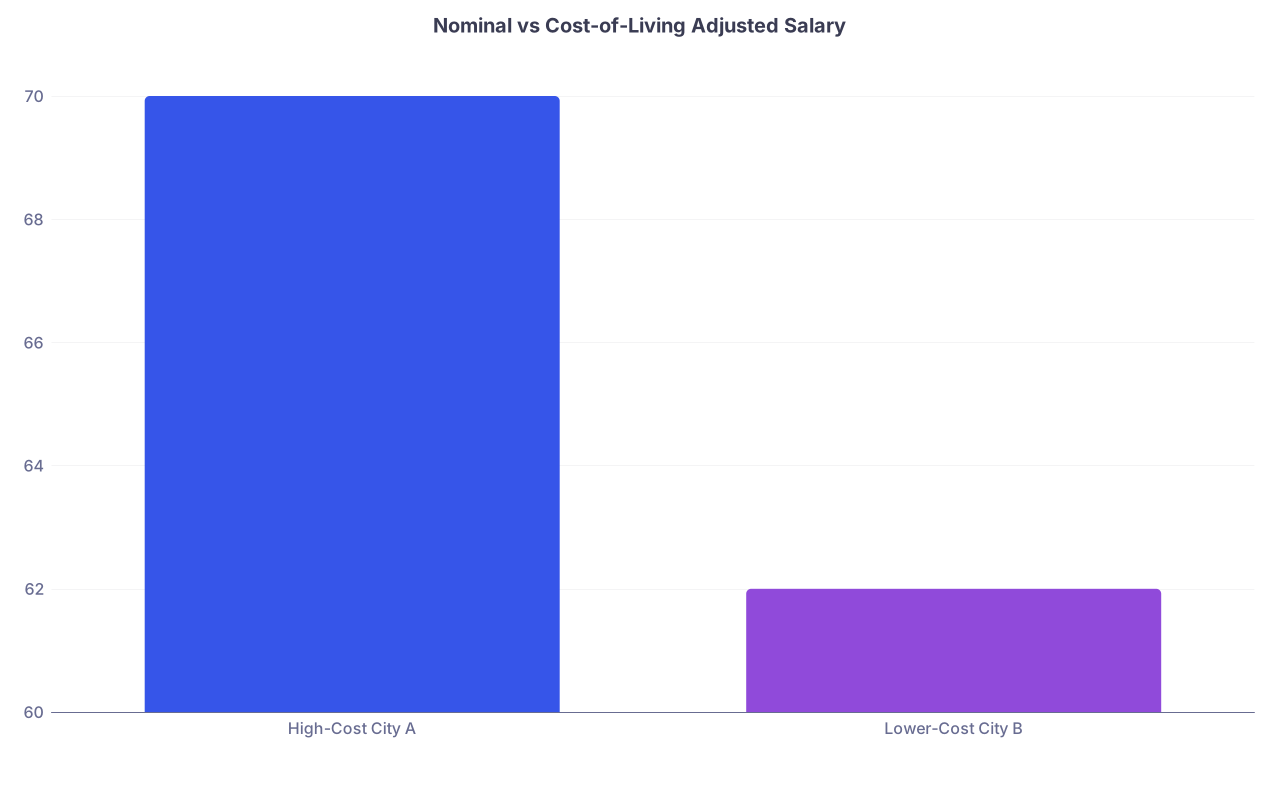
So if City A pays $70,000 but has COL index 135, and City B pays $62,000 with COL index 95, the raw numbers are misleading. The adjusted numbers are not:
- City A: 70,000 ÷ 135 × 100 ≈ $51,852
- City B: 62,000 ÷ 95 × 100 ≈ $65,263
On a cost-of-living basis, that “lower paying” program is effectively paying you about $13,000 more per year in real terms.
Over a 4-year residency: ~$52,000 of purchasing power. That is, quite literally, the difference between “I can save something” and “I carry a card balance every month.”
| Category | Value |
|---|---|
| High-Cost City A | 70 |
| Lower-Cost City B | 62 |
(Nominal salaries in thousands. Without adjustment, City A looks better. After COL adjustment, City B wins by a wide margin.)
Step 1: Get Clean Inputs – The Four Numbers That Matter
You do not need a PhD in economics. You need four inputs for each program:
- PGY-1 salary (from the program or GME site)
- Local cost-of-living index (from a consistent data source)
- Estimated tax burden (federal + state + local)
- Core fixed expenses (primarily rent and transportation)
If you shortcut any of these, your “analysis” turns into vibes again.
1. Residency Salary Data: Use the Contract, Not Reddit
Program salary pages sometimes lag a year. The contract is more reliable.
For each program, capture:
- PGY-1 base salary
- Automatic step increases (PGY-2, PGY-3, etc.)
- Any guaranteed extras:
- Meal stipends
- Parking or transit subsidy
- Annual educational allowance (books, exams, conferences)
- Housing stipends (especially in places like SF, NYC, LA, Boston)
Ignore “possible” moonlighting or bonus unless it is written in stone with clear numbers. I have seen too many residents count on phantom moonlighting that never materialized because of credentialing delays or service demands.
2. Cost-of-Living Index: Use One Source, Not a Frankenstein Mix
There are multiple COL calculators: MIT Living Wage, Numbeo, NerdWallet, federal BEA regional price parities, etc. The data themselves vary. What matters is consistency.
Pick one national or reputable source and apply it across all programs. Do not mix sources.
For example:
- Use a national average = 100
- Then:
- New York City (Manhattan) ≈ 150–170
- San Francisco ≈ 160–180
- Chicago ≈ 110–120
- Mid-size Midwest city ≈ 90–100
- Smaller Southern city ≈ 85–95
You are not trying to forecast to the dollar. You are comparing orders of magnitude.
3. Taxes: The Quiet 5–10% Swing
Two residents with identical salaries can end up with a 7–10% difference in net pay purely from state/local tax structure.
You need:
- State income tax rate ranges
- City/local income tax where applicable
- Whether the state taxes residents heavily (CA, NY) or minimally (TX, FL, WA, NV)
Quick example on a $65,000 PGY-1 salary, single filer, standard deduction:
- No state income tax state (e.g., Texas):
- Effective combined tax (federal + FICA) might run ~20–22%
- High-tax state (e.g., California, NY):
- Effective combined might be 25–28% or more
That is a net difference of about 4–6% of gross, or $2,600–$3,900 per year on $65,000.
Residents tend to ignore this. They should not.
4. Fixed Expenses: Rent Is The Killer Variable
Your largest cost is usually rent. The data are brutal.
For each program, look up:
- Median 1-bedroom apartment rent within 20–30 min commute of primary hospital
- Or realistic roommate setup if you actually plan to share housing
Do not use city-wide averages if your hospital is in a particularly expensive neighborhood. Example: A program in Manhattan vs a program in Brooklyn vs a program in New Jersey with PATH access to Manhattan. Same metro region, totally different rent reality.
A simple comparative snapshot:
| City / Program Region | PGY-1 Salary | Est. 1BR Rent | Rent as % of Gross |
|---|---|---|---|
| Manhattan, NY | $72,000 | $3,200 | 53% |
| San Francisco, CA | $68,000 | $2,900 | 51% |
| Chicago, IL | $64,000 | $1,900 | 36% |
| Mid-size Midwest City | $60,000 | $1,200 | 24% |
| Medium Southern City | $58,000 | $1,050 | 22% |
The data show something obvious but often ignored: in NYC/SF, more than half of your gross paycheck can vanish into rent alone. That is before tax, loans, food, car, anything.
Step 2: Run the Numbers for True Take-Home Pay
Now we turn inputs into something you can actually compare.
Use this sequence for each program:
- Nominal salary (from contract)
- Estimate annual tax burden → net salary
- Subtract estimated rent and other fixed costs
- Adjust for cost-of-living index to convert into “real” or national-average dollars
A Simple Worked Example: Program A vs Program B
Assume you are choosing between:
Program A – High-cost coastal city
- PGY-1 salary: $72,000
- COL index: 150
- State + local taxes: high
- Monthly rent: $3,000 (basic 1BR or small studio)
Program B – Mid-cost city
- PGY-1 salary: $62,000
- COL index: 100
- State taxes: moderate
- Monthly rent: $1,500
Now run it stepwise.
1. Estimate After-Tax Salary
We will use approximate effective total tax (federal + state + FICA) percentages.
Program A (high tax): ~27% effective
Net: 72,000 × (1 − 0.27) ≈ $52,560Program B (moderate tax): ~24% effective
Net: 62,000 × (1 − 0.24) ≈ $47,120
At this stage, Program A still “wins” by about $5,400 on a nominal after-tax basis.
2. Subtract Core Fixed Housing Costs
Program A:
- Rent = $3,000/month = $36,000/year
- Remaining after rent: 52,560 − 36,000 = $16,560
Program B:
- Rent = $1,500/month = $18,000/year
- Remaining after rent: 47,120 − 18,000 = $29,120
Already you see the real story. After rent, Program B gives you about $12,560 more per year to cover food, transport, debt, and any savings.
3. Adjust for Cost of Living
Now scale these “post-rent net” numbers by the cost-of-living index.
Formula:
Adjusted remaining = Remaining after rent ÷ COL index × 100
Program A:
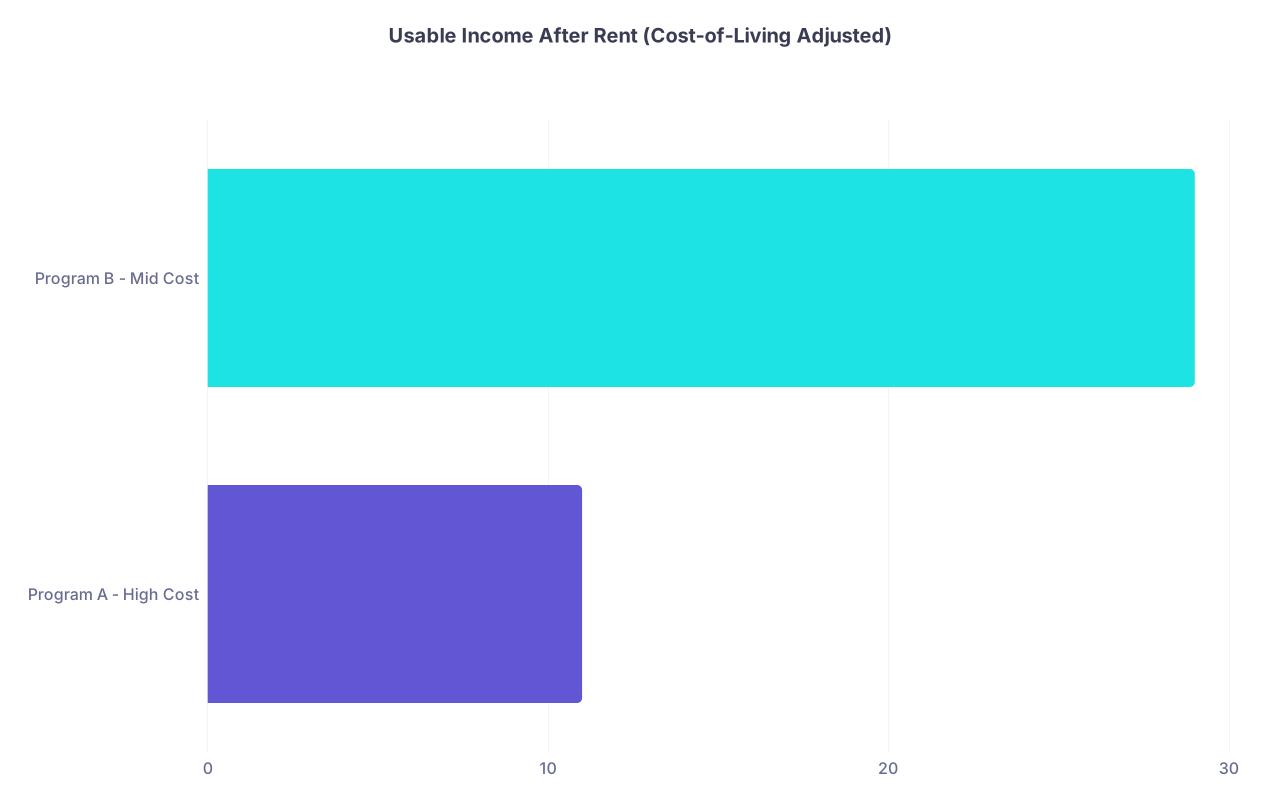
- 16,560 ÷ 150 × 100 ≈ $11,040 (national-average equivalent)
Program B:
- 29,120 ÷ 100 × 100 = $29,120
You read that correctly. Once everything is normalized, Program B gives you more than 2.5x the effective usable income compared to Program A.
Over a 3-year residency:
Difference ≈ ($29,120 − $11,040) × 3 ≈ $54,240 of additional real spending power.
Over 4 years: $72,320.
You can love a coastal city all you want, but that is the financial price tag.
| Category | Value |
|---|---|
| Program A - High Cost | 11 |
| Program B - Mid Cost | 29 |
(Values in thousands. Once cost of living is accounted for, Program B dominates.)
Step 3: Standardize Program Comparisons With a Simple Spreadsheet
If you are serious about matching intelligently, you should not be doing this in your head.
Set up a sheet with one row per program and these columns:
- Program Name
- City / Region
- PGY-1 Salary
- Cost-of-Living Index
- Estimated Effective Tax Rate (%)
- After-Tax Salary
- Est. Monthly Rent
- Annual Rent
- Remaining After Rent
- Cost-of-Living Adjusted Remaining
Then a few formulas:
- After-Tax Salary = Salary × (1 − Tax Rate)
- Annual Rent = Monthly Rent × 12
- Remaining After Rent = After-Tax Salary − Annual Rent
- Adjusted Remaining = Remaining After Rent ÷ COL × 100
Sort by Adjusted Remaining (descending). That list will not match the “prestige” ranking in your head. At all.
And that is the point.

| Step | Description |
|---|---|
| Step 1 | List Programs |
| Step 2 | Get PGY1 Salary |
| Step 3 | Assign COL Index |
| Step 4 | Estimate Tax Rate |
| Step 5 | Calculate Net Salary |
| Step 6 | Estimate Rent |
| Step 7 | Subtract Rent |
| Step 8 | Adjust for COL |
| Step 9 | Rank by Adjusted Remaining |
Step 4: Do Not Ignore Non-Salary Financial Factors
Salary is not the only lever. Two programs with identical “adjusted remaining” can still feel very different because of structural support (or lack of it).
You should explicitly quantify:
Benefits that replace out-of-pocket costs:
- Free parking vs $200+/month garage
- Free or heavily subsidized in-hospital meals vs nothing
- Public transit pass (NYC, Boston, SF) vs car-dependent city
- Health insurance premiums and out-of-pocket maximums
Housing support:
- On-campus or hospital-affiliated housing below market
- Housing stipend (e.g., $5,000–$10,000 per year in some high-cost cities)
- Eligibility for income-based or subsidized housing near academic centers
Workload and moonlighting:
- Programs that truly allow moonlighting after PGY-2 and actually have shifts available
- Programs that ban or practically block moonlighting
I have seen residents at a “lower salary” Midwest program earn an extra $8,000–$12,000 per year in moonlighting PGY-3 and PGY-4. That dwarfs a $2,000–$3,000 nominal salary difference.
You do not assume this income. You model it as an upside scenario.
Step 5: Understand the Debt and Savings Impact
A lot of applicants treat residency as a financial “holding pattern.” That mindset is naïve and expensive.
The data say otherwise. What you do with those 3–7 years compounds.
High-Cost Program Scenario
Resident at Program A:
- Real usable income after fixed costs: ~low
- No room to save; occasional credit card use to bridge gaps
- Ends residency with:
- $8,000–$15,000 in credit card or personal loan debt
- No emergency fund
- Loan principal essentially unchanged or capitalized interest growing
Lower-Cost Program Scenario
Resident at Program B:
- Real usable income substantially higher
- Saves:
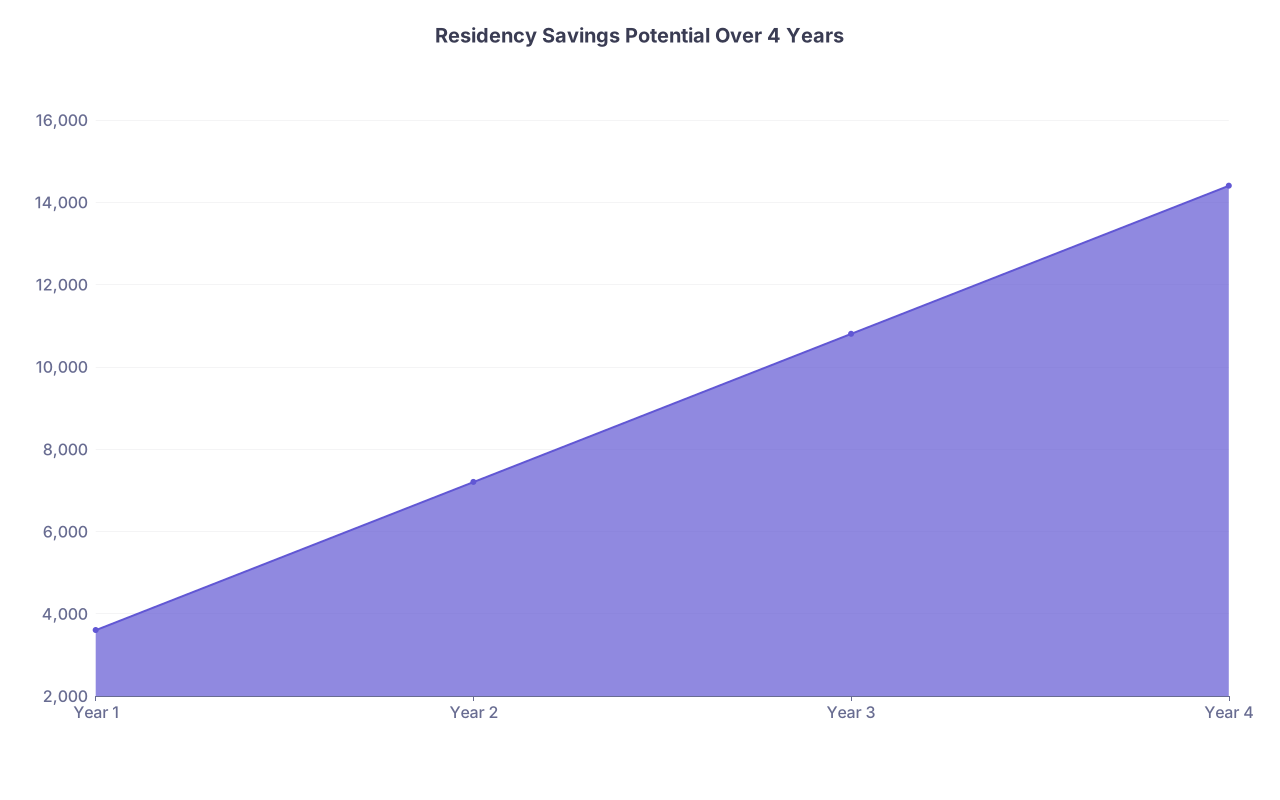
- Even $300/month → $3,600/year
- Over 4 years: $14,400 (excluding any investment growth)
- Or chooses to make aggressive interest-only payments or targeted additional loan payments, preventing $10,000–$20,000 of extra interest accumulation.
Small monthly differences, compounded over multiyear training, matter. Your future attending self will care a lot.
| Category | Value |
|---|---|
| Year 1 | 3600 |
| Year 2 | 7200 |
| Year 3 | 10800 |
| Year 4 | 14400 |
(Assumes disciplined $300/month saving. High COL with zero capacity to save yields a flat line at 0.)
Step 6: Where This Fits in Your Rank List
No, I am not saying you rank purely by adjusted income. That would be dumb. But I am saying this:
If you are torn between similar programs, and one choice quietly costs you $50,000+ in real terms over residency, you should know that number.
Reasonable weighting:
- Training quality / fit / career impact: 50–60%
- Geography, support system, partner job prospects: 20–30%
- Financial reality, including cost-of-living adjusted salary: 20–25%
If a program is a dream fit and opens unique doors (elite fellowship pipelines, research niche, etc.), you may rationally accept a worse financial profile. You go in with open eyes. You budget differently. Maybe you moonlight aggressively PGY-3+. Fine.
What is irrational is ranking purely off brand and city “cool factor” while pretending money does not exist.
Use This Heuristically
When you have your sheet:
- Mark any program where adjusted remaining is less than half of your best option. Those are financially punishing choices.
- Mark any program where rent would exceed ~40–45% of your gross income. That is going to feel tight, consistently.
- Identify any program where adjusted remaining + realistic moonlighting potential push it well above peers. Those are hidden financial gems.
You are not chasing dollars. You are avoiding traps.
Common Mistakes Applicants Make With Residency Pay
I have seen the same bad assumptions repeat every year.
Comparing raw salaries without COL adjustment
“Program X pays $3,000 more.” Completely meaningless without rent, taxes, and COL.Ignoring taxes
Residents moving from no-income-tax states to CA/NY often get a nasty surprise on their first paycheck.Underestimating rent in high-demand neighborhoods
Program website lists “average rent in city” at $2,300, but anything near the hospital and safe enough for post-night-shift walking is $3,000+.Assuming roommate situations that will not actually happen
You tell yourself you will split a 2BR with someone to save money, then schedules, personalities, and relationships make that unrealistic. Do your core calc on a conservative but realistic baseline.Treating a housing stipend as a pure bonus
A $10,000 housing stipend in a market where rent is $1,500/month higher than a comparable city is not a perk. It is a partial band-aid.Not factoring transportation structure
Owning a car (loan + insurance + gas + parking) vs a pure transit lifestyle can swing annual costs by $3,000–$6,000 easily.
How to Use This Before and After Rank List Certification
You are in the “Residency Match and Applications” phase. Here is the clean, data-driven sequence to follow:
Before interviews:
- Pull rough salary, COL, and rent data for each program on your target list.
- Flag high-COL regions where you will need more financial scrutiny.
-
- Ask residents very specific, numerical questions:
- “What do most interns pay for rent?”
- “How many people realistically moonlight PGY-3+? How much do they earn?”
- “Do you feel you can save anything on your current salary?”
- Ignore vague answers like “It’s fine” and “Depends how you live.” Push for numbers.
- Ask residents very specific, numerical questions:
After interviews, before rank list:
- Build the spreadsheet, run the formulas.
- Identify where your subjective preferences fight the math.
- Decide consciously where you are willing to accept a financial penalty and where you are not.
Once matched:
- Use the same framework to build a day-one budget:
- Starting from your actual first paycheck net amount
- Plugging in actual signed rent
- Understanding exactly how much non-fixed cash you have each month
- Use the same framework to build a day-one budget:
Final Takeaways
You are not just choosing a residency. You are choosing a 3–7 year financial environment that can either stabilize your life or quietly bury you further in debt.
Three core points:
- Raw salary is misleading; cost-of-living adjusted, after-tax, after-rent income is the only honest comparison.
- The gap between a high-cost “prestige” city and a mid-cost solid program is often $50,000+ of real purchasing power over residency.
- Use a simple, consistent data model—salary, COL index, taxes, rent—to rank programs with clear eyes, and decide consciously when the financial hit is worth it.