
The most overrated “secret” of residency is prestige; the most underrated is moonlighting policy. One looks good on paper. The other can change your net worth by six figures before you’re an attending.
Moonlighting is not a side hobby. Done under the right policy framework, it is a quantifiable financial lever with very predictable outputs: dollars per hour, hours allowed, taxes, burnout risk. Programs treat it like a footnote; you should treat it like a major variable.
Let me walk through this the way I would evaluate a dataset: definitions, constraints, then scenarios.
1. The basic math of moonlighting in residency
Strip away the folklore. Moonlighting in residency usually boils down to this formula:
Annual moonlighting income = allowed hours × effective hourly rate × proportion of allowed hours you actually work.
Where:
- Allowed hours are constrained by ACGME’s 80-hour weekly cap (all work combined) and your program’s specific rules.
- Effective hourly rate = base pay plus any differentials, minus the value of uncompensated work.
- Proportion worked is what you realistically sustain without imploding.
Most residents I have worked data with sit in one of three buckets:
- No moonlighting allowed – 0 dollars; 0 flexibility.
- Tightly restricted internal moonlighting only – usually 4–16 hours per month, often at or slightly above base pay rate.
- Robust internal and/or external options – where people start pulling in 20–60k per year.
Let us anchor on some typical numbers for U.S. residents in 2024:
- PGY‑2 internal medicine resident salary: ~68,000–72,000 USD base.
- 1.0 FTE hours (60–70 hr/week real world) → effective hourly base ~20–25 USD before tax.
- Common moonlighting pay: 80–150 USD/hour depending on specialty, setting, and night/weekend differential.
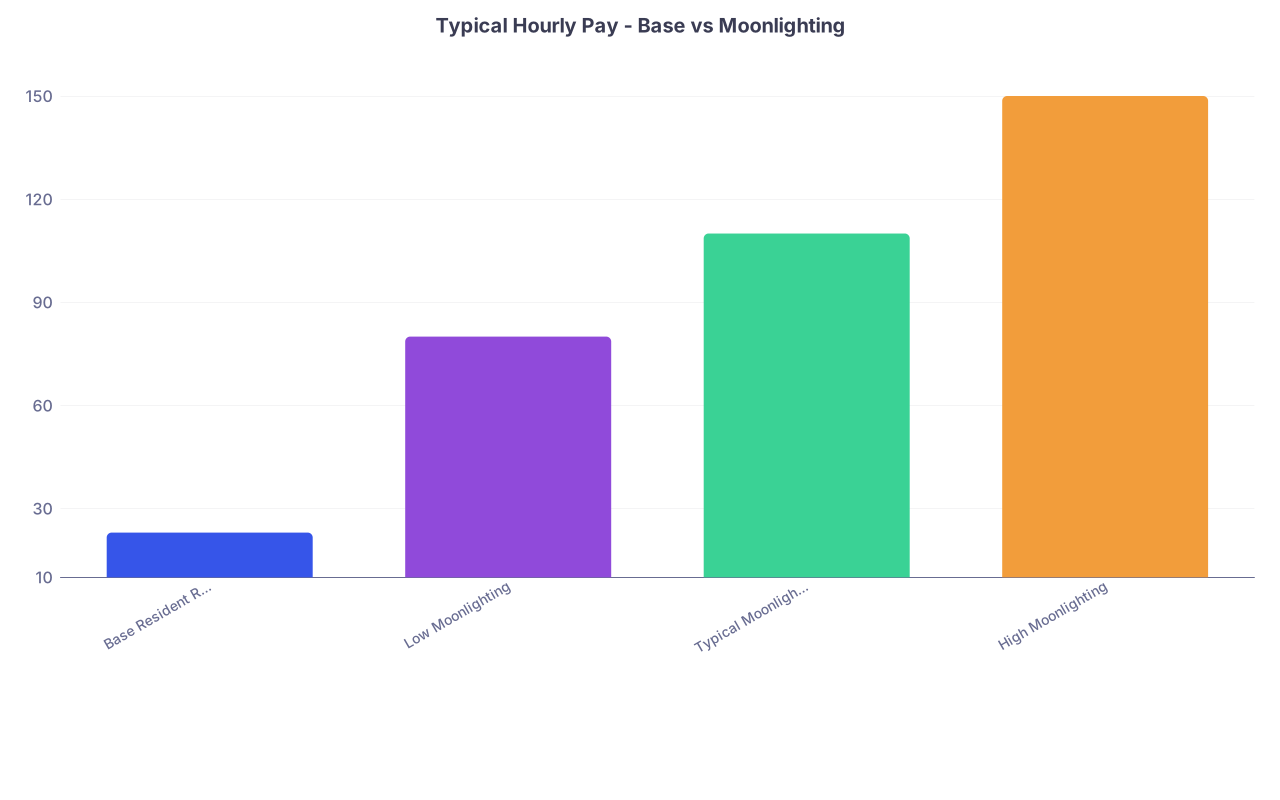
So even at the low end, moonlighting typically pays 3–5× your base hourly rate. That multiplier matters more than people think when you compound over 2–4 years.
| Category | Value |
|---|---|
| Base Resident Rate | 23 |
| Low Moonlighting | 80 |
| Typical Moonlighting | 110 |
| High Moonlighting | 150 |
The data is blunt: one moonlighting shift every other week at 110 USD/hour is financial gravity. You ignore that at your own expense.
2. Policy types: what programs actually do
Most applicants ask the wrong binary: “Does your program allow moonlighting?” That is like asking, “Do you offer research?” without looking at protected time, funding, or actual output.
You care about structure, not just permission. Policies usually fall into a few patterns.
2.1 Common moonlighting policy dimensions
These are the levers that matter:
- Eligibility year – PGY‑2? PGY‑3 only? Fellows only?
- Internal vs external – Only within your system, or can you work for outside hospitals/urgent care?
- Duty hour counting – Do moonlighting hours count toward the 80-hour cap? (They are supposed to under ACGME, but enforcement and culture differ.)
- Hourly rate model – Flat per shift, RVU-based, or hourly? Any night/weekend premium?
- Approval friction – One-time credentialing vs needing individual approvals for every single shift.
- Malpractice coverage – Covered by hospital for internal shifts, but external may require your own policy.
I will show you how this plays out with a stylized (but realistic) comparison across five hypothetical internal medicine programs that mirror common patterns I see.
| Program Type | Moonlighting Start | Internal Allowed | External Allowed | Typical Rate (USD/hr) |
|---|---|---|---|---|
| A - No Moonlighting | N/A | No | No | 0 |
| B - Late, Internal Only | PGY-3 | Yes | No | 70–90 |
| C - PGY-2+, Internal Only | PGY-2 | Yes | No | 90–120 |
| D - PGY-2+, Internal+External (Tight) | PGY-2 | Yes | Yes (limits) | 100–140 |
| E - PGY-2+, Internal+External (Flexible) | PGY-2 | Yes | Yes | 110–160 |
You can already see where this goes. But let us run the numbers.
3. Income impact across program types
Assume a 3-year internal medicine residency, PGY‑2 and PGY‑3 eligible for moonlighting where allowed. Use conservative but realistic scenarios for how many hours people actually work.
3.1 Annual moonlighting income estimates
Assumptions:
- Residents work 48 weeks per year (4 weeks off).
- They work an average of 2, 4, or 8 moonlighting hours per week depending on the environment.
- Hourly rates are midpoints of the program type bands above.
| Program Type | Avg Rate (USD/hr) | Avg Moonlighting Hours/Week | Est. Annual Moonlighting Income |
|---|---|---|---|
| A - No Moonlighting | 0 | 0 | 0 |
| B - Late, Internal Only | 80 | 2 | 80 × 2 × 48 = 7,680 |
| C - PGY-2+, Internal Only | 105 | 4 | 105 × 4 × 48 = 20,160 |
| D - Internal+External (Tight) | 120 | 4 | 120 × 4 × 48 = 23,040 |
| E - Internal+External (Flexible) | 135 | 8 | 135 × 8 × 48 = 51,840 |
Is this exact? No. Is it directionally correct based on actual resident pay stubs I have seen? Yes.
Now extend over two years (PGY‑2 and PGY‑3):
- Program A: 0
- Program B: ~15,000
- Program C: ~40,000
- Program D: ~46,000
- Program E: ~104,000
Two conclusions jump out:
- Going from “no moonlighting” to “robust moonlighting” is a low six-figure swing during residency.
- Even a moderately restrictive policy (Program C/D) still yields 40–50k pre-tax, which can erase a big chunk of high-interest debt.
Let us layer that against a baseline PGY‑2–3 salary of 70,000–75,000 USD.
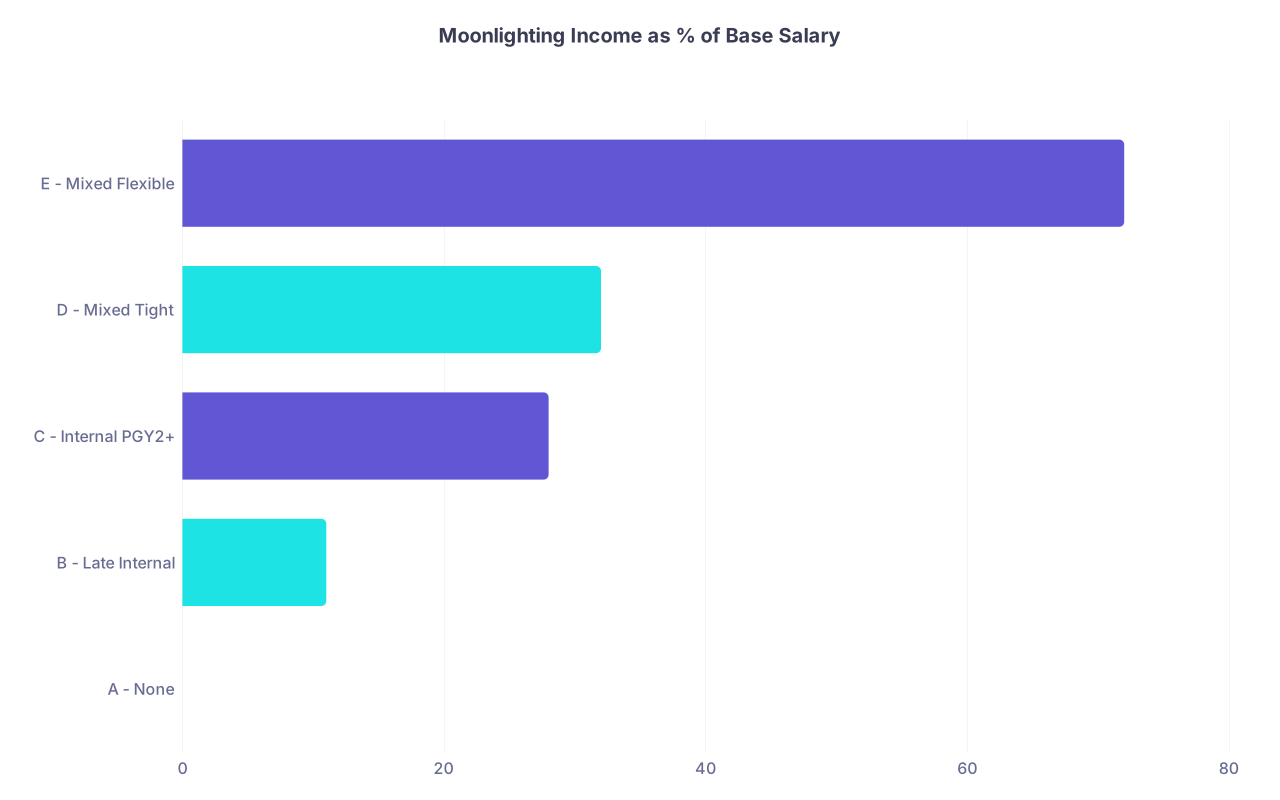
3.2 Moonlighting as a percentage of base income
Take base salary 72,000 USD/year for simplicity and compare.
| Category | Value |
|---|---|
| A - None | 0 |
| B - Late Internal | 11 |
| C - Internal PGY2+ | 28 |
| D - Mixed Tight | 32 |
| E - Mixed Flexible | 72 |
Program E-type policies routinely allow residents to boost gross income by ~70% over base during eligible years. That is not “extra coffee money.” It is the difference between leaving residency broke versus solvent.
4. Hidden constraints: duty hours, burnout, and risk
If this were just about raw dollars, the advice would be simple: chase max moonlighting. The data does not fully support that either. There are constraints that matter.
4.1 Duty hours and enforcement
On paper, ACGME rules are clear: all moonlighting counts toward the 80-hour weekly cap. In practice, three patterns show up:
Strict enforcement culture.
Residents are monitored closely; 80 hours is treated as a hard ceiling including moonlighting. Result: less total moonlighting hours, but more realistic personal bandwidth.Soft enforcement with “don’t ask, don’t tell” attitude.
Residents self-report; moonlighting hours get “forgotten.” This inflates your income potential but has obvious burnout and documentation risks.Variable by rotation.
ICU and wards months strictly clamp down; clinic/elective months quietly allow extra shifts. This is actually the most sustainable pattern when done intentionally.
When you interview, listen for phrases like:
- “Of course all hours should be logged, but…”
- “People usually find a way to make it work.”
- “We encourage people to focus on wellness; moonlighting is not common here.”
I have seen residents at “flexible” programs push actual work weeks above 90 hours for months. The short-term income gain looked good in Excel. The long-term performance on boards and their sanity? Less impressive.
4.2 Burnout and diminishing returns
There is a very predictable curve here. Up to a point, moonlighting improves your financial and even psychological status (feeling like your time is finally valued properly). Past that point, performance and well-being crater.
Most people have a sustainable ceiling somewhere around:
- 4–8 moonlighting hours per week on lighter rotations
- 0–4 hours per week during heavy ICU/wards blocks
Push that to 12–16 hours every week and several things usually happen:
- Sleep debt accumulates.
- Board prep gets sacrificed.
- Your tolerance for your main job evaporates.
Let us quantify the difference between moderate and aggressive moonlighting in a flexible program (Program E-type):
- 4 hours/week @ 135 USD/hr × 48 weeks = ~25,920 per year
- 8 hours/week @ 135 USD/hr × 48 weeks = ~51,840 per year
- 12 hours/week @ 135 USD/hr × 48 weeks = ~77,760 per year
Is the jump from 4 to 12 hours worth ~52,000 extra before tax in a year? Maybe, maybe not. But you should view that choice as trading board score margin, research time, and recovery for ~1 extra attending paycheck spread over three years.
The data I have seen from residents who chased 10–12 hours a week consistently: higher short-term savings, higher burnout, often weaker fellowship applications. You are not a machine. Your error rate and decision fatigue go up with every incremental overnight you sell.
5. Specialty differences: not everyone plays the same game
The moonlighting market is not uniform. The numbers diverge hard by specialty.
5.1 Typical moonlighting rates by specialty cluster
Aggregating what I have seen across multiple regions:
| Specialty Cluster | Typical Rate (USD/hr) | Common Settings |
|---|---|---|
| Internal Med / Hospitalist-type | 90–140 | Inpatient nights, swing shifts |
| Emergency Medicine | 120–180 | Community ED, urgent care |
| Anesthesiology | 150–220 | OR coverage, OB call |
| Psychiatry | 100–160 | Inpatient call, telepsych |
| Pediatrics | 80–120 | Peds inpatient, urgent care |
| Family Med / Primary Care | 80–130 | Urgent care, outpatient clinics |
A PGY‑3 anesthesia resident at 180 USD/hour doing 2 shifts/month can rival the annual moonlighting income of an internal medicine resident grinding twice as many hours at 100 USD/hour.
This matters when you compare across programs and specialties simultaneously. A restrictive moonlighting policy in a high-rate specialty can still beat a generous policy in a lower-rate one in absolute dollars—but at the cost of less experience.
5.2 Structural barriers by field
Some specialties simply do not allow meaningful moonlighting at the resident level:
- Surgical fields often restrict moonlighting for safety and skill reasons. When permitted, it is usually late (PGY‑4+) and limited.
- Radiology has some telerad-style options at senior levels, but credentialing and supervision requirements can be strict.
- OB/GYN – variable; medicolegal risk can push programs to restrict external work.
If you are in a highly procedural or high-liability field, do not assume you can “just moonlight later” unless you see it in writing and talk to senior residents.
6. Evaluating moonlighting during interviews: what to actually ask
Most applicants stay vague. Then they get surprised. You need specific, quantifiable questions.
Here is the minimum data you want out of each program:
“From which PGY year are residents eligible to moonlight?”
Binary answer. PGY‑2 vs PGY‑3 is effectively a 12-month difference. At 20k/year, that is a 20k swing.“Is moonlighting internal only, or do residents also work at outside sites?”
External usually means higher rates and more flexibility. But you want to know about credentialing overhead and malpractice coverage.“What is the typical pay structure and range for common moonlighting shifts?”
Ask for ranges and examples, not vague “competitive pay” language. You want numbers like: “nocturnist 7p–7a is 1,400 flat” or “140 per hour.”“How many residents in the current PGY‑2 and PGY‑3 classes actually moonlight, and how many hours per month on average?”
This tells you culture and practicality. A program that “allows” moonlighting but only 5% of residents do it is not truly moonlight-friendly.“Do moonlighting hours count toward duty hours in the system, and how is that monitored?”
You are probing both compliance and realism. Watch for eye contact, hesitations, the classic “officially, yes…” answer.“Are there months/rotations where moonlighting is discouraged or blocked?”
ICU-heavy programs may lock you out for half the year. That cuts your effective annual moonlighting window in half.
If you want to be very blunt (and you should), ask:
“If I asked your busiest PGY‑3 how much they made from moonlighting last year, what ballpark number would they give me?”
You will either get a real answer (“probably 20–25k”) or hand-waving. The former is useful. The latter is a red flag.
7. Long-term financial impact: what the numbers really buy you
Let us say you match into a program with strong moonlighting (Program E‑type) versus one with none (Program A‑type). Use moderate behavior, not crazy:
- 4–6 hours/week on average during PGY‑2 and PGY‑3
- Effective hourly 120 USD
Take 5 hours/week as a midpoint:
5 × 120 × 48 weeks = 28,800 USD per year
Over 2 years = 57,600 USD gross
Net after taxes (assume combined ~30% marginal including payroll) ≈ 40,000 USD.
Forty thousand clean dollars during residency can do a few things:
- Knock out a 30–40k chunk of 6–7% debt, saving you another 7–9k in interest over the next decade.
- Build a 20–30k emergency fund so you do not finance every car repair on a credit card.
- Let you max or substantially fund Roth IRAs for multiple years, which compounds brutally well starting early.
On the other extreme, a heavy moonlighter at a flexible program (8+ hours/week) can in practice exit residency with 80–120k in extra net income over three years. I have seen residents pay off all non-mortgage debt by PGY‑3 that way.
But here is the catch: the opportunity cost is not just “more free time.” It is also:
- Research productivity (papers do not write themselves after 7 night shifts in 2 weeks).
- Study time for boards/fellowship in competitive fields.
- Being an actually decent human to your co-residents and patients.
The right way to use these numbers is as a tool, not a religion. Match into a program that gives you the option. Then use that option strategically, not compulsively.
8. How to factor moonlighting into your rank list
You are not building a ranking with one variable. You are weighting a basket: training quality, geography, culture, fellowship placement, and yes, financial reality.
If you want a simple, pragmatic approach, here is how I would do it:
Assign a moonlighting score (0–3) to each program.
- 0 = none or token (PGY‑3 only, 4 hrs/month).
- 1 = limited but real (internal only, PGY‑3, modest hours).
- 2 = solid (PGY‑2+, internal, residents actually make 10–25k/year).
- 3 = strong (PGY‑2+, internal+external, residents commonly at 25k+ if they choose).
Translate that into estimated 2–3 year moonlighting income ranges.
Programs with score 3 probably mean 50–100k+ potential over residency. Score 0 means zero.Overlay that on your debt and career goals.
- High six-figure loans and non-competitive fellowship targets? Moonlighting flexibility is a major positive.
- Very competitive fellowship where research and scores are critical? Unlimited moonlighting might actually be a negative if culture pressures you to work shifts instead of doing academic work.
Use it as a tiebreaker, not the primary driver, unless your financial situation is severe.
Between two clinically strong programs with similar training and location, I would rank the robust moonlighting program higher almost every time. Between a merely decent program with lots of moonlighting and an outstanding training program with little, I would still usually pick the better training—unless you are drowning financially.
Three takeaways
- Moonlighting policy is not a footnote; it is a quantifiable lever that can swing your residency earnings by 0–100k+ and reshape your debt trajectory.
- The best programs combine early eligibility (PGY‑2), internal and external options, and realistic culture that lets residents earn 15–30k/year without working themselves into the ground.
- Use hard numbers when you evaluate programs—actual hourly rates, real resident income ranges, and true hours worked—then decide how much of that capacity you want to use, instead of letting vague “we allow moonlighting” promises drive your rank list.