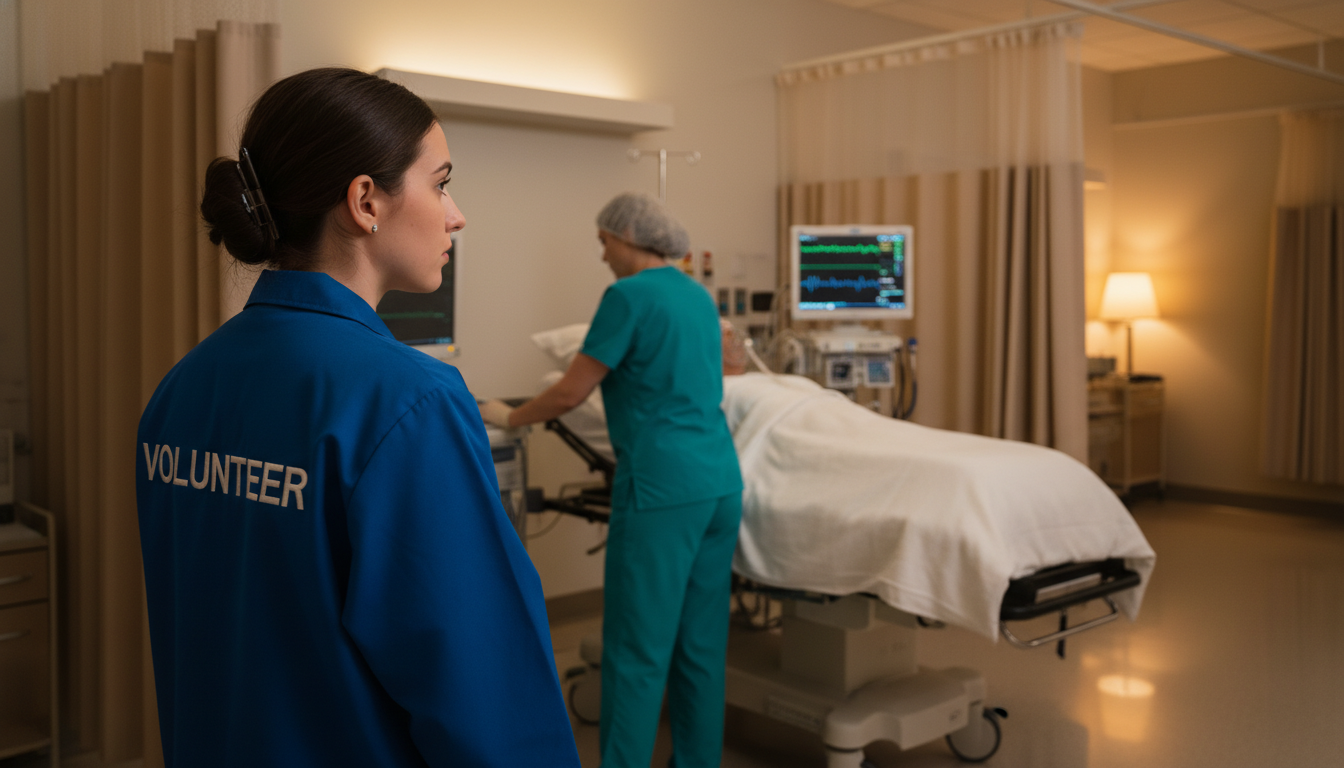
Working in Pre‑Op and PACU as a volunteer is one of the most underrated ways to understand how a hospital actually functions around surgery.
Most students crowd into ED volunteer shifts or patient transport. Pre‑op and PACU (post-anesthesia care unit) are quieter, more controlled, and far more revealing if you are serious about medicine, anesthesia, surgery, or perioperative care.
Let me break this down specifically: what you will actually do, what you will actually see, and how to turn this into meaningful clinical experience that matters for applications and your own development.
Understanding the Perioperative Environment: What You Are Walking Into
Before you step into pre‑op or PACU, you need a mental map of the perioperative flow. Otherwise, you are just another person handing out warm blankets with no idea what is happening.
Basic surgical patient flow:
Pre‑Op (Pre‑Anesthesia / Holding Area)
- Final checks before surgery
- IVs started (if not already)
- Consent verified
- Surgical site marked
- Pre‑medications given
Operating Room (OR)
- Induction of anesthesia
- Procedure itself
- Emergence from anesthesia
PACU (Post‑Anesthesia Care Unit)
- Immediate post-op monitoring
- Pain control and airway management
- Nausea control
- Readiness assessment for discharge or transfer to inpatient bed
Your volunteer role usually sits at either end: pre‑op before surgery, and PACU after. Both spaces are dense with clinical decision-making, even when they look calm from the outside.
Pre‑Op vs PACU: Different Roles, Different Learning
Pre‑Op (Holding Area)
What dominates this area:
- Anxiety management (patients and families)
- Checklists and safety protocols
- Verifying details rather than doing heroics
You will see:
- Nurses reviewing NPO status (“when was the last time you ate or drank?”)
- Surgeons doing quick pre‑op visits and marking surgical sites
- Anesthesiologists evaluating airway, reviewing meds, explaining anesthesia plans
PACU
This is where patients first wake up from anesthesia. The pace can range from almost serene to extremely intense.
You will see:
- Airway maneuvers (jaw thrust, oral airways, nasal airways)
- Pain and nausea protocols implemented quickly
- Hemodynamic changes right after surgery
- Surgical dressings, drains, Foley catheters, oxygen therapy
- Criteria-based decisions about when a patient is safe to transfer
When you understand that, your volunteer shift becomes a structured observation of a complex system, not just “helping in a unit.”
What Volunteers Actually Do: Pre‑Op Tasks and Responsibilities
Your tasks will vary by hospital, liability policy, and whether you are a high school student, premed, or early medical student. Still, typical pre‑op volunteer responsibilities fall into several categories:
1. Patient Comfort and Non‑Clinical Support
This is the spine of your role.
Common tasks:
- Offering warm blankets, socks, extra pillows
- Making sure call buttons, tissues, and personal items are within reach
- Adjusting curtains for privacy (after asking permission)
- Helping family members find restrooms, cafeteria, waiting areas
What you learn:
- How pre‑operative anxiety presents:
- The patient who keeps asking the same question three times
- The silent, withdrawn teenager before orthopedic surgery
- The overly “cheerful” adult masking fear with jokes
- How nurses use small actions and simple language to de‑escalate worry
This is where you get repetition in one of the core skills of medicine: being with someone who is scared, without overpromising or disappearing.
2. Logistics and Flow Support
Pre‑op is all about timing and flow. Everything is carefully choreographed to prevent delays.
Your logistics tasks may include:
- Restocking:
- Warm blanket cabinets
- Wipe containers
- Gloves (within supply room only)
- Patient belongings bags
- Cleaning and turning over bays:
- Wiping down bedside tables
- Changing pillowcases after discharge
- Ensuring no patient info is left visible (HIPAA discipline)
- Escorting:
- Guiding family members to waiting rooms
- Bringing family back (when allowed) for brief pre‑op visits
What you learn:
- How the smallest delays (a missing consent form, an incomplete lab, a late patient) cascade and affect the OR schedule
- The importance of throughput and why staff are so obsessed with “turnover times”
You begin to see a surgery not as a single event, but as part of a tightly timed perioperative production line—with safety checks built into every step.
3. Communication Observation and Professionalism
Pre‑op is dense with short, high-stakes conversations:
- Surgeon to patient: last-minute clarification, risks, expectations
- Anesthesia to patient: airway, nausea risk, prior experiences
- Nurse to patient: targeted checklist questions and reassurance
- Staff to staff: quick, precise handoffs
As a volunteer, you do not lead these conversations. You watch and, when permission is given, you stand close enough to hear.
You should be noticing:
- How staff introduce themselves and set expectations in under 60 seconds
- How they obtain and verify consent without sounding rushed
- How they manage difficult family dynamics (the argumentative relative, the overbearing family spokesperson)
If you are smart, you keep a mental or written log of specific phrases that work. These become the seeds for your future communication style and for concrete examples in your personal statement and interviews.
What Volunteers Actually Do: PACU Tasks and Responsibilities
PACU feels different. Patients are often sedated, in pain, or disoriented. Family is usually not present at first. The staff focus is intensely on vital signs, airway, and complications.
Within strict boundaries, PACU volunteers can still be deeply useful.
1. Patient Comfort and Orientation (Within Limits)
Typical activities:
- Reorienting patients when they are more awake:
- “You are in the recovery room. Your surgery is finished. You are safe.”
- Always confirm with the nurse first and use the unit’s standard language
- Simple comfort measures:
- Adjusting blankets when allowed
- Bringing ice chips or water when the nurse has cleared oral intake
- Holding an emesis basin if patient feels nauseated (nurse will usually medicate and you support)
- Non-clinical reassurance:
- Staying nearby (quietly) for patients who wake up anxious or confused
- Helping them call for the nurse instead of trying to get out of bed
What you learn:
- How different patients emerge from anesthesia:
- Agitated, combative, or tearful
- Calm but disoriented
- Completely unaware for a long time
- How nurses use tone, touch (when appropriate), and environment to reduce delirium and panic
2. Environmental Support and Turnover
PACU has a constant rhythm: admission from OR → stabilization → transfer or discharge.
Your role aligns with that rhythm:
- Turning over bays:
- Removing used linens
- Wiping down non-clinical surfaces
- Ensuring supplies are restocked between patients
- Running simple errands:
- Bringing discharge packets from a printer or nursing station
- Hand-carrying labeled, non-PHI materials where allowed
- Escorting stable discharged patients in wheelchairs if hospital permits volunteer transport
This exposes you to recovery criteria without touching a chart:
- How awake does a patient look before they are considered “ready”?
- How much pain seems acceptable at transfer time?
- What oxygen support is patients usually on when leaving PACU?
You begin to see patterns, which is exactly what early clinical learners should train themselves to notice.
3. Family Reunification and Communication Observation
A surprisingly powerful part of PACU work is observing how staff:
- Call and update families after surgery
- Manage expectations about:
- Pain levels
- Length of stay in PACU
- When family can come back, if at all
- Address concerns when a surgeon runs late in visiting post‑op
Your contribution:
- Guiding family members from waiting areas to designated meeting points after the nurse says it is appropriate
- Answering non-clinical questions: where to sit, where to get food, where the restroom is
- Being the calm, clear navigator in a space that feels confusing to them
From this, you learn not just medicine, but systems navigation and how non-clinical staff and volunteers can dramatically affect a family’s stress level.
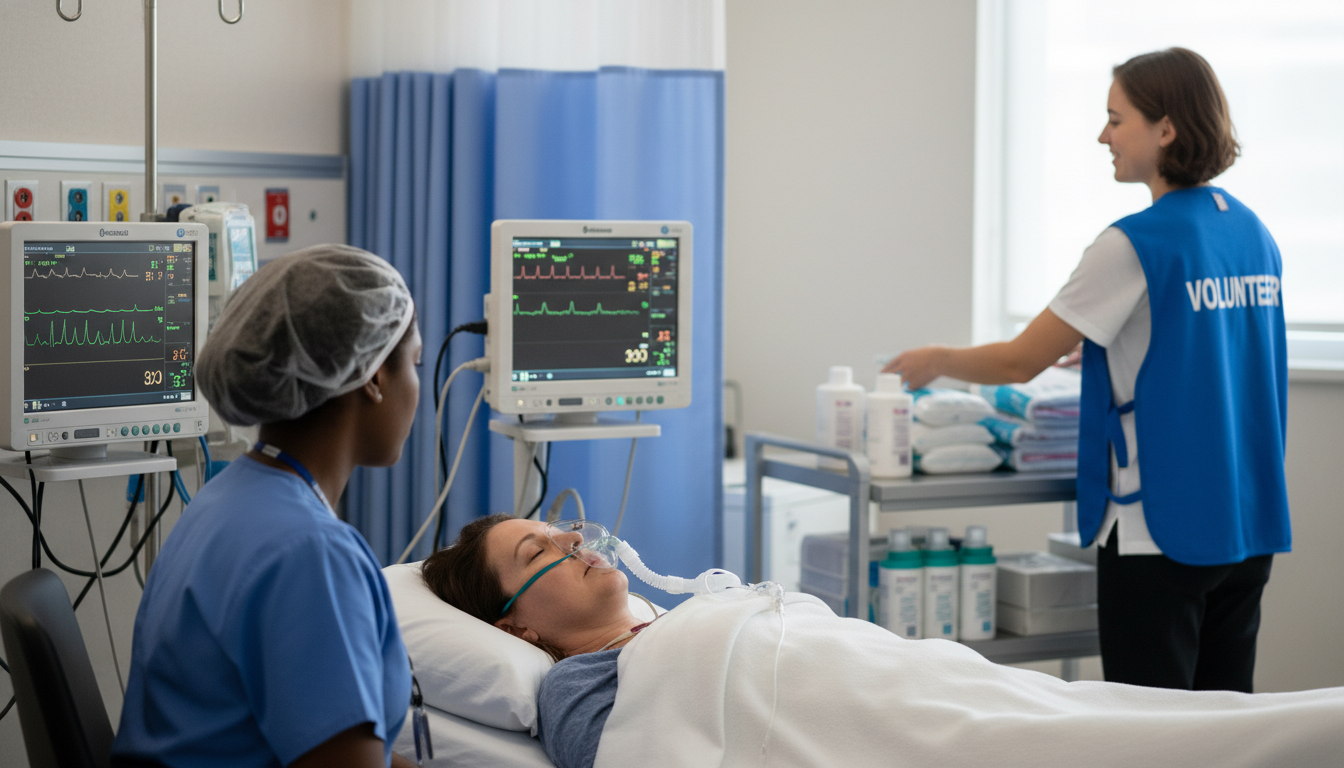
Clinical Insight: What You Actually Learn About Medicine
You are not just “helping out” in pre‑op and PACU. You are silently collecting a compressed curriculum in perioperative medicine.
Let us make that explicit.
1. Core Concepts in Anesthesia and Perioperative Physiology
From repeated observation, you begin to understand:
Why NPO status matters
You will hear nurses ask:- “When was the last time you had anything to eat or drink, even gum or mints?” This connects to aspiration risk under anesthesia. You can later explain this clearly in an interview.
Airway risk and assessment
You may hear anesthesia ask:- “Do you have sleep apnea?”
- “Have you ever had any trouble being put to sleep or with a breathing tube?” Over time, you recognize that obesity, certain neck anatomies, beards, and prior intubation issues trigger extra caution.
Post-op pain and nausea patterns
You see:- Certain surgeries (e.g., laparoscopic cholecystectomy, gynecologic procedures) with higher nausea rates
- Regional blocks that leave limbs numb for hours but patients in less pain
- The routine use of antiemetics, multimodal pain control, and early mobilization
You will not be dosing medications or reading charts, but pattern recognition alone builds your conceptual framework.
2. Safety Culture and Checklists
You will see multiple safety “gates” that every patient must pass through before the OR and before leaving PACU:
- Identity verification: “Tell me your name and date of birth?”
- Procedure verification: “What surgery are you having today?”
- Surgical site marking: usually by the surgeon with a marker
- Allergies triple-checked
- Time-out protocols before entering OR (you might hear references even in pre‑op)
You are being exposed to systems-based practice years before many students understand what that means.
This matters because residency programs are now very attentive to safety culture. When you can discuss checklists and communication breakdowns using real examples, you stand out as someone who sees medicine as a team sport, not a solo performance.
3. Interprofessional Roles and Team Dynamics
Pre‑op and PACU are rich in interprofessional interactions:
- Nurses coordinating timing with the OR charge nurse
- Surgeons negotiating schedule shifts
- Anesthesiologists deciding if a patient is optimized or needs a delay
- Nurse anesthetists (CRNAs) or anesthesia assistants carrying out much of the hands‑on perioperative work
You can directly observe:
- Who actually runs the schedule minute-to-minute (often nursing and anesthesia)
- How conflict is handled when late add‑on cases appear or when a surgeon is behind
- How an experienced nurse quietly shields a nervous patient from seeing behind‑the-scenes arguments
This can shape your understanding of hierarchy and collaboration, which is crucial if you are considering surgery, anesthesia, perioperative internal medicine, or acute care fields.
Skill Development: Turning Volunteering into Preparation
Most students treat volunteer shifts as checkboxes. You should treat them as deliberate training sessions.
Here is how to do that specifically.
1. Build Focused Observation Goals per Shift
Do not “just show up.” Before each shift, choose a specific learning angle, for example:
- “Today I will focus on how anesthesia providers explain risks and benefits in under 5 minutes.”
- “Today I will pay attention to how nurses respond to agitated or confused patients waking up.”
- “Today I will map the physical layout and flow of this unit. Where are the bottlenecks?”
After your shift, write 5–10 bullet points on what you saw. Not in patient-identifiable detail, but in process detail.
Over a semester, this produces:
- A real understanding of perioperative systems
- A bank of specific stories and insights for:
- Secondaries
- Interviews
- Future Q&A with mentors
2. Practice Professional Communication Early
Use this environment to refine behaviors that will be expected of you as a medical student:
- Knock, pause, then enter each bay area if curtain is closed.
- Introduce yourself clearly:
- “Hello, my name is [Name]. I am a hospital volunteer working with the pre‑op team today.”
- Ask for permission for even small actions:
- “Is it alright if I adjust your blanket?”
- Learn how to exit a conversation gracefully when the nurse or physician arrives:
- “I will step out so your nurse can work with you now. I will check back later if you need anything non-medical.”
This kind of respect for space and workflow is noticed by staff. Those same staff may later write you a letter of recommendation.
3. Strengthen Emotional Resilience and Boundaries
Perioperative settings expose you to:
- Raw fear before surgery
- Patients waking confused, crying, or calling for loved ones
- Family members who vacillate between gratitude and frustration
Use this to learn:
- How to be present but not engulfed:
- You are kind, you listen briefly, but you do not promise outcomes.
- When to escalate:
- If a patient hints at self-harm, regrets, severe panic, or you feel out of depth, you notify the nurse immediately.
- How your own body reacts:
- Do you tense up? Feel drained? Over-identify with one patient’s story?
Learning to recognize these reactions early is preventive maintenance for eventual burnout.
Translating This Experience for Applications
Experience is wasted if you cannot articulate it.
1. On Your Resume or Activities List
Use precise language rather than vague “hospital volunteer.”
For example:
- Pre‑operative and Post‑anesthesia Care Unit Volunteer, 120 hours
- Supported nurse-led care in surgical pre‑op holding and PACU by providing non‑clinical patient comfort, orienting post‑anesthesia patients when appropriate, and improving throughput via bay turnover and supply restocking.
- Observed perioperative workflows, including anesthesia risk assessment, surgical safety checklists, and early recognition of post‑op complications.
Notice how that description:
- Clarifies settings
- Emphasizes your role boundaries correctly
- Hints at systems-level understanding
2. In Personal Statements
Avoid the cliché “I knew I wanted to be a doctor when…”. Instead, describe:
- A very specific moment:
- A nurse quietly re-explaining what “going to sleep for surgery” means to a terrified child
- An anesthesiologist calmly delaying a case because of a subtle airway concern
- What you learned:
- Safety over speed
- The unseen complexity behind a “simple” surgery
- The power of clear, simple language
Then connect that to how you now understand medicine as:
- Evidence-based
- Team-dependent
- Safety-oriented
- Deeply human in high-stress, time-limited interactions
3. During Interviews
If asked about clinical exposure, you can say:
“Most of my sustained clinical experience was in the pre‑op and PACU areas of a mid-size hospital. That gave me repeated exposure to how teams prepare patients for anesthesia, verify safety at multiple checkpoints, and manage the immediate post‑operative period, particularly airway, pain, and nausea. I was restricted to non‑clinical tasks, but I watched hundreds of short, critical interactions and started to appreciate perioperative medicine as a high-reliability system rather than a single dramatic event.”
Interviewers will hear three things:
- You respected your scope.
- You understand systems-based care.
- You can synthesize observations into insight.
Practical Realities: Getting and Maintaining These Roles
Not every hospital offers pre‑op or PACU volunteering to students. Some will restrict students to outpatient units or gift shops.
1. How to Target Perioperative Volunteer Roles
You increase your odds by:
- Looking for:
- Large community hospitals
- Academic centers with structured volunteer programs
- Children’s hospitals (pediatric perioperative exposure is excellent, but roles may be more limited)
- Asking specifically:
- “Do you have volunteer positions in pre‑op, day surgery, or PACU?”
- “Are there roles where volunteers support surgical patients before or after procedures?”
If nothing exists, you can ask the volunteer coordinator:
- “If I start in transport or a general unit, is there a pathway to be moved to pre‑op or PACU after a certain number of hours?”
You must accept that some institutions simply will not place volunteers in those units. Patient acuity and privacy concerns shape these decisions.
2. Expectations and Boundaries
You should be crystal clear about what you cannot do:
- No touching IV lines, pumps, or monitors
- No adjusting oxygen
- No handling medications
- No reading or handling medical charts
- No discussing diagnosis, treatment, or prognosis with patients
If staff ask you to do anything that feels clinical or beyond your scope, you say:
“I am sorry, I am a volunteer and I am not allowed to do that. But I can get your nurse or another staff member.”
This shows that you prioritize safety and professionalism. Long-term, that protects the unit and protects you.
3. When to Move On
A smart student occasionally asks:
- “Have I plateaued in this role?”
- “Am I still learning something new each month, or is this just hours accumulation?”
If you have:
- 6–12 months of consistent pre‑op/PACU volunteering
- A solid understanding of perioperative flow
- Several meaningful observations and stories
Then it may be time to add:
- ED volunteering (different acuity and chaos)
- Inpatient unit work (continuity of care and chronic illness)
- Outpatient clinic exposure (longitudinal relationships and chronic disease management)
Your story becomes richer when you can compare how perioperative care differs from chronic care, primary care, or emergency medicine.
How This Experience Prepares You for Medical School
When you reach medical school, early rotations often include:
- Anesthesiology exposure
- Surgery clerkships with pre‑op and post‑op components
- Recovery room “post‑ops” as part of surgical follow-up
Students with pre‑op/PACU volunteering under their belt often:
- Feel more comfortable around:
- Intubated patients
- Oxygen supplementation
- Beeping monitors
- Understand basic orders:
- NPO after midnight
- DVT prophylaxis
- PCA pumps and multimodal analgesia
- Appreciate that:
- A “successful surgery” is not just a clean operative note.
- Complications often declare themselves in the first few hours.
Also, you enter with:
- Mature expectations of hospital workflow
- Realistic appreciation of nursing workload
- A grounded sense of how much effort goes into a “routine” case
That tends to show up as better performance on early rotations and more insightful reflections on cases.
With deliberate attention, pre‑op and PACU volunteering can transform from “just another hospital role” into a focused apprenticeship in perioperative medicine, systems thinking, and clinical communication. If you use it well, you walk into medical school not as a tourist in the hospital, but as someone who already understands how one of its most complex engines really runs.
You have seen how patients move through the surgical pipeline, how teams coordinate under pressure, and how safety is woven into each step. With these foundations in place, you are well-positioned for your first OR or anesthesia rotation. What you do with that head start—shadowing, research, specialty exploration—belongs to the next phase of your journey.