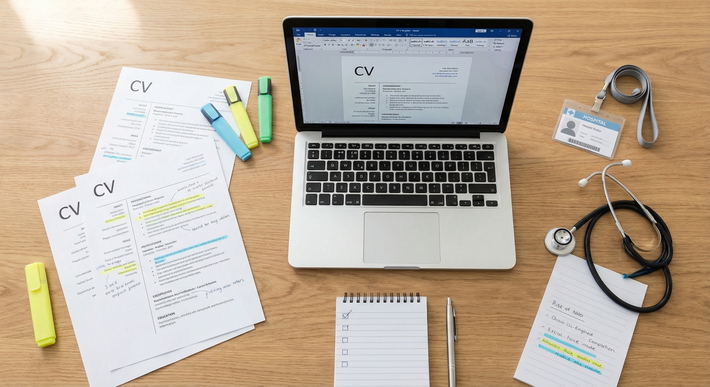
Opening Statement: Yes, 8 Weeks Is Enough to Improve a Residency CV
Short answer: yes. But not if you try to rebuild it from scratch.
Eight weeks won't turn zero research into a first-author publication. It won't magically invent a year of leadership. What it can do is fix the problems that actually make a CV look weak to a program director: sloppy formatting, vague descriptions, unexplained gaps, and missed opportunities to document legitimate work you're already doing.
At this point you should stop chasing perfection and start chasing clarity and completeness.
Here's the distinction that matters. You cannot ethically manufacture new honors, inflate titles, or claim publications that don't exist. You can rewrite every bullet, correct every date, align your CV with your ERAS experiences, and add finishable, documentable activities that show initiative. In 8 weeks, a messy, inconsistent CV becomes a clean, coherent, interview-ready story. That's the win.
Week 8: Audit Your CV and Identify the Weak Spots
At this point you should do a full, unsentimental audit. No tweaking. Audit first.
Print it out. Read it like a tired reviewer who has 90 seconds.
Ask:
- Are dates consistent and complete (Month Year, Month Year)?
- Is the formatting identical in every section?
- Do any experience descriptions say nothing? "Helped with research" tells me nothing.
- Are there gaps you never explained?
- Does your strongest experience get buried at the bottom?
I've seen strong applicants look weak because their research paragraph was three vague lines and their pizza-club leadership took up half a page. Prioritization is off.
At this point you should rank your sections by reviewer impact: Education/Credential, Clinical Experiences, Research/Scholarship, Service, Leadership, Honors. Pick the ONE or TWO sections that are hurting you most. You do not have time to fix everything equally.
Build your fix list. Literally. A list with deadlines.
Example: By Friday of Week 8, dates fixed, format standardized. By Sunday, rewrite clinical bullets. By end of Week 7, etc. If you don't assign dates now, the next seven weeks will be vague anxiety, not progress.
Weeks 7-6: Strengthen the Fastest-Correcting Sections
At this point you should work on what costs you zero new hours but gives you immediate return: presentation.
This is where weak CVs become decent fast.
1. Rewrite every bullet with an action + outcome. Bad: "Participated in quality improvement project." Good: "Analyzed 30 charts for post-op antibiotic timing; presented findings to QI committee, contributed to 15% improvement in compliance over 2 months."
Quantify when you can. Number of patients, hours, sessions led, abstracts submitted. Specific beats vague every time.
2. Align your documents. Your CV, your ERAS experiences, and your personal statement should not tell three different stories. If your CV says you love community health but your personal statement never mentions it and you have no service hours, that disconnect reads as fluff.
3. Use a residency-ready format. Program directors scan. They do not read novels. At this point you should switch to a clean single-font template: Bolded roles, right-aligned dates, bullets indented underneath, no paragraphs. Error-free. One page for early students, max two if you have real content.
At this point you should also delete dead weight. That one-day volunteer event from 2018? Unless it connects to your specialty story, cut it. Space is credibility.

Weeks 5-4: Add High-Yield Experiences You Can Finish Ethically
At this point you should only add what you can start now and legitimately finish before ERAS closes. And you can add more than you think.
No, you cannot start a basic science project and publish it. Yes, you can do this:
- Volunteer shift series: 4-6 consistent shifts in a free clinic, ED, or community health event. Documented. Consistent > one-off.
- Poster abstract submission: Many campus research days and state chapter meetings still accept late abstracts. A submitted poster counts if it's submitted.
- Case report draft: If you saw an interesting case on rotations and have an attending willing to co-author, writing the case and submitting the abstract is finishable.
- Tutoring / peer teaching: Formalize something you're already doing. "Peer Tutor, Physiology, 20 students, 2 hrs/week" is verifiable and shows teaching.
- QI project update: Join an ongoing QI effort, take ownership of one small PDSA cycle, track it.
- Focused shadowing block: 10-15 hours in your chosen specialty with a purpose, not to pad, but to reference intelligently in your application.
At this point you should ask every new addition: can I explain this for 3 minutes in an interview without hesitation? If not, don't add it. Resume padding smells desperate. Reviewers have seen it a thousand times.
Weeks 3-2: Tighten Impact, Consistency, and Storytelling
At this point you should stop adding and start connecting.
Every line should support one clear narrative. Example: "Future internal medicine physician interested in health equity and medical education." Then your free clinic shifts, tutoring role, and QI work on discharge instructions all make sense. The random orthopedic research from M1 year? Keep it, but frame it as early exploration that built skills.
At this point you should cross-check for contradictions. I've seen CVs list "Fluent in Spanish" while ERAS says "Some proficiency." Or dates that don't match LORs. Or a personal statement that talks about ICU passion with zero critical care experiences listed. That erodes trust.
If your CV is weak because you have limited research or no AOA, lean hard into what you do have. Reliability is attractive. Programs want residents who show up, follow through, care for patients, teach juniors, and improve systems. Emphasize longitudinal commitment, teamwork, upward trajectory, and patient exposure. A clear story of growth is stronger than a checklist of half-done impressive titles.
Final 14 Days: Proofread, Verify, and Lock the File
At this point you should become ruthless about details.
Proofread line by line. Out loud. Tense should be past for completed roles, present for ongoing. Periods either everywhere or nowhere at the end of bullets. Pick one. Same abbreviation style throughout.
Verify everything against source documents. Publication titles, conference dates, certification numbers, supervisor names. If you list a poster as "presented," you better have the program book to prove it. Nothing kills an interview faster than an inflated citation you cannot back up.
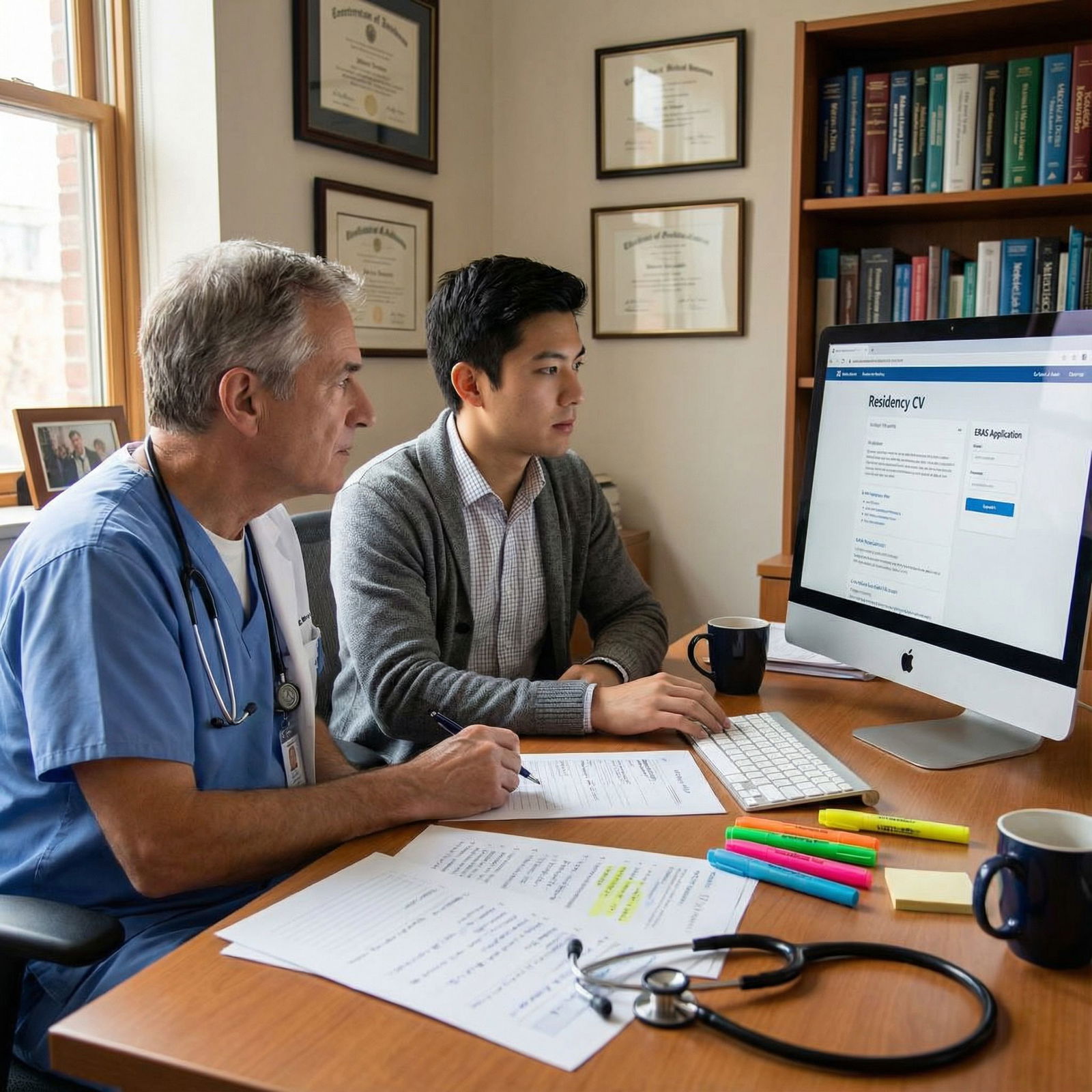
At this point you should get one, maybe two, trusted reviewers. Not ten. One faculty member who knows ERAS and one senior resident who just matched. Ask them: is this clear, credible, and coherent in 90 seconds? Then incorporate feedback and lock the file. You need to stop editing. A polished, submitted CV beats a perfect, late one.
Closing Action Steps: Your 8-Week CV Rescue Checklist
At this point you should execute, not worry. Here's your timeline distilled.
Week 8: Complete audit. List your top 2 weak spots. Create dated fix list. Weeks 7-6: Rewrite all bullets with action + outcome. Quantify. Standardize format. Delete clutter. Weeks 5-4: Add 1-3 finishable, legitimate experiences that fit your specialty story. Document them correctly. Weeks 3-2: Align CV, ERAS experiences, personal statement, and LORs. Build one clear narrative. Fill gaps with reliability and service. Final 14 Days: Verify every fact. Proofread for errors. One or two trusted reviews. Lock and upload.
You will not go from empty to stacked in 8 weeks. You can go from weak and messy to clean, credible, and compelling. I've seen it turn interviews around.
Discipline now saves explanations later. At this point you should start tonight.